
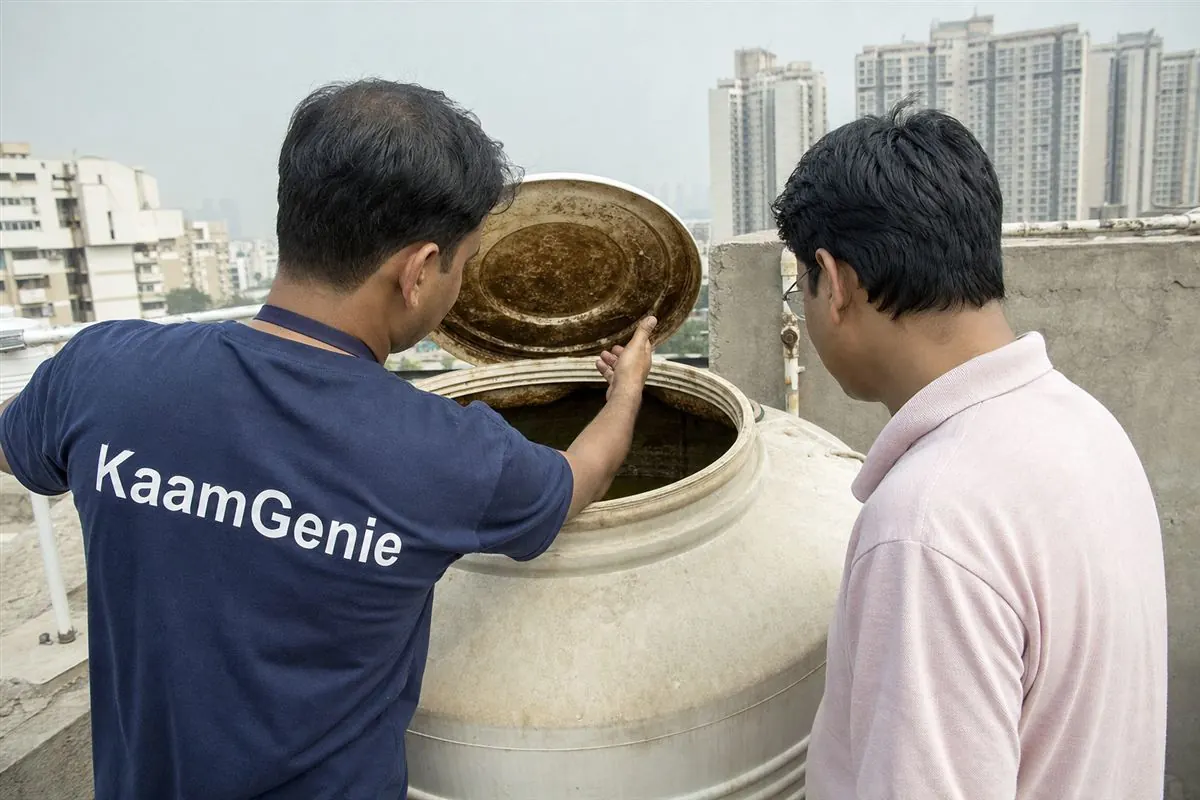
The short version
- Most waterborne diseases — typhoid, cholera, hepatitis A and E, giardia, E. coli gastroenteritis — spread when faecal matter or contaminated material reaches drinking water. A dirty storage tank is one place that happens inside your own building.
- A tank doesn’t create germs. It gives them somewhere to enter (broken lids, pests), survive (sediment, biofilm) and reach your taps.
- Children, the elderly, pregnant women and anyone with low immunity are hit hardest, per WHO guidance.
- The fix is unglamorous and reliable: drain, de-sludge, scrub and jet-wash the tank, then disinfect with food-grade chlorine — every six months for most Noida homes.
- An RO purifier only protects your drinking tap. Cleaning the tank protects the bathing, brushing, cooking and washing water too.
This article explains the “why.” If you just want it cleaned, book water tank cleaning in Noida and skip to the bottom.
Across Noida and Greater Noida, almost no one drinks water straight off the mains. The Noida Authority piped supply, treated Ganga Jal, hard borewell groundwater and private tankers all end up doing the same thing: filling a storage tank. For a plotted Authority house in Sector 15 it might be a single rooftop drum. For a high-rise tower in Sector 137 it’s a deep underground reservoir (UGR) pumped up to tank rooms feeding hundreds of flats. Either way, the storage tank — not the source — is usually the last thing your water touches before you do.
That makes the tank the single most important and most ignored point in the whole chain. Water can leave the treatment plant perfectly safe and still arrive at your glass carrying the organisms that cause waterborne disease, simply because it sat in a tank that nobody had opened in two years. This is not scare-mongering; it is the basic logic of how the World Health Organization and India’s own drinking-water standards treat storage and distribution as risk points to be managed.
| Disease | Organism | How a dirty tank contributes |
|---|---|---|
| Typhoid fever | Salmonella Typhi (bacteria) | Faecal contamination via pests, droppings or cross-connection; survives in sediment |
| Cholera | Vibrio cholerae (bacteria) | Faecal-oral spread through contaminated stored or supplied water |
| Hepatitis A & E | Hepatitis A / E viruses | Spread by water contaminated with faecal matter; viruses persist in still water |
| Giardiasis | Giardia (parasite cysts) | Cysts are chlorine-tolerant and settle in undisturbed sediment |
| Gastroenteritis / dysentery | E. coli, Shigella, others | Biofilm on tank walls shelters bacteria from any residual disinfectant |
| Amoebiasis | Entamoeba histolytica | Faecal-oral transmission via contaminated water and surfaces |
Protect the water your family actually uses
Full drain, de-sludge, scrub, jet-wash and food-grade disinfection — with before/after photos. Residential from ₹699 onwards; society UGR and commercial quoted on site.
How safe water turns unsafe inside a Noida tank
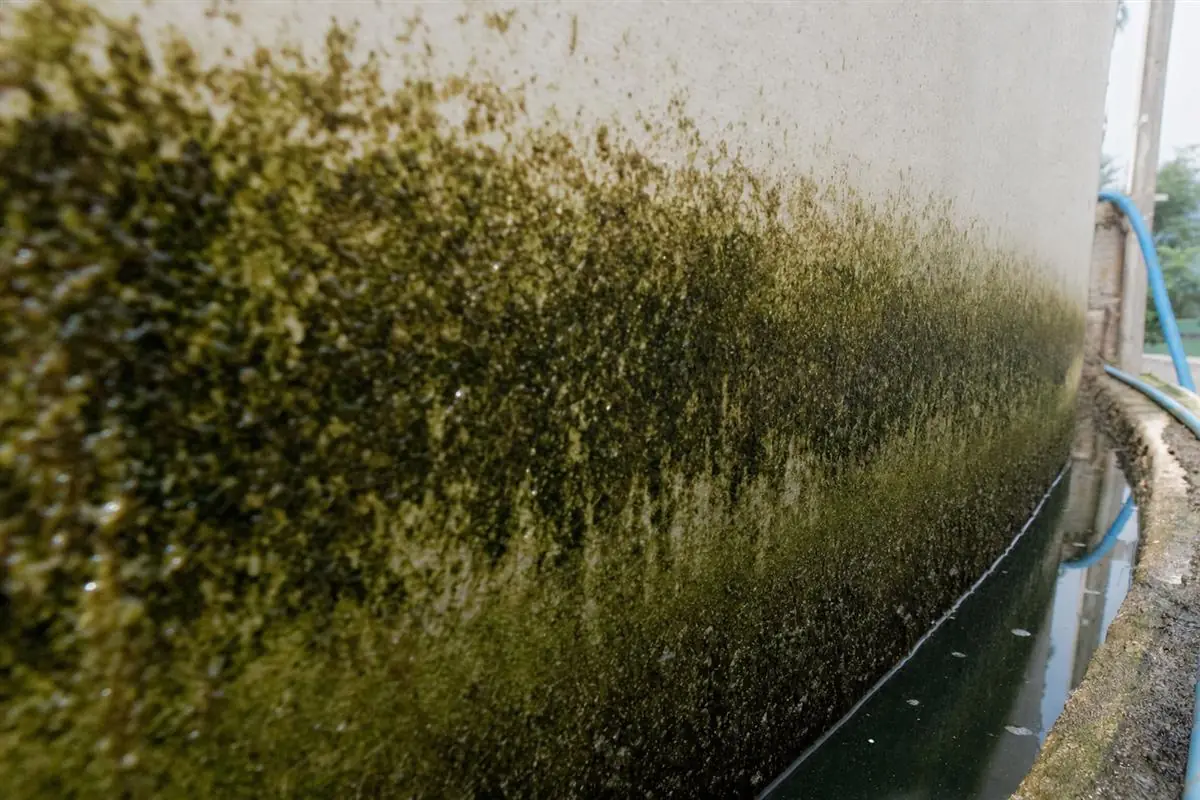
A storage tank does not generate germs out of nothing. What it does is provide three things that pathogens need: a way in, a place to survive, and a route to your tap. Remove any one of those and the risk drops sharply. A neglected tank provides all three.
A way in. The classic culprit is the lid. Across Noida we routinely open tanks with cracked, warped or simply missing lids — and an unscreened overflow or vent pipe is just as bad. That is an open invitation for dust, insects, lizards, frogs, and birds. When a dead bird or a nest of insects ends up in a tank, it adds organic matter and, in the case of droppings, faecal contamination — the exact route by which typhoid, hepatitis and cholera organisms travel. We have pulled dead pigeons, lizards and thick mats of insects out of rooftop tanks in older sectors more times than anyone would like.
A place to survive. Even sealed tanks accumulate sediment. Noida’s hard borewell groundwater and tanker supply both carry sand, silt, iron and calcium that settle to the bottom as a sludge layer. On the walls, a slimy biofilm forms — a community of bacteria bound in a protective film. Sediment and biofilm are not just ugly; they are shelter. Organisms hide inside them, protected from sunlight and from whatever chlorine residual the water once carried. Giardia cysts in particular are notoriously tolerant of normal chlorine levels and happily wait in undisturbed sediment.
A route out. The tank outlet feeds your taps continuously. Every time fresh water flows in and out, it sweeps a little of that biofilm and sediment along with it. So the contamination doesn’t stay politely at the bottom — it migrates, in small doses, into the water you bathe in, cook with and drink. This is why a tank can look “mostly fine” from a quick glance and still be a low-level, continuous source of trouble.
The diseases, and why they matter here
The WHO is unambiguous that contaminated drinking water transmits diseases such as diarrhoea, cholera, dysentery, typhoid, hepatitis A and polio, and that unsafe water and sanitation are a major global cause of preventable illness. Almost all of these spread by the faecal-oral route — microscopic faecal matter from one person, or from animal droppings, reaching another person’s mouth through water or food. A storage tank that admits pests, droppings or a cross-connection with drainage is precisely a place where that route can open up.
In day-to-day terms, the most common outcome in Noida households is not dramatic cholera but repeated, “ordinary” gastroenteritis — loose motions, vomiting, cramps, low fever — caused by E. coli and similar bacteria multiplying in a dirty tank. It gets blamed on “something we ate.” Sometimes it really is the tank. The more serious infections — typhoid, hepatitis A and E, giardiasis — are less frequent but far more costly when they land, often meaning a week or more of illness, tests and medication.
One honest caveat: we are a tank-cleaning company, not a diagnostic lab, and we will never tell you a specific illness “came from” your tank without evidence. What we can say plainly is that a clean, sealed, disinfected tank removes one well-documented pathway for these diseases, and a filthy one keeps it open.
Who gets hurt the most
Waterborne disease is not evenly dangerous. The WHO highlights that young children and people with weakened immunity face the highest risk of severe illness and dehydration from waterborne diarrhoeal disease. In a typical Noida home that means:
- Children under five — smaller bodies dehydrate faster, and toddlers swallow bathroom water without thinking.
- The elderly — weaker immunity and a harder time recovering from a bad bout of diarrhoea or typhoid.
- Pregnant women — hepatitis E in particular is recognised as more dangerous during pregnancy.
- Anyone immunocompromised — people on chemotherapy, post-transplant, or managing chronic illness.
This is why institutional tanks carry extra weight. A neglected reservoir at a school, hostel, PG, hospital or office in the Sector 62 IT belt doesn’t put one family at risk — it puts hundreds of children, patients or staff at risk at once. The same logic applies to the big shared underground reservoirs feeding high-rise towers along the Noida Expressway, where one dirty UGR sits upstream of every flat in the tower.
How contamination risk climbs the longer a tank goes uncleaned
Illustrative pattern — sediment, biofilm and pest-entry risk all compound with neglect, not a measured statistic
This is a general illustration of how sediment thickness, biofilm growth and the odds of an undetected pest entry tend to compound over time — not a precise measurement. The practical takeaway: a six-monthly clean keeps a tank in the “low” band rather than letting it drift into the “high” one.
Why cleaning — then disinfecting — actually breaks the chain
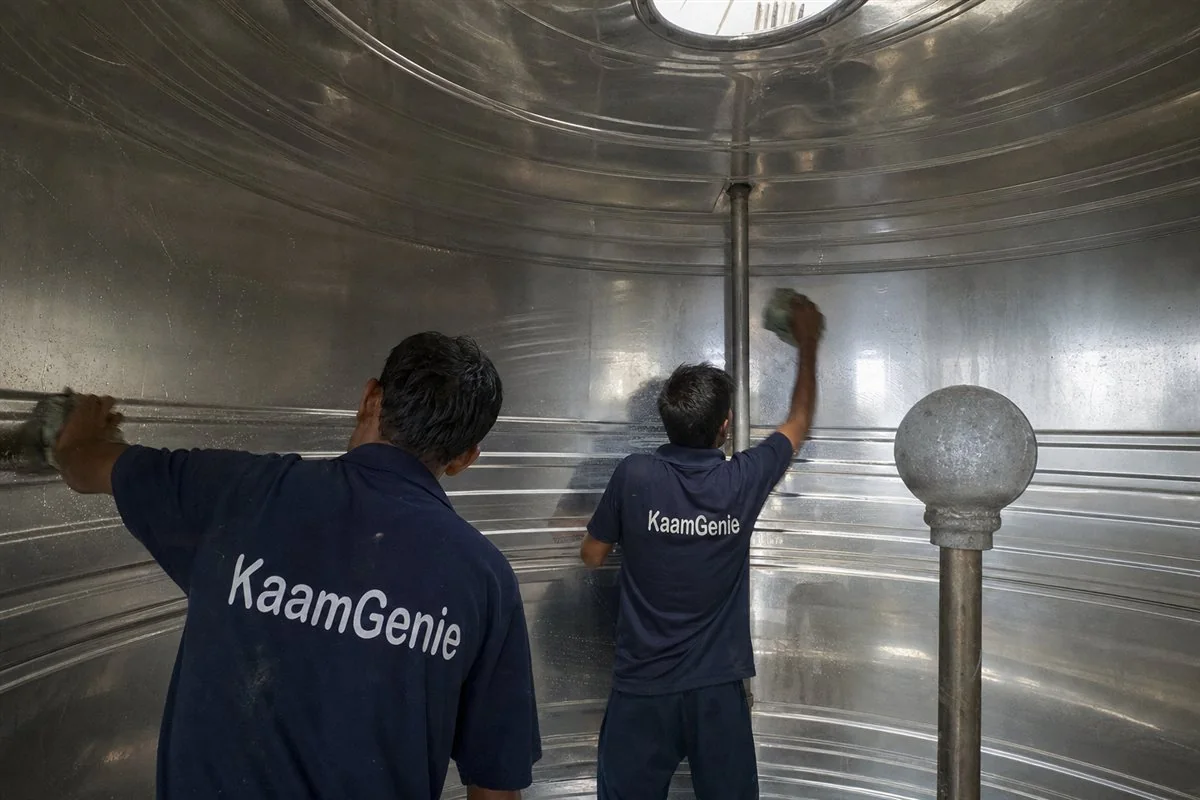
Here is the part people get wrong: pouring some chlorine into a dirty tank is not disinfection. The chlorine gets “used up” reacting with all the sludge and organic matter and never reaches the bacteria sheltering inside the biofilm. That is why the order matters. A proper job is mechanical first, chemical second:
- Drain the old water and shut the inlet so nothing new flows in mid-job.
- Remove the sludge by hand — the single most important step, because that sediment is where parasites and bacteria hide.
- Scrub the walls and floor with food-grade brushes to physically lift the biofilm. Biofilm does not rinse off; it has to be abraded away.
- High-pressure jet wash the corners, seams and fittings a brush can’t reach.
- Disinfect the now-clean surfaces with food-grade chlorine at the right concentration, give it proper contact time, then rinse.
Done in that order, you remove the shelter and kill what’s left. We go through the full sequence in our guide to water tank disinfection in Noida, but the principle is simple: clean removes, chlorine finishes. Skip the cleaning and the chlorine is theatre.
Two finishing touches matter just as much for keeping the tank safe afterwards: a properly fitting, sealed lid, and a screened overflow/vent. Those are what stop the next pigeon, lizard or batch of insects from re-opening the pathway a week later. A clean tank with a broken lid is back to dirty within a month.
The Noida-specific reasons this gets out of hand
A few local realities make tank neglect more consequential here than the all-India average:
- Tanker and borewell dependence. Greater Noida West (Noida Extension) and many newer Expressway townships lean heavily on tankers filling large underground reservoirs. Tanker water carries more sediment and rarely keeps a stable disinfectant residual, so the reservoir silts up and grows biofilm faster. We cover this in detail in our piece on hard water tank cleaning in Noida.
- Big shared reservoirs. The high-rise belt — Sectors 137, 150, 168, 75, 76, 78 and 100 — runs on deep UGRs pumped up to rooftop tanks. One dirty reservoir sits upstream of an entire tower, so the failure isn’t contained to one flat.
- Builder floors with shared sumps. In sectors full of independent builder floors, several families often draw from one shared underground sump that nobody owns clearly — so it goes years untouched.
- Large tenant and student population. Rented flats, PGs and hostels near the office and college belts turn tanks over heavily, and tenants reasonably assume the landlord handles cleaning — who reasonably assumes the tenant does. Nobody does. Our note on signs your Noida tank needs cleaning is written partly for exactly this situation.
None of this is unique to one address. A plotted house in Sector 15, an office tower in Sector 62 and a high-rise society in Sector 137 face the same basic physics — only the tank size and the number of people downstream change.
“But we have an RO — aren’t we covered?”
This is the most common reason people skip tank cleaning, and it’s a costly misunderstanding. An RO or UV purifier treats the litre or two you drink at the kitchen tap. It does nothing for the water you brush your teeth with, bathe in, wash vegetables and utensils in, or that a child swallows in the shower. Hepatitis A, giardia and many bacterial infections enter perfectly well through those routes. The purifier is the last line of defence for drinking water; the clean tank is what protects the entire supply that the rest of your household actually touches. You want both, and the tank comes first.
How often? For most Noida homes, every six months is the sensible rhythm, and once a year is the bare minimum. Tanker-fed and high-occupancy buildings should go shorter. We lay out the full reasoning in how often to clean a water tank in Noida, and you can read about our end-to-end method and equipment on our water tank cleaning services page.
When did your tank last get a real clean?
If the honest answer is “not sure” or “over a year,” that’s your cue. Photos before and after, food-grade disinfection, no upsell. ₹699 onwards for homes.
The simplest prevention you can buy
Most of what makes drinking water unsafe is outside your control — the source, the treatment plant, the kilometres of municipal pipe. The storage tank is the one link you actually own. Cleaning and disinfecting it twice a year, keeping the lid sealed and the overflow screened, is a small, cheap, repeatable habit that closes a genuine disease pathway for the people in your home who can least afford to get sick. That is the entire case for tank cleaning, stated plainly.
If you’d like ours to handle it, we run a trained crew, food-grade chemicals and before/after photos across the whole city — book water tank cleaning in Noida and we’ll confirm a slot, often same week. No scare tactics, no upsell calls; just a clean, sealed, disinfected tank and a record you can keep.
Frequently asked questions
Can a dirty water tank really make my family sick?
Yes. Most water that reaches a Noida home is stored in a rooftop tank or underground reservoir before it reaches your taps. If that tank holds sludge, biofilm or a dead insect or bird, it can re-contaminate water that arrived clean. The World Health Organization is clear that unsafe drinking water transmits diseases such as diarrhoea, cholera, typhoid and hepatitis A — and a contaminated storage tank is one of the points where safe water turns unsafe inside your own building.
Which waterborne diseases are linked to contaminated storage tanks?
The main ones spread through the faecal-oral route via contaminated water are typhoid (Salmonella Typhi), cholera (Vibrio cholerae), hepatitis A and hepatitis E, giardiasis (Giardia), amoebic dysentery, and general gastroenteritis caused by E. coli and other bacteria. A storage tank does not create these organisms, but a dirty, poorly sealed tank gives them a place to enter, survive in sediment and biofilm, and reach your glass.
We have an RO purifier — do we still need to clean the tank?
Yes. An RO or UV purifier only treats the small amount of water you drink at the kitchen tap. The same tank water is what you bathe in, brush your teeth with, wash vegetables and utensils in, and what children may swallow in the bathroom. Many waterborne infections enter through these uses, not just drinking. Cleaning the tank protects the whole supply; the purifier is the last step, not the first.
How does a closed rooftop tank get contaminated in the first place?
Common routes are a cracked or missing lid that lets dust, insects, lizards, birds or droppings fall in; an unscreened overflow or vent pipe that lets in pests; sediment and rust that settle from borewell or tanker water; and biofilm — a slimy bacterial layer that grows on the walls of any tank holding stagnant water. Once biofilm and sludge are present, even fresh incoming water mixes with them on its way to your taps.
Who in the household is most at risk from contaminated tank water?
Young children, the elderly, pregnant women, and anyone with a weakened immune system are the most vulnerable. The WHO notes that children under five and people with low immunity are at the highest risk of severe illness and dehydration from waterborne diarrhoeal disease. In a Noida household with small kids or elderly parents, a neglected tank is a disproportionate risk to exactly the people least able to cope with it.
How often should a Noida tank be cleaned to prevent waterborne illness?
A practical interval for most Noida homes is every six months, and at least once a year as a minimum. Tanker-fed and borewell-fed buildings in Greater Noida West and the Expressway belt usually need it more often because that water carries more sediment. High-occupancy buildings — PGs, hostels, schools and hospitals — should clean more frequently because the tanks turn over heavily and the consequences of contamination are larger.
Does cleaning alone prevent disease, or is disinfection also needed?
Both are needed, in order. Mechanical cleaning — draining, removing sludge, scrubbing and jet-washing — physically removes the biofilm and sediment where organisms live. Disinfection with food-grade chlorine then kills any bacteria left on the surfaces. Disinfecting a tank without first removing the sludge is mostly wasted, because the chlorine is consumed by the dirt and never reaches the bacteria sheltering underneath it.
Is borewell or tanker water in Noida more risky than the piped Ganga Jal supply?
Both can be safe at source and both can be spoiled by a dirty tank, but tanker and borewell supply tend to carry more sediment and lack a stable disinfectant residual, so the tank gets dirtier faster. Greater Noida West and many newer Expressway townships rely heavily on tankers feeding large underground reservoirs, which makes regular reservoir cleaning especially important there. Whatever the source, the storage tank is the common failure point.
What signs suggest our tank water might be making us ill?
Watch for an odd smell or taste, cloudy or yellow-tinted water, visible particles, a slimy feel, or recurring stomach upsets, loose motions and skin irritation across several family members at once — especially after the tank has gone many months without cleaning. None of these is a lab diagnosis, but together they are a strong prompt to get the tank inspected, cleaned and disinfected rather than waiting.
Sources & references
- Bureau of Indian Standards (BIS) — IS 10500:2012 is the canonical Indian Standard for drinking water specification, defining acceptable limits for physical, chemical, and biological parameters.
- WHO Guidelines for Drinking-water Quality, 4th edition — the global reference for water quality standards, including guidance on storage and disinfection.
- Food Safety and Standards Authority of India (FSSAI) — defines water quality requirements for food businesses, including hygiene standards for stored water and acceptable disinfection chemicals.
- WHO Fact Sheet on Drinking Water — overview of safe drinking water requirements, waterborne disease transmission and contamination risks.
- CPHEEO — Manual on Water Supply and Treatment — the Government of India’s engineering manual covering tank design, cleaning protocols, and disinfection practices.
Last verified: 30 June 2026. If you find any of these links broken, please let us know.