
Water Tank Cleaning Charges (Delhi NCR)
Raj Babbar · 9 min read
Home › Water Tank Cleaning › Overhead Tank Cleaning › Bakkarwala
Bakkarwala splits in two: DDA’s new EWS and LIG towers with sump-and-rooftop systems that need commissioning-grade cleans, and the old village where huge, seldom-drained tanks hold some of the outer west’s hardest borewell water. KaamGenie handles both halves. From ₹699.
Out on Delhi’s western edge near the Mundka corridor, Bakkarwala pairs an old village core with the large DDA flat clusters — EWS and LIG towers built for resettlement, including the Rajiv Ratan Awas Yojana blocks. The towers run society sumps pumping to rooftop tank banks, much of it newly commissioned or lightly maintained since handover. The village side is a different world: borewell-fed plots with very hard water and oversized tanks that rarely, if ever, get drained.
For the towers we run commissioning-style cleans — rooftop banks emptied unit by unit, construction residue and early scale removed, jet-washed, scrubbed and disinfected to hygienic standard, with block-level before-and-after photos for the managing agency or RWA. Village tanks get the deep de-scale their water demands. The area’s main service page is water tank cleaning in Bakkarwala.
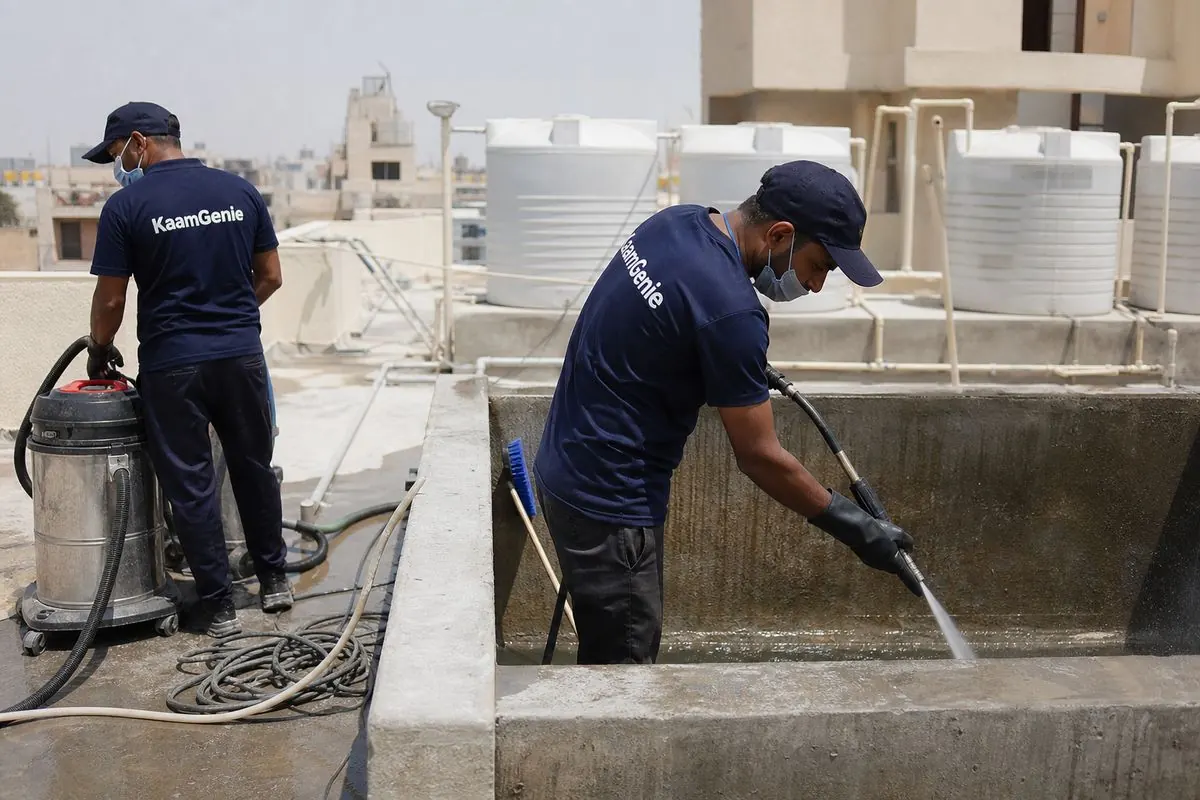
Resettlement towers inherit their tanks from the construction phase: cement wash, jointing compound and site dust sit in rooftop banks that may never have had a proper first clean before families moved in. Symptoms show up building-wide at once — whitish water, gritty aerators across many flats — because everyone shares the same bank. A commissioning-grade clean of the full rooftop bank, coordinated with the RWA or agency, resets the whole block in one shutdown.
The village core’s problem is time multiplied by chemistry. Outer-edge borewells pull some of the hardest water in west Delhi, and the big plot tanks — sized generously because supply hours are short — are kept permanently topped up, never drained, never inspected. Scale on scale, silt under silt. First-time village cleans here recover startling amounts of capacity, and a six-monthly cycle afterwards keeps the hard water from rebuilding its fortress.
No travel charge anywhere in Bakkarwala. The final price is confirmed on the call before we come — it depends only on tank size and access.
See it done in 45 seconds
Watch our web story on how a tank is really cleaned — drain, de-sludge, jet-wash, disinfect.
We reach every pocket of Bakkarwala — and there’s no travel charge to any of them:
Every locality in Delhi stores different water, and that decides how fast a tank fouls. This is Bakkarwala’s profile from The Delhi Water Index, built from our field observations across 250+ localities.
Indicative field characterisation, not a certified lab test. BIS IS 10500: TDS 500 mg/L acceptable, 2,000 permissible. Check any Delhi area →
“Can you clean an entire DDA tower’s rooftop tank bank?” Yes — block-scale jobs are exactly what we plan for in Bakkarwala’s towers. We coordinate a shutdown window with the RWA or managing agency, put enough crew on the roof to work the bank in parallel, and hand over a block-level quality report with per-tank photos. Most towers are done within a single day’s window.
“Our flats were handed over recently. Why does the water still run whitish?” Whitish water across many flats usually means the shared rooftop bank still carries construction residue — cement wash and jointing dust from before handover. It does not rinse out on its own; the bank needs a physical commissioning clean. Once done, the symptom clears building-wide because every flat draws from the same source.
“What will a big village tank cost to clean?” Standard sizes follow the usual slabs — ₹699 up to 500L, ₹899 for 501–1,000L — but many village-core tanks exceed that, so we take the capacity on the phone and fix a quote before the visit. Heavily scaled first-timers are quoted as one price for the complete job, however long the descaling takes.
“Is the borewell water here really harder than elsewhere in west Delhi?” The outer-edge belt including Bakkarwala draws from deeper, more mineralised groundwater, and the scale we chip out of village tanks confirms it — thicker and faster-forming than in the inner colonies. It also means cleaning frequency matters more here: six months of this water deposits what a year does elsewhere.
“How far in advance should we book, being on the city’s edge?” Individual tanks: call before 10 AM and same-day is often still possible — our Mundka-side route passes close. Tower tank banks need a few days’ notice to agree the shutdown with residents. Village first-time cleans are best booked a day ahead so the crew arrives with the full descaling kit and extra time.
See our complete water tank cleaning services in Delhi NCR — pricing, process, tank types and full city coverage.
Beyond water tank cleaning, KaamGenie is rolling out a full lineup of home services across Delhi NCR — see our complete list of 12 home services we offer or will be launching through 2026. New to tank cleaning? Read our guide on how to pick the right water tank cleaning service in Delhi — what to look for, what to avoid, and the questions that separate trustworthy crews from quick-job operators.
Rooftop plastic tanks
₹699+ →Kothi sumps & underground tanks
₹1,499+ →Apartments & RWAs
Bulk pricing →FSSAI-compliant cleaning
₹2,500+ →टंकी साफ़ करने वाले
हिन्दी पढ़ें →View all water tank cleaning guides →
All pockets and lanes of Bakkarwala covered. If your specific block or society isn’t named in the sub-areas above, just call — we almost certainly cover it.
Same crew, same 6-step process, same-day where possible. Pick any locality below for local pricing and the tanks we typically find there.
Book a slot — we can usually fit you in today or tomorrow.