
Waterborne Diseases & Tank Cleaning
Raj Babbar · 10 min read
Home › Water Tank Cleaning › Overhead Tank Cleaning › New Usmanpur
On the east bank of the Yamuna near the Kailash Nagar belt, New Usmanpur's riverside roofs collect dust and its borewell tanks collect grit. KaamGenie drains, scrubs and disinfects these overhead tanks by the river. From ₹699.
New Usmanpur runs along the Yamuna's east bank near Bhajanpura and Kailash Nagar, a dense stretch of self-built floors and small blocks on tight lanes close to the water. Its supply mixes DJB and borewell, with the borewell share hard and iron-tinged, stored in small rooftop plastic tanks on most buildings. Being right by the river means these roofs catch extra dust and the tanks take in more airborne grit than an inland pocket would. Shared tanks with slow turnover then let both the borewell sediment and the riverside dust settle and stay.
Our crews give the riverside tank a full clean: drain it, clear the settled grit and sediment from the base, jet and scrub the iron scale off the walls, then a anti-bacterial disinfectant wash and a clean refill. Before-and-after photos go to whoever manages the building, useful where a tank is shared up a self-built block. This overhead page sits under the wider water tank cleaning in New Usmanpur service and focuses on the rooftop tank. Tell us the lane toward the river and the crew will plan the access.
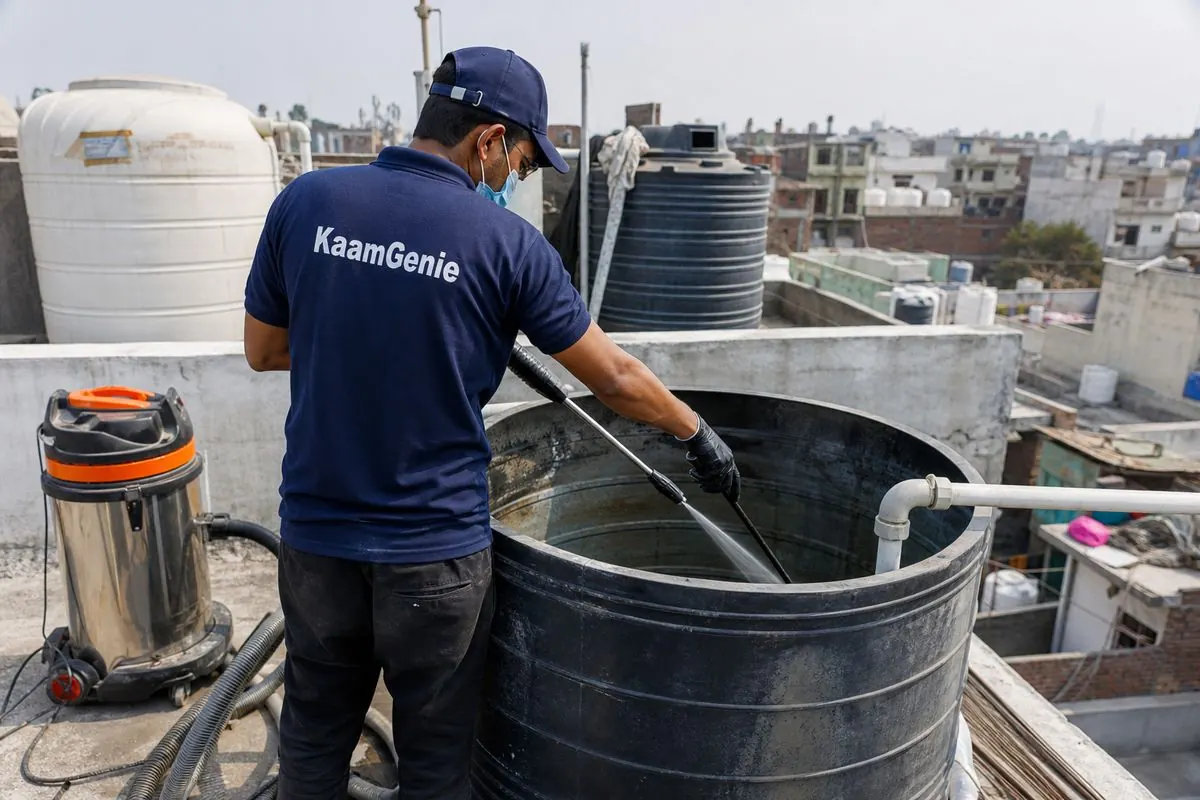
The riverside location adds a dust load on top of the water problem. Roofs along the Yamuna's east bank catch more airborne grit than inland ones, and that grit drifts into any tank with a loose lid, settling on the base alongside the borewell sediment. The borewell share of the supply is hard and iron-tinged, so it also scales the walls and drops an iron layer below. Together the dust and the borewell load fill the base of a New Usmanpur tank faster than either would alone.
A tank collecting both grit and iron sediment shows it at the taps. The disturbed layer clouds the water and gives it a metallic edge when the level drops, and biofilm along the walls of a slow-turnover shared tank harbours bacteria. The grit also settles into the pump and valves the building shares. A yearly clean at least, sooner for the most river-exposed roofs, keeps the combined dust-and-sediment load from building into a permanent layer, and a snug lid slows the dust between visits.
No travel charge anywhere in New Usmanpur. The final price is confirmed on the call before we come — it depends only on tank size and access.
See it done in 45 seconds
Watch our web story on how a tank is really cleaned — drain, de-sludge, jet-wash, disinfect.
We reach every pocket of New Usmanpur — and there’s no travel charge to any of them:
Every locality in Delhi stores different water, and that decides how fast a tank fouls. This is New Usmanpur’s profile from The Delhi Water Index, built from our field observations across 250+ localities.
Indicative field characterisation, not a certified lab test. BIS IS 10500: TDS 500 mg/L acceptable, 2,000 permissible. Check any Delhi area →
“Does being right by the river mean more dust in the tank?” Yes. Roofs along the Yamuna's east bank catch more airborne grit than inland ones, and it drifts into any tank with a loose lid. We check and advise sealing the lid and vents when we clean, which cuts the dust noticeably. Combined with a regular clean, that keeps the riverside grit under control.
“The water has an iron tint; will cleaning the tank help?” A clean removes the iron sediment and scale settled in the tank, which reduces the tint at the tap. If the borewell share of your supply is very high in iron at the source, we will suggest an iron filter alongside, since the clean cannot change the source. But an iron-lined tank always worsens the tint, so clearing it comes first.
“How much for a rooftop tank on a New Usmanpur building?” A 500-litre plastic rooftop tank is ₹699 and a 1,000-litre one is ₹899. Larger shared tanks of 1,500 to 2,000 litres run ₹1,299 to ₹1,499. Booking more than one tank on a roof together brings a discount.
“How often should a riverside tank here be cleaned?” At least yearly, and every six months for the most river-exposed roofs, because they take in more dust on top of the borewell sediment. The extra grit fills the base faster than inland. We can note the next due date on your quality report as a reminder.
“Do you clean both the DJB-fed and borewell-fed tanks in a building?” Yes. Many New Usmanpur buildings store both supplies, and we clean every rooftop tank on the building in one visit regardless of source. Doing them together is quicker and cheaper. Tell us how many tanks and their sizes when you book.
See our complete water tank cleaning services in Delhi NCR — pricing, process, tank types and full city coverage.
Beyond water tank cleaning, KaamGenie is rolling out a full lineup of home services across Delhi NCR — see our complete list of 12 home services we offer or will be launching through 2026. New to tank cleaning? Read our guide on how to pick the right water tank cleaning service in Delhi — what to look for, what to avoid, and the questions that separate trustworthy crews from quick-job operators.
Rooftop plastic tanks
₹699+ →Kothi sumps & underground tanks
₹1,499+ →Apartments & RWAs
Bulk pricing →FSSAI-compliant cleaning
₹2,500+ →टंकी साफ़ करने वाले
हिन्दी पढ़ें →View all water tank cleaning guides →
All pockets and lanes of New Usmanpur covered. If your specific block or society isn’t named in the sub-areas above, just call — we almost certainly cover it.
Same crew, same 6-step process, same-day where possible. Pick any locality below for local pricing and the tanks we typically find there.
Book a slot — we can usually fit you in today or tomorrow.