
Water Tank Cleaning Methods Explained
Raj Babbar · 10 min read
Home › Water Tank Cleaning › Overhead Tank Cleaning › Shakti Nagar
Shakti Nagar has been quietly changing, its old family kothis turning into multi-tenant rentals, and the rooftop tanks now see much heavier use with far less ownership. KaamGenie cleans those overhead tanks across the colony's houses and builder floors. From ₹699.
Shakti Nagar is an established older colony near Kamla Nagar, long a mix of independent kothis and, increasingly, newer builder floors let out to students and working tenants. The supply is mostly DJB piped water lifted into rooftop overhead tanks, but the plumbing on many of these decades-old plots has aged, and the tanks sit tucked away where nobody looks. As the character of the colony shifts from single families to multiple tenants per building, the tanks are drawn on far harder than they were designed for. Yet ownership has thinned in the same measure, so nobody feels it is their job to open and check the tank. Sediment and rust settle unnoticed between fills, and scale creeps up the walls. Buildup keeps climbing until a scheduled clean is the only reset the tank ever gets.
We reset these tanks with a full clean. The crew drains the tank, lifts out the settled sludge, jet-washes the scale off the walls, hand-scrubs the corners and outlet, then finishes with an anti-bacterial disinfectant wash before refilling. Dated before-and-after photos come to you on WhatsApp. This page is part of our wider water tank cleaning in Shakti Nagar service and focuses specifically on the overhead (rooftop) tanks that feed the taps.
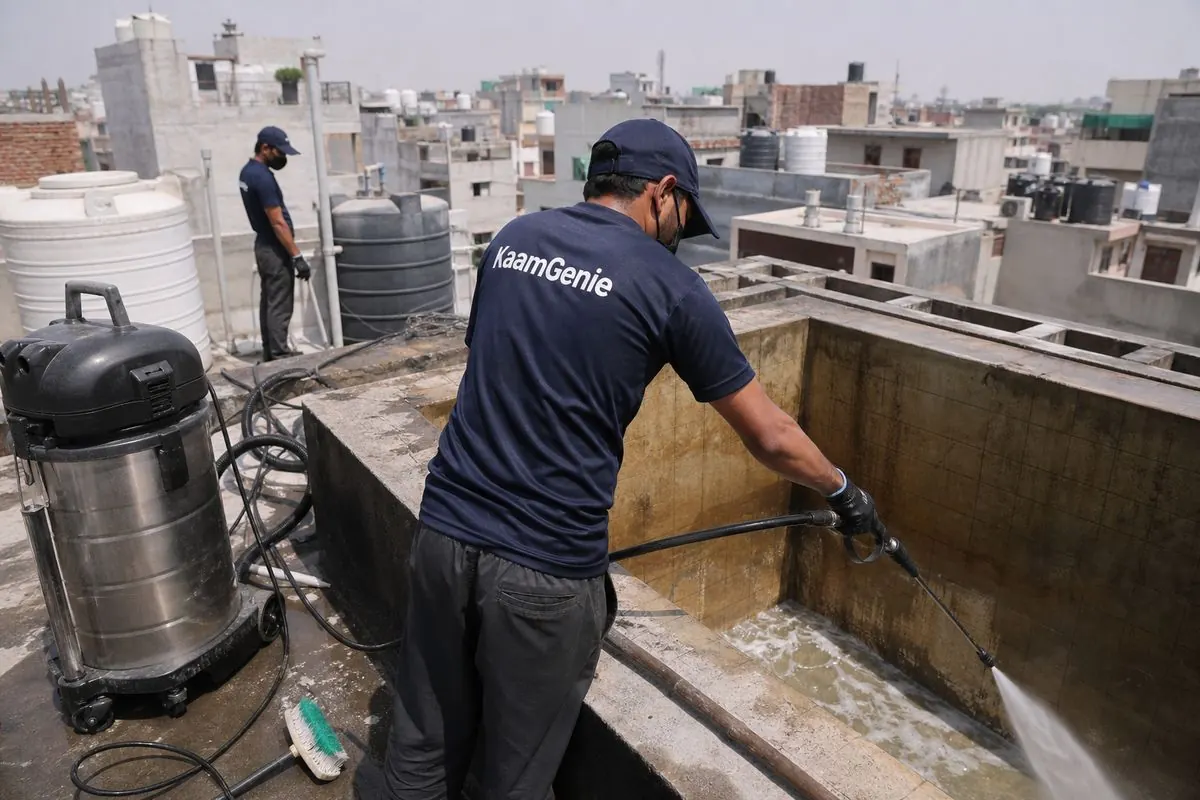
The shift to multi-tenant use is the underlying change. A tank sized for one family is now feeding several, so it turns over harder and refills more often, and each refill stirs sediment back into the water rather than letting it settle. At the same time the ageing pipes on these older plots shed rust that darkens the sludge on the tank floor. Heavier use and older plumbing together push the buildup faster than the tank's original owners ever had to deal with.
Thinning ownership is the other half. When a building was one family's home, someone noticed and acted when the water tasted off; now, with a rotating set of tenants, the tank is nobody's responsibility and simply gets skipped. It stays shut for years even as it works harder than ever. For a Shakti Nagar building that has gone multi-tenant, a clean every six to eight months keeps the water honest, and it is far cheaper than the goodwill lost when tenants complain.
No travel charge anywhere in Shakti Nagar. The final price is confirmed on the call before we come — it depends only on tank size and access.
See it done in 45 seconds
Watch our web story on how a tank is really cleaned — drain, de-sludge, jet-wash, disinfect.
We reach every pocket of Shakti Nagar — and there’s no travel charge to any of them:
Every locality in Delhi stores different water, and that decides how fast a tank fouls. This is Shakti Nagar’s profile from The Delhi Water Index, built from our field observations across 250+ localities.
Indicative field characterisation, not a certified lab test. BIS IS 10500: TDS 500 mg/L acceptable, 2,000 permissible. Check any Delhi area →
“My kothi is now let to several tenants. Should I clean the tank more often?” Yes. Once a house goes multi-tenant the tank turns over much harder, so we suggest every six to eight months rather than the annual clean that suited it as a family home. The heavier use stirs sediment and the tank rarely gets opened. Putting it on a set cycle keeps the water right and saves tenant complaints.
“The sludge in my tank looks rusty. What causes that here?” It is the ageing galvanised pipework common on these older Shakti Nagar plots. The pipes corrode inside and flush a little rust into the tank on each fill, which settles as brown sludge on the floor. We drain and scrub it out. If the pipes are badly gone we will tell you, but the clean handles the sediment itself.
“Who arranges access if the tenants are out during the day?” You just need to tell us who will let the crew onto the terrace, whether that is you, a caretaker or a ground-floor tenant. We only need roof access and a power point for the pump. Give us a name and number when you book and we will coordinate the timing directly so nobody has to wait around.
“Can you do the tank and give me photos I can show the tenants?” Yes. We send dated before-and-after photos on WhatsApp after every clean, which many Shakti Nagar landlords forward to their tenants as proof the tank was properly done. It is a simple way to show the water has been looked after without anyone having to climb up and check.
“What is the cost for a rooftop tank on a multi-tenant building?” A single 500-litre tank starts at ₹699 and a 1,000-litre one is ₹899. Larger 1,001 to 2,000-litre tanks are ₹1,299 to ₹1,499. If the building has several tanks and you want them all done in one visit we quote ₹2,400 to ₹3,000 for the building.
See our complete water tank cleaning services in Delhi NCR — pricing, process, tank types and full city coverage.
Beyond water tank cleaning, KaamGenie is rolling out a full lineup of home services across Delhi NCR — see our complete list of 12 home services we offer or will be launching through 2026. New to tank cleaning? Read our guide on how to pick the right water tank cleaning service in Delhi — what to look for, what to avoid, and the questions that separate trustworthy crews from quick-job operators.
Rooftop plastic tanks
₹699+ →Kothi sumps & underground tanks
₹1,499+ →Apartments & RWAs
Bulk pricing →FSSAI-compliant cleaning
₹2,500+ →टंकी साफ़ करने वाले
हिन्दी पढ़ें →View all water tank cleaning guides →
All pockets and lanes of Shakti Nagar covered. If your specific block or society isn’t named in the sub-areas above, just call — we almost certainly cover it.
Same crew, same 6-step process, same-day where possible. Pick any locality below for local pricing and the tanks we typically find there.
Book a slot — we can usually fit you in today or tomorrow.