
The safe-chemicals shortlist
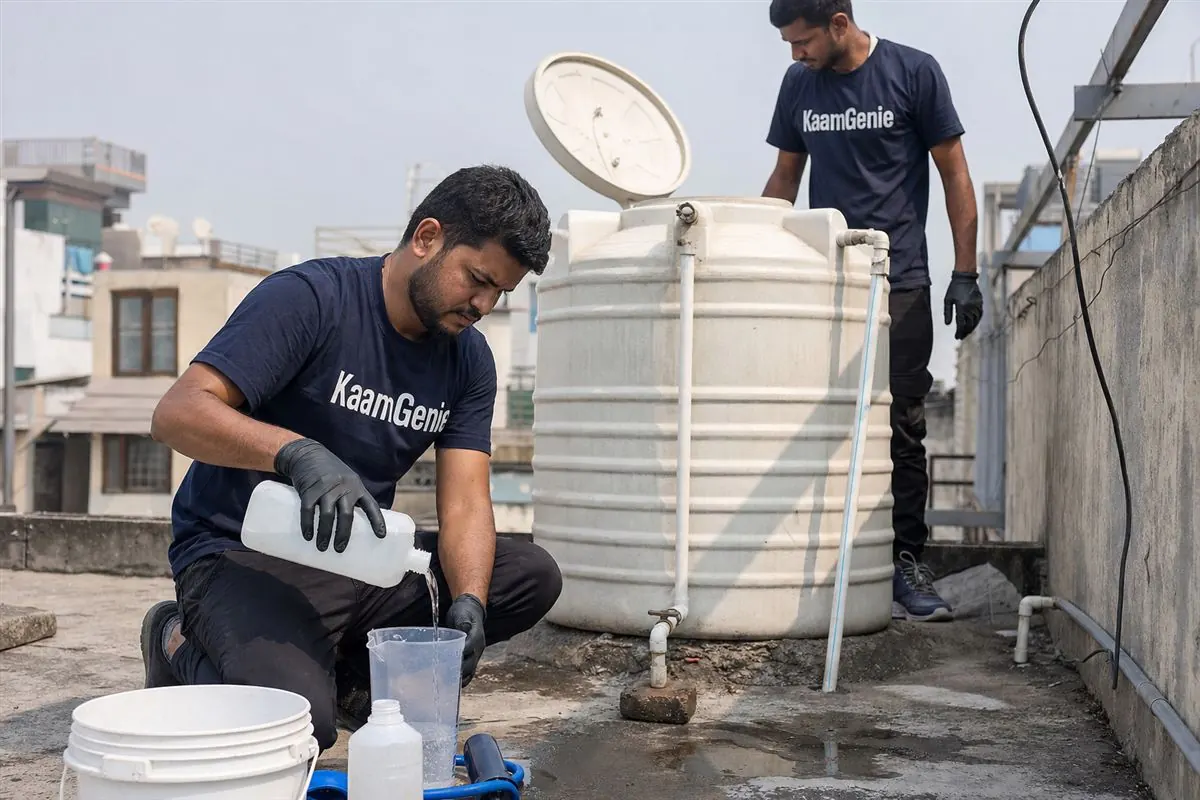
For a drinking-water tank, only a short list of chemicals is actually safe:
- Food-grade sodium hypochlorite — the standard disinfectant. Roughly 50–100 ppm available chlorine on the surfaces, 15–30 minutes contact time, then rinse.
- Food-grade hydrogen peroxide — a chlorine-free alternative for premium jobs; breaks down into water and oxygen, no chlorine smell.
- A mild food-grade detergent — for the scrubbing stage, to lift biofilm before disinfection.
- UV or ozone — equipment-based disinfection for large systems, used instead of chemicals.
And the headline rule: never use scented bleach, acids, phenyl, or hardware-shop chemicals on a drinking-water tank. And never mix bleach with acid — that releases toxic chlorine gas.
| Chemical / agent | What it’s for | Safe for potable tanks? | Notes / dosing |
|---|---|---|---|
| Food-grade sodium hypochlorite | Disinfection (kills bacteria) | Yes | ~50–100 ppm available chlorine on surfaces, 15–30 min contact, then rinse |
| Hydrogen peroxide (food-grade) | Chlorine-free disinfection | Yes | Premium alternative; breaks down to water + oxygen, no chlorine taste |
| Mild food-grade detergent | Lifting biofilm during scrubbing | Yes | Cleaning stage only — rinse off before disinfecting |
| Potassium permanganate | Mild oxidiser / iron removal | Limited — pros only | Occasional, controlled use; stains everything pink; not a routine tank disinfectant |
| Industrial / scented bleach | General disinfection | No | Fragrances, stabilisers and possible heavy-metal contaminants — not food-grade |
| Hydrochloric / muriatic acid | Heavy descaling | No (not for DIY) | Dangerous fumes, etches surfaces; pros use mild food-safe descalers carefully |
| Phenyl / floor & toilet cleaner | Household cleaning | No | Never meant for drinking-water contact; near-impossible to rinse fully out |
Want it done with the right chemicals?
Food-grade disinfectant, correct dosing, proper rinse — documented every job. ₹699 onwards.
The two chemical jobs: cleaning vs disinfecting
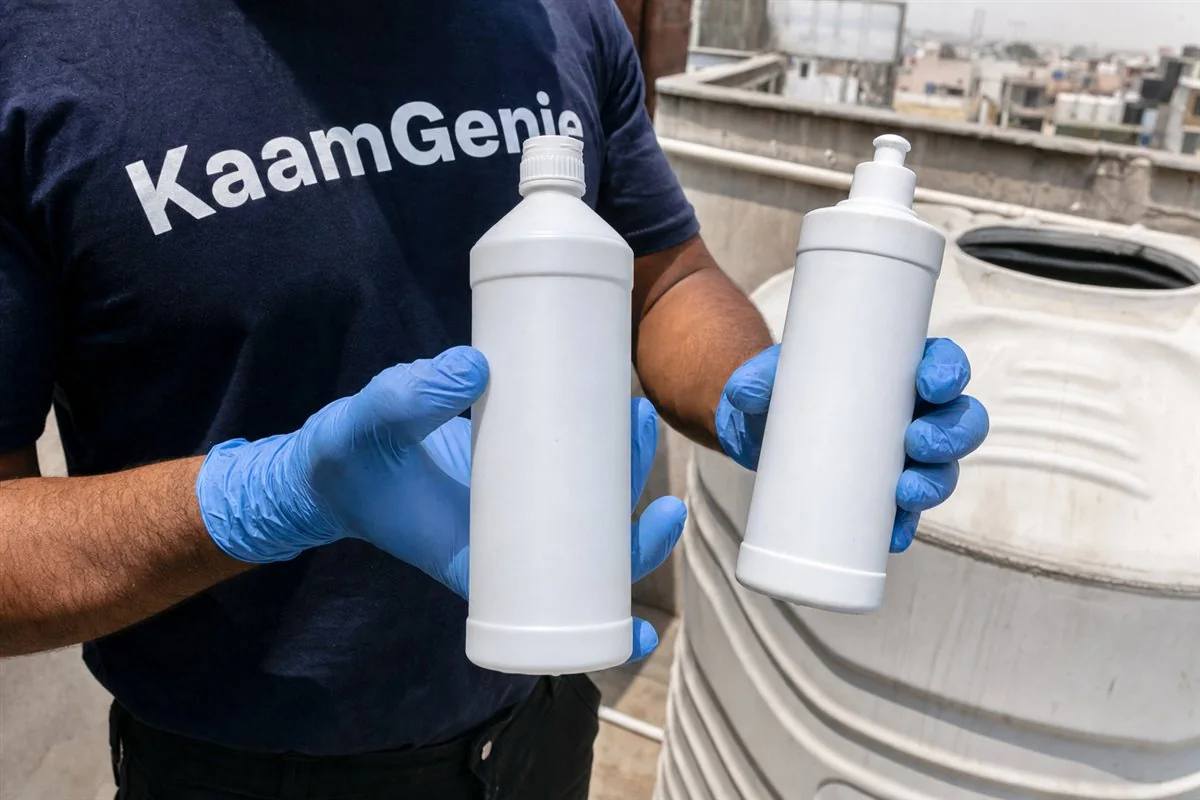
The single biggest misunderstanding about tank chemicals is treating them as one thing. They’re not. A real clean uses two chemical stages, and they do completely different work.
Stage one is cleaning. Before you can disinfect anything, the tank has to be physically clean. The walls and floor carry a thin, slippery layer of biofilm — a living film of bacteria, algae and organic gunk that water alone won’t shift. A mild, food-grade detergent applied during manual scrubbing breaks the surface tension and lifts that film off the surface. This is the same stage covered in detail in our 8-step cleaning process.
Stage two is disinfecting. Once the tank is scrubbed, jet-washed and vacuumed dry, you apply a disinfectant to kill whatever bacteria remain on the now-clean surfaces. This is where sodium hypochlorite or hydrogen peroxide comes in.
Why does the order matter so much? Because disinfectant doesn’t work properly through dirt. Chlorine reacts with organic matter — if you spray it onto a tank still coated in sludge and biofilm, most of it gets used up reacting with the muck instead of killing bacteria. That’s why pouring bleach into a dirty tank is close to useless. Clean first, disinfect second. No shortcut.
Sodium hypochlorite — the workhorse disinfectant
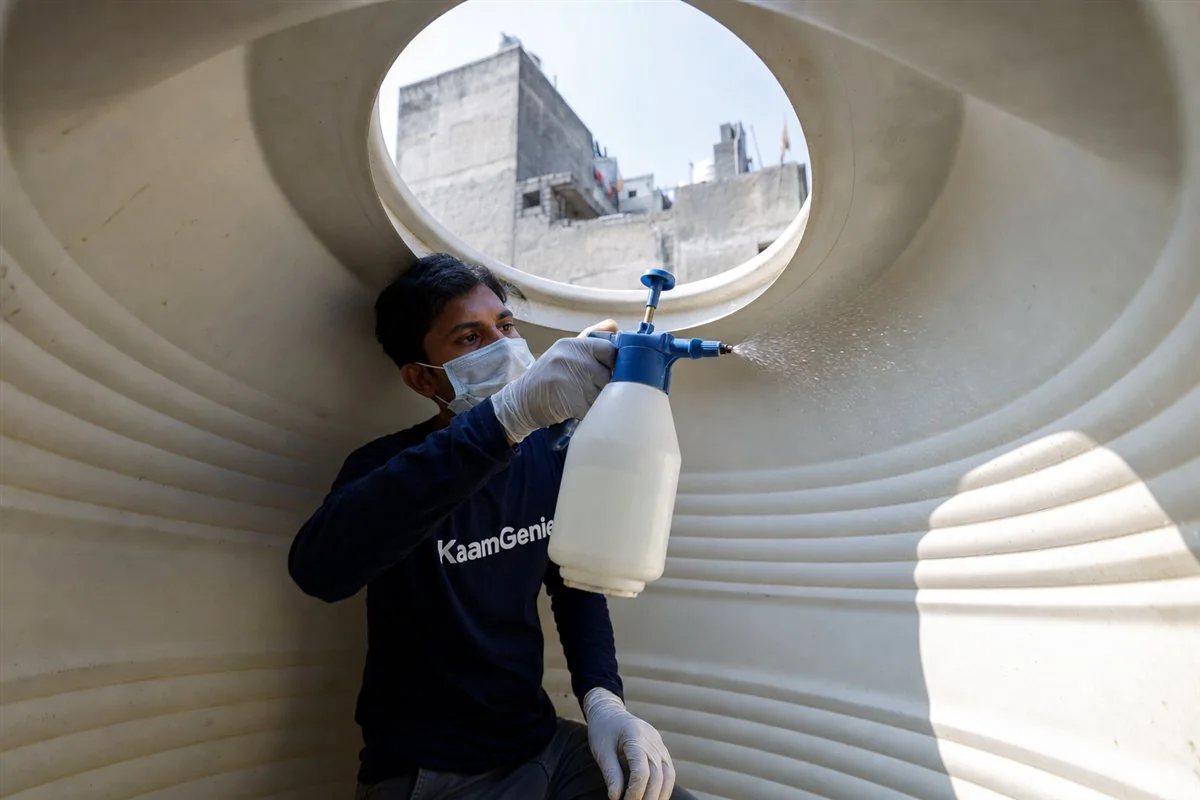
Sodium hypochlorite is just liquid chlorine bleach in its purest form — and in food-grade form it’s the same family of disinfectant your municipal supply (DJB) uses to treat the water that reaches your building. It’s effective, cheap, well understood, and it leaves a small protective residual. For the vast majority of tanks, it’s the right answer.
The two numbers that matter are concentration and contact time, and they work together:
- Concentration: for surface disinfection of an emptied, scrubbed tank, professionals target roughly 50–100 ppm available chlorine on the walls and floor. This is a surface treatment — not something you dose into drinking water.
- Contact time: the solution needs to stay wet on the surfaces for 15–30 minutes. Chlorine kills bacteria over time, not instantly. Rinse it off after five minutes and you’ve applied chemical without actually disinfecting.
- Rinse: after contact time, the tank is rinsed with clean water so only a trace residual remains before refill.
Here’s the part most DIY guides get dangerously wrong: they tell you to “add a cup of bleach” with no reference to concentration, contact time or rinsing. Hardware-shop bleach varies wildly in strength, often contains additives, and dumping an unmeasured amount into a full tank either does nothing useful or over-chlorinates the water you’re about to drink. This is exactly why we don’t recommend casual DIY tank cleaning with chlorine. After cleaning, BIS guidance for drinking water is around 0.2 mg/L free chlorine at the point of use — a faint, protective trace, nowhere near what bleach-dumping produces.
Hydrogen peroxide & other alternatives
Chlorine isn’t the only safe option. Food-grade hydrogen peroxide is a chlorine-free disinfectant that’s become popular for premium jobs and for customers who dislike any chlorine smell. Its big advantage: it breaks down into nothing but water and oxygen, so there’s no chlorine taste, no lingering odour, and no chlorinated by-products. It’s a clean finish, literally.
The trade-offs are honest ones: food-grade hydrogen peroxide costs more than sodium hypochlorite, and unlike chlorine it doesn’t leave a protective residual in the water afterwards. For a tank that gets refilled regularly that’s rarely an issue, but it’s why chlorine remains the default for most jobs.
For larger and institutional systems, there are equipment-based options that don’t rely on adding chemicals at all:
- UV (ultraviolet): water passes a UV lamp that inactivates bacteria and viruses. Common at the point of use (your home UV purifier) and on large supply lines. It disinfects flowing water but doesn’t scrub a dirty tank — you still need the physical clean.
- Ozone: a powerful oxidising disinfectant generated on-site, used mainly on large commercial and industrial systems. Effective but capital-heavy and overkill for a home tank.
For a typical Delhi home or society tank, a short, correctly-dosed application of food-grade sodium hypochlorite or hydrogen peroxide remains the practical, proven choice. UV and ozone are tools for big systems, not the rooftop Sintex tank.
Food-grade vs industrial — why it matters for your family
“Sodium hypochlorite” on a label doesn’t automatically mean it’s safe to drink water after. The crucial distinction is food-grade vs industrial, and it’s not marketing fluff — it’s a real difference in what’s in the bottle.
Food-grade sodium hypochlorite is certified for potable (drinking) contact. It contains the active disinfectant and not much else — no fragrances, no stabilisers, no heavy-metal contaminants. It’s the grade FSSAI and water-treatment standards expect for anything touching food or drinking water.
Industrial bleach, hardware-shop bleach and pool chlorine are a different story. They’re formulated for floors, laundry, swimming pools and general disinfection — jobs where a bit of fragrance or stabiliser doesn’t matter. Scented household bleach contains added perfumes. Pool chlorine often contains stabilisers like cyanuric acid. Some industrial grades can carry trace heavy-metal contaminants from manufacturing. None of that belongs in water your family drinks, cooks with and gives to children.
The catch is that to the eye they look identical — both are pale yellow liquids that smell like chlorine. The only way to know you’re using the right one is to buy a product that’s explicitly certified food-grade for potable water, and to use a service that does the same. The food-grade product costs more. For a drinking-water tank, it isn’t optional.
Chemicals you must NEVER use in a water tank
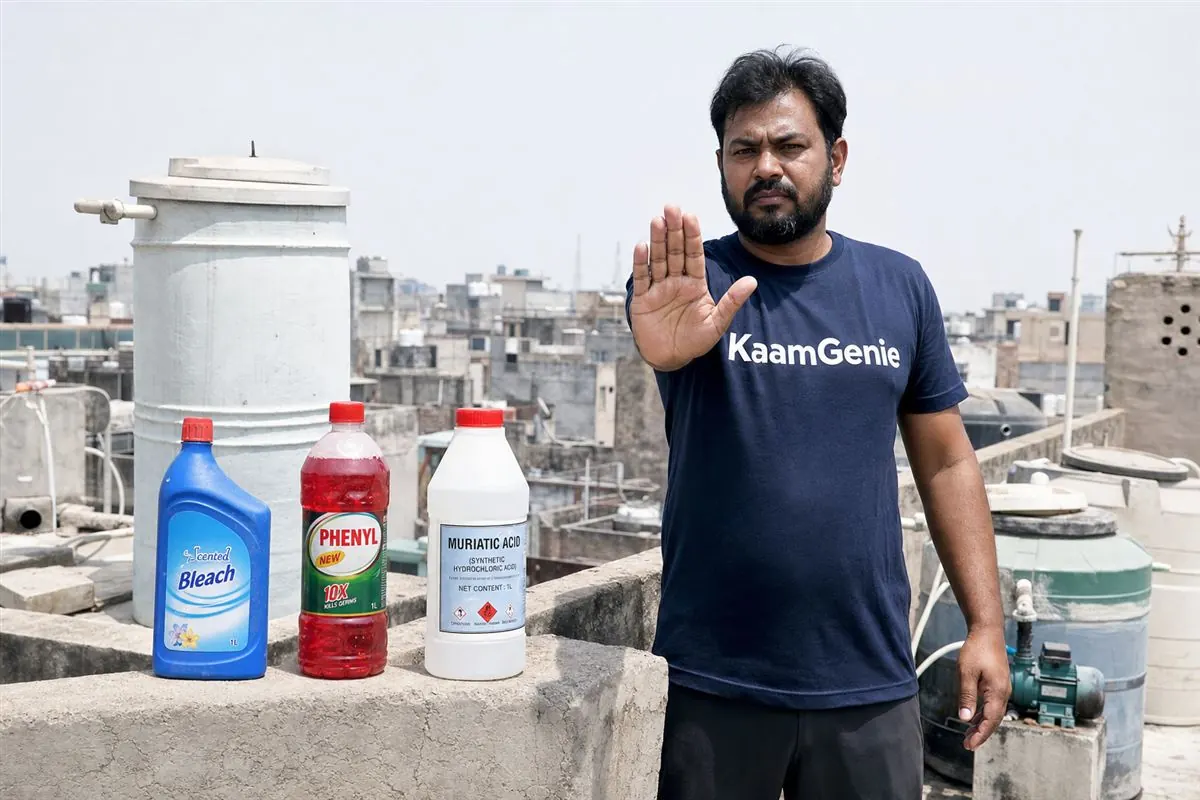
This is the most important section in the article, so read it twice. The following should never go into a drinking-water tank:
- Scented household bleach — the fragrances and stabilisers aren’t food-grade and are hard to rinse out fully.
- Phenyl, floor cleaners and toilet cleaners (Harpic and similar) — these contain acids, surfactants and perfumes designed for bathrooms, never for drinking water. They cling to surfaces and are almost impossible to rinse out of a tank.
- Industrial and pool chlorine — right family, wrong grade. Additives unsafe for potable contact.
- Hydrochloric / muriatic acid (for casual DIY descaling) — it etches concrete, corrodes metal fittings, and gives off dangerous fumes. Professionals occasionally use mild, food-safe descalers under controlled conditions; a homeowner with a bottle of muriatic acid is asking for trouble.
⚠ The chlorine-gas danger — never mix bleach with acid or ammonia
If you mix bleach (sodium hypochlorite) with any acid — including toilet cleaners and descaling acids — or with ammonia-based cleaners, the reaction releases toxic chlorine gas. In an open room that’s bad enough. Inside a confined water tank or underground sump, where the gas has nowhere to go and a person may be standing inside, it can be life-threatening within minutes. This is a real, documented hazard — not a theoretical one. Never combine these chemicals, and never let anyone do “a bit of acid then a bit of bleach” in the same tank.
Hard water & scale: how pros descale safely in Delhi
Large parts of Delhi NCR — especially borewell-fed areas — have hard water, and hard water leaves white calcium and magnesium scale on tank walls, fittings and inlet pipes. Over a couple of years it builds into a crusty layer that ordinary scrubbing won’t fully remove.
The safe way to handle scale is mostly mechanical: thorough scrubbing followed by a high-pressure jet wash dislodges most light-to-moderate scale without any aggressive chemicals at all. For stubborn, hardened scale, professionals may use a controlled, food-safe descaling agent — applied to the affected area, given a measured dwell time, then thoroughly rinsed and the tank re-disinfected afterwards.
What we strongly warn against is the common shortcut of DIY acid descaling with muriatic/hydrochloric acid. People buy it cheaply at a hardware shop and tip it into the tank. The problems: the fumes are dangerous in a confined space, the acid can etch concrete and corrode metal fittings (creating new rough spots for bacteria), and any residue ends up in your drinking water. If your tank has heavy scale, that’s a job for someone with the right food-safe products and the training to rinse it out properly — not a Sunday-afternoon experiment.
Is the water safe to drink after chemical cleaning?
Yes — with a short, sensible wait. When a clean is done correctly, the disinfectant has already been rinsed out before the tank is refilled, so what you’re left with is fresh water with at most a trace residual.
- For non-drinking use (bathing, washing, cleaning, plants) the water is safe to use immediately after refill.
- For drinking, give it about 2–3 hours, then run it through your RO/UV purifier as you normally would. Any faint chlorine smell will dissipate in that window — that’s the trace residual doing its protective job, and it’s normal.
As a reference point, BIS IS 10500:2012 (the Indian drinking-water standard) treats a small free-chlorine residual — guideline around 0.2 mg/L at the point of use — as desirable, because it keeps the water protected on its way to your tap. A correctly cleaned and rinsed tank lands right in that safe zone. A bleach-dumped tank does not — which is the whole reason dosing and rinsing are done by measurement, not by guesswork.
Why concentration AND contact time both matter
Disinfection effectiveness against common waterborne bacteria, by how the chemical is applied
Illustrative comparison. The takeaway: the right chemical only works at the right concentration AND for the full contact time, on an already-clean surface. Miss any one of those and you’ve applied chemical without disinfecting.
Not sure what’s in your tank?
We use only food-grade disinfectant, dosed and timed correctly, with the rinse step never skipped. Standard residential cleaning ₹699 onwards.
The simplest safe answer: let a trained crew handle the chemicals
If all of this feels like a lot to get right — the grade, the concentration, the contact time, the rinse, the never-mix rules — that’s exactly the point. Drinking-water chemistry is one of those areas where the downside of a mistake is far larger than the saving. A clean done with the wrong chemical, or the right chemical applied wrongly, is worse than no clean at all.
Our crews carry only food-grade sodium hypochlorite and food-grade hydrogen peroxide, dose them by measurement, hold the full contact time, and never skip the rinse. If your tank has heavy scale or a special situation, we’ll tell you honestly what it needs. See pricing and book on our water tank cleaning service in Delhi page, read the full 8-step cleaning process, or compare the different tank cleaning methods we use. If you run a food business, our guide to FSSAI water-tank requirements for Delhi restaurants covers the compliance side. And if you’re not sure whether yours is due, here are the signs your tank needs cleaning urgently.
Frequently asked questions
What chemical is used to clean a water tank?
A proper clean uses two chemicals for two different jobs. First a mild food-grade detergent lifts biofilm and grime off the walls during scrubbing. Then, once the tank is physically clean, a disinfectant kills bacteria — the standard one is food-grade sodium hypochlorite (chlorine), the same compound used in municipal water treatment. Hydrogen peroxide is a chlorine-free alternative for premium jobs.
How much chlorine or bleach should I add to my tank?
For surface disinfection of an emptied, scrubbed tank, professionals target roughly 50–100 ppm available chlorine on the walls and floor, left for 15–30 minutes of contact time, then rinsed. This is a surface treatment, not something you add to drinking water. We strongly advise against guessing doses with hardware-shop bleach at home — concentration varies, scented additives are unsafe, and the contact time and rinse matter as much as the dose.
Is it safe to drink water after the tank is cleaned with chemicals?
Yes, once the disinfectant has been rinsed out and the tank refilled. For non-drinking uses like bathing and washing, water is fine to use immediately. For drinking, give it 2–3 hours, run it through your RO/UV purifier as usual, and any faint chlorine smell will dissipate. A correctly done clean leaves only a trace residual — BIS guidance for drinking water is around 0.2 mg/L free chlorine at the point of use, which is normal and protective.
Can I use Harpic, phenyl or normal household bleach to clean my tank?
No. Phenyl, floor cleaners and toilet cleaners like Harpic contain acids, fragrances and surfactants that are never meant for drinking-water contact and are extremely hard to rinse out of a tank. Scented household bleach contains fragrances and stabilisers that are not food-grade. For a potable tank you need a food-grade detergent and food-grade sodium hypochlorite — nothing from the bathroom-cleaning shelf.
Is hydrogen peroxide better than chlorine for a water tank?
Neither is strictly better — they suit different jobs. Food-grade sodium hypochlorite is cheaper, leaves a small protective residual, and is the proven workhorse. Food-grade hydrogen peroxide is chlorine-free, leaves no chlorine taste or smell, and breaks down into water and oxygen, which makes it popular for premium jobs or customers sensitive to chlorine odour. Both are effective when used at the right concentration and contact time.
How long should disinfectant stay in the tank?
Contact time is what actually kills bacteria. For surface disinfection at 50–100 ppm available chlorine, 15–30 minutes is the standard dwell time before rinsing. Cut the contact time short and you have applied chemical without doing the disinfecting — one of the most common shortcuts cheap operators take.
Will the chemicals damage my plastic or concrete tank?
No, when used at the correct concentration. Food-grade sodium hypochlorite at 50–100 ppm and food-grade hydrogen peroxide are gentle on both Sintex/plastic and RCC concrete surfaces. Damage comes from the wrong chemicals — strong acids like muriatic/hydrochloric acid can etch concrete and corrode metal fittings, which is exactly why casual acid use on a potable tank is a bad idea.
How do I remove white calcium scale safely?
Light scale usually comes off with mechanical scrubbing and a jet wash. For stubborn hard-water scale, professionals may use a controlled, food-safe descaling agent, applied carefully and then thoroughly rinsed and re-disinfected. We strongly advise against DIY acid descaling — muriatic acid fumes are dangerous in a confined tank, it can damage the surface and fittings, and any residue ends up in your drinking water.
Is chemical-free or UV cleaning an option?
The physical clean — draining, scrubbing, jet washing, vacuuming — is mechanical and chemical-light, and a mild food-grade detergent is all that’s needed there. For disinfection, large systems can use UV or ozone equipment instead of chlorine, but for a typical home or society tank a short dose of food-grade sodium hypochlorite or hydrogen peroxide is the practical, proven method. There’s no safe way to skip disinfection entirely on a potable tank.
What chemicals should never go into a water tank?
Never use scented household bleach, phenyl, floor or toilet cleaners, or industrial/pool chlorine in a drinking-water tank. Never use hydrochloric/muriatic acid casually for descaling. And never mix bleach with acid or with ammonia-based cleaners — the reaction releases toxic chlorine gas, which is genuinely dangerous in a confined tank or sump. When in doubt, use only food-grade products certified for potable-water contact.
Sources & references
- Bureau of Indian Standards (BIS) — IS 10500:2012 is the canonical Indian Standard for drinking water specification, defining acceptable limits for physical, chemical, and biological parameters, including residual free chlorine.
- WHO Guidelines for Drinking-water Quality, 4th edition — the global reference for water quality standards, including guidance on storage, disinfection and chlorine dosing.
- Food Safety and Standards Authority of India (FSSAI) — defines water quality requirements for food businesses, including hygiene standards for stored water and acceptable disinfection chemicals.
- WHO Fact Sheet on Drinking Water — overview of safe drinking water requirements and contamination risks.
- CPHEEO — Manual on Water Supply and Treatment — the Government of India’s engineering manual covering tank design, cleaning protocols, and disinfection practices.
Last verified: 23 June 2026. If you find any of these links broken, please let us know.