
Same-Day Water Tank Cleaning in Delhi
Raj Babbar · 8 min read
Home › Water Tank Cleaning › Overhead Tank Cleaning › Gulabi Bagh
When does a Gulabi Bagh household actually notice its rooftop tank? Usually only when the water turns cloudy, and by then the sediment and film have been building on those crowded roofs for a long time. KaamGenie clears it before it gets that far. From ₹699.
Gulabi Bagh is a dense middle-class North Delhi colony of independent houses and stacked builder floors, mostly on DJB piped water lifted into rooftop tanks. The plots are built tight and the buildings often hold several families, so the tanks are used hard through the day. Yet they sit forgotten on crowded roofs between fills, out of sight and out of anyone's routine. Settled silt, rust from the older pipes on some plots and a slow algae film accumulate quietly out of view. Residents rarely climb up to look, so nothing prompts a clean. The first real signal is usually the water itself turning cloudy at the tap, and by that point the tank has been overdue for a while. Catching it on a schedule saves the household from ever reaching that cloudy-water moment.
We clean these hard-used rooftop tanks the thorough way. The crew drains the tank, lifts out the settled silt, jet-washes the film and scale off the walls, hand-scrubs the corners and outlet, then finishes with an anti-bacterial disinfectant wash before refilling. Dated before-and-after photos come to you on WhatsApp. This page is part of our wider water tank cleaning in Gulabi Bagh service and focuses specifically on the overhead (rooftop) tanks that feed your taps.
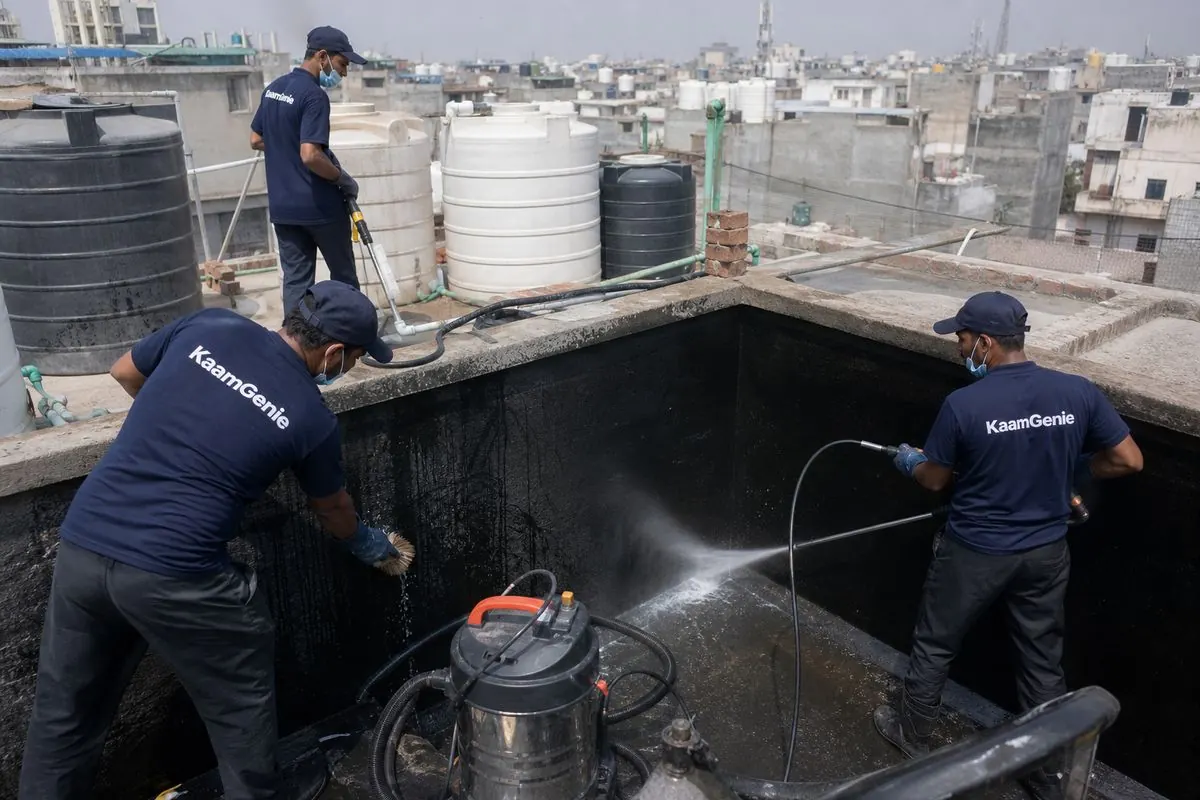
Multi-family occupancy on tight plots is the driver. Several families drawing from one tank means it turns over hard and refills often, and every refill stirs settled silt back into the water instead of letting it lie on the floor. On the older plots, ageing pipes add rust to that silt. The tank works far harder than a single-family tank of the same size, so its buildup outpaces what the owners would expect.
Being out of sight is what lets it run on. On a crowded Gulabi Bagh roof the tank is nobody's daily concern, so it goes years without being opened while it quietly accumulates silt, rust and algae film. Warm daylight through translucent tank walls feeds the algae, and thin municipal chlorine cannot hold the film back. Because the first warning is cloudy water, the sensible move is a yearly clean that heads it off rather than waiting for the tap to raise the alarm.
No travel charge anywhere in Gulabi Bagh. The final price is confirmed on the call before we come — it depends only on tank size and access.
See it done in 45 seconds
Watch our web story on how a tank is really cleaned — drain, de-sludge, jet-wash, disinfect.
We reach every pocket of Gulabi Bagh — and there’s no travel charge to any of them:
Every locality in Delhi stores different water, and that decides how fast a tank fouls. This is Gulabi Bagh’s profile from The Delhi Water Index, built from our field observations across 250+ localities.
Indicative field characterisation, not a certified lab test. BIS IS 10500: TDS 500 mg/L acceptable, 2,000 permissible. Check any Delhi area →
“My water has just started looking cloudy. Is that the tank?” Very often it is. In Gulabi Bagh cloudy water is usually stirred-up silt and algae film in the rooftop tank, especially where several families share one tank. A drain, scrub and anti-bacterial disinfectant wash clears it, and the water typically runs clear again within a day. If it does not, we will help you check the pipes below the tank.
“Several families share our tank. How do we split the cost?” That is up to the families, but most Gulabi Bagh buildings split the tank clean by floor or by household as part of shared maintenance. We raise one invoice for the tank and you divide it however suits you. For a building with more than one tank we give a bulk rate that keeps each family's share low.
“How often should a shared building tank here be cleaned?” Because several families work the tank hard, we suggest every eight to ten months rather than a flat once a year. The heavier turnover stirs sediment and the tank rarely gets opened otherwise. Putting the building on a set cycle means it is done before the water ever turns cloudy.
“Do you need every family's permission, or just roof access?” Just roof access and a power point for the pump. One person, usually the owner or a caretaker, needs to let the crew up and point out the tank. Give us a name and number when you book and we coordinate the timing directly, so the other families are not disturbed.
“What is the cost for a shared rooftop tank?” A single 500-litre tank starts at ₹699 and a 1,000-litre one is ₹899. Larger shared tanks of 1,001 to 2,000 litres are ₹1,299 to ₹1,499. To clean every tank on the building together we quote ₹2,400 to ₹3,000 depending on how many tanks and their sizes.
See our complete water tank cleaning services in Delhi NCR — pricing, process, tank types and full city coverage.
Beyond water tank cleaning, KaamGenie is rolling out a full lineup of home services across Delhi NCR — see our complete list of 12 home services we offer or will be launching through 2026. New to tank cleaning? Read our guide on how to pick the right water tank cleaning service in Delhi — what to look for, what to avoid, and the questions that separate trustworthy crews from quick-job operators.
Rooftop plastic tanks
₹699+ →Kothi sumps & underground tanks
₹1,499+ →Apartments & RWAs
Bulk pricing →FSSAI-compliant cleaning
₹2,500+ →टंकी साफ़ करने वाले
हिन्दी पढ़ें →View all water tank cleaning guides →
All pockets and lanes of Gulabi Bagh covered. If your specific block or society isn’t named in the sub-areas above, just call — we almost certainly cover it.
Same crew, same 6-step process, same-day where possible. Pick any locality below for local pricing and the tanks we typically find there.
Book a slot — we can usually fit you in today or tomorrow.