
Water Tank Cleaning Methods Explained
Raj Babbar · 10 min read
Home › Water Tank Cleaning › Sintex / Plastic Tank Cleaning › Chaukhandi
Chaukhandi’s village plumbing has grown by addition — extensions feeding extensions, tanks with two or three inlet lines and nobody quite sure which valve feeds what. KaamGenie untangles, cleans and disinfects the plastic tanks at the heart of it. From ₹699.
Chaukhandi is the old village pocket tucked behind Subhash Nagar and Tilak Nagar — village lanes with their characteristic odd-shaped, multi-level roofs, plus tenant-heavy rebuilt blocks. Its plumbing carries the village signature: buildings extended floor by floor over decades, each extension tapping the existing tank with its own inlet, so a single plastic tank may have two or three lines entering it, a booster on one and DJB timed supply on another. Add the drums every roof keeps against the timed supply, and the storage chain has more links — and more cleaning surface — than any planned colony’s.
KaamGenie’s clean starts by making sense of the tank — tracing which inlet is live, isolating each line, then drain, wet-vacuum, plastic-safe jet wash, hand-scrub, and a anti-bacterial disinfectant rinse with photos. We flush each inlet line’s first run back into the drained tank before the final rinse, so no line refills the clean tank with its own standing water, and we check the float valve where one exists. Drums and the wider chain are on water tank cleaning in Chaukhandi; this page is for the plastic tanks.
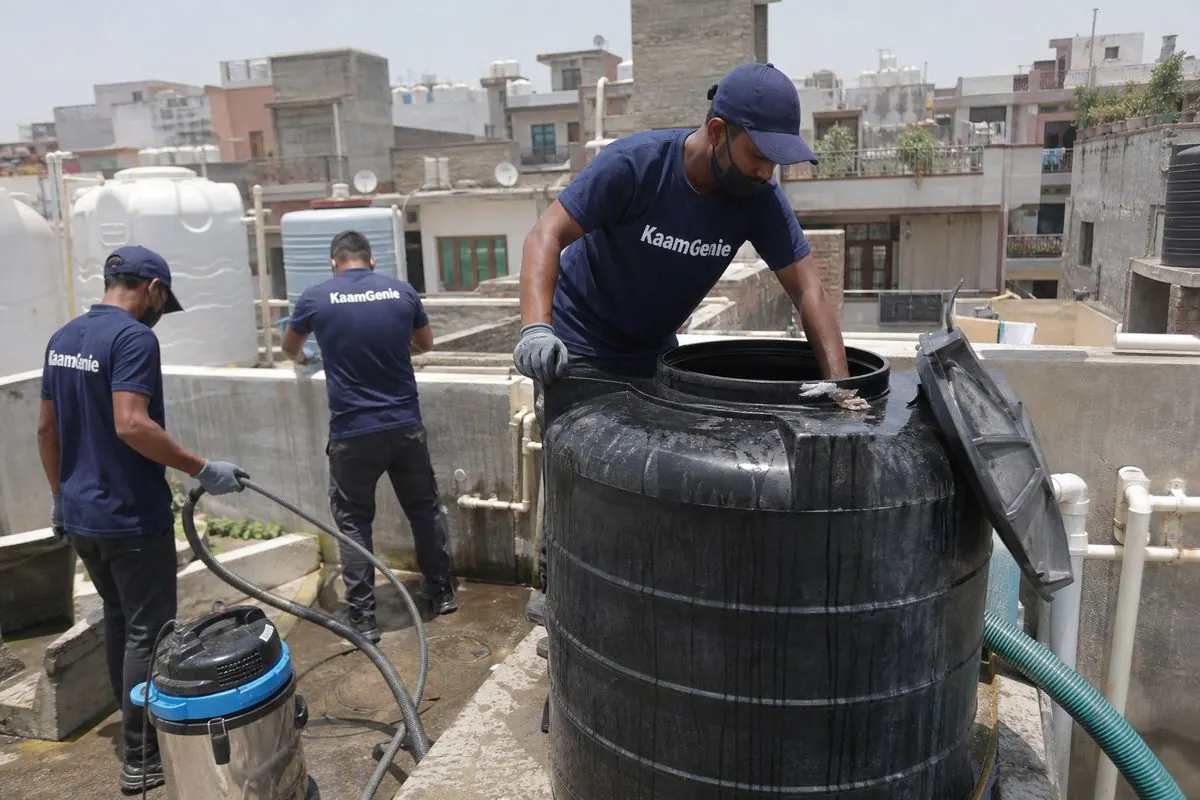
Every extra inlet is an extra history. One line runs from the original DJB connection through the oldest pipe in the building; another comes off a booster from a ground drum; a third was teed in when the top floor was built. Each carries its own sediment — old-pipe rust, drum silt, fresh-line cement traces — and the tank collects all of it. Multiple inlets also mean the water enters at odd angles and heights, stirring the floor layer in ways a single-inlet tank never does, so Chaukhandi tanks run cloudy on days the supply itself was perfectly clear.
The tenant-heavy rebuilt blocks layer on the familiar question of whose job the tank is — with the village twist that the tank may serve floors belonging to different branches of one family, which can make the question more delicate, not less. Our approach is practical: any user can book, the clean covers the tank and every line’s first flush, the drums can be added to the same visit at a small per-drum rate, and the photos give every floor the same view of what came out. On timed supply with drums in the chain, twice a year is the honest cycle.
No travel charge anywhere in Chaukhandi. The final price is confirmed on the call before we come — it depends only on tank size and access.
See it done in 45 seconds
Watch our web story on how a tank is really cleaned — drain, de-sludge, jet-wash, disinfect.
We reach every pocket of Chaukhandi — and there’s no travel charge to any of them:
Every locality in Delhi stores different water, and that decides how fast a tank fouls. This is Chaukhandi’s profile from The Delhi Water Index, built from our field observations across 250+ localities.
Indicative field characterisation, not a certified lab test. BIS IS 10500: TDS 500 mg/L acceptable, 2,000 permissible. Check any Delhi area →
“Our tank has three pipes going in and we do not know which is which. Can you still clean it?” Yes — tracing the inlets is the first step of every Chaukhandi job. We identify which lines are live, isolate them, clean and disinfect the tank, then flush each line’s first run before the final rinse so no pipe refills the clean tank with its own standing water. You also come away finally knowing what feeds what.
“Should the drums be cleaned along with the tank?” On timed supply, yes — drums are the first stage of your storage, and a clean roof tank refilled through a silted drum is only half protected. We add drums to the same visit at a small per-drum rate confirmed on the phone. Doing the chain together is cheaper and far more effective than either alone.
“What does the tank clean cost?” ₹699 up to 500 litres and ₹899 for 501-1,000L, including the inlet tracing, line flushes, plastic-safe wash, anti-bacterial disinfection and photos. Multi-level village roofs carrying more than one tank get a per-tank quote, and drums are added at the per-drum rate.
“Can your crew handle our odd multi-level roof?” Yes — Chaukhandi’s stacked, stepped village roofs are familiar ground. All equipment is hand-carried, hoses run to whichever level the tank sits on, and we have yet to meet a Chaukhandi roof the crew could not work. A photo of the roof on WhatsApp when you book helps us send the right hose lengths.
“Do you come the same day?” Usually — call before 10 AM on 95603 66362. Chaukhandi sits beside our Tilak Nagar-Subhash Nagar route, so a crew passes close daily. Tell us your DJB window timing and whether a booster or drums are in the chain, and we will schedule so everything is clean and refilled the same day.
See our complete water tank cleaning services in Delhi NCR — pricing, process, tank types and full city coverage.
Beyond water tank cleaning, KaamGenie is rolling out a full lineup of home services across Delhi NCR — see our complete list of 12 home services we offer or will be launching through 2026. New to tank cleaning? Read our guide on how to pick the right water tank cleaning service in Delhi — what to look for, what to avoid, and the questions that separate trustworthy crews from quick-job operators.
Rooftop plastic tanks
₹699+ →Kothi sumps & underground tanks
₹1,499+ →Apartments & RWAs
Bulk pricing →FSSAI-compliant cleaning
₹2,500+ →टंकी साफ़ करने वाले
हिन्दी पढ़ें →View all water tank cleaning guides →
All pockets and lanes of Chaukhandi covered. If your specific block or society isn’t named in the sub-areas above, just call — we almost certainly cover it.
Same crew, same 6-step process, same-day where possible. Pick any locality below for local pricing and the tanks we typically find there.
Book a slot — we can usually fit you in today or tomorrow.