
Tank Cleaning Before Moving In
Raj Babbar · 10 min read
Home › Water Tank Cleaning › Sintex / Plastic Tank Cleaning › Lodi Road
Lodi Road's government quarters and institutional blocks keep plastic tanks that green quietly on long maintenance cycles. KaamGenie cleans them gently, hygienic and photographed. From ₹699.
Lodi Road is a planned Central Delhi enclave of government quarters and institutional blocks set among tree-lined avenues. The rooftop stores serving these older quarters include Sintex or plastic tanks on the DJB supply, and they accumulate sediment quietly as the buildings age. Being translucent, the plastic lets sun through the wall, even filtered through the trees, to warm the water and feed algae and biofilm. Dust drifts into loose lids and lays grit on the plastic floor. A concrete tank would keep the light out, but the plastic ones let it in, so the inside greens quietly. Institutional ownership and long maintenance cycles mean the rooftop tanks are often cleaned far less frequently than daily use warrants. By the time a cleaning cycle comes round, the film is well set.
We clean these institutional plastic tanks gently and fully: check the body and lid, drain, hand-scoop the slimy sediment, wet-vacuum the base and jet-wash at a plastic-safe pressure. The algae film lifts with soft pads rather than wire brushes, and we finish with an anti-bacterial disinfectant wash and provide before and after photos for the records. If a block's underground store or an RCC tank also needs a scheduled clean, see our full water tank cleaning in Lodi Road. This page is specifically about Sintex and plastic tanks.
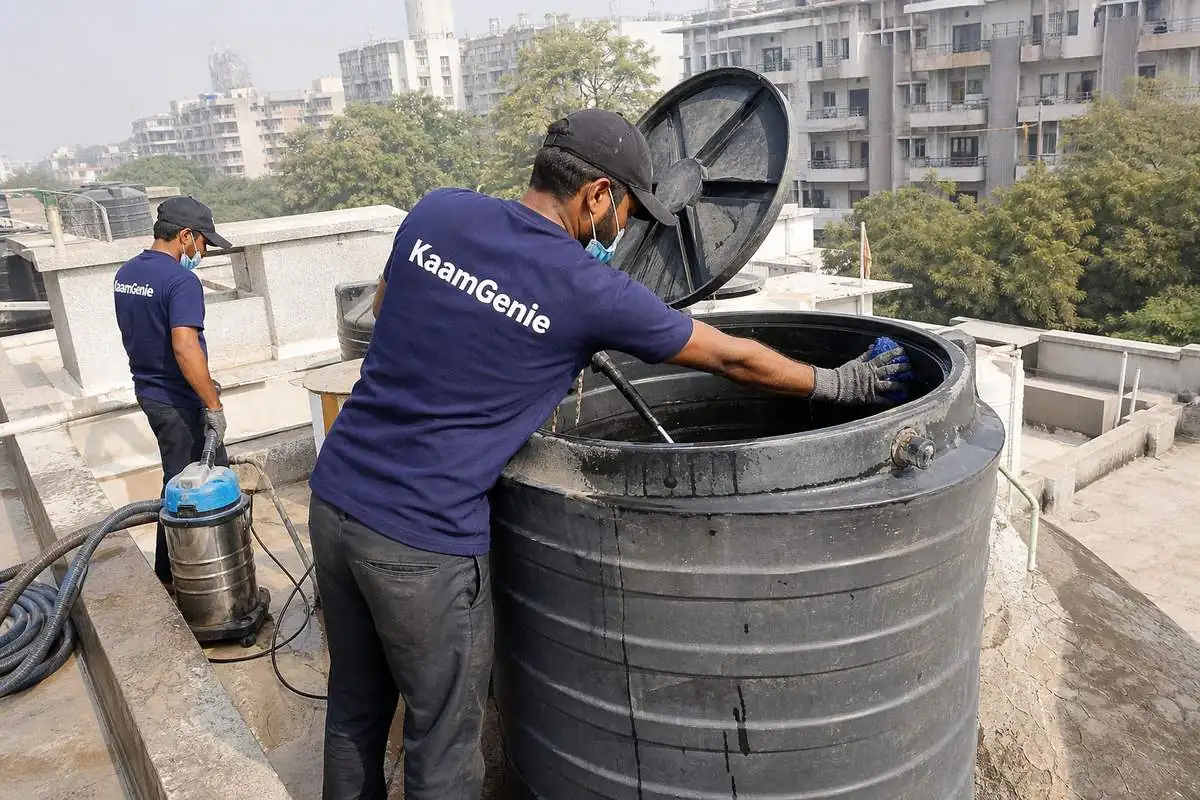
The plastic wall greens the tank between cleaning cycles. A Sintex tank on a Lodi Road quarter is translucent, so sun passing through the avenue trees still reaches the wall and warms the water, and that warmth is what algae and biofilm need. A concrete tank would block the light and stay cooler, holding up longer, while the exposed plastic one greens on the inside. Daily occupant use keeps the water warm and moving, so the film establishes on the same DJB supply well within a long maintenance interval.
Long institutional cycles are why it is left. When a tank is cleaned on an infrequent maintenance schedule rather than to actual use, the plastic tank greens and gathers sediment far ahead of the next cleaning round. Dust drifting in through loose lids lays grit on the plastic floor for the algae to grip, and the ageing quarters add their own sediment to the store. Left across a long cycle, the plastic tank coats up heavily, so a proper drain and plastic-safe scrub, ideally on a tighter schedule, is what keeps the water clear here.
No travel charge anywhere in Lodi Road. The final price is confirmed on the call before we come — it depends only on tank size and access.
See it done in 45 seconds
Watch our web story on how a tank is really cleaned — drain, de-sludge, jet-wash, disinfect.
We reach every pocket of Lodi Road — and there’s no travel charge to any of them:
Every locality in Delhi stores different water, and that decides how fast a tank fouls. This is Lodi Road’s profile from The Delhi Water Index, built from our field observations across 250+ localities.
Indicative field characterisation, not a certified lab test. BIS IS 10500: TDS 500 mg/L acceptable, 2,000 permissible. Check any Delhi area →
“Do you clean the plastic tanks on government quarters at Lodi Road?” Yes. We clean the Sintex and plastic tanks on the quarters and institutional blocks here, with a lid check, drain, hand-scoop, jet-wash and an anti-bacterial disinfectant wash, and we provide photo records for the maintenance file.
“Our block is cleaned on a long cycle, is that enough?” Often it is not, because a plastic tank greens far ahead of a long maintenance interval. We suggest a tighter schedule of every three to four months for exposed Sintex tanks, and we can arrange a recurring slot for the block.
“Can you provide records for our maintenance file?” Yes. We send before and after photos of the tank interior for every clean, so the block has a dated record of the sediment and film cleared and the disinfected finish.
“What does it cost to clean a plastic tank for a quarter or block?” A Sintex up to 500 litres starts at ₹699 and a standard 1000L is ₹899. Larger 1000 to 2000L tanks are ₹1,299 to ₹1,499, and a block with several tanks gets a bulk per-tank rate.
“Can the whole block book several tanks together?” Yes, and it is the cheaper way. When a block has several plastic tanks, one booking covers them all on a coordinated visit, and we give a bulk per-tank rate for the property.
See our complete water tank cleaning services in Delhi NCR — pricing, process, tank types and full city coverage.
Beyond water tank cleaning, KaamGenie is rolling out a full lineup of home services across Delhi NCR — see our complete list of 12 home services we offer or will be launching through 2026. New to tank cleaning? Read our guide on how to pick the right water tank cleaning service in Delhi — what to look for, what to avoid, and the questions that separate trustworthy crews from quick-job operators.
Rooftop plastic tanks
₹699+ →Kothi sumps & underground tanks
₹1,499+ →Apartments & RWAs
Bulk pricing →FSSAI-compliant cleaning
₹2,500+ →टंकी साफ़ करने वाले
हिन्दी पढ़ें →View all water tank cleaning guides →
All pockets and lanes of Lodi Road covered. If your specific block or society isn’t named in the sub-areas above, just call — we almost certainly cover it.
Same crew, same 6-step process, same-day where possible. Pick any locality below for local pricing and the tanks we typically find there.
Book a slot — we can usually fit you in today or tomorrow.