
The short version
- BIS IS 10500:2012 is India’s drinking-water standard. It sets quality limits (microbiological + chemical) — it is not a “clean every X months” law.
- For an ordinary home, there is no statutory cleaning frequency. Every six months is best practice, not a mandate.
- For food businesses (restaurants, cloud kitchens, hotels), FSSAI requires potable water plus hygiene and cleaning records — this is where it gets real.
- For societies, the obligation comes from the RWA’s own bylaws, AGM resolutions and maintenance contracts — not a single public statute.
- DJB guarantees its mains water; once it’s in your private tank, hygiene is your responsibility.
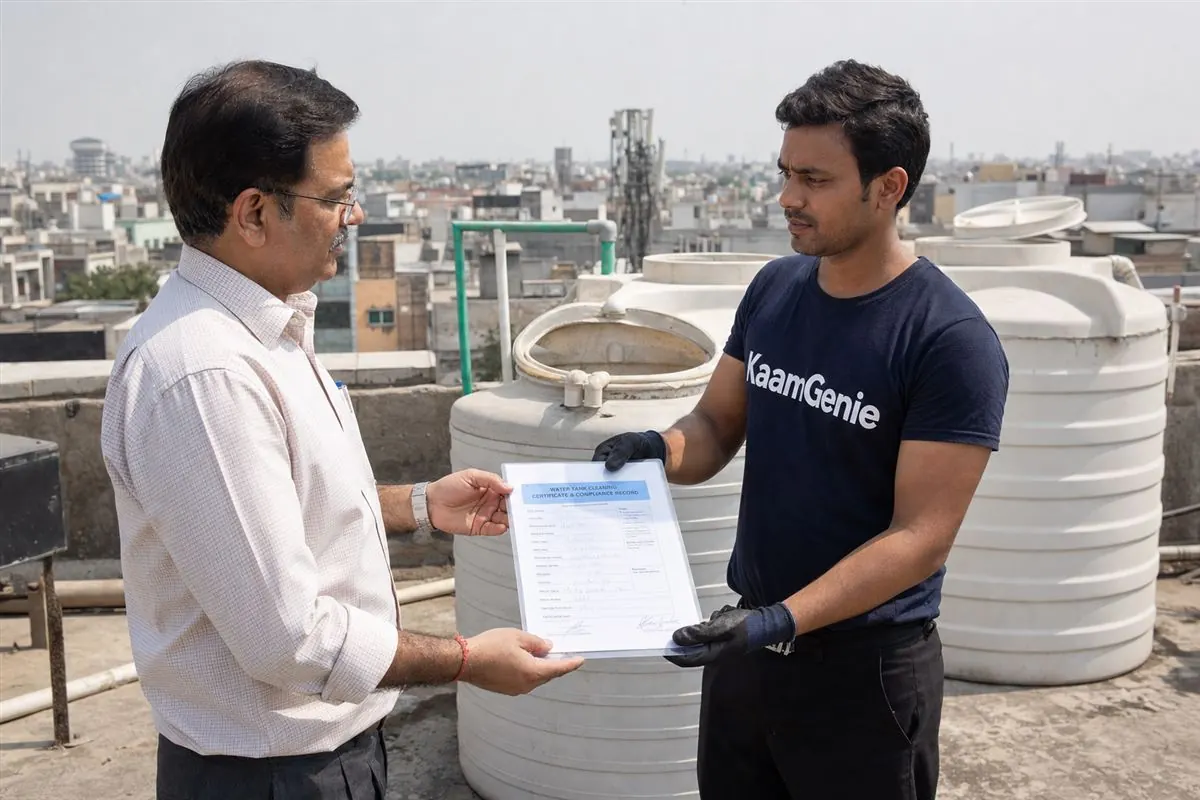
- Keep the cleaning certificate (date, chemicals, technician). It’s your proof for audits, RWAs and food licences.
The thread running through every rule: the water has to be safe, and you should be able to prove the tank is maintained. Hit those two and you satisfy the intent of all of them.
| Setting | Applicable standard or norm | What it requires in practice |
|---|---|---|
| Home / individual flat | BIS IS 10500:2012 (water quality) | No fixed legal interval. Keep water meeting IS 10500; clean roughly every 6 months as best practice. |
| Society / apartment (shared tank) | RWA / association bylaws + IS 10500 | Cleaning obligation set by AGM resolution & maintenance budget; typically quarterly or half-yearly under an AMC, with records kept. |
| Food business (restaurant, cloud kitchen, hotel) | FSSAI hygiene & sanitary requirements + IS 10500 | Potable water, protected clean storage, periodic cleaning, and dated cleaning records / certificate available for inspection. |
| Hospital / healthcare | Facility accreditation & infection-control norms + IS 10500 | Stricter: scheduled cleaning, disinfection and monitoring written into the institution’s own protocols. |
Need a compliant cleaning with a proper certificate?
Food-grade disinfection, before/after photos, and a dated record an RWA or FSSAI inspector will accept. ₹699 onwards.
BIS IS 10500:2012 — the quality standard, not a cleaning calendar
The single most-cited “rule” people reach for is BIS IS 10500:2012, the Indian Standard for drinking-water specification published by the Bureau of Indian Standards. It is the document that defines what counts as safe drinking water in India.
What it sets are limits, in two broad families:
- Microbiological: the requirement that disease-causing organisms be absent — for example, E. coli and coliform bacteria should not be detectable in drinking water.
- Chemical and physical: acceptable and permissible limits for turbidity, total dissolved solids (TDS), total hardness, pH, chlorides, nitrates, and a long list of other parameters that matter in Delhi’s mix of DJB supply and hard borewell water.
Here is the part most websites get wrong: IS 10500 is a quality standard, not a frequency law. It tells you whether the water in your tank is fit to drink. It does not say “clean your overhead tank every six months.” That cleaning interval is sound advice and we recommend it — but it comes from good practice and the realities of how fast a Delhi tank gets dirty, not from a clause in IS 10500. If your stored water can’t meet IS 10500 limits, that’s the real signal a cleaning is overdue. (For the practical reasoning on intervals, see how often you should clean a water tank in Delhi.)
Is there a legal frequency requirement? An honest answer
This is the question worth being precise about, because there is a lot of confident misinformation online.
- For an ordinary home or individual flat: no, there is no statutory rule fixing a cleaning interval. Cleaning every six months is best practice, widely recommended, and sensible given Delhi’s dust, intermittent supply and sediment-heavy water — but it is not a law you can be fined under simply for missing.
- For food businesses: the obligation is real but framed differently. FSSAI doesn’t prescribe a magic number of months either — it requires that the water be potable and that storage be kept clean, with records to show it. In practice that translates to periodic cleaning (commonly quarterly) plus a certificate.
- For societies: the “requirement” is whatever the RWA has resolved and written into its maintenance contract. That is genuinely binding on the association, just not via a public statute.
So when someone tells you “it’s the law to clean every six months,” the accurate version is: it’s the responsible interval, and for certain settings the surrounding rules effectively push you toward regular cleaning — but the law speaks in terms of water quality and records, not a fixed calendar for homes.
FSSAI — where rules genuinely bite (food businesses)
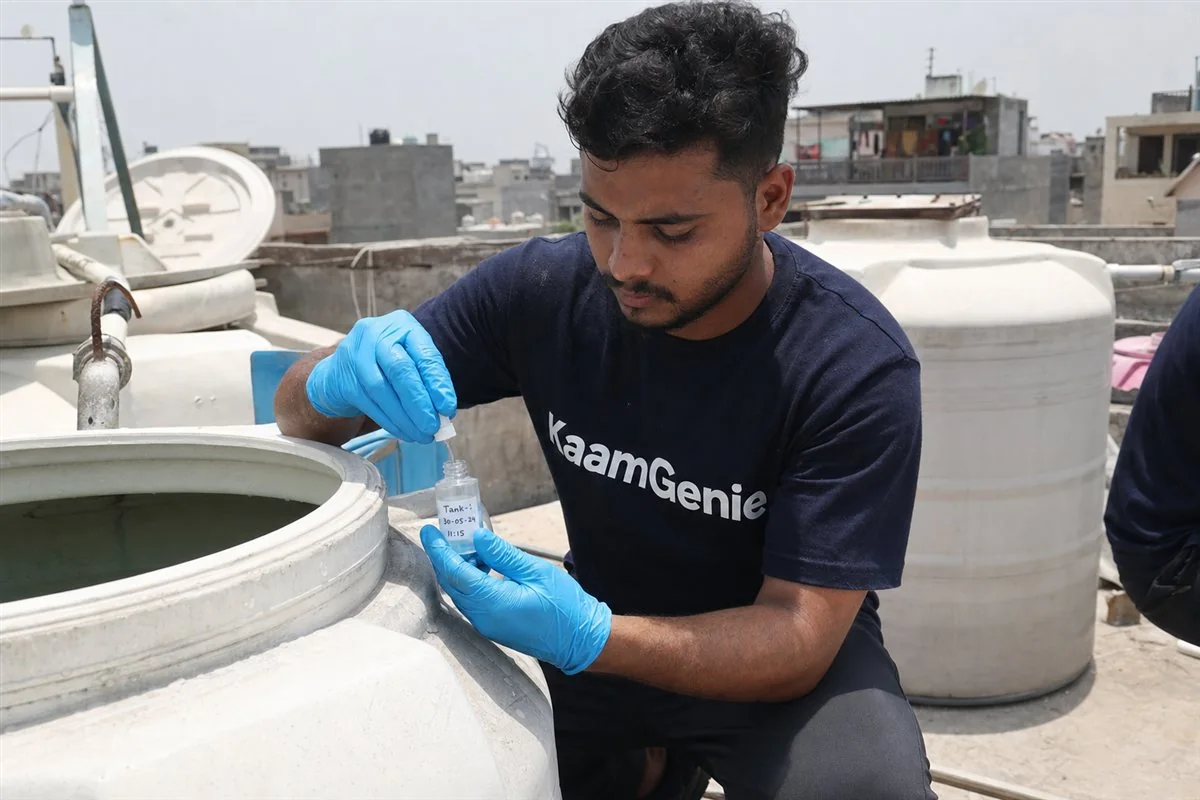
If you run a restaurant, cloud kitchen, hotel, bakery or any licensed food business, this is the section that matters most. Under FSSAI’s hygiene and sanitary requirements, food businesses are expected to:
- Use potable water that conforms to the IS 10500 standard for any process that touches food, including washing, cooking and ice;
- Keep water storage clean and protected from contamination — covered tanks, intact lids, no cross-contamination;
- Carry out periodic cleaning and sanitation of storage; and
- Maintain records of that cleaning — the dated certificate is what an inspector asks for.
The pattern here is potable water + clean storage + documented cleaning. A food business that cleans its tank but keeps no record is in a weak position at inspection, because there’s nothing to show. We’ve written a dedicated, restaurant-specific guide that goes into the licensing detail, frequency and what inspectors actually look for — read FSSAI water tank requirements for Delhi restaurants rather than relying on this overview alone.
Society & RWA bylaws — shared tanks, shared responsibility
For a flat in a society or apartment complex, the rules that bind you usually aren’t public statutes at all — they’re the association’s own bylaws and resolutions. The split typically works like this:
- Shared overhead tanks and underground reservoirs (the ones that feed multiple flats) are the RWA’s / association’s responsibility, funded from the common maintenance budget. No single flat owner is expected to arrange or pay for these.
- A private tank serving only one flat remains that owner’s responsibility.
Well-run societies formalise this with an AGM resolution fixing a cleaning schedule (commonly quarterly or half-yearly) and an annual maintenance contract (AMC) with a cleaning company so it happens on a calendar rather than only when residents complain about smell or colour. The cleaning records then become part of the society’s maintenance file — useful evidence of due diligence if a resident ever raises a water-quality concern. If you’re a committee member setting this up, our guide to RWA annual water tank cleaning contracts in Delhi walks through frequency, scope and what an AMC should include.
DJB & municipal guidance on stored water
A common misconception is that the Delhi Jal Board is responsible for the water sitting in your tank. It isn’t. The useful way to think about the boundary:
- Up to your connection: DJB supplies the water and is responsible for its quality in the mains, and it chlorinates and maintains its own service reservoirs.
- After your connection — your roof, your sump: the cleanliness of that private storage is the building owner’s or society’s responsibility. Even perfectly safe DJB water degrades if it sits in a tank with a broken lid, sediment on the floor, or no cleaning for two years.
Public-health and municipal guidance (in line with WHO and the CPHEEO engineering manual) consistently encourages the same simple things for stored water: keep tanks covered with intact lids, keep them clean, and disinfect periodically. We keep this section general on purpose — DJB does not issue cleaning certificates for private tanks, and we’d rather give you the durable principle than a specific circular that may change.
Who carries the cleaning obligation — by setting
Indicative strength of the formal requirement, not a legal score
Indicative only. The common thread across all four is identical: water that meets IS 10500 quality, and a record proving the tank is maintained.
Record-keeping — the certificate is the point
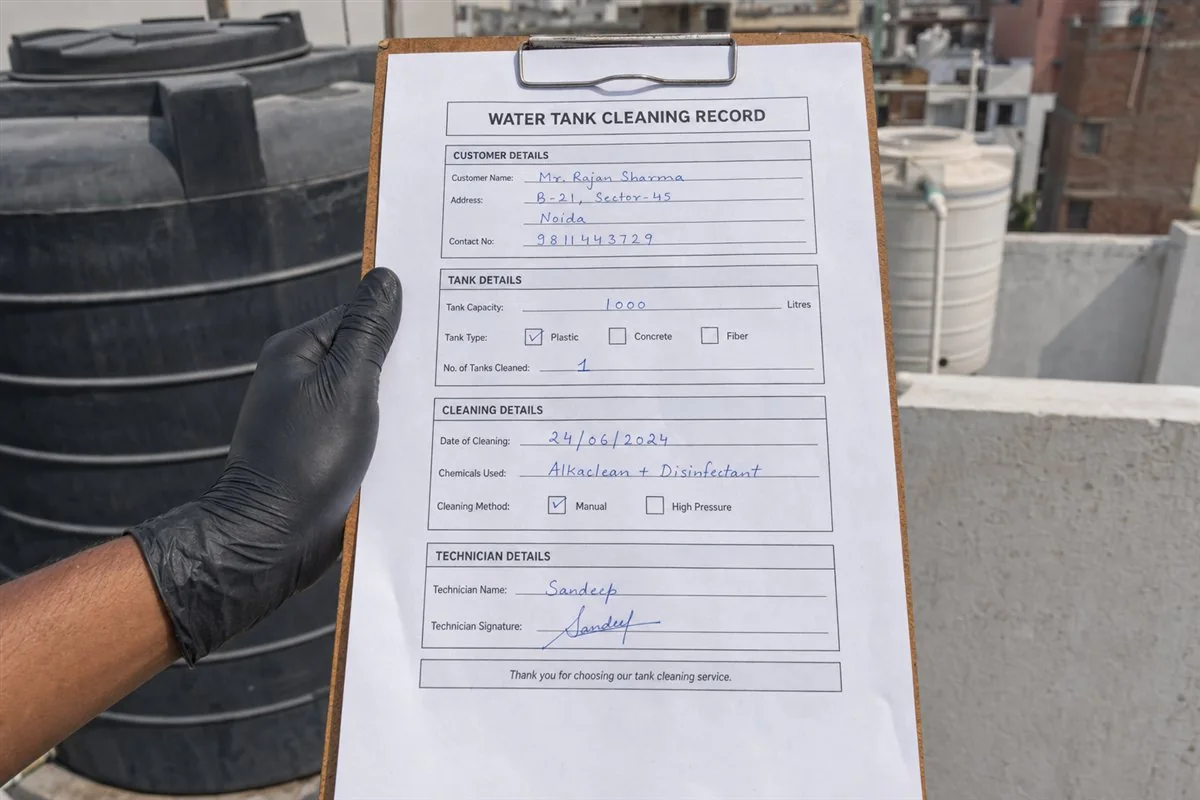
If there’s one practical takeaway from all of this, it’s that the cleaning record matters as much as the cleaning. Across every setting, the question that decides whether you’re compliant is the same: “can you show it was done?” A useful certificate is specific, not a generic rubber stamp. It should record:
- Date and time of the cleaning
- Property address and the specific tank (e.g. “overhead, terrace, 1,000 L”)
- Tank type and capacity — plastic/Sintex or RCC, overhead or underground sump
- Disinfectant used and concentration — e.g. food-grade sodium hypochlorite, in ppm
- Steps performed — drain, sludge removal, scrub, jet wash, disinfection, refill
- Technician / crew name and a signature
- Before-and-after photographs — not mandatory, but they make the record far stronger
Why it matters in real life: an RWA committee asks for proof before releasing payment or at the next AGM; an FSSAI inspector asks for the food-business cleaning log; an auditor or insurer wants evidence of maintenance. A specific, dated, photo-backed certificate answers all three. A self-cleaning with no paperwork answers none. For what a thorough cleaning actually involves — the steps that should appear on that record — see our water tank cleaning process walkthrough.
We hand you the certificate every job
Date, chemicals, capacity, technician, before/after photos — the record RWAs, food licences and audits actually accept. ₹699 onwards residential.
The simplest way to stay on the right side of every rule
You don’t need to memorise statute numbers. Across home, society, restaurant and hospital, the rules converge on two outcomes: water that meets IS 10500 quality, and a record that proves the tank is maintained. A professional cleaning with food-grade disinfectant and a proper dated certificate delivers both at once. See pricing and book on our water tank cleaning service page, or call +91 95603 66362 and we’ll confirm shortly.
Frequently asked questions
Is there a law that says how often I must clean my home water tank in Delhi?
For an ordinary home, there is no statutory rule that fixes a cleaning interval. Cleaning every six months is widely recommended best practice, not a legal mandate. The rules that do exist — BIS IS 10500:2012 — set the quality the stored water should meet, not a calendar. The picture changes for food businesses, where FSSAI requires potable water and hygiene records, and for societies, where the RWA’s own bylaws and maintenance resolutions create an obligation.
What does BIS IS 10500:2012 actually cover?
IS 10500:2012 is the Indian Standard for drinking-water specification. It sets acceptable and permissible limits for physical, chemical and microbiological parameters — things like turbidity, total dissolved solids, hardness, and the requirement that E. coli and coliform organisms be absent. It is a quality standard that tells you whether water is safe to drink. It does not say “clean your tank every X months” — that is left to good practice and, for regulated settings, to other rules.
What does FSSAI require for a restaurant or cloud kitchen tank?
FSSAI’s hygiene and sanitary requirements expect food businesses to use potable water that conforms to IS 10500, to keep water storage clean and protected, and to maintain records of cleaning and sanitation. In practice that means periodic tank cleaning with food-grade disinfectant and a dated cleaning certificate showing what was done, by whom, and with which chemicals. We cover the restaurant-specific detail in our FSSAI water tank requirements guide.
Who is responsible for cleaning a shared society or apartment tank?
For shared overhead tanks and underground reservoirs, responsibility usually sits with the RWA or apartment owners’ association under its bylaws and maintenance budget — not with any single flat. Most well-run societies pass an AGM resolution to clean every quarter or half-year and sign an annual maintenance contract. Individual flats with their own private tank remain responsible for that tank. See our RWA annual contracts guide for how this is typically structured.
Does the Delhi Jal Board inspect or certify private tank cleaning?
DJB supplies and is responsible for the quality of water in its mains, and it disinfects its own service reservoirs. The cleanliness of the private storage on your roof or in your sump — once water leaves the connection — is the building owner’s responsibility, not DJB’s. DJB and public-health guidance generally encourage keeping stored water covered, clean and periodically disinfected, but DJB does not issue cleaning certificates for private home or society tanks.
What should a proper water tank cleaning certificate contain?
A useful record shows the date and time of cleaning, the property address, the tank type and capacity, the disinfectant used and its concentration, the steps performed, the technician or crew name, and a signature. Before-and-after photographs strengthen it. This is the document an RWA committee, an FSSAI inspector, or an auditor will ask to see, so it should be specific rather than a generic stamp.
Are there fines for not cleaning a water tank in Delhi?
We deliberately avoid quoting specific penalty figures, because penalties depend on the exact regulation and the setting. For a private home, there is generally no direct fine simply for an unclean tank. For a food business, supplying non-potable water or failing to maintain hygiene records can attract action under food-safety law during licensing or inspection. The safe answer is: keep your water meeting IS 10500 quality and keep your cleaning records — that satisfies the intent of every rule that applies.
Does a hospital or healthcare facility have stricter requirements?
Yes. Healthcare facilities handle vulnerable patients, so stored water hygiene is taken more seriously — periodic cleaning, disinfection, and monitoring are usually written into the facility’s infection-control and accreditation requirements (for example, hospital quality-accreditation standards). The exact protocol is set by the institution’s accreditation and biomedical norms rather than by a single public statute, but it is meaningfully stricter than a home.
How often is cleaning recommended even though it isn’t always mandatory?
The common best-practice interval is every six months for a typical Delhi home, and quarterly for societies, restaurants and any tank under heavy use or fed by hard borewell water. We explain the reasoning, and the factors that justify more or less frequent cleaning, in our guide on how often to clean a water tank in Delhi.
Do I need a licensed company to clean my tank, or can anyone do it?
There is no special licence required to clean a private home tank. What matters for compliance is the outcome and the proof: water that meets IS 10500 quality, food-grade disinfectant, and a proper cleaning record. For food businesses and societies the practical expectation is a professional service that issues a dated certificate, because a self-cleaning with no documentation is hard to defend in an inspection or AGM.
Sources & references
- Bureau of Indian Standards (BIS) — IS 10500:2012 is the canonical Indian Standard for drinking water specification, defining acceptable limits for physical, chemical, and biological parameters.
- WHO Guidelines for Drinking-water Quality, 4th edition — the global reference for water quality standards, including guidance on storage and disinfection.
- Food Safety and Standards Authority of India (FSSAI) — defines water quality requirements for food businesses, including hygiene standards for stored water and acceptable disinfection chemicals.
- WHO Fact Sheet on Drinking Water — overview of safe drinking water requirements and contamination risks.
- CPHEEO — Manual on Water Supply and Treatment — the Government of India’s engineering manual covering tank design, cleaning protocols, and disinfection practices.
Last verified: 24 June 2026. If you find any of these links broken, please let us know.