
Tank Cleaning Before Moving In
Raj Babbar · 10 min read
Home › Water Tank Cleaning › Sintex / Plastic Tank Cleaning › Rajgarh Colony
Many of the Sintex tanks still in use around Rajgarh Colony were fitted back in the nineties, and decades of sun have left their plastic walls roughened and tired. On regular DJB the water looks fine, so residents clean only when it visibly turns. KaamGenie cleans these older rooftop Sintex tanks from ₹699.
The tanks here carry a lot of history. Rajgarh Colony, near the Krishna Nagar border, is an older neighbourhood where a good number of rooftop Sintex tanks date from the nineties and have simply never been replaced. Thirty-odd years of open sun have roughened the plastic on the inside, and a rough wall holds algae and sediment far more stubbornly than smooth new plastic. The supply is a regular DJB line, so the water arriving is reasonably clean, and that is part of the trap: because it looks fine most of the time, people leave the tank alone and only think about it when the water clearly turns. By then the ageing walls have been coating up unnoticed for a long while.
This service is aimed at plastic Sintex and rooftop plastic tanks, and especially these nineties-era, roughened ones that need a careful hand. Our crew drains the tank, scrubs the tired walls and base with soft pads and an anti-bacterial disinfectant wash, then refills, keeping wire brushes off the old plastic entirely. If your house also has an underground sump or a masonry tank, the broader water tank cleaning in Rajgarh Colony handles those as well. One call books it and a standard tank is done in about an hour.
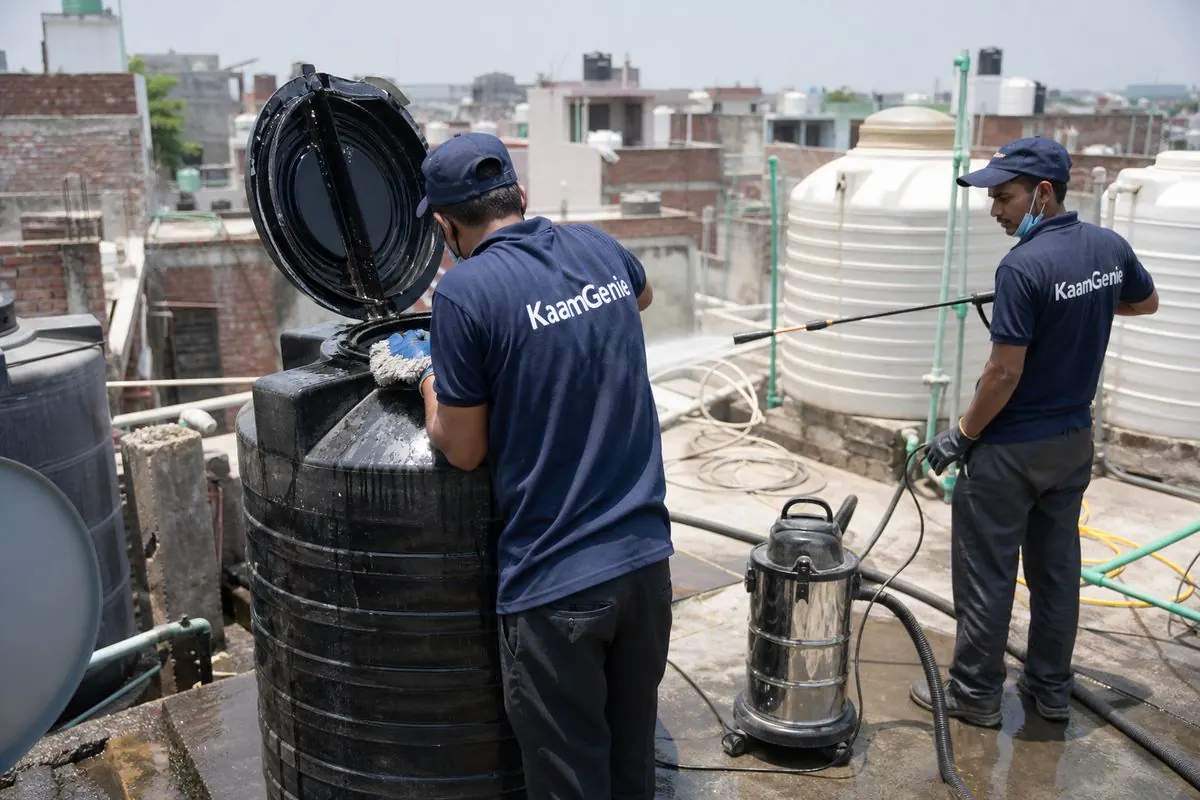
Tank age is the heart of it here. A nineties-era Sintex has spent decades in the sun, and that long exposure roughens the inside of the plastic so it grips biofilm and sediment where a smooth wall would shed them. Even the reasonably clean DJB supply leaves a film on walls this rough, and the translucent plastic lets sunlight through to feed a little algae on top. An old tank like this rewards a thorough clean, because clearing the buildup restores the surface and keeps the tank serviceable for years more.
The clean-only-when-it-turns habit makes the age matter more. Because the DJB water usually looks fine, residents put off cleaning until it visibly changes colour or smell, which means an ageing tank can go a very long time between washes while quietly coating over. By the time the water turns, the buildup is heavy and set into the rough walls. We clean plastic-safe, with jet pressure kept gentle for old, thin plastic and soft pads instead of wire brushes, so even a well-worn nineties tank is cleaned properly without cracking.
No travel charge anywhere in Rajgarh Colony. The final price is confirmed on the call before we come — it depends only on tank size and access.
See it done in 45 seconds
Watch our web story on how a tank is really cleaned — drain, de-sludge, jet-wash, disinfect.
We reach every pocket of Rajgarh Colony — and there’s no travel charge to any of them:
Every locality in Delhi stores different water, and that decides how fast a tank fouls. This is Rajgarh Colony’s profile from The Delhi Water Index, built from our field observations across 250+ localities.
Indicative field characterisation, not a certified lab test. BIS IS 10500: TDS 500 mg/L acceptable, 2,000 permissible. Check any Delhi area →
“Our Sintex is from the nineties. Can it still be cleaned safely?” Yes. We clean plenty of nineties-era tanks in this area. We keep the jet pressure gentle and use soft pads, not wire brushes, so the old plastic is cleaned thoroughly without being cracked. If a tank is genuinely too worn to hold up, we will say so honestly.
“We only clean when the water changes. Is that often enough?” Not really, because by the time the water visibly turns the tank has usually been dirty for months. For an older roughened tank we suggest every four to six months, which keeps the buildup light and is gentler on ageing plastic than a heavy clean later.
“The water on our DJB line looks clean. Why does the tank still need cleaning?” Even clean DJB water leaves a film on a decades-old tank whose inner walls have roughened in the sun, and the translucent plastic lets in light that grows a little algae. So the tank still coats up on the inside over time regardless of the source. A regular scrub is what keeps the stored water clean.
“How much does it cost to clean an old rooftop Sintex?” From ₹699 for up to 500 litres, around ₹899 for 1000 litres, and ₹1,299 to ₹1,499 for 1500 to 2000 litre tanks. Neighbours on the same lane booking together can get a better combined rate.
“How long will the tank be out of use?” About an hour for a standard rooftop tank, covering the drain, scrub, disinfectant wash and refill. We can pick a quieter time of day so the house is not left without water when you need it most.
See our complete water tank cleaning services in Delhi NCR — pricing, process, tank types and full city coverage.
Beyond water tank cleaning, KaamGenie is rolling out a full lineup of home services across Delhi NCR — see our complete list of 12 home services we offer or will be launching through 2026. New to tank cleaning? Read our guide on how to pick the right water tank cleaning service in Delhi — what to look for, what to avoid, and the questions that separate trustworthy crews from quick-job operators.
Rooftop plastic tanks
₹699+ →Kothi sumps & underground tanks
₹1,499+ →Apartments & RWAs
Bulk pricing →FSSAI-compliant cleaning
₹2,500+ →टंकी साफ़ करने वाले
हिन्दी पढ़ें →View all water tank cleaning guides →
All pockets and lanes of Rajgarh Colony covered. If your specific block or society isn’t named in the sub-areas above, just call — we almost certainly cover it.
Same crew, same 6-step process, same-day where possible. Pick any locality below for local pricing and the tanks we typically find there.
Book a slot — we can usually fit you in today or tomorrow.