
Plastic vs Concrete Tank Cleaning
Raj Babbar · 8 min read
Home › Water Tank Cleaning › Society / RWA Tank Cleaning › Civil Lines
Society tank cleaning for the staff-quarter blocks, institutional buildings and apartment addresses of Civil Lines, where a shared sump and a row of overhead tanks serve many households at once. One coordinated visit clears the whole set. Bulk pricing for the whole building.
Civil Lines reads as a leafy heritage precinct of bungalows and government kothis, but behind that low-density face sit the buildings that actually share their water: staff-quarter blocks, institutional hostels and a scatter of apartment addresses. These run the classic shared setup, a big underground sump on stable DJB supply feeding a bank of rooftop overhead tanks. The generous tank capacities that suit the precinct also mean the water turns over slowly, so sediment settles and an organic film forms on the walls between draws. Older masonry sumps here take in grit through hairline cracks in the plaster, adding to the load. Because the tanks are shared and no single resident owns them, lids stay shut for years at a stretch. An annual mechanical clean matters even where the piped water looks perfectly clear.
KaamGenie handles the full building for Civil Lines societies and staff blocks: the underground sump, the booster pumps and every shared overhead tank, done in one coordinated visit arranged with your RWA, estate office or building manager. We stagger the tanks so no wing loses supply while we work, log a dated record for the maintenance file, and photograph each tank before and after. For a single bungalow or flat, see water tank cleaning in Civil Lines. This page is about society and shared building tanks only.
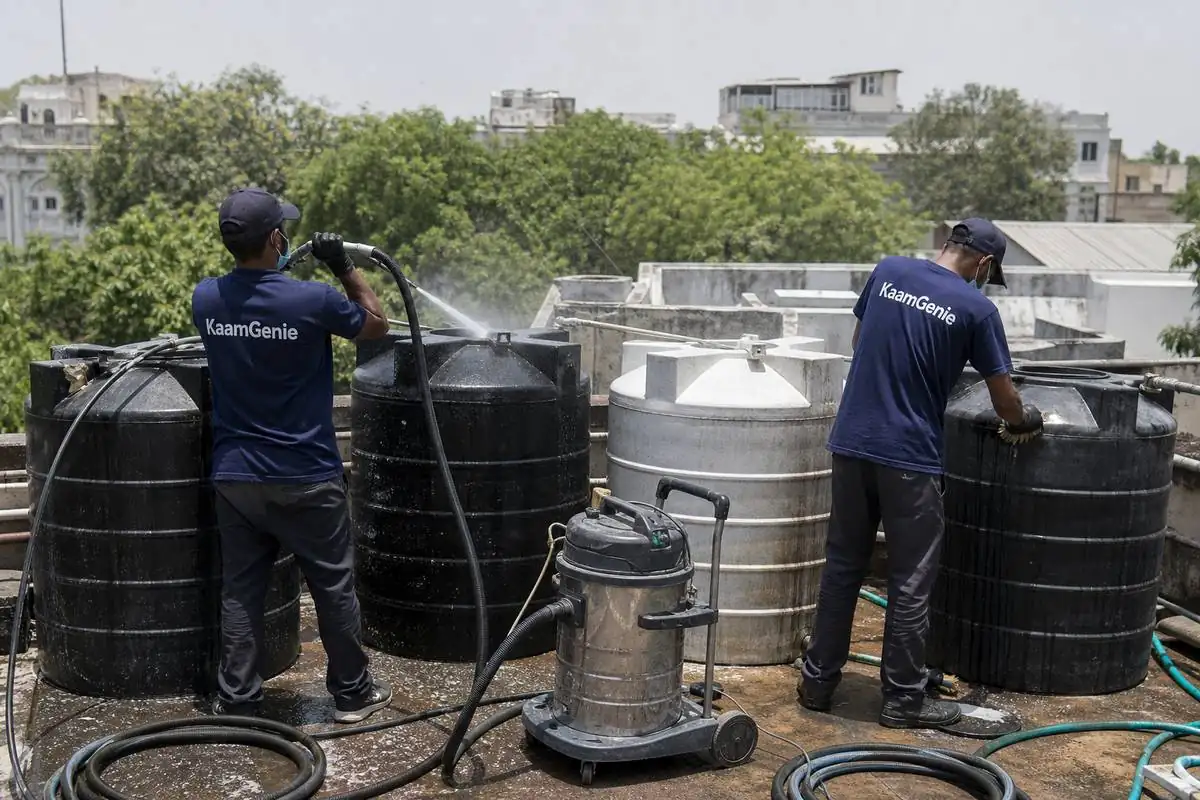
Slow turnover is the quiet risk in Civil Lines. A large shared tank that a bungalow-sized draw empties gently gives sediment plenty of time to settle and biofilm plenty of time to spread across the walls. In the staff blocks and hostels the draw is heavier, so the sump load climbs while the overhead tanks stay coated. Either way the standing water starts to shelter bacteria that reach the taps of every household on the connection. Cleaning every three to four months resets both the sump and the tanks before that happens.
The estate offices and committees that run these buildings often let cleaning slip because the plant is spread out and the paperwork feels heavy. We keep it simple: one survey maps the sump, pumps and tanks, and one visit clears them with a dated record ready for the file. Doing the whole building together is cheaper than calling someone tank by tank, and an annual contract means the manager has a standing schedule rather than a job to chase each year.
No travel charge anywhere in Civil Lines. The final price is confirmed on the call before we come — it depends only on tank size and access.
See it done in 45 seconds
Watch our web story on how a tank is really cleaned — drain, de-sludge, jet-wash, disinfect.
We reach every pocket of Civil Lines — and there’s no travel charge to any of them:
Every locality in Delhi stores different water, and that decides how fast a tank fouls. This is Civil Lines’s profile from The Delhi Water Index, built from our field observations across 250+ localities.
Indicative field characterisation, not a certified lab test. BIS IS 10500: TDS 500 mg/L acceptable, 2,000 permissible. Check any Delhi area →
“Do you provide a proper GST invoice for the estate accounts?” Yes. Every society and institutional job is billed on a full GST invoice made out to the building or estate office, itemising each tank and the whole-building rate, so your accounts and audit trail stay clean.
“How do you know how many tanks our block runs?” The site survey settles it. We open the pump room and walk the roof to count every overhead tank and the sump, note access and fill timing, then quote the exact set rather than a guess.
“Can you work around our fixed DJB fill hours?” Yes. We note your fill window at the survey and drain one tank at a time inside it, so the rest of the building keeps water. We confirm normal supply to every household before leaving.
“What is the cost for a full staff-quarter block?” Shared tanks of 2,000 to 3,000 litres are ₹1,500 to ₹2,000 each. We bulk-quote the whole block, sump plus rooftop tanks, at 15 to 20 percent below the per-tank rate for one coordinated visit.
“Do institutional buildings get an annual plan?” Yes. The AMC covers scheduled visits across the year for the sump, pumps and all tanks at 20 to 25 percent off the per-visit rate, with a dated record filed each time for the estate office.
See our complete water tank cleaning services in Delhi NCR — pricing, process, tank types and full city coverage.
Beyond water tank cleaning, KaamGenie is rolling out a full lineup of home services across Delhi NCR — see our complete list of 12 home services we offer or will be launching through 2026. New to tank cleaning? Read our guide on how to pick the right water tank cleaning service in Delhi — what to look for, what to avoid, and the questions that separate trustworthy crews from quick-job operators.
Rooftop plastic tanks
₹699+ →Kothi sumps & underground tanks
₹1,499+ →Apartments & RWAs
Bulk pricing →FSSAI-compliant cleaning
₹2,500+ →टंकी साफ़ करने वाले
हिन्दी पढ़ें →View all water tank cleaning guides →
All pockets and lanes of Civil Lines covered. If your specific block or society isn’t named in the sub-areas above, just call — we almost certainly cover it.
Same crew, same 6-step process, same-day where possible. Pick any locality below for local pricing and the tanks we typically find there.
Book a slot — we can usually fit you in today or tomorrow.