
Water Tank Disinfection Explained
Raj Babbar · 10 min read
Home › Water Tank Cleaning › Society / RWA Tank Cleaning › Haiderpur
Village-committee tank cleaning in Haiderpur, the colony beside Delhi’s biggest water treatment plant — mixed roof clusters, landlord buildings and committee lanes served by crews who answer sharp water-quality questions. From ₹1,500 per tank.
Haiderpur lives beside the Haiderpur WTP — Delhi’s largest water treatment plant — with the standing irony that the village itself runs on timed supply and borewells while treating water for half the city. Village-core roofs carry mixed clusters of old and new tanks, the Badli industrial edge dusts the northern lanes, and proximity to the plant has bred an unusually water-aware population: residents here ask about TDS, disinfection chemistry and quality report details that most localities never raise.
KaamGenie serves Haiderpur through its village committees and landlord buildings. A committee lane books one shared service day and the crew works the roofs in sequence, cleaning whole tank clusters as single systems; landlords with tenant floors book building rounds with photo proof; and every visit ends with the dated quality report this locality actually reads. For a one-tank household booking, see water tank cleaning in Haiderpur; this page is for committees, landlord groups and multi-tank roofs.
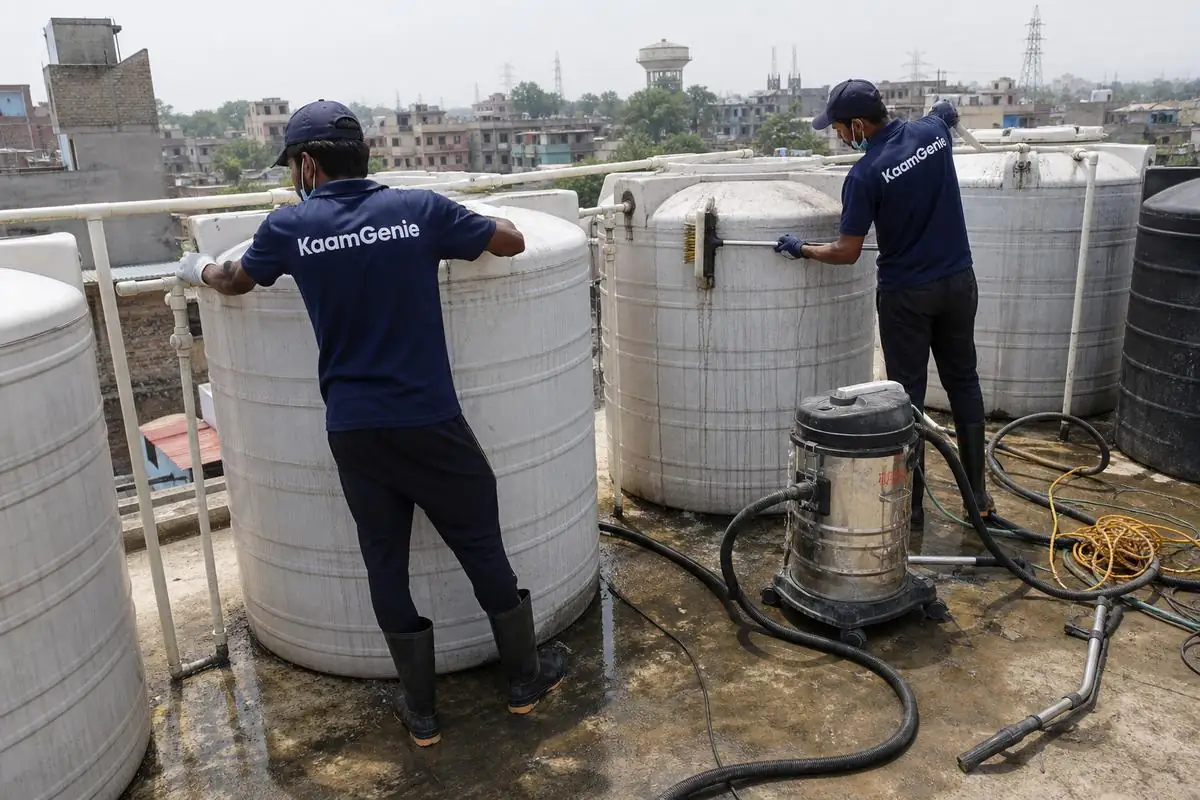
The plant next door treats water for half of Delhi, but what reaches Haiderpur’s own taps is timed supply plus borewell backup — and whatever the source, it all lands in storage. A tank cluster on a village roof undoes good water fast: the timed fill stirs the old sediment, the borewell share adds hardness, the Badli-edge dust films the northern lanes’ lids, and old tanks plumbed to new ones trade contamination through shared lines. Treatment quality at the source cannot survive a fouled vessel at the destination.
Haiderpur’s water-awareness is an asset we lean into rather than talk around. Our crews explain what the sediment is, why the disinfectant is hygienic and what the quality report attests — and committee lanes here often send a member to watch the first clean, which we welcome. The committee model fits the village fabric: one lane, one day, every roof cluster reset together at a pooled rate, with the northern lanes nearest the industrial edge advised onto a shorter cycle than the plant-side lanes.
No travel charge anywhere in Haiderpur. The final price is confirmed on the call before we come — it depends only on tank size and access.
See it done in 45 seconds
Watch our web story on how a tank is really cleaned — drain, de-sludge, jet-wash, disinfect.
We reach every pocket of Haiderpur — and there’s no travel charge to any of them:
Every locality in Delhi stores different water, and that decides how fast a tank fouls. This is Haiderpur’s profile from The Delhi Water Index, built from our field observations across 250+ localities.
Indicative field characterisation, not a certified lab test. BIS IS 10500: TDS 500 mg/L acceptable, 2,000 permissible. Check any Delhi area →
“We live next to the treatment plant — why would our tanks be dirty?” Because the plant treats water for the city grid, not for Haiderpur’s own timed-and-borewell supply — and even perfectly treated water fouls in a dirty vessel. Sediment, hardness scale and biofilm build in the tank itself, after the source. Cleaning the storage is the one link in the chain that is entirely in the village’s hands.
“How does a committee lane booking work in Haiderpur?” A committee member fixes a date and gives us the lane’s rough roof count. The crew works roof to roof, treating each cluster of tanks as one system — drain, scrub, jet, anti-bacterial disinfection — with photos per household and a pooled rate that beats any solo booking against the standard ₹1,500 per tank. Committee members are welcome to observe the work.
“What exactly does your quality report attest?” It records the date, the address, each vessel cleaned, the process completed — drain, sediment removal, jet wash, hand scrub, anti-bacterial disinfection — and is backed by the before-and-after photo record. Haiderpur customers tend to read it properly, which we like: it is a maintenance document, not a sticker.
“Our lane is on the Badli side and the dust is constant — how often should we clean?” The northern lanes catching the industrial edge’s fallout do best on a quarterly cycle, while the plant-side and interior lanes hold well at twice a year. We also check lid fit on every visit — on the dusty lanes, a sealed lid buys more time between cleans than anything else.
“Can you come the same day if our water suddenly changes?” Call 95603 66362 before 10 AM and we aim for same-day service in Haiderpur. A sudden change in taste or colour deserves a fast look — we drain, inspect and photograph before cleaning, so you see whether the problem was the tank, and the clean-and-disinfect resets it either way.
See our complete water tank cleaning services in Delhi NCR — pricing, process, tank types and full city coverage.
Beyond water tank cleaning, KaamGenie is rolling out a full lineup of home services across Delhi NCR — see our complete list of 12 home services we offer or will be launching through 2026. New to tank cleaning? Read our guide on how to pick the right water tank cleaning service in Delhi — what to look for, what to avoid, and the questions that separate trustworthy crews from quick-job operators.
Rooftop plastic tanks
₹699+ →Kothi sumps & underground tanks
₹1,499+ →Apartments & RWAs
Bulk pricing →FSSAI-compliant cleaning
₹2,500+ →टंकी साफ़ करने वाले
हिन्दी पढ़ें →View all water tank cleaning guides →
All pockets and lanes of Haiderpur covered. If your specific block or society isn’t named in the sub-areas above, just call — we almost certainly cover it.
Same crew, same 6-step process, same-day where possible. Pick any locality below for local pricing and the tanks we typically find there.
Book a slot — we can usually fit you in today or tomorrow.