
Which Chemicals Are Used for Tank Cleaning?
Raj Babbar · 11 min read
Home › Water Tank Cleaning › Society / RWA Tank Cleaning › Sultanpuri
Block-committee tank cleaning in Sultanpuri’s lettered blocks — pooled service days that cover a whole row’s shared tanks and ground drums in one round, with photos every household can see. From ₹1,500 per tank, pooled rates for blocks.
Sultanpuri is one of Delhi’s large 1970s resettlement colonies, laid out in lettered blocks of compact row housing with a dense market spine and small workshops through it — and entirely distinct from Sultanpur village down on South Delhi’s MG Road, a confusion worth clearing at booking time. Water here is timed DJB supply that arrives pressure-poor at the block tails, so booster motors and ground drums are universal, and the low roofs carry small shared tanks that several households draw on at once.
KaamGenie serves Sultanpuri the way its blocks are organised — through the block pradhan or committee. A pooled service day covers a row’s shared tanks and ground drums door to door, each household getting before-and-after photos of its own vessels, and the pooled rate keeps the per-home cost genuinely small. Market-spine buildings running one tank over shop and home book the whole structure in one visit. Individual households can book via water tank cleaning in Sultanpuri; this page is for committees and grouped rows.
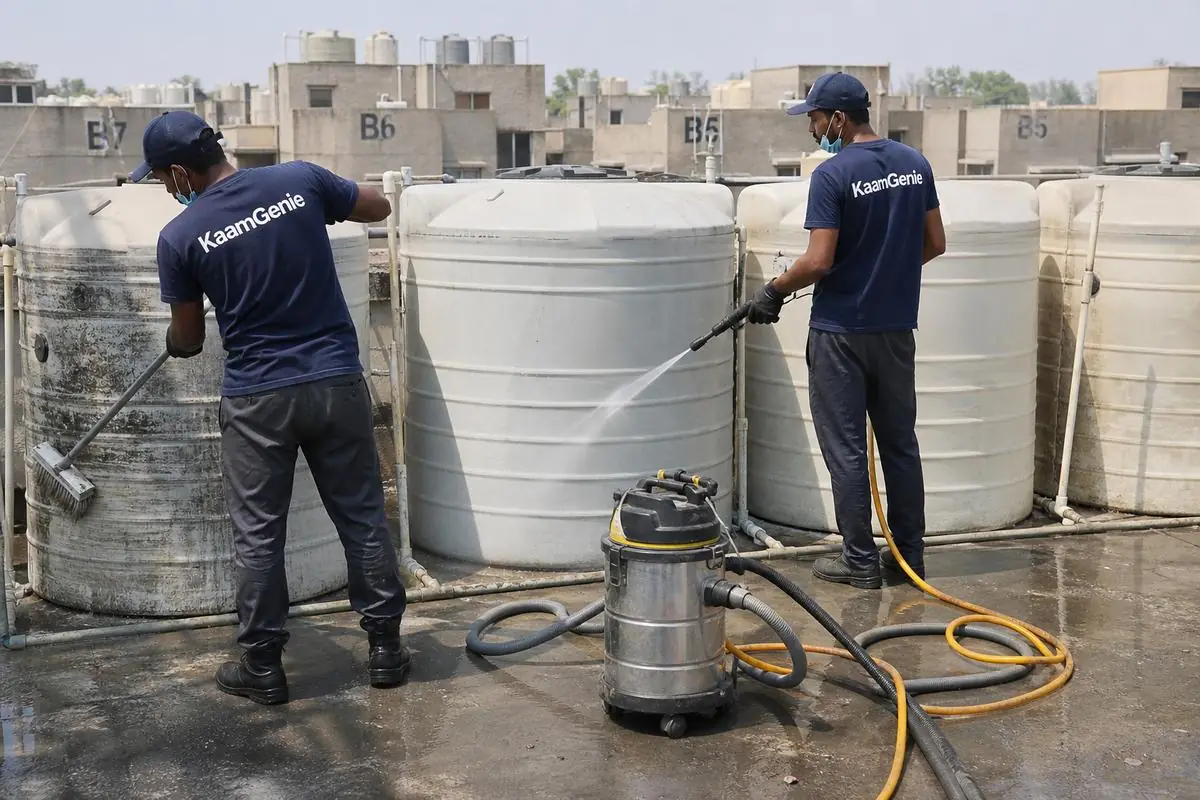
A small tank under constant shared draw is the fastest-silting setup in Delhi. Sultanpuri’s timed supply means every fill window sends the booster motors racing, and boosted flow churns whatever sits in the line and the drum straight into the tank; with several households drawing all day, the sediment never gets still water to settle out of. In a 500-litre shared tank, the same silt load that a big tank would dilute becomes a visible floor layer within a season — and at the pressure-poor block tails, where drums stand longer between fills, it is worse still.
Because the tanks are shared, cleaning them one household at a time never sticks — the block-level round is what works. A committee fixes the day, we clean the row’s tanks and drums in sequence, and the shared photo record settles the perennial question of whose turn it was to care. Rows nearest the workshops and the market spine should book quarterly; quieter residential rows hold well at twice a year. Either way, the pooled economics mean a block round costs each household less than one family’s solo booking.
No travel charge anywhere in Sultanpuri. The final price is confirmed on the call before we come — it depends only on tank size and access.
See it done in 45 seconds
Watch our web story on how a tank is really cleaned — drain, de-sludge, jet-wash, disinfect.
We reach every pocket of Sultanpuri — and there’s no travel charge to any of them:
Every locality in Delhi stores different water, and that decides how fast a tank fouls. This is Sultanpuri’s profile from The Delhi Water Index, built from our field observations across 250+ localities.
Indicative field characterisation, not a certified lab test. BIS IS 10500: TDS 500 mg/L acceptable, 2,000 permissible. Check any Delhi area →
“How does a block pooled booking work in Sultanpuri?” The block pradhan or a committee member collects the row’s households onto one date and gives us the approximate count. Our crew works the row in sequence — shared roof tanks and ground drums both — with each household receiving before-and-after photos of its own vessels. Pooled rows pay a per-home rate well under the standard ₹1,500-per-tank solo pricing.
“Is this the Sultanpuri near Mangolpuri or Sultanpur on MG Road?” This page is for Sultanpuri, the north-west Delhi resettlement colony in lettered blocks beside Mangolpuri and Kirari. Sultanpur village near the Qutub-MG Road corridor in South Delhi is a different place with its own service page. Mention your block letter when you call and there is no confusion.
“Do you clean the ground drums as well as the roof tanks?” Yes, always — in Sultanpuri the drum is half the storage chain. Timed supply lands in the drum first, the booster lifts it to the roof tank, and a silted drum re-dirties a clean tank on the next fill window. We clean both in the same visit so the chain is actually reset.
“Our block is at the tail of the line — does poor pressure affect cleaning?” It affects the schedule, not the quality. Tail-of-line blocks get the least water in each window, so we time the clean between fill windows when tanks are lowest, wasting almost nothing, and we finish before the next window so the row does not miss a fill. The crew brings its own pressure equipment, so weak line pressure never limits the wash.
“Can you come the same day if our shared tank smells foul?” Call 95603 66362 before 10 AM and we will aim to reach Sultanpuri the same day. A foul shared tank touches every family drawing on it, so we treat it as priority: drain, full scrub, anti-bacterial disinfection, and photos the committee can circulate the same evening.
See our complete water tank cleaning services in Delhi NCR — pricing, process, tank types and full city coverage.
Beyond water tank cleaning, KaamGenie is rolling out a full lineup of home services across Delhi NCR — see our complete list of 12 home services we offer or will be launching through 2026. New to tank cleaning? Read our guide on how to pick the right water tank cleaning service in Delhi — what to look for, what to avoid, and the questions that separate trustworthy crews from quick-job operators.
Rooftop plastic tanks
₹699+ →Kothi sumps & underground tanks
₹1,499+ →Apartments & RWAs
Bulk pricing →FSSAI-compliant cleaning
₹2,500+ →टंकी साफ़ करने वाले
हिन्दी पढ़ें →View all water tank cleaning guides →
All pockets and lanes of Sultanpuri covered. If your specific block or society isn’t named in the sub-areas above, just call — we almost certainly cover it.
Same crew, same 6-step process, same-day where possible. Pick any locality below for local pricing and the tanks we typically find there.
Book a slot — we can usually fit you in today or tomorrow.