
Water Tank Cleaning Methods Explained
Raj Babbar · 10 min read
Home › Water Tank Cleaning › Underground Sump Cleaning › Civil Lines
Civil Lines has some of the largest buried sumps in North Delhi: heritage bungalows, government kothis and institutional blocks that store the day’s water underground before lifting it to the roof. Those big, slow-turning reservoirs settle the most sediment of any tank on the plot. Confined-space trained crews, hygienic finish. From ₹1,499.
Civil Lines grew up as the old British administrative quarter, and its low-density plots still carry sprawling bungalows and government kothis built around generous water storage. Almost every one draws stable DJB piped supply into a big underground sump, then pumps it up to a rooftop overhead tank. The sheer capacity that suits these houses works against the water: it turns over slowly, so sediment has all the time it needs to settle to the sump floor and organic film to coat the walls. Many of the sumps here are old masonry rather than modern RCC, and hairline cracks let ground grit and a little seepage work in between fills. All of that collects below ground, out of sight, in the vessel nobody opens. The rooftop tank gets the occasional glance; the buried sump under a heritage plot can sit closed for a decade. An annual mechanical clean is what keeps these large, slow reservoirs from souring the supply.
Our crews clean these big Civil Lines sumps in full sequence. We open and ventilate the chamber, test the air, pump the standing water out, scoop the settled silt, wet-vacuum the residual sludge, then jet-wash the caked mud and biofilm off the walls before an anti-bacterial disinfectant wash and a clean rinse. Before and after photos go on record for the estate or the household. Because a large buried reservoir holds stale, low-oxygen air, every entry follows confined-space protocol with air-testing and a top-side spotter. To pair the rooftop tank into the same visit, see our water tank cleaning in Civil Lines. Here, the focus is squarely on the underground sump.
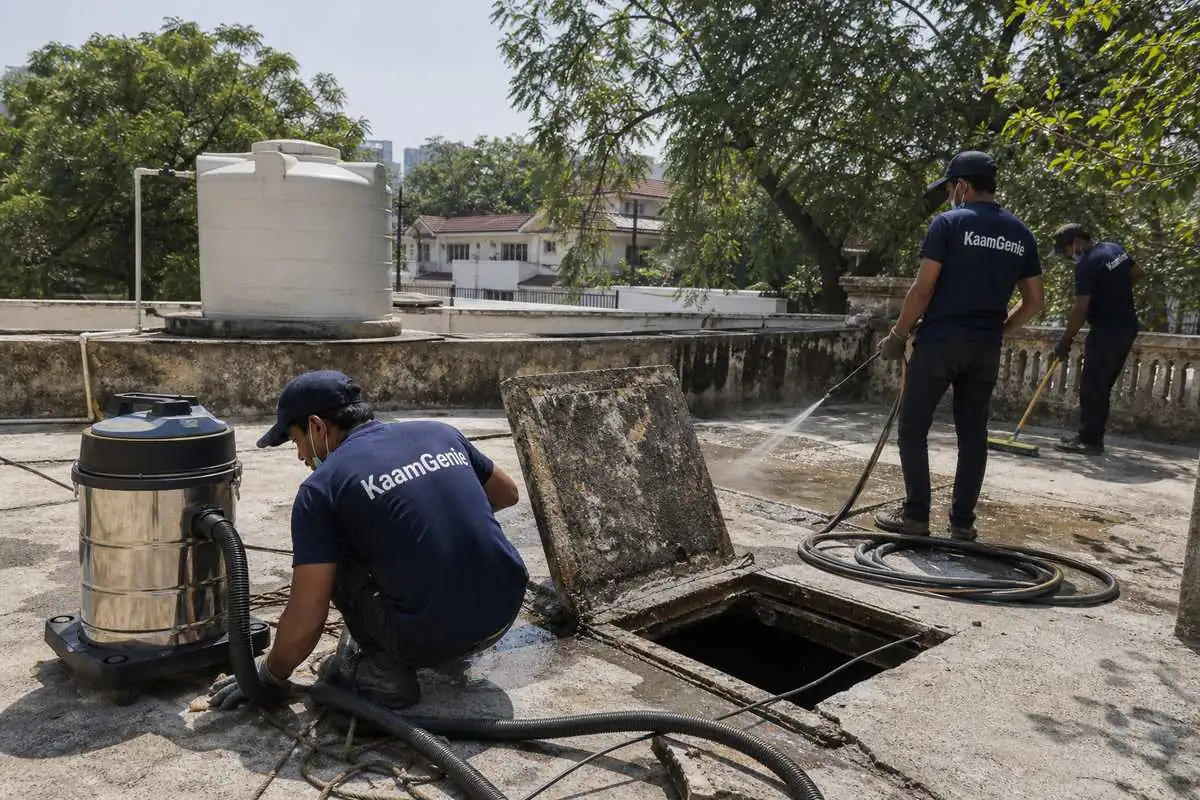
Capacity is the whole story. A sump sized for a large bungalow or an institutional block holds far more than it turns over in a day, so water stands long enough for even fine sediment to drop and settle. Being the first stop for every fill, it collects the grit before the pumps send cleaner water to the roof. On the older masonry sumps common here, cracks in the plaster quietly add ground grit and seepage to that load.
The size that makes these sumps efficient also makes them dangerous to enter casually. A deep, closed reservoir over a sludge bed holds stale air, so we ventilate and air-test every time before a trained crew member goes in. We also read the walls and floor for the cracks and damp patches common in Civil Lines’ heritage-era construction, and flag anything structural for the estate to note.
No travel charge anywhere in Civil Lines. The final price is confirmed on the call before we come — it depends only on tank size and access.
See it done in 45 seconds
Watch our web story on how a tank is really cleaned — drain, de-sludge, jet-wash, disinfect.
We reach every pocket of Civil Lines — and there’s no travel charge to any of them:
Every locality in Delhi stores different water, and that decides how fast a tank fouls. This is Civil Lines’s profile from The Delhi Water Index, built from our field observations across 250+ localities.
Indicative field characterisation, not a certified lab test. BIS IS 10500: TDS 500 mg/L acceptable, 2,000 permissible. Check any Delhi area →
“The estate has a large old masonry sump. Do you handle reservoirs that size?” Yes, the big buried reservoirs are routine for us in Civil Lines. We bring higher-capacity pumps for the volume and treat the chamber as confined space: ventilate, air-test, then a trained crew member enters to scoop and vacuum the bed while a spotter stays up top. On old masonry we also check for cracks and seepage and report what we find.
“What will a large Civil Lines sump cost to clean?” Capacity sets the price. Smaller sumps start at ₹1,499, mid-size ones run ₹1,799–2,200, and the large heritage or institutional reservoirs are ₹2,500–3,500 once we measure them. For estates with several tanks we quote the set together and apply a bulk rate rather than charging each in isolation.
“The piped water here looks clear. Is a sump clean really needed?” Clear water at the tap does not mean a clean sump. The sediment sits at the bottom of the buried tank, undisturbed, until a heavy draw or a refill stirs it up into the supply. Because these Civil Lines sumps turn over slowly, that bed builds steadily even on good DJB water, which is why an annual clean matters here specifically.
“Can you work around a government or institutional building’s schedule?” Yes. We book a fixed slot and can work early or off-peak so supply to offices or quarters is barely interrupted. For a property with more than one sump we sequence them so at least one tank stays in service while another is cleaned, and we leave the site tidy with photos logged for records.
“How long is the water off during the clean?” For a single large sump, expect the supply drawn from it to be down for the few hours we are pumping, cleaning and refilling. We time the visit so the rooftop tank still holds a buffer for the household during that window, and we refill and restart the pump before we leave.
See our complete water tank cleaning services in Delhi NCR — pricing, process, tank types and full city coverage.
Beyond water tank cleaning, KaamGenie is rolling out a full lineup of home services across Delhi NCR — see our complete list of 12 home services we offer or will be launching through 2026. New to tank cleaning? Read our guide on how to pick the right water tank cleaning service in Delhi — what to look for, what to avoid, and the questions that separate trustworthy crews from quick-job operators.
Rooftop plastic tanks
₹699+ →Kothi sumps & underground tanks
₹1,499+ →Apartments & RWAs
Bulk pricing →FSSAI-compliant cleaning
₹2,500+ →टंकी साफ़ करने वाले
हिन्दी पढ़ें →View all water tank cleaning guides →
All pockets and lanes of Civil Lines covered. If your specific block or society isn’t named in the sub-areas above, just call — we almost certainly cover it.
Same crew, same 6-step process, same-day where possible. Pick any locality below for local pricing and the tanks we typically find there.
Book a slot — we can usually fit you in today or tomorrow.