
Waterborne Diseases & Tank Cleaning
Raj Babbar · 10 min read
Home › Water Tank Cleaning › Underground Sump Cleaning › Gulabi Bagh
The complaint we hear in Gulabi Bagh is cloudy water on a busy floor, and the cause is usually the buried sump under the plot, worked hard by several families and left closed for years. Clearing it settles the supply. Confined-space trained crews, hygienic finish. From ₹1,499.
Gulabi Bagh is a dense middle-class colony of independent houses and stacked builder floors on largely DJB piped water. On these tightly built plots the supply is usually drawn into a below-ground or ground-level sump before a pump lifts it to the rooftop tank, and multi-family occupancy means that sump is used hard through the day. Being the first fill point, it takes the grit and sediment before cleaner water goes up, and the constant draws keep stirring the settled bed. Rust from older pipes and a slow algae film add to what collects on the floor and walls. Because the sump sits out of sight while attention goes to the visible rooftop tank, it stays forgotten between fills. The sediment builds quietly until the water turns cloudy, and by then the bed is thick. Residents only notice at the tap, which is precisely when a mechanical clean of the sump is already overdue.
We clean these Gulabi Bagh sumps completely. The chamber is opened and ventilated, the air tested, then we pump out the water, scoop the settled silt, wet-vacuum the fine sludge, and jet the caked mud, rust and biofilm off floor and walls before an anti-bacterial disinfectant wash and rinse. Before and after photos go on record so the change is visible. A sealed sump holds stale air over its sludge, so every entry is confined-space work with air-testing and a spotter. To add the rooftop tank in the same visit, see our water tank cleaning in Gulabi Bagh. This page is about the underground sump.
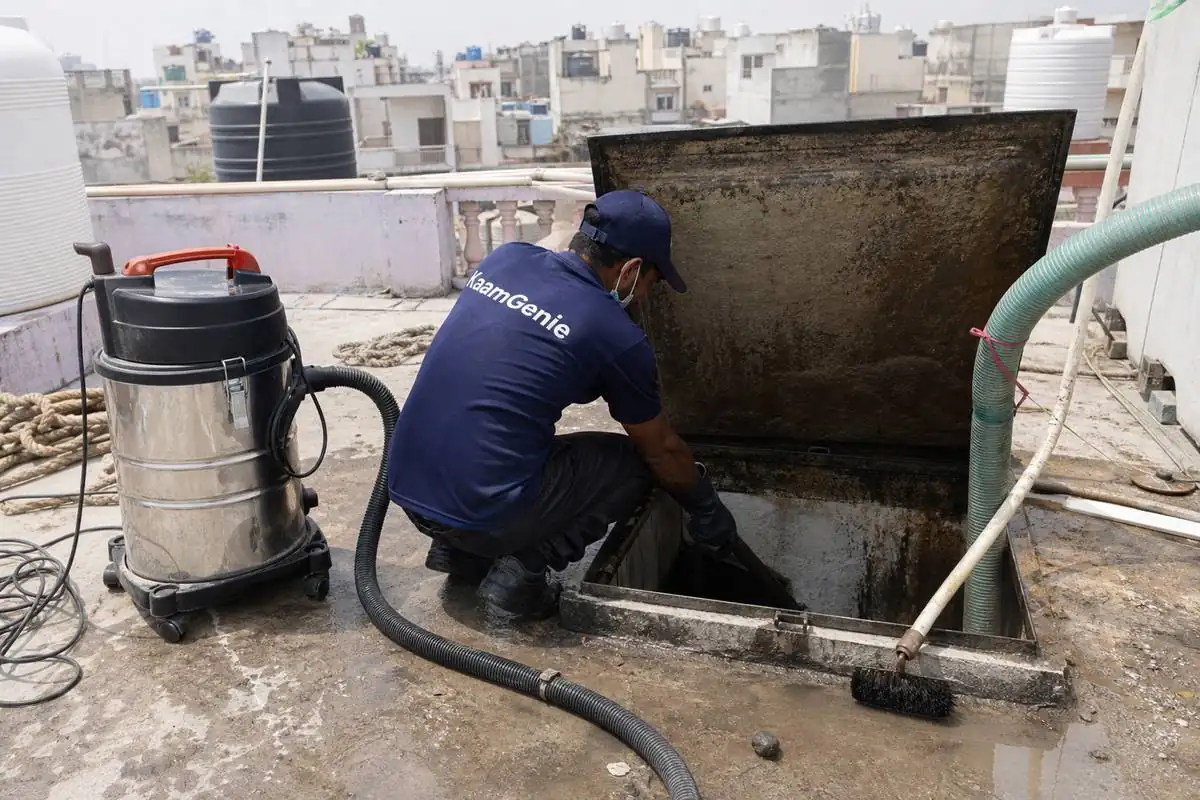
Multi-family use keeps the sump churning. Several households drawing off one buried tank means many refills a day, and each one stirs the settled sediment back into the water instead of letting it clear. The sump takes the first fill and its grit, older pipes shed rust into it, and a slow algae film forms on the standing water. All of that shows up at the tap as cloudiness once the bed is thick enough.
A hard-worked, sealed sump under a crowded plot holds stale, low-oxygen air over its sludge, so entering it casually is a real risk. We ventilate and air-test before anyone goes in, keep a spotter up top, and check the walls for cracks and seepage common on these older dense plots. Clearing it properly, at the source, is what actually stops the cloudy water returning.
No travel charge anywhere in Gulabi Bagh. The final price is confirmed on the call before we come — it depends only on tank size and access.
See it done in 45 seconds
Watch our web story on how a tank is really cleaned — drain, de-sludge, jet-wash, disinfect.
We reach every pocket of Gulabi Bagh — and there’s no travel charge to any of them:
Every locality in Delhi stores different water, and that decides how fast a tank fouls. This is Gulabi Bagh’s profile from The Delhi Water Index, built from our field observations across 250+ localities.
Indicative field characterisation, not a certified lab test. BIS IS 10500: TDS 500 mg/L acceptable, 2,000 permissible. Check any Delhi area →
“Our water goes cloudy by evening on a busy day. Is the sump behind it?” Very likely. On a plot where several families draw off one sump, heavy evening use stirs the settled sediment bed back into the supply, which shows as cloudiness. Clearing the sump removes that bed at the source, so the churn no longer has silt to lift. If it clouds again quickly, we will point to whether the rooftop tank needs doing too.
“Several families share the building. How is the cost handled?” One sump feeds the whole plot, so a single clean serves every household drawing off it. We give one invoice for the job, and the families can split it between themselves however they arrange. It works out far cheaper per home than each trying to sort their own supply.
“What does a shared-plot sump cost to clean in Gulabi Bagh?” By capacity: a small sump up to 1,000 litres starts at ₹1,499, a typical 1,001–2,000 litre one runs ₹1,799–2,200, and a larger reservoir under a bigger building is ₹2,500–3,500. Sump plus rooftop tank together is ₹2,000–2,800.
“Will you clean the rooftop tank too, since the water still passes through it?” We can, and on a cloudy-water complaint it is usually worth doing both. Silt lifted from the sump earlier can still sit in the overhead tank, so cleaning only one leaves the other feeding the problem. Doing the pair in one visit resets the whole supply chain, priced at ₹2,000–2,800 together.
“How soon can you come out?” Usually same-day or next-day. We keep crews working across Gulabi Bagh, Shakti Nagar and Ashok Vihar most days, so a single plot sump is easy to fit in. For a building with more than one buried tank we prefer a booked slot so supply to the floors is barely interrupted.
See our complete water tank cleaning services in Delhi NCR — pricing, process, tank types and full city coverage.
Beyond water tank cleaning, KaamGenie is rolling out a full lineup of home services across Delhi NCR — see our complete list of 12 home services we offer or will be launching through 2026. New to tank cleaning? Read our guide on how to pick the right water tank cleaning service in Delhi — what to look for, what to avoid, and the questions that separate trustworthy crews from quick-job operators.
Rooftop plastic tanks
₹699+ →Kothi sumps & underground tanks
₹1,499+ →Apartments & RWAs
Bulk pricing →FSSAI-compliant cleaning
₹2,500+ →टंकी साफ़ करने वाले
हिन्दी पढ़ें →View all water tank cleaning guides →
All pockets and lanes of Gulabi Bagh covered. If your specific block or society isn’t named in the sub-areas above, just call — we almost certainly cover it.
Same crew, same 6-step process, same-day where possible. Pick any locality below for local pricing and the tanks we typically find there.
Book a slot — we can usually fit you in today or tomorrow.