
Which Chemicals Are Used for Tank Cleaning?
Raj Babbar · 11 min read
Home › Water Tank Cleaning › Underground Sump Cleaning › Maurya Enclave
Maurya Enclave’s large rebuilt homes expect service done properly — uniformed crews, before-after photos, a fixed annual date — and their sump-plus-rooftop systems currently fight one enemy above all: metro-corridor construction dust. From ₹1,499.
In the inner lanes off Madhuban Chowk, Maurya Enclave is the Pitampura belt’s premium address — trading and professional families in large rebuilt homes where lifts, stilt parking and basements are simply standard. Water runs as a system: basement sump, booster, rooftop tanks. And the recurring complaint in these lanes right now is specific — construction dust off the nearby metro corridor, which finds every gap in a sump cover or roof-tank lid and settles into storage as a fine grey film residents can see on the water.
KaamGenie serves the enclave to its own standard: uniformed crew, confined-space procedure on every sump entry — ventilation, air test, attendant at the opening — full pump-down, sediment and dust-film removal, jet wash, anti-bacterial disinfection, and the before-after photo set delivered. Most households here run it as a fixed annual date. The rooftop half of the system pairs through our water tank cleaning in Maurya Enclave page; this one covers the sump below.
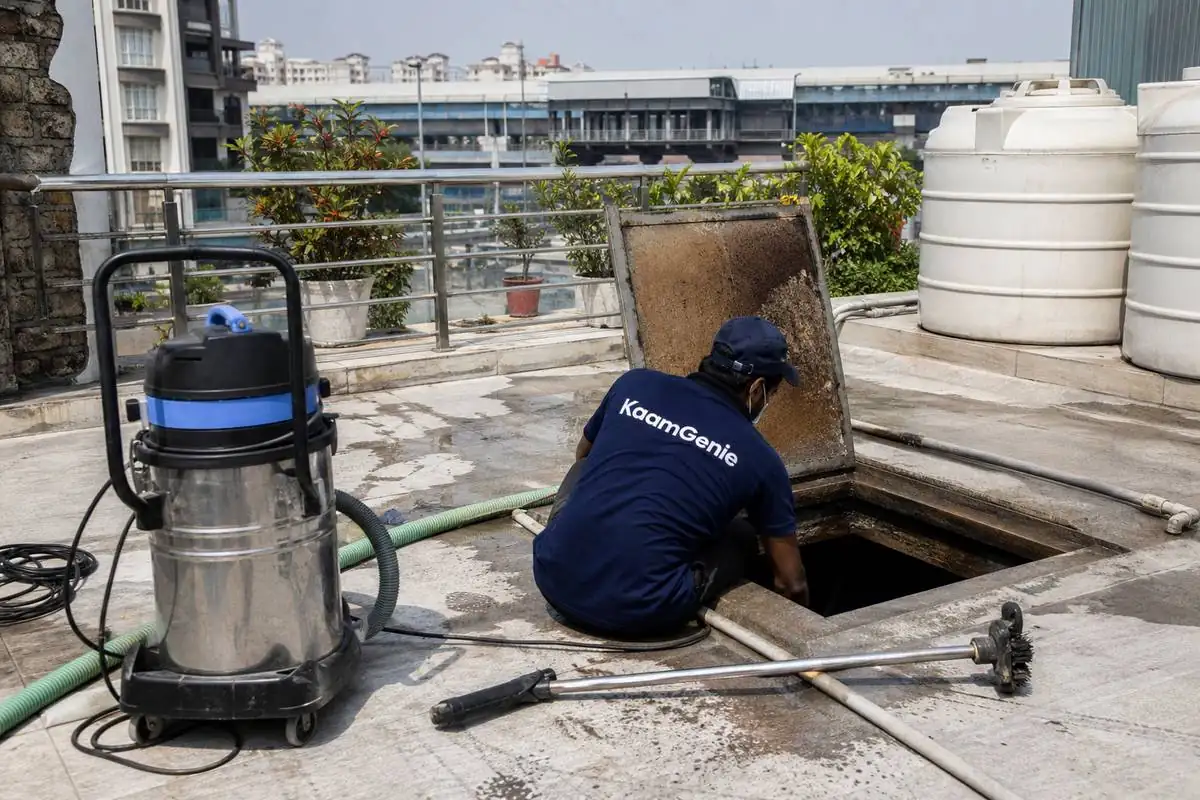
Construction dust is finer than lane dust — it hangs longer, travels further and slips through gaps ordinary dust never finds: the rim of a sump cover, a hairline gap at a roof-tank lid, the sleeve where pipes enter. Once inside, it settles as a soft grey layer that mixes into the normal fine sediment of DJB fills and thickens the bed measurably faster than the colony’s pre-construction norm. Homes closest to the corridor see it most, and will until the work ends.
The honest response is two-part. The clean removes what has settled — sump floor, walls, waterline — and the inspection finds where it is entering: we photograph every gap and sleeve we find so you can have them sealed, which cuts the re-entry rate sharply. For the corridor-side lanes we currently suggest tightening the annual cycle to nine or ten months until construction settles. That is the schedule, the sealing and the evidence — the way this colony expects things done.
No travel charge anywhere in Maurya Enclave. The final price is confirmed on the call before we come — it depends only on tank size and access.
See it done in 45 seconds
Watch our web story on how a tank is really cleaned — drain, de-sludge, jet-wash, disinfect.
We reach every pocket of Maurya Enclave — and there’s no travel charge to any of them:
Every locality in Delhi stores different water, and that decides how fast a tank fouls. This is Maurya Enclave’s profile from The Delhi Water Index, built from our field observations across 250+ localities.
Indicative field characterisation, not a certified lab test. BIS IS 10500: TDS 500 mg/L acceptable, 2,000 permissible. Check any Delhi area →
“There is grey dust on our stored water. Is it the metro work?” Very likely — it is the enclave’s most common complaint right now. Fine construction dust slips past sump covers and lid gaps and settles as the film you are seeing. The clean removes it and the bed it has joined; more usefully, we photograph the entry gaps we find so you can seal them and slow the return sharply.
“What standard of crew and process should we expect?” Uniformed KaamGenie crew, confined-space procedure on every sump entry — ventilation, air test, attendant posted at the opening — Anti-bacterial disinfection to close with the full before-after photo set. It is the standard the colony’s households ask for, and the same crew format returns for your annual date.
“What does the sump clean cost for a large rebuilt home?” Sumps to 1,000 litres from ₹1,499; the enclave’s typical 1,001–2,000 litre sump runs ₹1,799–2,200; larger basements are quoted by capacity before work starts. Pairing the rooftop tanks in the same visit gives the whole system one service date and prices better than two bookings.
“Should we clean more often while the metro construction continues?” For corridor-side lanes, yes — we currently suggest nine to ten months instead of twelve, returning to annual once the heavy work ends. Sealing the entry gaps we photograph makes the bigger difference, though; several sealed homes have held a clean sump through a full year of construction next door.
“Can you fit us in quickly?” Call before 10 AM on 95603 66362 and a same-day visit is usually possible — Maurya Enclave sits at the heart of our Pitampura-belt route. Annual-date customers have their slot held each year, and neighbours often align dates so the crew does adjacent homes in one run.
See our complete water tank cleaning services in Delhi NCR — pricing, process, tank types and full city coverage.
Beyond water tank cleaning, KaamGenie is rolling out a full lineup of home services across Delhi NCR — see our complete list of 12 home services we offer or will be launching through 2026. New to tank cleaning? Read our guide on how to pick the right water tank cleaning service in Delhi — what to look for, what to avoid, and the questions that separate trustworthy crews from quick-job operators.
Rooftop plastic tanks
₹699+ →Kothi sumps & underground tanks
₹1,499+ →Apartments & RWAs
Bulk pricing →FSSAI-compliant cleaning
₹2,500+ →टंकी साफ़ करने वाले
हिन्दी पढ़ें →View all water tank cleaning guides →
All pockets and lanes of Maurya Enclave covered. If your specific block or society isn’t named in the sub-areas above, just call — we almost certainly cover it.
Same crew, same 6-step process, same-day where possible. Pick any locality below for local pricing and the tanks we typically find there.
Book a slot — we can usually fit you in today or tomorrow.