
Water Tank Cleaning Rules & Norms
Raj Babbar · 9 min read
Home › Water Tank Cleaning › Underground Sump Cleaning › Mahavir Enclave
Sump and ground-tank cleaning across Mahavir Enclave Parts 1–3 — where summer tanker top-ups discharge visible silt into the first tank they meet, leaving muddy beds that shared rooftop tanks inherit. Confined-space trained, photo proof. From ₹1,499.
Mahavir Enclave runs dense and vertical — narrow plots, 4-storey walk-ups, ground-floor shops and heavy tenant occupancy across Parts 1, 2 and 3 between Palam and Dwarka Mor. Borewell supply carries the base load, but the belt’s signature is the summer tanker: when the borewells fall behind, DJB tankers top up buildings directly, and tanker water arrives visibly silty. Whatever tank takes that discharge first — a ground-level storage tank, a buried sump, or drums by the gate — collects a muddy base layer that then feeds the shared rooftop tank above.
KaamGenie clears that inheritance chain from the bottom — pump down the ground tank or sump, scoop and wet-vacuum the tanker mud, jet-wash, disinfect to hygienic, and photograph the lot for the landlord’s records. The shared rooftop tanks are handled through our water tank cleaning in Mahavir Enclave — and after a tanker-heavy summer, doing both stages together is the reset most buildings here need.
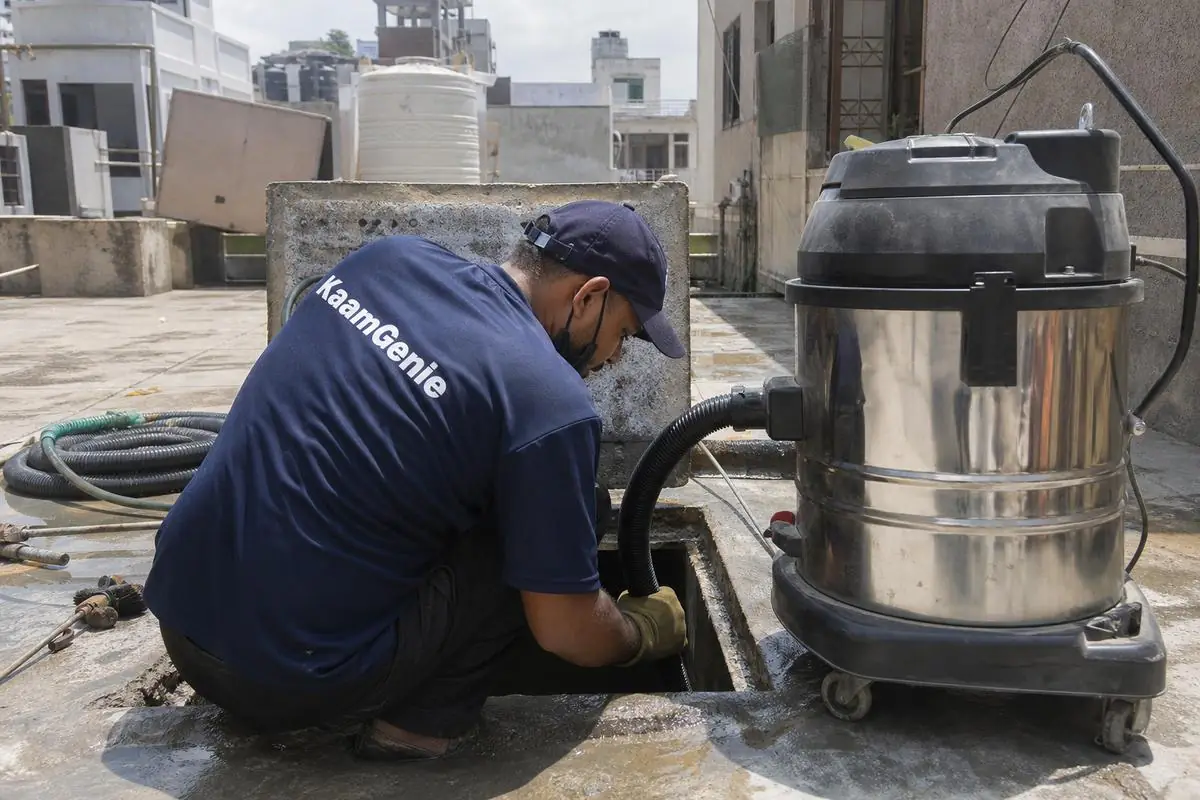
Tanker water is honest about what it carries — you can see the silt swirl as it discharges. A single summer top-up can drop more sediment into a ground tank than months of piped supply, and buildings here may take several top-ups a season. The mud settles into a soft brown bed that every subsequent pump cycle stirs, so the water reaching the shared roof tank stays cloudy long after the tanker has gone. By September, many Mahavir Enclave ground tanks hold a bed you can measure with a finger.
Density does the rest. One ground tank and one roof tank often serve a whole walk-up of tenant households plus a ground-floor shop, so the system cycles all day and sediment never settles out of reach of the pump. Tenants assume the landlord handles the tanks; landlords assume no news is good news. Our post-summer clean — September and October are our busiest Mahavir Enclave months — removes the season’s accumulated mud in one visit, with before-after photos that show exactly what the tankers left behind.
No travel charge anywhere in Mahavir Enclave. The final price is confirmed on the call before we come — it depends only on tank size and access.
See it done in 45 seconds
Watch our web story on how a tank is really cleaned — drain, de-sludge, jet-wash, disinfect.
We reach every pocket of Mahavir Enclave — and there’s no travel charge to any of them:
Every locality in Delhi stores different water, and that decides how fast a tank fouls. This is Mahavir Enclave’s profile from The Delhi Water Index, built from our field observations across 250+ localities.
Indicative field characterisation, not a certified lab test. BIS IS 10500: TDS 500 mg/L acceptable, 2,000 permissible. Check any Delhi area →
“When is the best time to clean after tanker season?” Early autumn — September or October — once the summer top-ups stop. That removes the whole season’s mud in one clean instead of chasing it top-up by top-up. If a mid-season tanker leaves your water visibly muddy, an interim clean of just the ground tank is quick and worth it.
“What does it cost in Mahavir Enclave?” From ₹1,499 for the ground tank or sump up to 1,000 litres; ₹1,799–2,200 up to 2,000 litres. The ground-plus-roof combined visit gets a package rate, which is what we recommend after a tanker-heavy summer since both stages will be carrying mud.
“Can you work in the narrow lanes of Part 2?” Yes — Parts 1 to 3 are regular territory and the lanes are what they are. The crew parks at the nearest wide point and hand-carries pumps and hoses in; buildings deep in the lane grid are no problem, just mention a landmark when booking.
“Do you offer same-day cleans here?” Usually — call before 10 AM and we can typically slot Mahavir Enclave into that day’s Palam–Dwarka Mor run. After a visibly dirty tanker delivery, mention it — we prioritise those because the mud is easiest to remove before it compacts.
“Is tanker water itself unsafe?” DJB tanker water is treated supply, but the delivery process stirs sediment and the tank it lands in adds whatever it already holds. The realistic risk is the muddy bed building in your storage — a habitat for bacteria and a constant source of cloudy taps. Keeping the receiving tank clean and disinfected is the practical defence.
See our complete water tank cleaning services in Delhi NCR — pricing, process, tank types and full city coverage.
Beyond water tank cleaning, KaamGenie is rolling out a full lineup of home services across Delhi NCR — see our complete list of 12 home services we offer or will be launching through 2026. New to tank cleaning? Read our guide on how to pick the right water tank cleaning service in Delhi — what to look for, what to avoid, and the questions that separate trustworthy crews from quick-job operators.
Rooftop plastic tanks
₹699+ →Kothi sumps & underground tanks
₹1,499+ →Apartments & RWAs
Bulk pricing →FSSAI-compliant cleaning
₹2,500+ →टंकी साफ़ करने वाले
हिन्दी पढ़ें →View all water tank cleaning guides →
All pockets and lanes of Mahavir Enclave covered. If your specific block or society isn’t named in the sub-areas above, just call — we almost certainly cover it.
Same crew, same 6-step process, same-day where possible. Pick any locality below for local pricing and the tanks we typically find there.
Book a slot — we can usually fit you in today or tomorrow.