
Key takeaways
- Black sediment is usually manganese, biofilm, degrading material, or dark silt — not one single cause.
- The white-cloth test sorts gritty minerals from slimy biofilm from rubbery washer bits.
- Borewell areas in Delhi often have manganese that oxidises into black particles.
- Biofilm is a hygiene issue — it must be scrubbed off, not just rinsed.
- A full drain-scrub-vacuum clean removes the sludge; overhead tanks from ₹699.
- Clean the sump too — its sediment gets pumped up into the overhead tank.
This guide breaks down what black sediment in a Delhi tank usually is, how to tell the harmless kinds from the ones that signal a failing pipe or contaminated source, and how a proper cleaning clears it. We also cover why it keeps coming back in some buildings, the role of DJB silt and borewell minerals, and when black particles mean you should stop drinking the water and get things checked.
What black sediment usually is
Black particles or dark sludge in a Delhi tank typically come from one of these:
- Manganese — a mineral in borewell and some groundwater-mixed supply that oxidises into fine black grit.
- Biofilm and organic decay — dark slimy build-up on tank walls and floor that breaks loose in flakes.
- Degrading material — bits of an old rubber washer, decaying gasket, or a breaking-down cheap plastic tank liner.
- Settled silt — DJB and monsoon dust that darkens as it sits in the sludge layer.
Manganese and borewell minerals
In parts of Delhi and the NCR fringe that run on borewell or mixed groundwater — Dwarka, Najafgarh, Chattarpur and many unauthorised colonies — manganese is a frequent cause of black sediment. Like iron, it’s dissolved and invisible in fresh groundwater, then oxidises into black or brown-black particles once exposed to air in an open overhead tank. You may see dark staining on fittings and laundry too. A cleaning removes the manganese sludge already settled in the tank, which stops the worst of it, but if the source keeps supplying manganese the particles slowly rebuild. Get the water tested; persistent cases need a filter or oxidation treatment at the source alongside regular tank cleaning.
Biofilm and organic sludge
The dark, soft layer coating the walls and floor of a neglected tank is biofilm — a mix of bacteria, dust and organic matter that thickens over months. When a hard DJB refill hits, chunks break loose and appear as black slimy flakes at your taps. Delhi’s heat speeds biofilm growth, and any light leaking through a translucent lid encourages it further. Unlike mineral grit, biofilm is a hygiene issue — it can harbour bacteria and cause smells too. The fix is a proper tank cleaning that scrubs the walls and floor rather than just rinsing, so the film is physically removed and disinfected, not left to regrow.
Book your water tank cleaning
Trained crew, food-grade process, before/after photos and a service record every job. ₹699 onwards, same-day where possible across Delhi NCR.
Rust, washers and degrading material
Sometimes the black bits are pieces of your own plumbing breaking down. A perished rubber washer or gasket in a valve sheds soft black fragments. An old, cheap plastic tank left in Delhi’s sun for years can degrade internally and flake. Corroding metal fittings shed dark rust that mixes into the sludge. These are usually easy to spot on white cloth — rubbery or flaky rather than gritty. Cleaning removes what has already collected, but the shedding continues until the failing part is replaced. During a tank clean it’s worth having the inlet, float valve, washers and lid checked, and swapping anything perished so the black flakes don’t simply return.
How a proper cleaning clears it
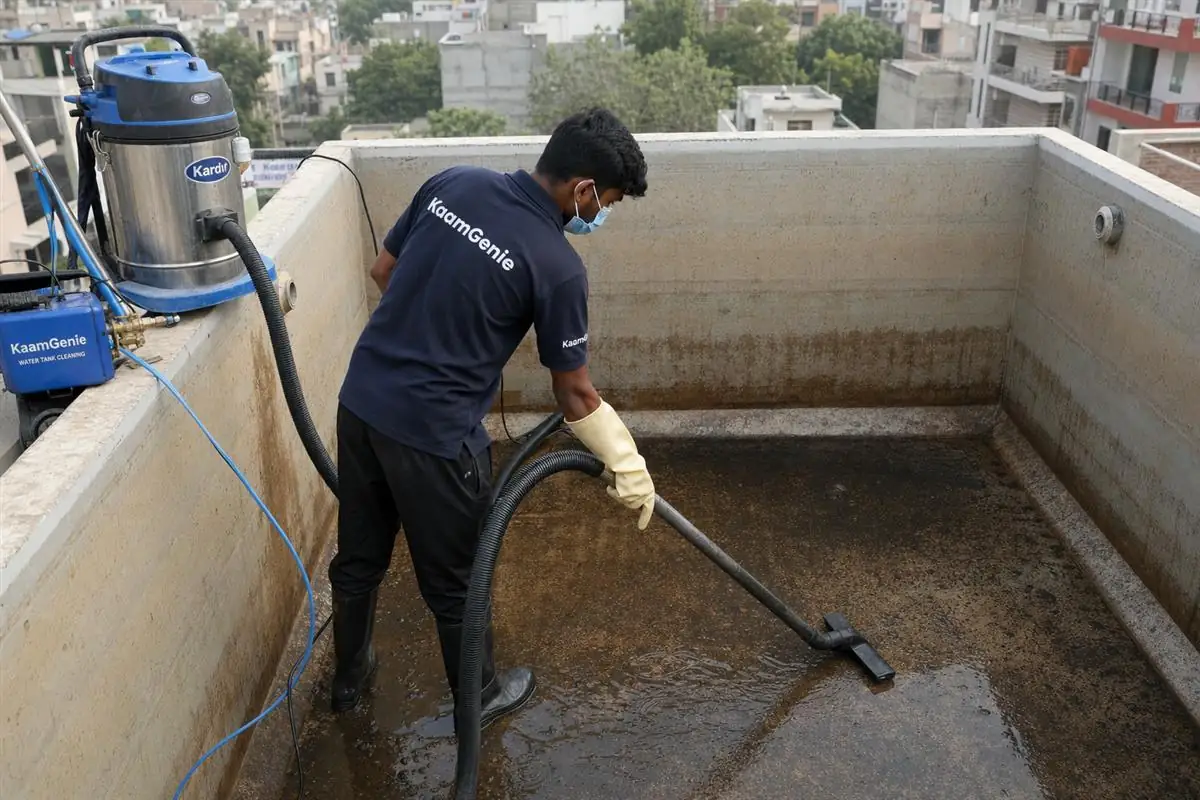
For silt, manganese sludge and biofilm, a full cleaning is the direct fix. The crew drains the tank, scrubs every surface, vacuums out the black sludge layer, disinfects and refills — taking out exactly the material that’s reaching your taps. A rinse alone won’t do it; the settled layer has to be physically removed. KaamGenie overhead tank cleaning starts from ₹699 and underground sumps run ₹1,500–2,500 by size and access; societies and commercial buildings are quoted after a site check. Clean the sump too if you have one — black sediment there gets pumped straight up into the overhead tank, so cleaning only one leaves the problem half-solved.
When to stop drinking and call
Black sediment is often just minerals or silt, but treat these as reasons to stop drinking and get it checked:
- Black flakes with a musty or sewage smell — possible contamination.
- Slimy black biofilm with cloudiness — a hygiene risk.
- Particles that keep returning within weeks of a clean — an ongoing source, washer or liner problem.
Frequently asked questions
Is black sediment in tank water harmful?
It depends what it is. Manganese and silt grit are mostly an aesthetic and taste nuisance, though heavy manganese is best filtered out. Slimy black biofilm is a hygiene concern because it can harbour bacteria, and black flakes with a bad smell may signal contamination. When in doubt, stop drinking the water and get the tank cleaned and the water tested.
What causes black particles in Delhi tank water?
The usual causes are manganese from borewell or mixed supply oxidising into black grit, biofilm and organic sludge breaking loose from neglected tank walls, dark silt settled at the tank floor, or fragments from a perished rubber washer or degrading plastic tank. A white-cloth test — gritty, slimy or rubbery — helps you tell which one you have.
Will cleaning the tank remove black sediment?
A full clean that drains, scrubs and vacuums the sludge removes the black material already in the tank and usually clears the problem. If the source keeps supplying manganese, or a failing washer or tank liner keeps shedding, the particles return — so treat the source or replace the failing part alongside the cleaning for a lasting result.
Why does black sediment keep coming back?
Recurring black sediment means an ongoing source. Borewell manganese rebuilds if untreated, biofilm regrows if the tank was only rinsed not scrubbed, and a perished washer or degrading plastic tank keeps shedding flakes. Clean thoroughly, clean the sump too so it can’t re-supply the overhead tank, and fix the underlying source or part.
How much does it cost to clear black sediment in Delhi?
A full overhead tank clean with KaamGenie starts from ₹699 and underground sumps run ₹1,500–2,500 by size and access. If manganese treatment or a part replacement is needed, that’s quoted separately after inspection. An AMC gives 15–25% off scheduled cleans. Call 95603 66362 to book an inspection and diagnosis.
Can black sediment damage my RO filter, geyser or washing machine?
Yes. Black particles clog RO pre-filters faster, settle in geysers and block washing-machine inlet valves, shortening their life and raising repair bills. It is cheaper to remove the source by cleaning the tank than to keep replacing cartridges and parts. Once the tank runs clear, your appliances and filters last noticeably longer between services.
Should I be worried if the black bits feel slimy rather than gritty?
Slimy black material is usually biofilm — a bacterial layer — rather than harmless mineral grit, and it is the more concerning of the two. It clings to tank walls and returns quickly if only rinsed. This needs a proper scrub and disinfection, not just draining. If your sediment smells or feels slippery, book a full clean rather than waiting.
Will flushing my taps clear the black sediment or do I need the tank cleaned?
Flushing taps only clears what is already in the pipes; it does nothing about the sediment still settling on the tank floor, so it comes back within days. The lasting fix is draining the tank, scrubbing the base and walls, and disinfecting. After that, a quick tap flush clears any leftover particles from the lines and the water stays clean.
Is black sediment worse from borewell water than from DJB supply?
Often, yes. Borewell water in parts of Delhi carries more manganese and minerals that oxidise into black grit, so borewell-fed tanks tend to build sediment faster. If you are on borewell, expect to clean a little more often. We can advise a realistic schedule for your supply during the visit so the black sediment does not keep returning.
Do I need to replace the tank if black sediment keeps coming back?
Usually not. Recurring black sediment is nearly always about the water source or an overdue cleaning schedule, not the tank itself. Replacement is only worth considering if the tank’s inner surface is badly degraded or the material is flaking. We inspect during cleaning and tell you honestly if the tank is fine to keep — which it almost always is.
Sources & references
- Bureau of Indian Standards (BIS) — IS 10500:2012 is the canonical Indian Standard for drinking water specification, defining acceptable limits for physical, chemical and biological parameters.
- WHO Guidelines for Drinking-water Quality, 4th edition — the global reference for water quality standards, including guidance on safe storage and disinfection.
- Food Safety and Standards Authority of India (FSSAI) — defines water quality requirements for food businesses, including hygiene standards for stored water and acceptable disinfection chemicals.
- WHO Fact Sheet on Drinking Water — overview of safe drinking water requirements and contamination risks.
- CPHEEO — Manual on Water Supply and Treatment — the Government of India’s engineering manual covering tank design, cleaning protocols and disinfection practices.
Last verified: 6 July 2026. If you find any of these links broken, please let us know.