
Key takeaways
- Much of Delhi’s “low pressure” is caused by sediment burying the tank outlet, not a bad pump.
- Silt comes from muddy DJB supply, sandy borewell water and years of settled grit—worst in the monsoon.
- Weak flow at every tap plus occasional grit points to a tank problem; one weak tap does not.
- De-silting physically removes packed sludge and often restores pressure the same day.
- Underground sumps are the biggest hidden sediment trap and the first place to check.
- Inlet filters and six-monthly cleaning keep flow strong; an AMC automates it at 15–25% off.
We explain where all that silt comes from—monsoon-muddied DJB supply, sandy borewell water, and years of settled grit—and how it slowly buries your tank outlet and clogs the pipe feeding your home. You will learn the simple checks that separate a tank problem from a genuine pump or pipe fault, why cleaning often restores pressure instantly, and what a full de-silting costs. No unnecessary plumbing bills, just the real cause.
How sediment quietly kills your water pressure
Every tank collects sediment—fine sand, silt, rust flakes and organic sludge—that settles to the bottom over months and years. The problem is that the outlet pipe feeding your home usually sits a few centimetres above the tank floor to avoid drawing muck. As the sludge layer builds, it creeps up toward that outlet, narrowing the effective opening and letting fine grit get sucked into your pipes and fittings. The result is gradually weakening flow that you barely notice month to month until, one day, the taps are only trickling. Because the decline is slow and the cause is hidden inside a closed tank, most Delhi households instinctively blame the pump, the plumbing, or erratic municipal supply—and spend money on all three—when the real bottleneck is a thick bed of silt sitting inside their own tank the whole time.
Where all that silt comes from in Delhi
Delhi water carries an unusually high sediment load, from two main sources.
- DJB municipal supply often runs muddy after rain or pipeline repairs, and Delhi’s ageing mains shed rust and grit straight into your tank whenever pressure fluctuates.
- Borewell water, common wherever DJB supply is patchy or absent, pulls up fine sand and dissolved minerals that settle out as a heavy, packed bottom layer.
Is it the tank, the pump, or the pipes?
Run these quick checks before spending on plumbing. If pressure is weak at every tap in the house and drops further as the tank empties toward the silted floor, sediment near the outlet is the likely cause. If only one tap is weak, it is a local aerator or pipe issue, not the tank—unscrew the aerator and check for trapped grit. If you see grit, sand or cloudy water when you first open a tap in the morning, that is sediment being pulled straight through your system. If the pump runs hard but delivers little water, check whether its intake is buried in sump sludge. When flow is poor across the whole home and the water sometimes carries fine sand, clean the tank first—it is by far the cheapest possibility to rule out, and it fixes the problem more often than people expect.
Book your water tank cleaning
Trained crew, food-grade process, before/after photos and a service record every job. ₹699 onwards, same-day where possible across Delhi NCR.
Why a proper de-silting restores flow fast
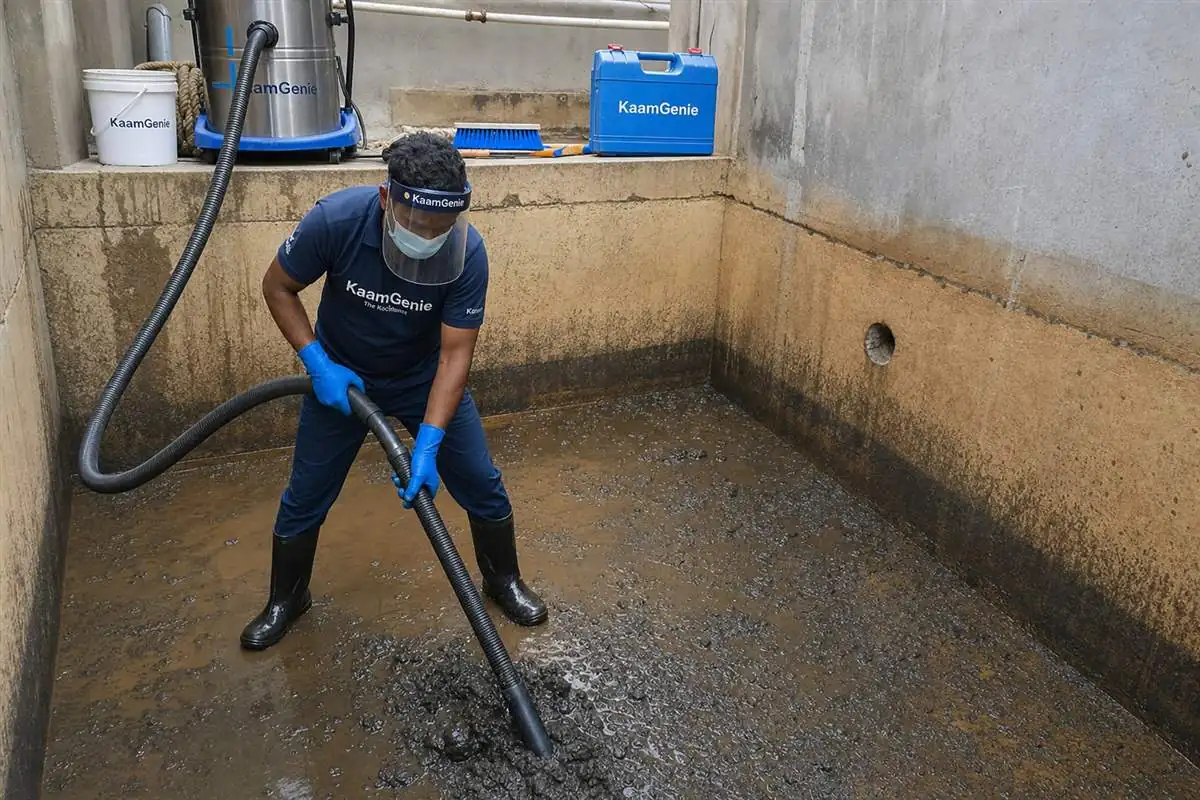
Clearing sediment often restores pressure the same day, because you are literally unblocking the outlet the water flows through. A surface rinse will not do it—packed, compacted silt has to be physically dug and vacuumed out. At KaamGenie we drain the tank, shovel and vacuum out the heavy sludge and sand layer, hand-scrub the floor and walls to release stuck grit, then high-pressure rinse and disinfect. We clear the outlet itself and check the inlet so sediment stops accumulating so quickly afterward. Customers are often surprised how much material comes out of a tank they thought was fine. For an overhead tank this starts from ₹699; an underground sump—which collects the most silt and is the usual culprit in low-pressure homes—runs ₹1,500–2,500 by size and access.
Sumps: the hidden sediment trap
If your home has an underground sump feeding an overhead tank—the standard setup in most Delhi houses and kothis—that sump is almost always where the sediment sits. Being at the lowest point of the system, it collects everything: monsoon silt, borewell sand, pipe rust and settled sludge, and its pump intake sits right down in the muck. A silted sump strains the pump, reduces how much water actually reaches the rooftop tank, and pushes grit up into the entire system. Sumps are also the single most neglected tank precisely because they are underground and out of sight, so they go years untouched. If you have never had your sump cleaned and your pressure is steadily failing, this is the very first place to look. Read more in our sump cleaning guide.
Keeping sediment from building up again
Once cleared, a few simple habits keep flow strong. Fit a basic inlet filter or sediment mesh so incoming grit is caught before it ever settles on the floor. After heavy monsoon supply or a DJB pipeline repair, let the first muddy fill settle and then drain it rather than pushing it through your taps. Do not let the tank run bone-dry again and again, as the final dregs stir settled silt straight into your pipes. Most importantly, clean on a fixed schedule—every six months for silt-prone borewell or sump systems, and at least yearly for others. An AMC at 15–25% off handles the scheduling automatically, so the sediment never builds back to the point where you drift into weak-pressure territory and start blaming the pump all over again.
When to call in a professional
If you have ruled out single-tap faults and your whole-home pressure keeps fading, or you spot sand and grit in your water, do not keep throwing money at new pumps and pipe fittings—get the tank inspected first. A professional de-silting is far cheaper than a plumber’s repeated visits and usually fixes the problem at its actual source in a single visit. It is especially worth it for older homes, borewell-fed houses, and any property with an underground sump that has not been opened in over a year, where the sediment load is highest. Call KaamGenie on 95603 66362 and we will inspect and tell you honestly whether silt is genuinely your issue before you spend a rupee on anything else—we would rather solve it than sell you a clean you do not need.
Frequently asked questions
Can a dirty water tank really cause low pressure?
Yes, very often. Sediment settles on the tank floor and builds up around the outlet pipe, narrowing the opening and choking flow to your home. It happens slowly, so most people blame the pump or municipal supply. Clearing the silt frequently restores pressure the same day, making it the cheapest fix to try first.
How do I know if it is the tank or my pump?
If pressure is weak at every tap and worsens as the tank empties, and you occasionally see grit, sediment in the tank is the likely cause. If only one tap is weak, it is a local aerator or pipe issue. If the pump runs hard but delivers little, its intake may be buried in sump sludge—clean the tank before replacing the pump.
Where does all the sediment come from in Delhi?
Two main sources: DJB municipal supply that runs muddy after rain or pipeline work and sheds rust from old mains, and borewell water that carries fine sand and minerals. The monsoon is worst, filling tanks with silt faster than it settles. Hard-water scale and organic sludge add to the layer over time.
How much does de-silting a tank or sump cost?
An overhead tank clean starts from ₹699. An underground sump—usually the main sediment trap in low-pressure homes—runs ₹1,500–2,500 depending on size and access. Societies are quoted after inspection. An AMC gives 15–25% off scheduled cleans. Call KaamGenie on 95603 66362 for a firm quote.
How can I stop sediment building up again?
Fit an inlet filter or sediment mesh to catch grit before it settles. After muddy monsoon supply or a DJB repair, let the first fill settle and drain it rather than using it. Avoid running the tank bone-dry repeatedly. Clean every six months for borewell or sump systems, ideally on an AMC so it is automatic.
Will de-silting my tank actually improve pressure on the top floor?
If sediment is the cause, yes — clearing a silted tank and outlet lets water flow freely again, and top-floor taps that had dropped to a trickle usually recover noticeably. If pressure stays weak after de-silting, the issue is likely the pump, pipe diameter or an airlock rather than the tank, and we will tell you which during the visit.
Can sediment block my tank’s outlet completely and cut off supply?
It can. As silt builds up around the outlet at the tank base, it slowly chokes the opening until flow drops sharply or stops, often at the worst time. A de-silting clears the outlet and the accumulated sludge so full flow returns. If your pressure has fallen suddenly rather than gradually, a blocked outlet is a likely culprit worth checking fast.
How often should a Delhi tank be de-silted to avoid pressure loss?
For most Delhi homes, a thorough clean and de-silt every six months keeps sediment from building up enough to affect flow. Homes on borewell or muddy monsoon supply may need it sooner, as they collect silt faster. During the service we assess your build-up rate and suggest a realistic interval so pressure stays steady rather than slowly fading again.
Does low pressure from sediment get worse during Delhi’s monsoon?
Often, yes. Monsoon supply can carry more mud and fine silt, which settles in the tank and sump and accelerates the build-up that chokes flow. Many people notice pressure dropping through and after the rains. Cleaning before or just after monsoon clears that fresh sediment load and is a good time to book if your flow has been fading.
Should I clean the sump too, or just the overhead tank, to fix pressure?
Usually both. The underground sump is where most silt collects first, and if it is left dirty the pump pushes that sediment up into the overhead tank and pipes, so cleaning only the top tank gives short-lived results. We inspect both and de-silt whichever is contributing, which is why the pressure fix from a combined clean lasts longer.
Sources & references
- Bureau of Indian Standards (BIS) — IS 10500:2012 is the canonical Indian Standard for drinking water specification, defining acceptable limits for physical, chemical and biological parameters.
- WHO Guidelines for Drinking-water Quality, 4th edition — the global reference for water quality standards, including guidance on safe storage and disinfection.
- Food Safety and Standards Authority of India (FSSAI) — defines water quality requirements for food businesses, including hygiene standards for stored water and acceptable disinfection chemicals.
- WHO Fact Sheet on Drinking Water — overview of safe drinking water requirements and contamination risks.
- CPHEEO — Manual on Water Supply and Treatment — the Government of India’s engineering manual covering tank design, cleaning protocols and disinfection practices.
Last verified: 6 July 2026. If you find any of these links broken, please let us know.