
Key takeaways
- White scale is limescale—calcium and magnesium from Delhi’s hard water; harmless to drink but hard on plumbing.
- Borewell and groundwater areas suffer the worst scaling; DJB supply is softer but still moderately hard.
- Ignored scale wastes electricity via choked geysers, narrows pipes, and clogs RO and appliances.
- De-scaling a tank needs mechanical removal plus safe treatment, not just a rinse.
- A softener cuts future scale on heavy borewell water; RO only protects drinking water—neither replaces cleaning.
- De-scale every six months on borewell water; an AMC keeps it automatic at 15–25% off.
We break down where hard water comes from in different parts of Delhi, why borewell-fed areas suffer most, and how scale builds up inside tanks and creeps into everything downstream. You will learn how cleaning removes existing scale, why it is different from a normal tank clean, and what longer-term options like softeners actually achieve. We keep it honest—no miracle cures, just what works and what a proper de-scaling clean costs.
What white scale actually is
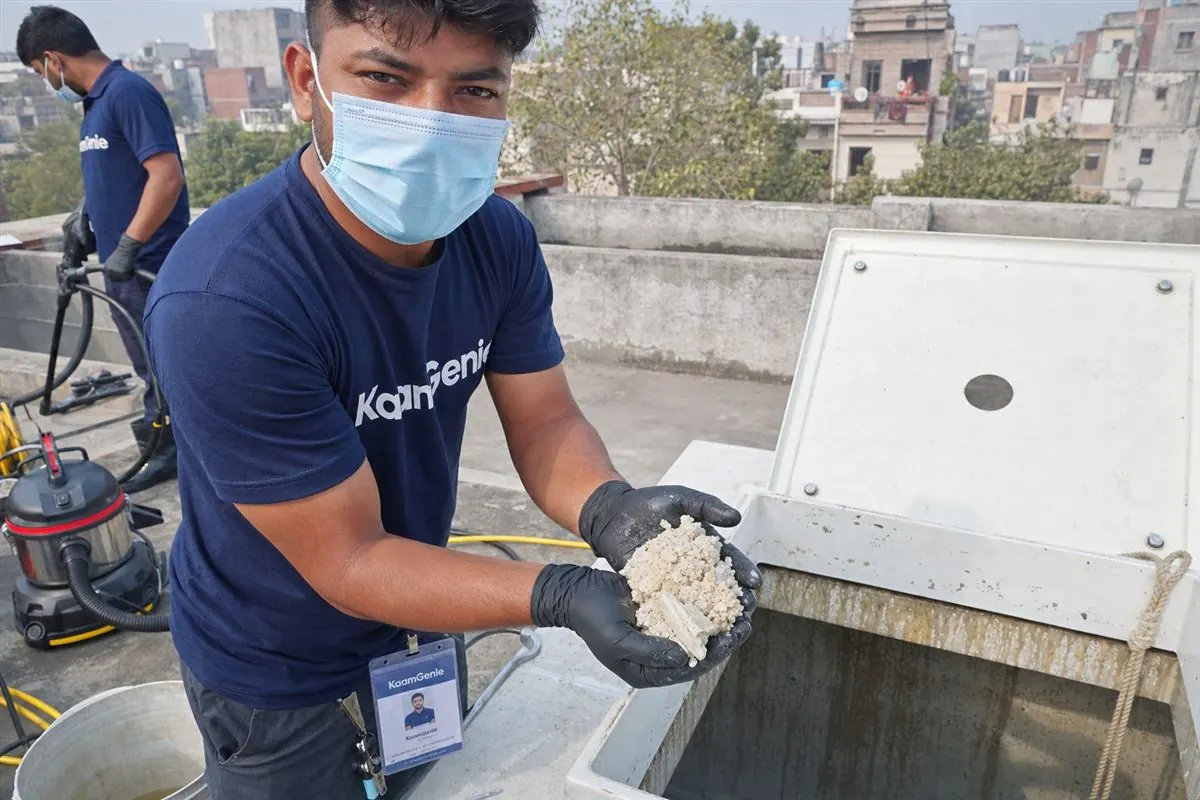
That chalky white crust is limescale—deposits of calcium and magnesium that precipitate out of hard water and stick to surfaces. When hard water sits in a tank or, especially, heats up in a geyser, these dissolved minerals come out of solution and bond to the walls, pipes and heating elements as a stubborn white or off-white layer that grows thicker over time. It is why your kettle furs up, your taps grow crusty rings, your bathroom tiles show a dull haze, and your tank walls feel rough and powdery to the touch. Scale is completely harmless to swallow in the amounts found in water—it is just minerals—but as a coating it is quietly destructive: it insulates heating elements, narrows the bore of pipes, jams valves, and shortens the working life of virtually every appliance the water touches.
Why Delhi water is so hard
Delhi’s water hardness varies sharply by area and by source.
- Borewell and groundwater—common in outer Delhi, unauthorised colonies, farmhouses and many kothis—is naturally very high in dissolved calcium and magnesium, so scaling here is severe and fast.
- DJB piped supply is generally softer but still moderately hard across many zones, and homes that mix DJB with borewell get unpredictable, fluctuating hardness.
The hidden cost of ignoring scale
Scale is expensive even though it looks harmless. A scaled geyser element wastes electricity every single day—a mineral coating just a few millimetres thick insulates the element, forcing it to run far longer to heat the same water, and often making it burn out years early. Scale also narrows pipes and chokes tap aerators, steadily weakening flow throughout the house. It clogs RO membranes and washing-machine inlet valves, and leaves that dull, cloudy film on glasses, tiles, taps and shower screens that no amount of wiping truly fixes. Left unchecked inside a tank, thick scale eventually flakes off and travels through your plumbing, blocking fittings and mixers downstream. Every month of ignored scale quietly adds to your electricity bill and your repair costs, which is precisely why staying ahead of it is far cheaper than paying for the damage later.
Book your water tank cleaning
Trained crew, food-grade process, before/after photos and a service record every job. ₹699 onwards, same-day where possible across Delhi NCR.
How professional de-scaling cleans a tank
Removing hardened scale from a tank takes far more than a rinse—the crust is bonded to the surface. At KaamGenie we drain the tank, then work the scaled walls and floor mechanically to lift the crust, using a safe descaling treatment on the most stubborn deposits where scrubbing alone will not shift them. We then remove all the loosened scale and any flakes that have already collected on the floor, high-pressure rinse and disinfect, so nothing sheds into your pipes and taps afterward. Clearing scale from the tank at the source also protects everything downstream, from your geyser to your RO. A standard overhead tank starts from ₹699; underground sumps run ₹1,500–2,500 by size and access. Book through our water tank cleaning service or call 95603 66362 for a quote.
Do water softeners and RO help?
They address different things, and it helps to be clear about which. A water softener plumbed at the tank or main inlet swaps hardness minerals out before the water ever reaches your home, dramatically cutting scale on taps, geysers, washing machines and tiles—genuinely worthwhile for heavy borewell hardness. An RO unit, by contrast, softens only the drinking water at that one point, so it protects your kettle and glasses but does nothing for the geyser, bathroom pipes or appliances. Neither device replaces tank cleaning—a softener reduces future scale, but existing deposits, sediment and general sludge still need physical removal from the tank. The honest answer for a Delhi home: install a softener if your hardness is severe, but keep cleaning the tank on schedule regardless, because the two solve different halves of the problem.
A realistic scale-management routine
You cannot make Delhi water soft by cleaning alone, but you can keep scale firmly under control with a realistic routine. De-scale the tank on a regular schedule—every six months for borewell-fed homes where build-up is fast, and at least yearly for softer DJB supply. Descale your geyser and clean tap aerators periodically so the heater stays efficient and flow stays strong. Consider a softener if you are on heavy groundwater and scaling everything constantly. Between cleans, wipe taps, tiles and glass with a mild acid such as diluted vinegar to shift light surface scale before it hardens. The cheapest and easiest way to stay ahead of all this is an AMC at 15–25% off, which schedules de-scaling cleans automatically so scale never gets thick enough to damage your appliances or plumbing.
When scale means it is time to act
Some signs mean you should not wait for the next scheduled clean. If your geyser is heating noticeably slowly or tripping, if flow has visibly weakened and your taps are crusting up fast, if the kettle furs within days of descaling, or if you can scrape thick white deposits straight off the tank walls, scale has reached a genuinely costly level. Homes on borewell water that have never once had a de-scaling clean are almost always badly overdue. Acting early saves a geyser element or a set of fittings that each cost far more than a single tank clean. If you are unsure how bad your build-up really is, call KaamGenie on 95603 66362—we will inspect it and tell you honestly whether it is simply time to de-scale, or whether investing in a softener would serve your particular water supply better in the long run.
Frequently asked questions
Is white scale in my water tank dangerous to drink?
No. The calcium and magnesium in limescale are not harmful to swallow at the levels found in water—they are the same minerals in hard water everywhere. The problem is scale as a coating: it damages geysers, narrows pipes and clogs appliances. So while you can drink it safely, you should still remove it to protect your plumbing and heaters.
Why is my Delhi water so hard and scaly?
It depends on your source. Borewell and groundwater, common in outer Delhi and many kothis, is naturally very high in calcium and magnesium, causing heavy scale. DJB piped supply is softer but still moderately hard in many areas. High TDS readings are largely hardness minerals, so borewell-fed homes see the fastest, thickest scale build-up.
How is de-scaling different from a normal tank clean?
A normal clean removes sludge, biofilm and sediment. De-scaling additionally targets hardened limescale bonded to the walls, which needs mechanical working and safe descaling treatment on stubborn deposits. We then remove the loosened scale so it does not shed into your pipes. Both are done together at KaamGenie, starting from ₹699 for an overhead tank.
Will a water softener or RO stop the scale?
A softener at the tank or inlet removes hardness before it reaches your home, cutting scale on taps, geysers and appliances—useful for heavy borewell water. RO softens only drinking water, so it protects your kettle but not your geyser. Neither removes existing scale or replaces tank cleaning; they reduce future build-up alongside regular cleans.
How often should I de-scale my tank in Delhi?
For borewell-fed homes where scale builds fast, de-scale every six months. Softer DJB-supplied homes can often go longer. Also descale geysers and clean aerators periodically to keep heaters efficient. The cheapest approach is an AMC at 15–25% off, which schedules de-scaling automatically so scale never gets thick enough to damage appliances.
Is white scale in my tank ruining my geyser and washing machine?
Very likely. The same hard-water scale that coats your tank walls builds up inside geysers, washing machines and taps, cutting their efficiency and shortening their life. Descaling the tank reduces how much scale gets carried into appliances, so they run better for longer. It is far cheaper than repeated appliance repairs caused by ignoring the hard-water build-up.
Will white scale leave chalky marks on my utensils, tiles and taps?
Yes — hard water leaves white chalky spots and crust on utensils, glass, tiles and chrome fittings that are stubborn to wipe off. Descaling the tank and outlets reduces the mineral load reaching your taps, so the spotting eases. Existing marks lift with a mild acidic cleaner, but the source is the hard water sitting in your tank and pipes.
Do you use acid to descale, and is my plastic tank safe from it?
We use controlled, food-grade descaling agents at the right strength for your tank material, then rinse and disinfect thoroughly so nothing harmful remains. Plastic and cement tanks are both handled safely — we do not pour raw acid and leave it. After rinsing and refilling, the water is safe to use, and we show you the before and after.
How is descaling priced compared with a normal tank clean in Delhi?
A standard clean starts from ₹699; descaling is a deeper job because dissolving hardened mineral crust takes more time and treatment, so it is quoted as an add-on once we see how heavy the scale is. We tell you the figure before starting, never after. For very light scale, a normal thorough clean is sometimes enough on its own.
If I’ve installed a water softener, do I still need to descale the tank?
A softener slows new scale but does not remove the crust already coating your tank from before it was fitted — that hardened layer needs a physical descale once. After that, with the softener working, you will descale far less often. We can check the existing build-up and tell you whether a one-time descale is worth doing now.
Sources & references
- Bureau of Indian Standards (BIS) — IS 10500:2012 is the canonical Indian Standard for drinking water specification, defining acceptable limits for physical, chemical and biological parameters.
- WHO Guidelines for Drinking-water Quality, 4th edition — the global reference for water quality standards, including guidance on safe storage and disinfection.
- Food Safety and Standards Authority of India (FSSAI) — defines water quality requirements for food businesses, including hygiene standards for stored water and acceptable disinfection chemicals.
- WHO Fact Sheet on Drinking Water — overview of safe drinking water requirements and contamination risks.
- CPHEEO — Manual on Water Supply and Treatment — the Government of India’s engineering manual covering tank design, cleaning protocols and disinfection practices.
Last verified: 6 July 2026. If you find any of these links broken, please let us know.