
Key takeaways
- Algae blooms because Delhi rooftops give it both light and heat—translucent tanks are the main cause.
- Green water shelters bacteria, ruins taste, and clogs RO and filters; stop drinking it until cleaned.
- Bleaching alone fails—it leaves the rooted algae mat that feeds the next bloom.
- A proper clean drains, hand-scrubs, vacuums, disinfects and cures the tank.
- Blocking light with an opaque or shaded tank is the permanent fix.
- Clean every 3–4 months in summer; an AMC keeps it automatic at 15–25% off.
We look at the two things algae needs to bloom—light and warmth—and why Delhi’s translucent tanks and blazing rooftops are the perfect nursery. You will learn the difference between harmless-looking green and genuinely risky growth, why bleaching alone never fully works, and the step-by-step professional method that removes it at the root. We also cover cheap, permanent prevention so you never have to look at green water again.
Why Delhi tanks turn green so easily
Algae needs just two things: sunlight and warmth—and Delhi rooftops deliver both in abundance. The biggest culprit is the translucent tank. Cheaper white or single-layer tanks let light pass straight through the walls, and light plus 40°C summer water is an algae paradise. Add a slightly loose lid letting in spores and dust, water that sits for days between uses, and traces of nutrients from DJB or borewell supply, and a tank can go visibly green in under a week. Sun-facing terrace tanks with no shade are the worst affected, which is why so many Delhi homes see it. This is also why the same tank stays crystal clear through winter but blooms every April as the temperature climbs. The lesson is important: the fix is never just cleaning—you have to cut off the light that feeds the bloom, or it comes straight back.
Is algae in drinking water harmful?
Most common green algae is not directly toxic in small amounts, but algae-laden water is far from safe. The slimy growth shelters bacteria, changes the taste to earthy or musty, and clogs RO membranes, tap aerators and washing-machine inlets—so it quietly costs you in appliance wear too. Some blue-green algae can release toxins that cause stomach upsets and skin irritation, and these are impossible to spot by eye. For young children, the elderly and anyone unwell, green tank water is a real risk not worth taking. At minimum, a green tank means it has not been cleaned in far too long and other contaminants are likely present alongside the algae. If your water looks or smells green, stop drinking and cooking with it until the tank has been fully cleaned and disinfected, and rely on stored or RO water in the meantime.
Why bleaching alone does not work
Tipping a bottle of bleach into a green tank is the classic Delhi shortcut, and it fails for two reasons. First, chlorine kills the surface bloom but leaves the rooted biofilm and dead algae mat stuck to the walls, which decomposes and becomes a nutrient bed that simply feeds the next bloom—often thicker than before. Second, the underlying cause—light hitting warm water—is untouched, so growth returns within days of the water clearing. Over-bleaching also leaves a harsh chemical taste, irritates skin, and can degrade cheaper plastic over time. The only lasting fix is mechanical: physically scrub every wall and the floor, lift out the algae mat completely, then disinfect and thoroughly rinse. Bleach has its place as a final disinfecting step, but on its own it is never the whole job and gives people a false sense that the problem is solved.
Book your water tank cleaning
Trained crew, food-grade process, before/after photos and a service record every job. ₹699 onwards, same-day where possible across Delhi NCR.
The professional algae-removal method
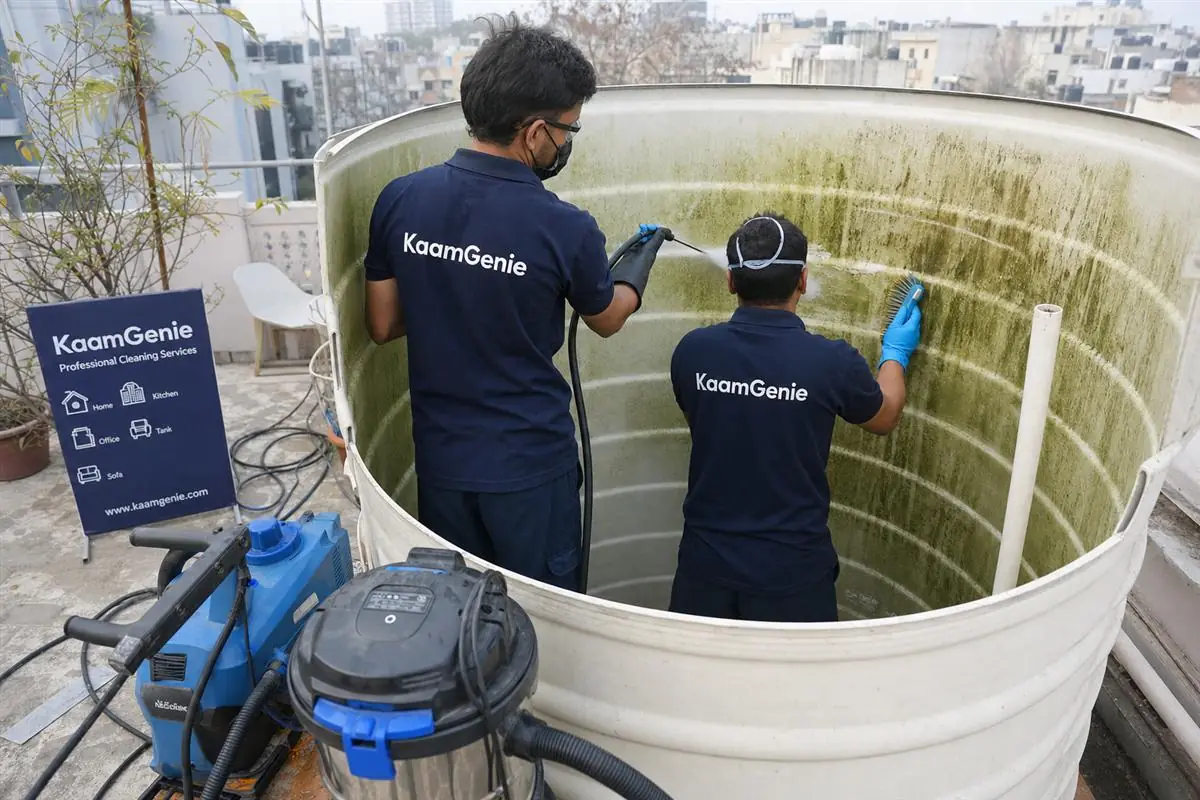
A proper de-algae clean is systematic, not a quick rinse. At KaamGenie we drain the tank completely, then hand-scrub every internal surface with food-safe brushes to lift the algae mat and rooted biofilm that bleach leaves behind. We vacuum out the green sludge, high-pressure rinse away the loosened growth, disinfect with a controlled chlorine dose, and let the tank cure fully before refilling with clean water. Crucially, we also check the lid seal and inlet mesh and flag if a translucent tank needs shading, because a spotless tank re-blooms within days if light and spores still get in. That combination of thorough removal plus source control is what keeps it clear for months. A standard overhead tank starts from ₹699; underground sumps run ₹1,500–2,500 by size and access. Book via our water tank cleaning service.
Blocking the light: the permanent fix
Cleaning removes today’s algae; blocking light stops tomorrow’s, and this is the step most people skip. The single best move is switching to, or wrapping, a tank with an opaque, dark or triple-layer body that light simply cannot penetrate—dark outer layers are specifically designed to starve algae. If a full replacement is not an option right now, a shade cover, a covered terrace enclosure, a false roof, or even a tank cabinet dramatically cuts blooms by keeping sunlight off the walls. Always keep the lid fully sealed—a finger-width gap is enough to let in both spores and light. Fit a mesh on the overflow and inlet too. These are small, cheap changes, but together they turn a tank that blooms every single summer into one that stays clear for months, and they quickly pay for themselves in fewer repeat cleans.
How often to clean to stay algae-free
In Delhi’s climate, a translucent or partly-lit tank needs cleaning every three to four months through the warm season to stay ahead of algae, and even sooner if it is in direct sun. A properly shaded, opaque tank with a sealed lid can comfortably go six months between cleans. The cheapest way to manage this is an AMC—our maintenance plan schedules cleans automatically at 15–25% off single-visit rates, so you never forget and never come home to a fully bloomed tank again. Societies and apartment blocks with large rooftop tanks especially benefit, because one neglected tank can turn dozens of flats’ water green at once, and coordinating a single scheduled clean is far cheaper per home. Call KaamGenie on 95603 66362 to set up a schedule that matches your tank type, location and exposure.
Algae vs oily film vs scale: telling them apart
Not every discolouration is algae, and treating the wrong problem wastes money. Use colour and texture to tell them apart.
- Green, slimy, stringy growth on the walls that gets worse in summer heat is algae—a light and warmth problem.
- A shimmering rainbow or greasy sheen on the surface is usually a bacterial biofilm or settled pollution, not algae; see our guide on oily films in Delhi tanks.
- Chalky white crust on the walls and taps is limescale from hard water, a mineral issue.
Frequently asked questions
Why does my water tank keep turning green in summer?
Algae needs light and warmth, and Delhi summers supply both. Translucent or single-layer tanks let sunlight pass through the walls, and warm rooftop water lets algae bloom in days. That is why the same tank stays clear in winter but goes green every April. The permanent fix is blocking the light with an opaque or shaded tank.
Is it safe to drink water from an algae-filled tank?
No. While most green algae is not highly toxic in small amounts, algae-laden water shelters bacteria, tastes musty and can contain toxin-producing blue-green algae that cause stomach upsets and skin irritation. It is especially risky for children and the elderly. Stop drinking it and get the tank cleaned and disinfected first.
Can I just add bleach to kill the algae?
Bleach kills the surface bloom but leaves the rooted algae mat stuck to the walls, which quickly feeds a new bloom. It also does nothing about the light causing it, so green returns in days. Bleach only works as a finishing disinfectant after every surface has been mechanically scrubbed and rinsed clean.
How much does algae tank cleaning cost in Delhi?
A standard overhead residential tank starts from ₹699, including drain, scrub, sludge removal and disinfection. Underground sumps run ₹1,500–2,500 depending on size and access. Societies are quoted after inspection. An AMC gives 15–25% off scheduled cleans. Call KaamGenie on 95603 66362 for a quote.
How do I stop algae coming back after cleaning?
Cut off the light. Use an opaque, dark or triple-layer tank, or shade a translucent one under a cover or enclosure. Keep the lid fully sealed and mesh the overflow. In Delhi’s heat, also clean every 3–4 months through summer. Together these keep a tank clear for months instead of blooming every few weeks.
Does a green tank need cleaning more often than a normal one through summer?
Yes. Once a tank has hosted algae, spores linger and it greens up faster, so through Delhi’s hot months a previously affected tank benefits from a shorter cleaning interval. The real fix, though, is blocking light — a dark, opaque or shaded tank stays clear far longer. We advise a realistic summer schedule for your specific tank during the visit.
Is it safe to bathe or wash in algae water while I wait for cleaning?
For flushing, yes. For bathing, light greenness is low risk but rinse with clear water and keep it off young children’s faces; heavy algae can irritate skin and eyes and should be avoided. Do not drink or cook with it. Given how fast algae spreads, it is usually easiest to book a same-day clean rather than manage around it.
My overhead tank is translucent plastic — is that why it keeps going green?
Almost certainly. Light passing through a translucent or light-coloured tank is exactly what algae needs to grow, especially on a sunny Delhi rooftop. Cleaning removes the current bloom, but the lasting fix is blocking that light — shading the tank, wrapping it, or moving to an opaque tank. We will point out the light source during the clean.
Can you clean the algae the same day, or does it need more than one visit?
One visit is enough. Our crew drains the green water, scrubs off the algae, disinfects and refills in a single same-day appointment across most of Delhi — you do not need a second trip. What matters after is preventing regrowth by cutting the light. Call 95603 66362 and we will usually fit an algae clean in the same day.
Will scrubbing leave green stains on the tank walls that never come off?
Fresh algae wipes off cleanly and leaves no stain. Long-neglected algae can leave a faint green shadow on the walls, but our food-grade scrubbing and disinfection removes almost all of it and, more importantly, kills what causes it. The tank looks and runs clean afterwards; any faint mark left is cosmetic and does not affect water safety.
Sources & references
- Bureau of Indian Standards (BIS) — IS 10500:2012 is the canonical Indian Standard for drinking water specification, defining acceptable limits for physical, chemical and biological parameters.
- WHO Guidelines for Drinking-water Quality, 4th edition — the global reference for water quality standards, including guidance on safe storage and disinfection.
- Food Safety and Standards Authority of India (FSSAI) — defines water quality requirements for food businesses, including hygiene standards for stored water and acceptable disinfection chemicals.
- WHO Fact Sheet on Drinking Water — overview of safe drinking water requirements and contamination risks.
- CPHEEO — Manual on Water Supply and Treatment — the Government of India’s engineering manual covering tank design, cleaning protocols and disinfection practices.
Last verified: 6 July 2026. If you find any of these links broken, please let us know.