
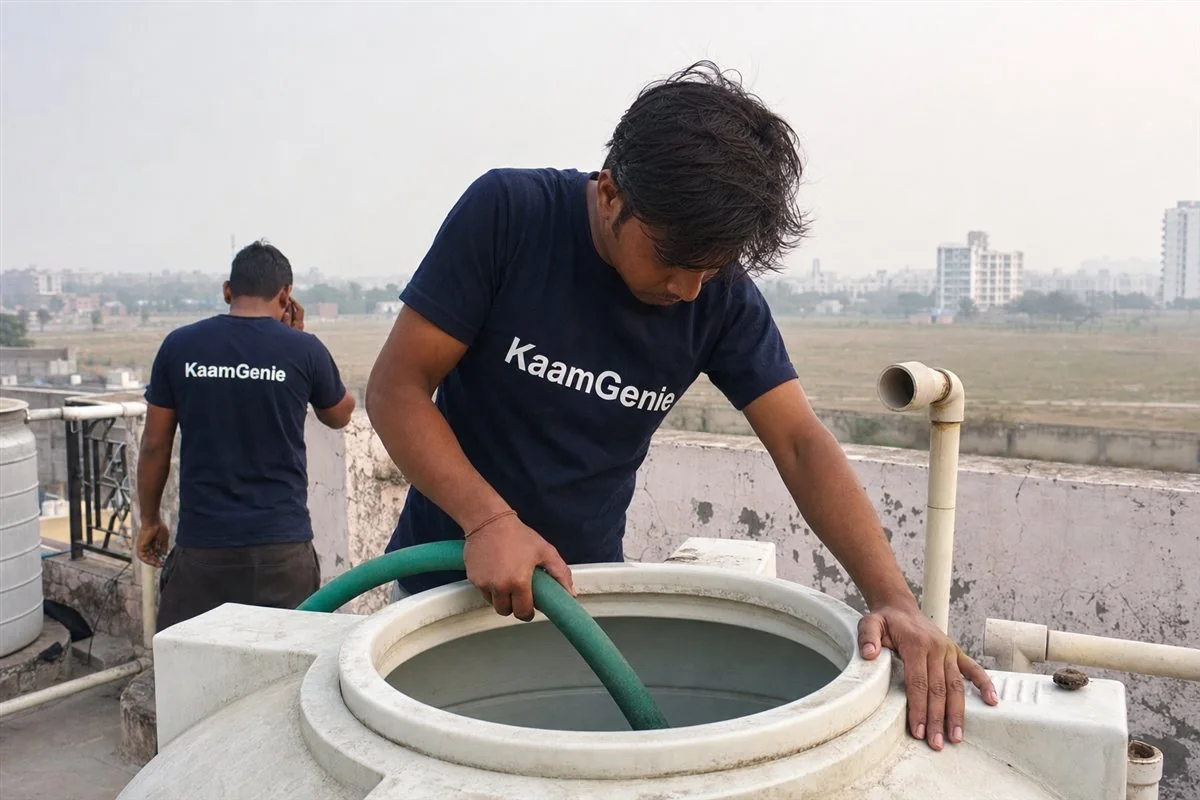
The short version
- Borewell groundwater is raw, untreated water from the aquifer. Across Noida’s peripheral sectors, Greater Noida West and plotted homes, a lot of supply is borewell-fed.
- It arrives carrying iron and manganese (orange-brown and dark staining), fine sand and silt (a gritty floor sludge), and dissolved hardness (calcium scale) — none of which a piped, treated supply has much of.
- All of it settles and crusts inside your tank, and the rough deposit grips even more dirt and bio-film, so the tank gets dirty faster.
- That’s why a borewell-fed tank needs cleaning every 3–4 months, not yearly — with sediment removal and descaling, not just a rinse.
- In a borewell setup the underground reservoir and rooftop tank are cleaned together, because the reservoir is where the worst sediment settles.
If your building runs on a borewell and the tank hasn’t been opened in over a year, there’s almost certainly a stained, gritty sludge layer building right now.
| What’s in the water | Where it comes from | What you see / smell | Why it sludges the tank faster |
|---|---|---|---|
| Iron | Dissolved in groundwater; oxidises in the tank | Orange-brown stains, rust-coloured sediment, metallic taste | Drops out as fine particles that coat walls and floor |
| Manganese | Dissolved in groundwater alongside iron | Dark brown-black staining and grime | Settles as a sticky deposit that grips other dirt |
| Sand & silt | Drawn from the aquifer, esp. new/heavily pumped borewells | Gritty layer at the bottom, clogged aerators and filters | Heavy, settles straight to the floor as a sludge bed |
| Hardness (Ca/Mg) | Minerals picked up moving through rock and soil | White/grey chalky scale on walls and fittings | Rough scale crust traps sediment and bio-film |
| Organic load & bacteria | Aquifer matter feeding on the settled sludge | Rotten-egg (sulphur) smell, slimy bio-film | Thrives in the deposit the other contaminants leave |
Indicative only — borewell chemistry varies bore by bore and society by society. The hardness and scale side of this story is covered in depth in our companion piece on hard water tank cleaning in Noida. For how to judge your own interval, see how often to clean a water tank in Noida.
Borewell-fed tank in Noida? Get the sediment and scale out properly
Sludge removal, iron and scale descaling, manual scrub, jet wash and before/after photos — not a quick rinse that leaves the stains behind. ₹699 onwards.
Why so much of Noida & Greater Noida runs on borewell water
Not every part of Noida is on the same tap. The older, planned central sectors are largely on consistent treated piped supply, much of it Ganga Jal that’s been filtered and treated before it reaches you. But Noida and Greater Noida grew outward and upward fast, and the infrastructure didn’t always keep exact pace with the construction.
So a great deal of the city leans on borewell groundwater, pulled straight from the aquifer into a storage tank with little or no treatment in between. That’s the norm in the peripheral and newer sectors, across the dense high-rise townships of Greater Noida West / Noida Extension, and in thousands of plotted Authority houses and builder floors that run their own bore. Many societies use a mix: piped supply when it’s available, topped up by borewell when it isn’t.
The key difference is simple. Treated piped water has already had its iron, sediment and a chunk of its hardness removed at a plant. Borewell water hasn’t — whatever the ground holds, your tank now holds too. That’s why a tank in a borewell-fed home or tower behaves completely differently from one on clean piped supply, and why our water tank cleaning in Noida crews can usually tell a building’s water source the moment they open the lid.
What borewell groundwater actually carries
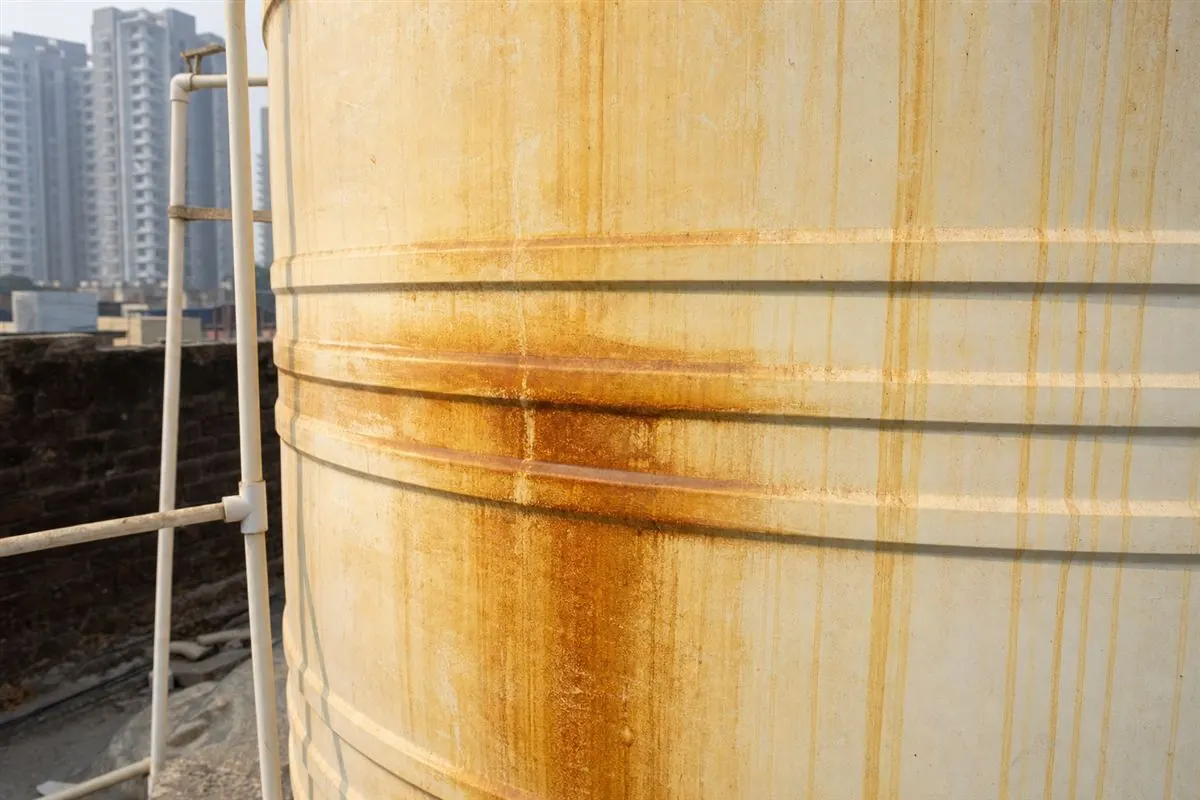
Open a borewell-fed tank and you can usually read its water source straight off the walls. Four things tend to be doing the damage:
- Iron. The big one. Underground, iron is dissolved and invisible. The moment the water sits in your tank and meets air, it oxidises and drops out as orange-brown, rust-coloured particles that stain the walls and settle as a fine sludge. It’s why borewell tanks look stained even when the tap water first runs clear — the water turns colour after it’s been standing.
- Manganese. Iron’s frequent companion in this belt. It behaves the same way but in a darker brown-black shade, leaving a stickier grime that other dirt clings to.
- Sand and silt. Borewells, especially newer or heavily pumped ones, draw fine sand and silt up from the aquifer. Being heavier than water, it settles straight to the bottom as a gritty bed. You feel it as grit in a bucket, and it clogs tap aerators and washing-machine inlet filters.
- Hardness. Groundwater here is mineral-rich in calcium and magnesium, which lays down a chalky scale on walls and fittings. We won’t re-explain the full hardness story here — it has its own guide on hard water tank cleaning in Noida — but it matters because the rough scale crust traps yet more sediment and bio-film.
None of this is acutely toxic in the way sewage contamination would be. The problem is cumulative: borewell water is constantly depositing solids that a treated supply simply doesn’t, and those solids turn your tank into a stained, gritty, scaled vessel far faster.
Why borewell-fed tanks sludge up faster — and smell
Here’s the chain of events inside a borewell-fed tank. Every refill brings a fresh dose of iron, manganese, sand and minerals. The heavy stuff — sand and silt — sinks immediately. The iron and manganese oxidise over hours and settle as fine particles. The hardness precipitates as scale on the surfaces. Over weeks, all of that builds into a sludge bed on the floor and a stained crust on the walls.
Then it compounds. That deposit is rough and slightly porous, so it grips dust, construction debris from new towers, and bio-film far more readily than smooth, clean plastic would. So the dirtier the tank gets, the faster it keeps getting dirtier. A sludge layer that might take six months to build in a clean tank on soft piped water can build in three or four months in a borewell-fed one.
That bottom sludge is also where the smell comes from. A metallic smell is the iron and manganese themselves. A rotten-egg, sulphur smell is hydrogen sulphide — gas produced when organic matter and certain bacteria act on the deposit sitting undisturbed at the floor of the tank. Topping up with fresh water does nothing for it, because the source of the smell is the layer at the bottom. Only physically removing that full sediment layer and disinfecting the surfaces clears it — which is the difference between a real clean and a rinse. If your water has started looking off-colour or smelling, our guide to the signs a water tank needs cleaning in Noida walks through what to check.
Why these tanks need cleaning — and descaling — more often
The general advice for an ordinary NCR tank is to clean it every six months. That assumes ordinary, fairly clean water. Borewell groundwater breaks the assumption in two ways. First, the deposit never stops: unlike a one-off contamination event, every single refill adds more iron, sand and scale, so the longer you wait the thicker and more stubborn the layer gets. Second, the deposit accelerates everything else: the rough, stained surface grips sediment and bio-film, so the tank hits “needs cleaning” condition sooner.
Put together, that’s why we generally recommend cleaning a borewell-fed tank every 3–4 months (quarterly) rather than every six. And it can’t be a plain rinse: iron staining and hard-water scale don’t come off with water alone, so the job needs sediment scooping plus a descaling step. The chart below shows the pattern we see again and again across borewell-heavy pockets like Noida Extension and the plotted Greater Noida homes.
Sludge & stain buildup over time — borewell vs treated piped supply
Indicative relative buildup in a Noida tank. Borewell-fed tanks reach “needs cleaning” condition roughly twice as fast.
Illustrative pattern, not lab data — actual buildup depends on the borewell’s iron and sand load, tank material and water turnover. The point holds: a borewell-fed tank hits the cleaning threshold well before a treated-piped-supply one.
How we clean a borewell-fed tank and reservoir
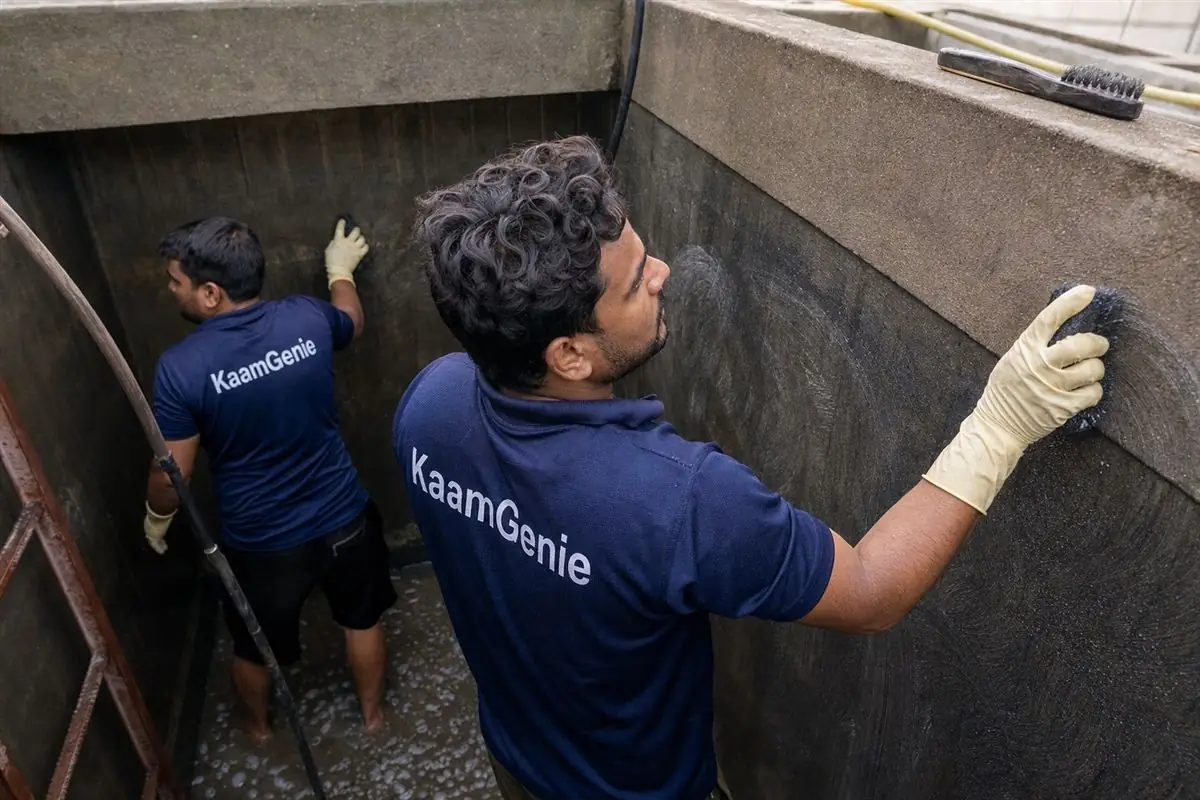
A borewell-fed clean follows our standard professional process, with two extra emphases — heavy sediment removal and descaling. In practice:
- Inspect and drain. Open the tank, take before-photos, shut the inlet and drain the old water. On borewell tanks the “before” shot usually shows obvious orange-brown staining and a gritty floor.
- Scoop and vacuum the sediment. The sand, silt and iron sludge bed at the bottom is physically scooped out and wet-vacuumed — you cannot rinse a settled sand layer away from the top, it has to be lifted out.
- Descale and de-stain. A food-safe descaling agent at a controlled concentration is applied to the scaled, iron-stained walls, floor and fittings, given contact time, then scrubbed with food-grade brushes (never metal) and blasted off with a high-pressure jet — including around the inlet, outlet and float valve where deposits crust hardest.
- Disinfect, rinse and refill. Food-grade disinfectant on every surface with proper contact time to kill the bacteria behind the smell, a thorough rinse so no residue is left, then refill and after-photos.
The part people miss is the underground reservoir. In most borewell setups the bore fills an underground reservoir or sump first — and that’s where the heaviest sand and iron sludge settles — before pumps push water up to the rooftop tanks. Clean only the rooftop tank and the reservoir keeps feeding sediment straight back up. So we clean the reservoir and the rooftop tank together. For the reservoir side specifically, see our guide to underground sump cleaning in Noida. Throughout, we use only food-safe agents — never hardware-shop acid in a drinking-water tank — the same standard described across our water tank cleaning services.
Which Noida & Greater Noida pockets are most borewell-dependent
Honestly, this varies bore by bore, so no map is ever exactly right — but the pattern across the jobs we run is fairly consistent.
Most borewell-heavy (and so the worst iron and sediment):
- The Greater Noida West / Noida Extension township belt — dense high-rise societies, many leaning on borewell-fed reservoirs. If you’re here, see water tank cleaning in Noida Extension.
- Greater Noida plotted homes and kothis around the Pari Chowk belt, where individual bores are common.
- Newer outer and Expressway-corridor sectors developed on groundwater rather than full piped supply — including parts of the Sector 168 high-rise belt.
Generally cleaner (consistent treated piped supply): much of the older, planned central Noida on steady piped Ganga Jal tends to have far less iron and sediment. Not zero — just slower-building, and usually fine on a six-month schedule.
Treat all of that as indicative, not absolute. The reliable answer for your building is simply to open the tank and look: if the walls are orange-stained and the floor is gritty, you’re on borewell water and quarterly cleaning is the right plan. For the wider picture of tank care across the city, our complete Noida water tank cleaning guide ties it together.
Not sure how stained or gritty your tank is?
Book a clean and the before-photos will show you exactly what your borewell has been depositing. Sediment removal and descaling included where needed — ₹699 onwards for standard residential; reservoir/society quoted custom.
Book a borewell tank clean with our Noida team
If your home or society runs on a borewell — and especially if you’re in a Greater Noida West tower, a plotted Greater Noida kothi, or a peripheral Noida sector — assume iron, sand and scale are building and plan a clean every three to four months. We scoop and vacuum the sediment, descale the iron staining and hard-water crust, disinfect with food-safe agents only, clean the underground reservoir and rooftop tank together, and hand over before/after photos and a cleaning record every job. See pricing and coverage on our water tank cleaning in Noida hub, or jump straight to your area: Noida Extension, Sector 168 or Pari Chowk.
To book, call +91 95603 66362 or use the booking form on this site — we’ll confirm shortly.
Frequently asked questions
Why do borewell-fed water tanks in Noida get dirty faster?
Borewell groundwater is raw, untreated water pulled straight from the ground, so it carries iron, manganese, fine sand, silt and dissolved hardness that treated piped supply has mostly had removed. All of that settles and crusts inside your storage tank. The sediment forms a sludge layer on the floor, the iron stains the walls, and the hardness lays down scale that grips even more dirt. So a borewell-fed tank reaches needs-cleaning condition in a few months where a piped-supply tank might take twice as long.
What causes the orange or brown staining inside my borewell water tank?
That’s almost always iron, and sometimes manganese, dissolved in the groundwater. Underground the iron is invisible and dissolved, but once the water sits in your tank and meets air it oxidises and drops out as orange-brown rust-coloured particles that stain the walls and floor and settle as a fine sludge. Manganese does the same in a darker brown-black shade. It’s the classic signature of borewell water and the reason these tanks look stained even when the water from the tap initially runs clear.
Why does my borewell water smell of metal or rotten eggs?
A metallic smell usually points to iron and manganese. A rotten-egg smell points to hydrogen sulphide gas, often produced when organic matter and certain bacteria act on the sediment sitting at the bottom of a neglected tank. Both get worse the longer the sludge layer is left in place, because the deposit at the floor of the tank is where the smell-causing reactions happen. A proper clean that removes the full sediment layer and disinfects the surfaces is what actually clears the smell, not just a top-up of fresh water.
How often should a borewell-fed tank in Noida be cleaned?
We generally suggest every 3–4 months for tanks running on borewell groundwater, against roughly six months for tanks on softer, treated piped supply. Borewell water deposits sediment and scale continuously with every refill, and because that rough deposit grips more dirt and bio-film, the tank gets dirtier faster between cleans. In a brand-new Greater Noida tower still shedding construction dust into a borewell-fed reservoir, even sooner.
Does borewell water leave sand and silt at the bottom of the tank?
Yes, very commonly. Borewell water in this belt often carries fine sand and silt drawn up from the aquifer, especially from newer or aggressively pumped borewells. Being heavier than water, it settles straight to the bottom of the underground reservoir and the rooftop tank as a gritty layer. You feel it as grit in the bottom of a bucket or clogging tap aerators and washing-machine inlet filters. It has to be physically scooped and vacuumed out, because no amount of rinsing from the top shifts a settled sand layer.
Is borewell water in Greater Noida safe to drink after the tank is cleaned?
A clean, disinfected tank removes the stored contamination, sludge and bio-film that a dirty tank adds to your water, which is a real and important improvement. But tank cleaning isn’t water treatment: it doesn’t remove dissolved iron, hardness or other groundwater chemistry from the supply itself. For drinking, borewell water should still go through a suitable RO or treatment unit. The clean tank makes sure that what reaches your purifier and your taps isn’t picking up extra dirt on the way.
Can you remove iron and hardness scale from the tank, or just the dirt?
Both. On a borewell-fed tank we fold a descaling step into the clean: a food-safe descaling agent at a controlled concentration is applied to the scaled and iron-stained surfaces, given contact time, then scrubbed with food-grade brushes and jet washed off, including around the inlet, outlet and float valve where deposits crust hardest. That lifts iron staining and hard-water scale that a plain rinse leaves behind. For the deeper detail on hardness and scale specifically, see our companion guide on hard water tank cleaning in Noida.
Do you clean both the underground reservoir and the rooftop tank?
For a borewell setup, yes, and it matters. In most Noida and Greater Noida homes and societies the borewell fills an underground reservoir or sump first, and that’s where the heaviest sand, silt and iron sludge settles. Pumps then push the water up to rooftop tanks. If we only clean the rooftop tank, the reservoir keeps feeding sediment back up, so we clean the underground reservoir and the rooftop tanks together. That’s why society and shared-reservoir jobs are quoted custom rather than at the flat residential rate.
How much does borewell tank cleaning cost in Noida and Greater Noida?
Standard residential cleaning starts at ₹699 onwards, with sediment removal and descaling folded into the job where iron staining and scale are present. Underground reservoirs, society UGRs and shared sumps are quoted custom because the price depends on the number and size of tanks, the reservoir capacity and access. Booking through our Noida service page gets you a fixed quote before any work begins.
Sources & references
- Bureau of Indian Standards (BIS) — IS 10500:2012 is the canonical Indian Standard for drinking water specification, defining acceptable limits for physical, chemical, and biological parameters including iron and hardness.
- WHO Guidelines for Drinking-water Quality, 4th edition — the global reference for water quality standards, including guidance on storage and disinfection.
- Food Safety and Standards Authority of India (FSSAI) — defines water quality requirements for food businesses, including hygiene standards for stored water and acceptable disinfection chemicals.
- WHO Fact Sheet on Drinking Water — overview of safe drinking water requirements and contamination risks.
- CPHEEO — Manual on Water Supply and Treatment — the Government of India’s engineering manual covering tank design, cleaning protocols, and disinfection practices.
Last verified: 30 June 2026. If you find any of these links broken, please let us know.