
The short version
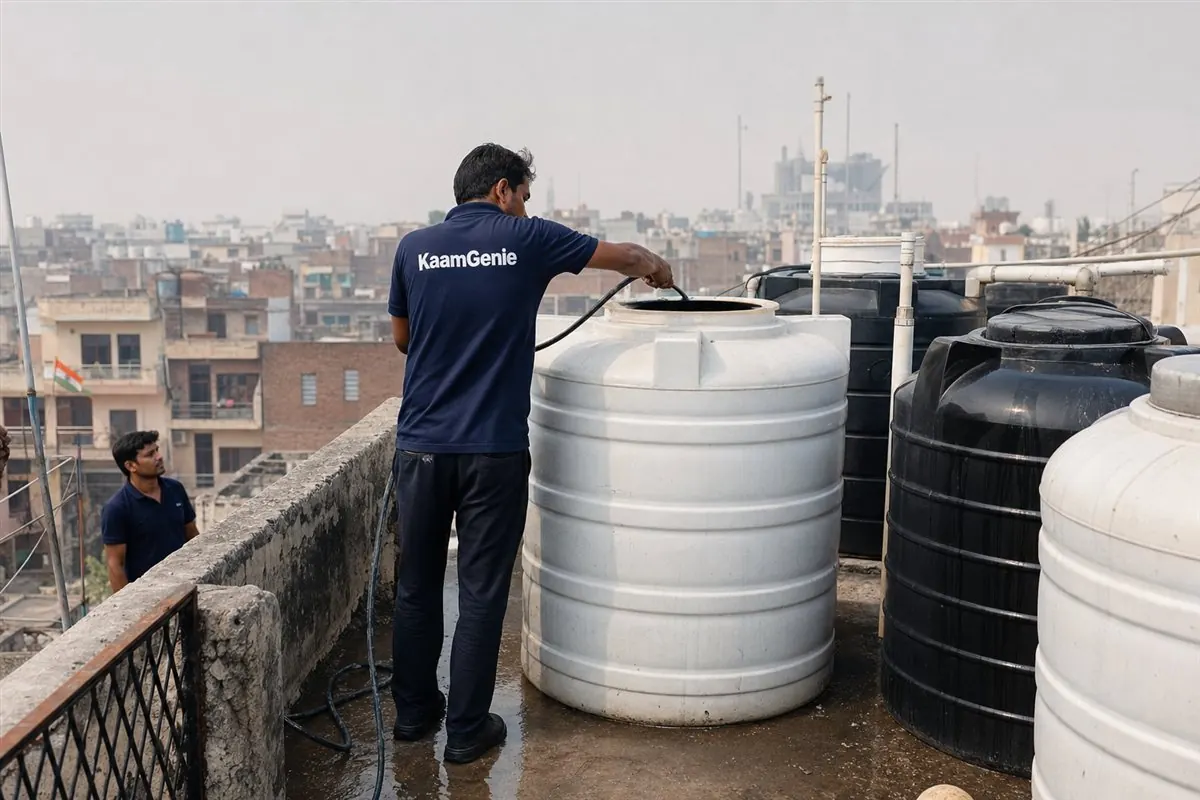
- A Delhi builder floor almost always has one shared underground sump plus one rooftop drum per flat — so a four-flat building has five tanks.
- The rooftop drum is the flat owner’s job. The shared sump is nobody’s job, which is exactly why it gets ignored for years.
- There’s usually no RWA and no maintenance fund — cleaning happens only when one neighbour organises it and the rest split the cost.
- Do the whole stack in one visit: clean the sump first, then every drum, so fresh drums aren’t refilled from a dirty sump.
- Hard, borewell and tanker water in outer Delhi means more sediment and scale — tighten the cleaning cycle.
If your building has never cleaned its ground sump — and most builder floors haven’t — that’s the tank doing the most damage to your water.
| Tank | Where | Whose responsibility | Cleaning interval |
|---|---|---|---|
| Shared ground sump | Underground at plot level | All flats (shared) | Every 4-6 months |
| Ground-floor drum | Terrace / rooftop | Ground-floor owner | Every 6 months |
| First-floor drum | Terrace / rooftop | First-floor owner | Every 6 months |
| Second-floor drum | Terrace / rooftop | Second-floor owner | Every 6 months |
| Third-floor drum | Terrace / rooftop | Third-floor owner | Every 6 months |
Get your whole builder floor done in one visit
Shared sump plus every rooftop drum, one crew, one combined price. Photos and certificate for each tank. ₹699 onwards per drum.
What a “builder floor” actually is in Delhi
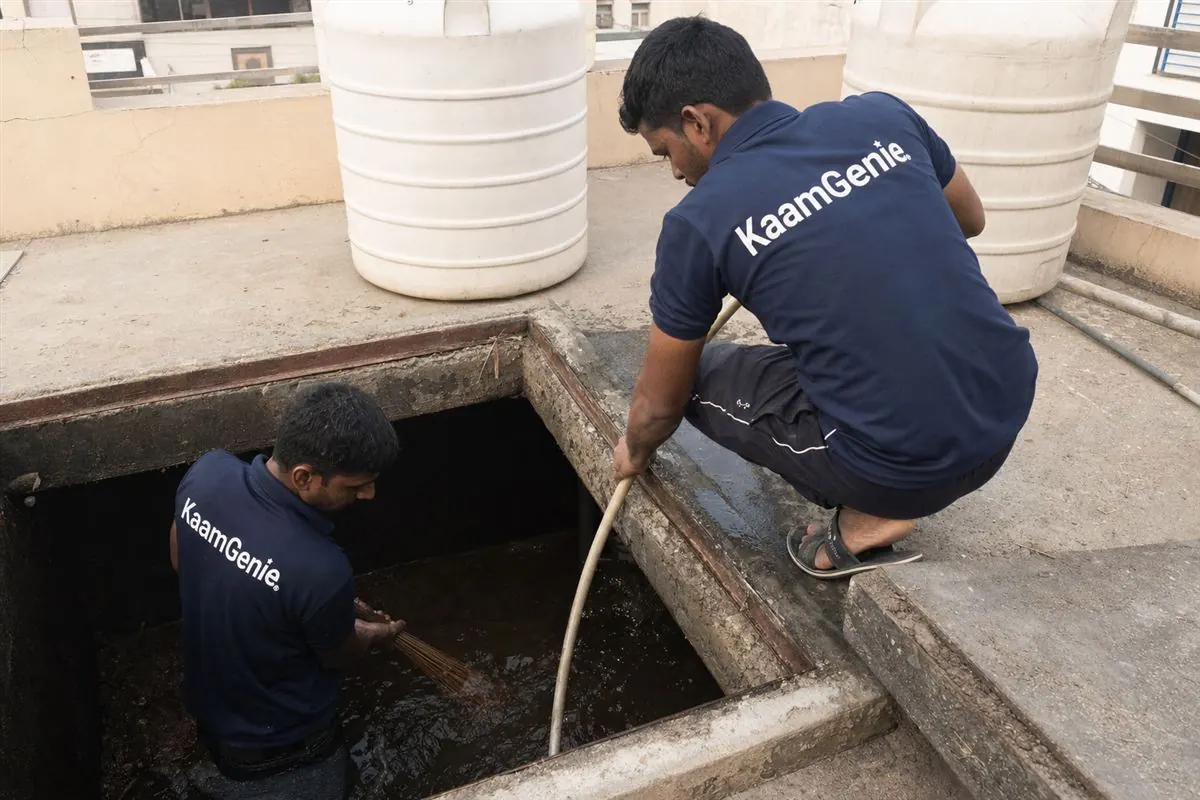
If you live in Delhi, you already know the building even if you’ve never heard the term. A developer buys an old single-storey plot in a colony — Uttam Nagar, Janakpuri, Preet Vihar, Rajouri Garden, Pitampura, the long stretches of outer-Delhi colonies — demolishes it, and rebuilds G+3 or G+4. Each floor is then sold to a different family as an independent flat. No lift lobby, no clubhouse, no society office. Just a narrow staircase and four separate front doors stacked on a 100- or 200-square-yard plot.
This is the dominant housing type across great swathes of the city, and its water plumbing is remarkably consistent. There is one underground sump at ground level where the incoming supply collects. A single common motor pumps that water up to the roof. And on the terrace sits a row of individual plastic drums — one per flat — each feeding only its own floor’s taps. It looks tidy. The problem is buried in who is supposed to look after each piece.
The water setup: one shared sump, a drum per flat
Trace a glass of water backwards from your kitchen tap on a builder floor and the path is almost always this: tap → your flat’s rooftop drum → common rising main → shared ground sump → the source. The source is usually a Delhi Jal Board (DJB) connection, but in unauthorised and regularised colonies and across outer Delhi it is just as often a borewell, and in summer it is frequently a private tanker topping up the sump.
That single sump is the heart of the system. Every flat’s water passes through it before it ever reaches an individual drum. So if the sump floor is carrying two years of silt, rust and tanker sediment, it doesn’t matter how clean your personal rooftop drum is — you’re lifting dirty water into it every single time the pump runs. The rooftop drums are the part residents can see and occasionally rinse; the sump is the part that does the real damage and that almost nobody opens.
Because the drums are separate, the cleaning logic splits in two: the rooftop drums are individual, the sump is collective. That single fact explains nearly every builder-floor water headache in Delhi.
The shared-responsibility trap — why builder floor sumps get neglected
In a proper society or a high-rise in Dwarka, a Residents’ Welfare Association collects maintenance, keeps a fund, and schedules the reservoir cleaning. A builder floor has none of that. There is no RWA for four families who happen to share a staircase, no monthly maintenance, no caretaker whose job it is to remember.
So the shared sump falls into a classic gap. The ground-floor owner thinks of it as “the building’s” tank, not his. The top-floor owner barely thinks about it at all because his water comes from a drum three storeys above it. Nobody wants to be the one who spends money and chases the others for their share. The result is predictable: rooftop drums get an occasional wipe, while the sump — the most important tank in the building — goes unopened for three, four, sometimes six years.
When our crew finally opens one of these long-neglected sumps, the floor is rarely just dusty. It’s a layer of silt, pipe rust, tanker sediment and biofilm, sometimes with insects or a dead bird that fell through a broken lid. This is why builder-floor residents complain of cloudy water, an earthy smell, or recurring stomach trouble even though each family swears their own rooftop drum “was cleaned recently.” You can read more about which tank to prioritise in our guide to overhead vs underground tank cleaning in Delhi, and on the confined-space handling a sump needs in our sump cleaning cost and safety guide.
Who pays? Splitting the cost fairly
Here is the fair and simple split that works for almost every builder floor:
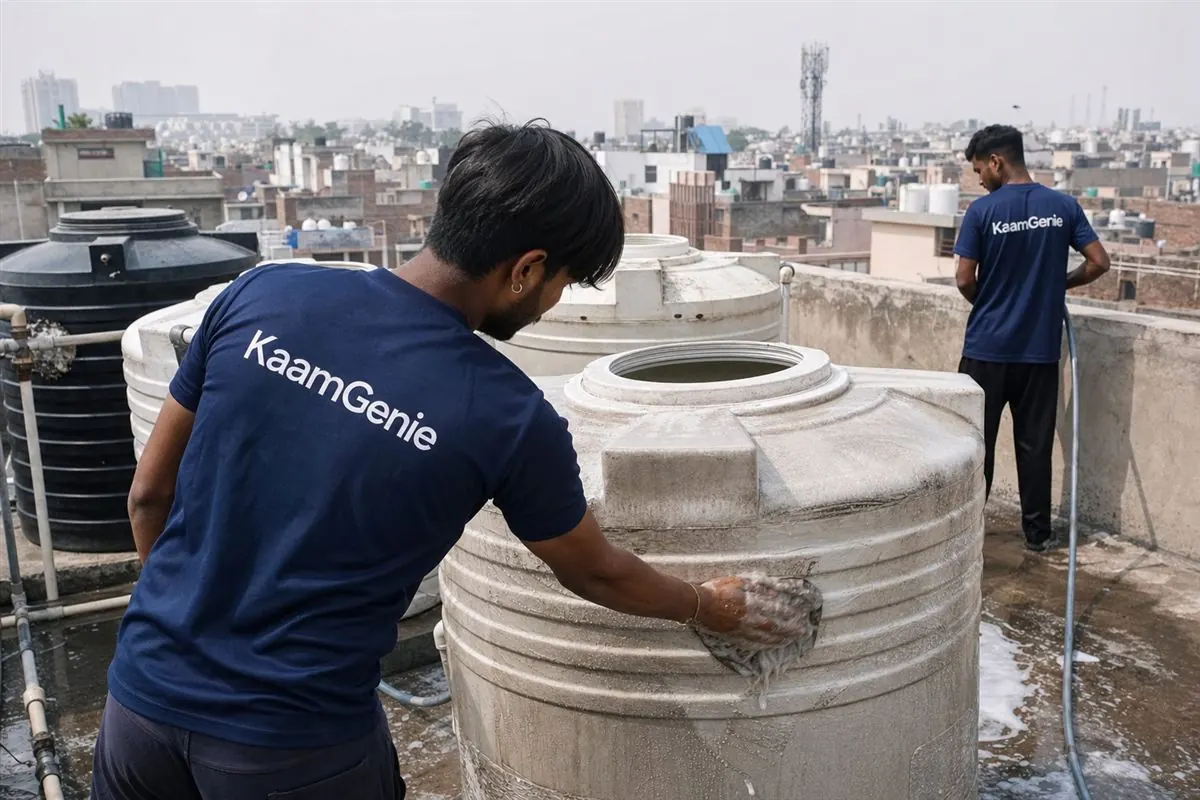
- Your rooftop drum is yours. Each flat owner pays for their own overhead drum. If the flat is rented, most owners pay while the tenant arranges access — worth writing into the rent agreement.
- The shared sump is split equally. Since every flat draws from it equally, divide the sump cleaning charge equally between the participating flats. In a four-flat building, each pays a quarter.
The honest money-saver is to clean everything in one booking. A single rooftop drum starts at ₹699. The sump is quoted on its capacity and access because it holds far more water and needs confined-space gear. But when you book the sump and all the drums together, the crew mobilises once, sets up once, and you get a combined price that lands lower per tank than four separate visits. Whoever coordinates collects each neighbour’s share and we hand over one certificate naming the building. For a sense of how individual tanks are priced, our Delhi cost guide breaks it down by tank type.
One practical tip: appoint a coordinator. Builder-floor cleanings stall not over money but over nobody volunteering to make the call. The flat that suffers the worst water — usually the ground floor or whoever is closest to the sump — is often the one happy to organise it.
Why cleaning the whole stack in one visit matters
This is the part people get wrong even when they do mean to clean. Someone cleans their rooftop drum on a Sunday, feels good about it, and the very next time the pump runs, that spotless drum fills with water lifted straight off a filthy sump floor. Within weeks the new sediment is back. Cleaning a drum while ignoring the sump is like mopping a floor while the roof leaks.
The correct sequence, which our crew follows on a builder floor, is:
- Clean the shared ground sump first — drain, scoop sludge, scrub, jet wash, vacuum, disinfect.
- Refill the sump with clean water and let the pump prime.
- Then clean each rooftop drum, floor by floor, and refill them from the now-clean sump.
Done in this order, the entire system is clean at the same moment and stays that way. A four-flat building — one sump and four drums — is a comfortable half-day for a single crew. You only deal with the disruption once, everyone’s water goes off and comes back together, and you don’t pay travel and setup five times over. If you’re booking for a freshly built or just-bought floor, the same one-visit logic applies, which we cover in post-construction tank cleaning for a new Delhi flat.
Where the contamination sits on a neglected builder floor
Approximate share of total sediment we recover, by tank — the shared sump dominates
Illustrative, from what our Delhi crews typically recover: the shared sump holds the bulk of the silt and sediment because it’s larger, lower, and almost always the least-cleaned tank in the building.
Sort out your building’s sump this weekend
One neighbour books, we clean the shared sump and every drum, and hand out a certificate per flat. Standard drum cleaning ₹699 onwards.
Hard water, borewell water and DJB supply
Where your building’s water comes from changes how often you should clean and how hard the sump fights back. Three patterns show up across Delhi builder floors:
- DJB piped supply — cleaner at source, but Delhi’s old distribution mains shed rust and pick up sediment, and intermittent pressure means the sump sits part-empty and re-fills repeatedly, stirring up its own floor.
- Borewell groundwater — common in outer colonies, unauthorised-regularised areas and the city’s edges. In many pockets it’s hard and iron-rich, leaving chalky scale on walls and a reddish-brown sludge at the bottom that no rinse removes.
- Tanker top-ups in summer — during the annual water crunch, sumps get filled by private tankers whose own tanks may be anything but clean, dumping a fresh load of sediment straight into your shared storage.
If your building runs on borewell or leans on tankers, treat the sump as a four-month job rather than six. Hard water in particular calls for proper scrubbing and sometimes a descaling pass — we go deeper on that in our guide to hard water tank cleaning in Delhi, and on edge-of-city groundwater in borewell water tank cleaning for outer Delhi. None of this is exotic: the BIS IS 10500 drinking-water standard simply assumes your storage is clean, and a neglected sump quietly breaks that assumption no matter how good your RO is.
Book builder floor tank cleaning anywhere in Delhi
Builder floors are everywhere in the city, and so are we. Whether you’re in Preet Vihar in the east, Pitampura in the north-west, near the airport belt in Mahipalpur, or anywhere else, we bring the same trained crew, the same fixed prices, and the same shared-sump-first method. See coverage, pricing and booking on our water tank cleaning in Delhi hub, or explore the full range of water tank cleaning services across Delhi NCR. One call gets your building’s entire water stack — sump and every drum — cleaned, documented and certified in a single visit.
Frequently asked questions
What is a builder floor and how is its water system usually set up in Delhi?
A builder floor is a single independent floor of a low-rise plotted building — typically a developer buys an old plot in a colony like Uttam Nagar, Janakpuri, Preet Vihar or Pitampura, rebuilds G+3 or G+4, and sells each floor as a separate flat. The water setup is almost always the same: one shared underground sump at ground level that the DJB line, borewell or tanker fills, a common pump that lifts water up, and a separate plastic rooftop drum (usually 500-1000L) for each flat on the terrace. So one building has one shared sump plus three or four individual overhead drums.
Who is responsible for cleaning the tank in a builder floor — the owner or the tenant?
The rooftop drum that feeds one flat is that flat owner’s responsibility — and if the flat is rented, most agreements make the occupant arrange routine cleaning while the owner pays for it. The shared ground sump is nobody’s individual property, which is exactly why it gets neglected. There is no RWA or maintenance fund for a four-flat builder floor, so the sump only gets cleaned when one resident takes the initiative and the others agree to split the cost. We strongly recommend you fix this responsibility in writing when you buy or rent the floor.
We have one shared sump and separate rooftop drums — can you clean all of them in one visit?
Yes, and it is the smartest way to do it. We clean the shared ground sump first, then go floor by floor cleaning each rooftop drum, all in the same visit with the same crew. Doing the whole stack together means the freshly cleaned drums are not immediately refilled from a dirty sump, the crew only mobilises once, and the per-tank cost drops because setup and travel are shared. A typical four-flat builder floor — one sump plus four drums — is a half-day job.
How much does builder floor water tank cleaning cost in Delhi?
A single rooftop drum starts at ₹699. The shared underground sump is quoted on capacity and access because it holds far more water and needs confined-space handling. When the whole building is done in one visit, we give a combined price for the sump plus all the drums that works out cheaper per tank than booking each separately. Exact figures depend on tank sizes and how dirty they are, so we confirm on a quick photo or call before the crew arrives.
How often should a builder floor in Delhi get its tanks cleaned?
Every six months for both the rooftop drums and the shared sump is the sensible standard for Delhi. If the building runs on borewell or tanker water — common in outer colonies and unauthorised regularised areas — push the sump to every four months because that water carries more sediment. Small rooftop drums in full sun also grow algae quickly, so a twice-yearly clean keeps them honest. The BIS drinking-water standard assumes clean storage, and a neglected sump quietly undoes everything your RO does downstream.
Our building runs on borewell water — does that change the cleaning?
Yes. A lot of builder floors in outer Delhi and unauthorised colonies depend on borewell groundwater, which in many pockets is hard and high in dissolved minerals and iron. That leaves chalky scale on the sump walls and a reddish sediment at the bottom that a simple rinse will not remove — it needs proper scrubbing and sometimes a descaling pass. Hard water also coats the drum walls faster, which is why borewell-fed buildings benefit from a shorter cleaning cycle.
Do all the flat owners need to agree before we clean the shared sump?
Practically, yes — because everyone draws water from that one sump and everyone should share the cost. In reality, one resident usually organises it and collects an equal share from the others. We can help by giving a single written quote and a cleaning certificate that names the building, so whoever coordinates has a clear document to show the neighbours. If one floor refuses to participate, the sump can still be cleaned; the cost is just split among those who agree.
My flat is rented out, or I’m a tenant — can I just book my own rooftop drum?
Absolutely. Because each flat has its own rooftop drum, a single floor can be cleaned on its own without touching the others. Tenants book their drum cleaning all the time, especially before moving in or when the water starts smelling or running cloudy. We will give you a dated photo record and certificate you can share with your landlord for reimbursement. The shared sump is the only part that needs the building to coordinate.
Do you provide a cleaning certificate and photos for builder floor jobs?
Every job, every tank. You get before-and-after photos and a cleaning record listing the date, tank type and capacity, the chemicals used, and the crew. For builder floors this matters more than usual: it is the proof one neighbour shows the others that the shared sump was actually done, and the document a tenant uses to claim the cost back from an owner. No photos and no certificate means you have no record and no recourse.
Sources & references
- Bureau of Indian Standards (BIS) — IS 10500:2012 is the canonical Indian Standard for drinking water specification, defining acceptable limits for physical, chemical, and biological parameters.
- WHO Guidelines for Drinking-water Quality, 4th edition — the global reference for water quality standards, including guidance on storage and disinfection.
- Food Safety and Standards Authority of India (FSSAI) — defines water quality requirements for food businesses, including hygiene standards for stored water and acceptable disinfection chemicals.
- WHO Fact Sheet on Drinking Water — overview of safe drinking water requirements and contamination risks.
- CPHEEO — Manual on Water Supply and Treatment — the Government of India’s engineering manual covering tank design, cleaning protocols, and disinfection practices.
Last verified: 30 June 2026. If you find any of these links broken, please let us know.