
Key takeaways
- Common sumps and shared overhead tanks are the society’s responsibility, not individual residents’
- Name one accountable role for common-tank cleaning to close the responsibility gap
- Clean shared tanks quarterly, or at least every six months
- Fold cleaning into the annual maintenance budget via an AMC (15–25% off)
- Keep a dated cleaning log with photos in the society register
- Give residents advance notice of supply-off windows and respond fast to complaints
We cover who is actually responsible in a CGHS or RWA setup, how often shared tanks should be cleaned, how to budget and record the work, how to handle resident communication, and how to keep the whole process transparent enough to avoid disputes at AGMs. It is written for office-bearers who want to do the right thing without turning water safety into a recurring committee fight or an audit headache — and framed around real duties, not invented rule numbers.
Who is responsible in a CGHS or RWA society
In group housing, the common underground sump and shared overhead tanks are society property, so the managing committee or RWA carries responsibility for keeping them clean. Individual flat-level tanks, where they exist, stay with the resident of that flat. Problems usually arise when this line is blurry — the caretaker assumes someone booked the cleaning, the committee assumes the caretaker did, and months pass with nobody actually accountable. The fix is simple: name one person or role responsible for common-tank cleaning in your society’s maintenance plan, and put the schedule in writing so it survives committee changes. Clear ownership prevents the “everyone’s job is no one’s job” gap that leads to neglected tanks and angry residents. In a CGHS society with an elected committee, this responsibility should ideally be minuted so it does not depend on any single person’s memory.
How often shared society tanks need cleaning
Shared tanks serve far more people than a single home, so contamination affects more families faster and the sensible interval is shorter. Most Delhi societies clean common overhead tanks and sumps quarterly, or at minimum every six months. High-density towers, buildings with mixed borewell and DJB supply, or any society that has had a water complaint should stay firmly on a quarterly cycle. Monsoon adds real risk because sumps can take in silt and seepage through the season, so a clean at the start and again at the end of monsoon is wise for Delhi societies. See our note on cleaning frequency and what the law expects to align your society’s schedule with reasonable practice. A fixed quarterly rhythm is easier to manage and defend than reacting whenever a resident notices something wrong.
Budgeting tank cleaning into maintenance
Tank cleaning is a small, predictable line in a society budget that prevents large, unpredictable problems and complaints. Rather than treating each clean as an ad-hoc expense that needs committee approval every single time, fold it into the annual maintenance plan so it happens automatically. An annual maintenance contract with a fixed quarterly schedule removes the booking friction and runs 15–25% below per-visit rates, which matters when you multiply across several tanks. For a society, we quote after a site visit based on the number and size of tanks and how accessible the sumps are. Budgeting it in advance also makes the cost transparent to residents, so nobody is surprised by a mid-year charge for something that should always have been planned. Predictable spending on cleaning is far cheaper than emergency responses to contaminated water.
Book your water tank cleaning
Trained crew, food-grade process, before/after photos and a service record every job. ₹699 onwards, same-day where possible across Delhi NCR.
Records and transparency for the committee
Committees change, memories fade, and AGMs bring pointed questions. Keep a simple tank-cleaning log in the society register: the date of each clean, which tanks were covered, capacity, the vendor, and before-and-after photos. When a resident asks “when was the tank last cleaned?” you then have an instant, credible answer instead of a vague recollection. Records also protect office-bearers personally — if a water-quality complaint ever escalates, being able to show a consistent schedule demonstrates the committee acted responsibly and did not neglect its duty of care. We provide a service record after each visit that slots straight into your society files. Transparent record-keeping turns tank cleaning from a recurring argument at meetings into a settled, trusted routine that residents can see is being managed properly on their behalf.
Communicating cleaning to residents
Draining a common tank means a few hours of interrupted supply, so advance notice matters a great deal. Post a notice or send a WhatsApp group message a day ahead with the date, the expected supply-off window, and a request to store drinking water in advance. Residents rarely object to a scheduled clean — they object to sudden dry taps with no explanation during a working morning. Communicating also builds goodwill: it signals the committee is actively managing water safety rather than letting it drift. After the clean, a short follow-up message confirming completion, ideally with a photo, closes the loop and reassures families that the shared water they and their children rely on is genuinely being looked after. Good communication converts a mild inconvenience into visible proof that the committee is doing its job well.
Handling common disputes and complaints
Water is one of the most common flashpoints in Delhi societies, so it helps to defuse disputes before they grow. When a resident complains about taste, colour or smell, respond quickly: check the tank record, arrange an off-cycle clean if the last one is old, and communicate what you found and did. Do not let it become a personal argument between neighbours and committee members. Having a written schedule and log means most complaints are answered in minutes with facts rather than opinions. If complaints cluster, it may signal a source or plumbing issue beyond the tank that needs investigating. Treating every water concern as legitimate and acting visibly on it builds trust, whereas dismissing residents tends to turn a single complaint into an AGM controversy that consumes far more of the committee’s time and goodwill.
Booking society tank cleaning with KaamGenie
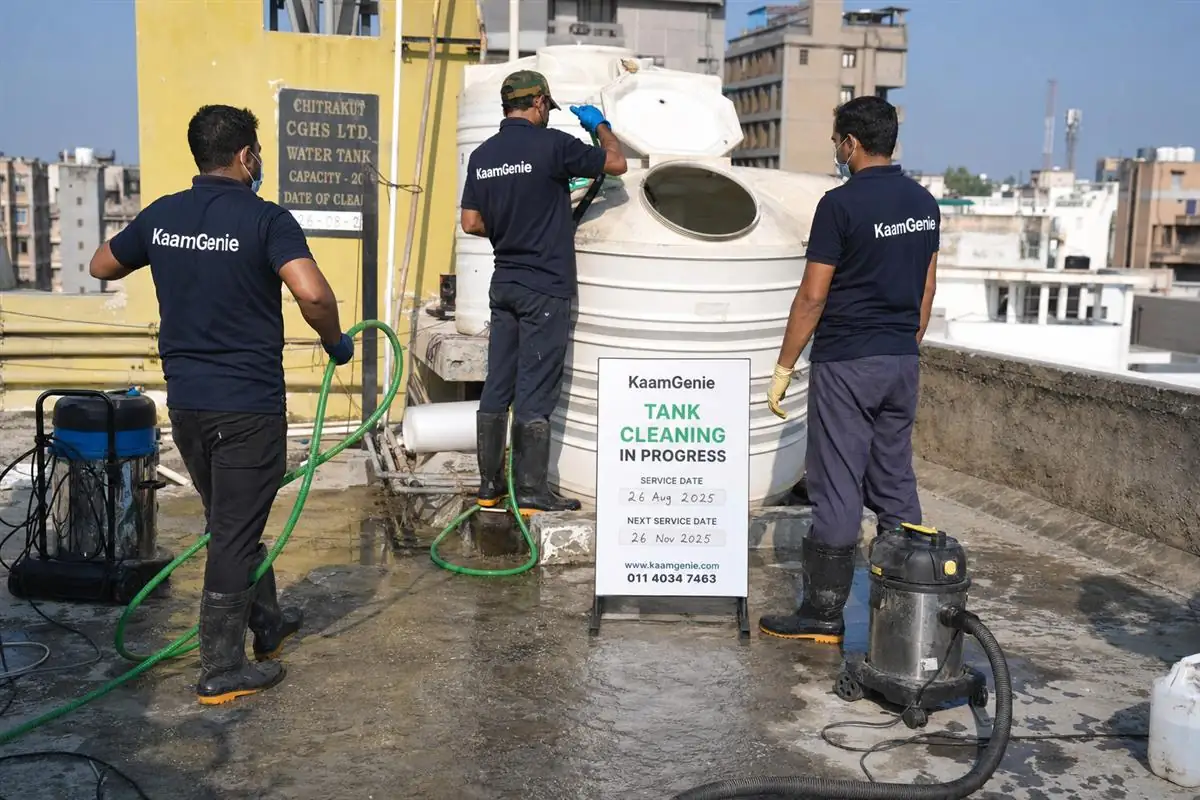
KaamGenie handles CGHS and RWA tank cleaning across Delhi, from mid-rise blocks to large group-housing complexes with multiple towers and sumps. We do a quick site check, quote transparently, and can set a fixed quarterly schedule under an annual maintenance contract at 15–25% off per-visit pricing so your cleaning never lapses between committees. Our crews work within your notified supply-off window to minimise disruption to residents. Call or WhatsApp your committee’s point of contact to 95603 66362, or explore our Delhi water-tank cleaning coverage for details. We are happy to present a written plan and quote directly to your managing committee before any work is approved, so the whole society can see exactly what is being done and why.
Frequently asked questions
Who is responsible for cleaning tanks in a CGHS society?
The common underground sump and shared overhead tanks are society property, so the managing committee or RWA is responsible for cleaning them. Any tank serving a single flat privately stays with that resident. The key is naming one person or role so the task does not fall through the cracks between committee and caretaker, ideally minuted.
How often must a Delhi society clean its shared tanks?
Most Delhi societies clean shared overhead tanks and sumps quarterly, or every six months at minimum. High-density towers and buildings on mixed borewell and DJB supply should stay quarterly. Cleaning around the start and end of monsoon is wise because sumps are more prone to silt and seepage during that season.
Can the cleaning cost be added to society maintenance?
Yes, and it should be. Folding tank cleaning into the annual maintenance budget makes the cost predictable and transparent to residents, and removes the need for repeated committee approvals each time. An annual maintenance contract with a fixed quarterly schedule also runs 15–25% below per-visit pricing, which adds up across several tanks.
What records should an RWA keep for tank cleaning?
Keep a simple log in the society register: the date of each clean, which tanks were covered, capacity, the vendor, and before-and-after photos. This answers resident questions instantly, protects office-bearers if a complaint escalates, and shows the committee has maintained a consistent, responsible cleaning schedule over time rather than acting only when problems appear.
How much notice should residents get before a tank clean?
At least a day. Post a notice or send a WhatsApp message with the date, the expected supply-off window, and a reminder to store drinking water in advance. Residents accept scheduled interruptions easily; they only object to sudden dry taps. A follow-up confirmation with a photo afterward reassures families the shared water is being looked after.
Can KaamGenie clean all the tanks in our CGHS society in one visit?
Usually yes. For a multi-block society we send a crew sized to your number of overhead tanks and sumps and work block by block so water disruption stays short. We give the committee a single consolidated quote and one service record covering every tank, which makes the accounts and audit trail far simpler.
Do you provide a GST invoice the RWA can put in society accounts?
Yes. We issue a proper invoice the treasurer can file against the maintenance fund, along with the dated service record and before and after photos. Having the paperwork matched to each tank helps the committee show residents and any auditor that the spend was genuine and the work was done.
Our society tanks are on a high rooftop with tricky access — is that a problem?
No. Our crew is used to Delhi rooftop and DDA-style access, ladders and tight tank openings. Just tell us at booking if there are locked terrace doors or a caretaker whose presence we need, so we arrive with the right equipment and someone to open up. Call 95603 66362 to arrange access.
How do we handle residents who are away when the tank is cleaned?
The RWA only needs to notify residents of the date and the short water-off window; nobody has to be home for the tank itself. We post the before and after photos and service record to the committee, so absent residents can still see proof the shared tank was cleaned properly.
Can we set up a regular contract instead of calling every time?
Yes. Many Delhi societies prefer a scheduled plan — commonly every three to six months — so cleaning happens automatically and the committee never forgets. We hold your tank details on file, remind you before each due date, and keep a running record. Ask about a society schedule when you call 95603 66362.
Sources & references
- Bureau of Indian Standards (BIS) — IS 10500:2012 is the canonical Indian Standard for drinking water specification, defining acceptable limits for physical, chemical and biological parameters.
- WHO Guidelines for Drinking-water Quality, 4th edition — the global reference for water quality standards, including guidance on safe storage and disinfection.
- Food Safety and Standards Authority of India (FSSAI) — defines water quality requirements for food businesses, including hygiene standards for stored water and acceptable disinfection chemicals.
- WHO Fact Sheet on Drinking Water — overview of safe drinking water requirements and contamination risks.
- CPHEEO — Manual on Water Supply and Treatment — the Government of India’s engineering manual covering tank design, cleaning protocols and disinfection practices.
Last verified: 6 July 2026. If you find any of these links broken, please let us know.