
The short version
- Gurgaon’s borewell and tanker water is very hard — high in dissolved calcium and magnesium.
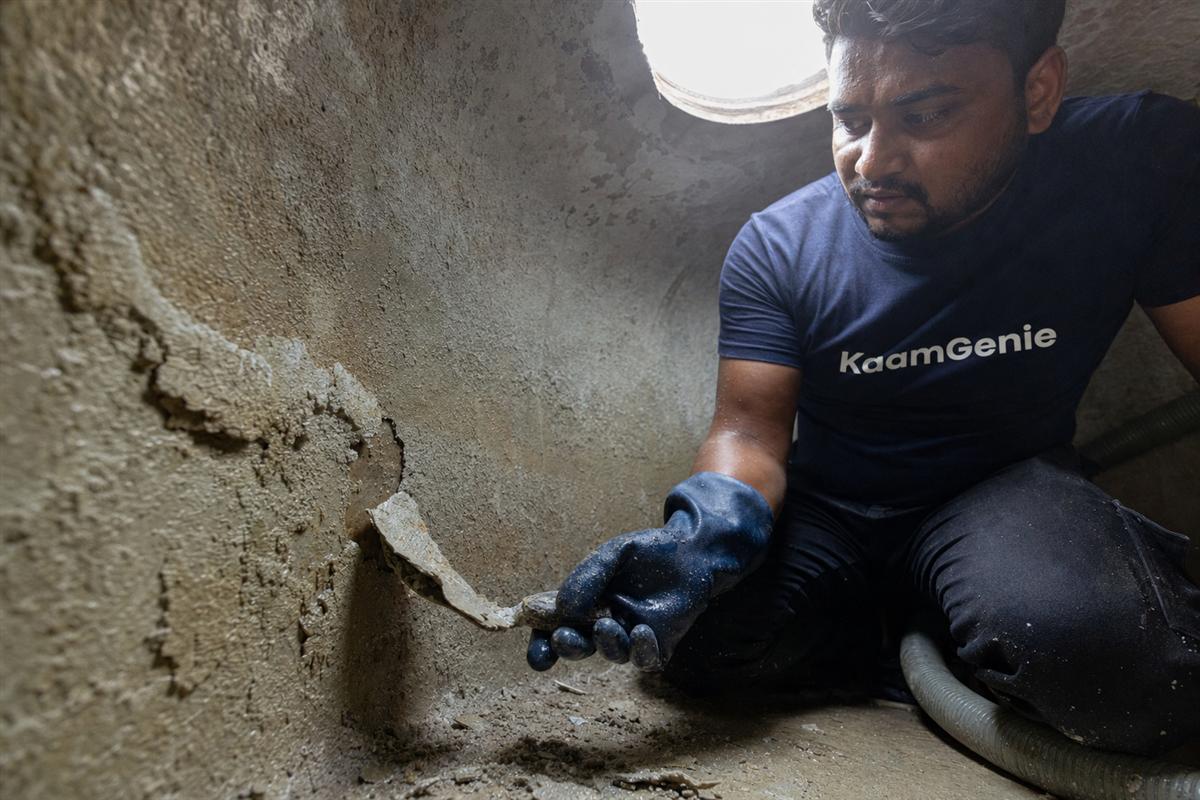
- Those minerals settle out and bake onto tank walls as a chalky scale crust that a rinse cannot remove.
- Scale is porous, so it traps sediment and shelters bacteria — it isn’t just cosmetic.
- Removing set scale needs descaling — a food-grade descaling agent plus mechanical scrubbing, not just water.
- Because scale rebuilds fast here, quarterly cleaning is the realistic Gurgaon norm, not twice a year.
- Tanker-fed buildings need an even tighter cycle — tanker water is usually harder and siltier.
If your cleaner finishes a scaled Gurgaon tank in twenty minutes with just a hose, they left the scale exactly where it was.
Gurgaon — Gurugram on the paperwork — is the Millennium City: DLF colonies, glass-tower corporate parks in Cyber City and Udyog Vihar, luxury condominiums along Golf Course Road, and an endless new-tower belt running down the Southern Peripheral Road (SPR) and Dwarka Expressway. What ties all of it together below ground is water that is genuinely hard, and a heavy dependence on borewells and water tankers to keep supply flowing. That combination is what makes tank cleaning here a different problem from cleaning a tank in central Delhi.
What “hard water” actually means for your tank
Hard water is simply water carrying a lot of dissolved minerals, chiefly calcium and magnesium, picked up as groundwater moves through limestone and mineral-rich strata. You already see its effects everywhere in a Gurgaon home: white spots on glasses, crusty geyser elements, soap that won’t lather, faucet aerators clogging up. The same chemistry plays out inside your storage tank, just out of sight.
When hard water sits in a tank, two things happen. Heavier sediment and silt settle to the floor as sludge. And along the walls, at the waterline, and around fittings, the dissolved calcium and magnesium gradually come out of solution and deposit as a hard mineral crust — what we call scale. It starts as a faint film. Left alone, it thickens into a chalky white-grey layer you can chip with a fingernail but not wipe away.
| Factor | Typical Gurgaon situation | Effect on the tank |
|---|---|---|
| Water source | Heavy reliance on borewells and tankers | More dissolved minerals than treated supply |
| Hardness level | Consistently high calcium & magnesium | Faster, thicker scale on walls and floor |
| Tanker water | Often siltier and harder than piped | More sludge plus more scale together |
| Storage chain | Large underground reservoir feeding rooftop tanks | Two surfaces scaling, not one |
| Tank material | Plastic rooftop tanks, RCC sumps | Porous concrete holds scale hardest |
Got a chalky, scaled-up tank?
We descale, scrub, jet-wash and disinfect — not just rinse. Before/after photos and a certificate every job. ₹699 onwards.
Why a rinse won’t touch hard-water scale
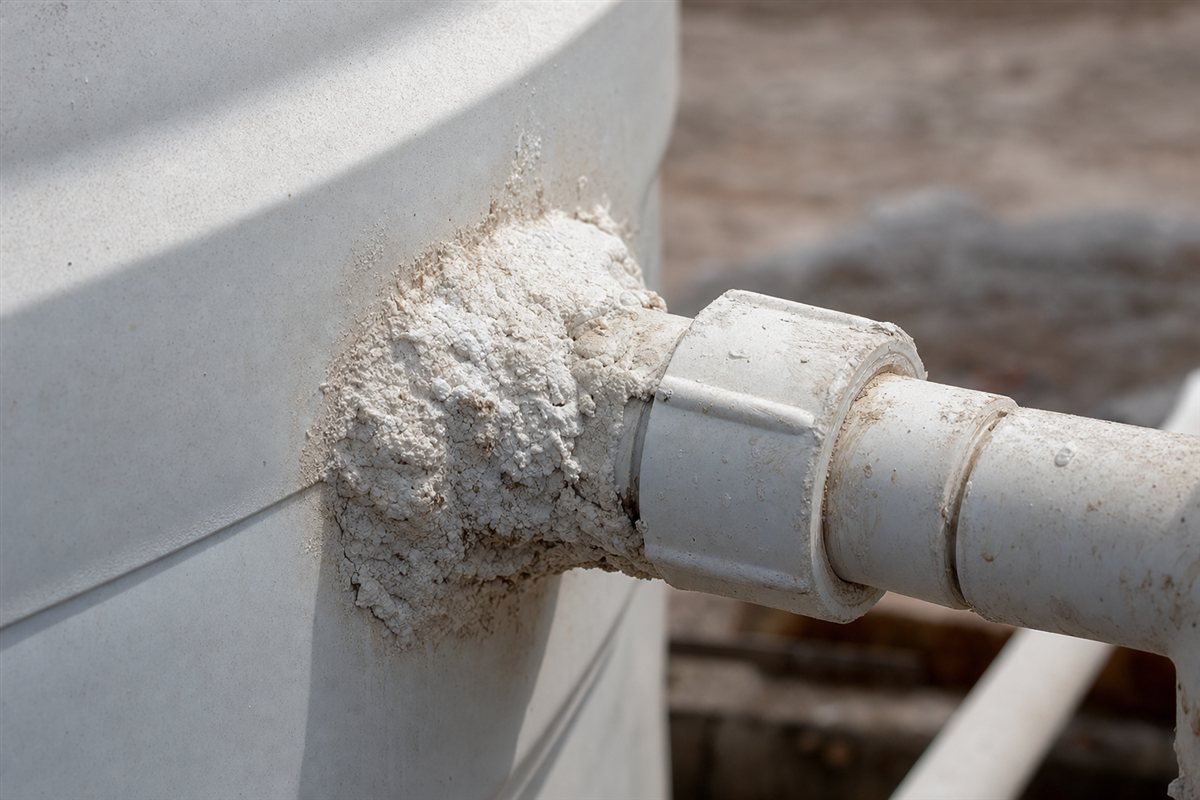
This is the part most people get wrong, and the part cheap operators exploit. Ordinary tank dirt — dust, silt, dead insects, soft sludge — is loose. A drain and a hose move most of it. Hard-water scale is different. It is a bonded mineral deposit, chemically stuck to the wall the way limescale fuses to a kettle. Spray water at it and the water just runs off a hard, rough surface that stays exactly where it was.
Removing set scale needs two things working together: a mild food-grade descaling agent that chemically softens and dissolves the calcium carbonate, and mechanical scrubbing with food-grade nylon brushes to lift the loosened crust off the wall. Then the tank is jet-washed, vacuumed, and disinfected so nothing is left behind. We never use harsh industrial acid or metal scrapers, because those pit plastic tanks and etch concrete, creating even more surface for the next round of scale to grab onto. If you want the full step-by-step of how a proper clean runs start to finish, our 8-step cleaning process walks through it; descaling is the extra stage we add for hard-water cities like Gurgaon.
Scale isn’t just ugly — it’s a hygiene problem
It would be easy to dismiss scale as cosmetic. It isn’t. The reason matters: scale is porous and rough. A clean, smooth tank wall gives bacteria very little to cling to. A scaled wall is full of microscopic pits and ridges — an ideal surface for bio-film to take hold and for sediment to lodge where a hose can’t reach. So a heavily scaled Gurgaon tank tends to grow the organisms behind stomach upsets and skin irritation faster than a clean one would, even with the same water going in.
Scale causes mechanical trouble too. It crusts up float valves so they stick open or shut, it narrows outlet fittings and slows your flow, and it shortens the life of every metal fitting in the system. By the time the water at your tap looks or tastes off, the tank has usually been scaled for a while — the warning signs show up downstream of a problem that started on the walls months earlier.
How fast scale rebuilds in Gurgaon — and what that means for frequency
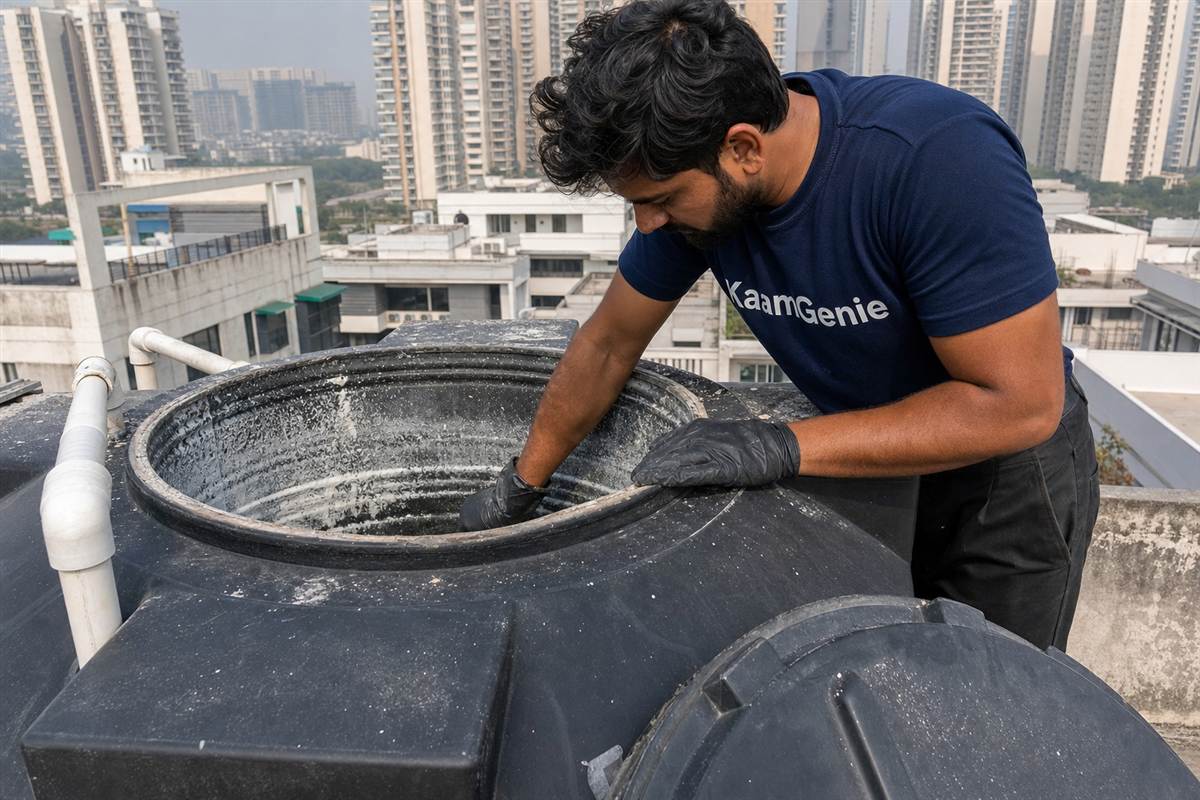
Across most of Delhi NCR the standard advice is to clean your tank twice a year. In Gurgaon, the hard water rewrites that maths. Because minerals deposit continuously, scale doesn’t wait for your annual schedule — a tank cleaned spotless in January can carry a visible film again by spring and a real crust by mid-year. The longer you leave it, the thicker and more stubborn the crust, and the more aggressive the descaling needed to remove it.
That is why the practical norm here is quarterly — every three months. Cleaning on a tighter cycle keeps the scale thin enough to come off cleanly and gently, instead of letting it bake into a layer that needs heavy descaling. It is the same logic as wiping a kettle weekly versus battling a year of limescale. For a fuller breakdown of timing by tank type and household, see our guide on how often to clean your water tank in Gurgaon.
Typical scale build-up on a Gurgaon tank wall by months since last cleaning
Borewell/tanker-fed tank — the longer the gap, the harder the crust is to remove
Indicative pattern from tanks we clean across Gurgaon, not a lab measurement. The exact rate depends on your water source and how full the tank runs — tanker-fed and borewell-fed tanks scale at the faster end.
The tanker connection — why parts of Gurgaon scale worst
Gurgaon’s reliance on water tankers isn’t a side note — for many buildings it’s the main supply. New high-rise belts along the Dwarka Expressway and SPR, independent builder floors waiting on piped connections, and whole pockets with patchy municipal supply lean on tankers to fill their underground reservoirs. The catch is that tanker water is usually drawn from borewells and is frequently harder and siltier than treated municipal supply. So it loads the tank with more dissolved minerals (faster scale) and more suspended sediment (more sludge) at the same time.
For these buildings the storage chain matters too. A large underground reservoir (UGR) takes the tanker delivery, then pumps up to rooftop tower tanks. That’s two sets of surfaces collecting scale and silt, not one, which is exactly why tanker-dependent societies tend to run the shortest cleaning cycles in the city. If your building runs on tankers, the case for descaling on a quarterly schedule is strongest of all — we cover the supply side in detail in our piece on tanker water and tank cleaning in Gurgaon.
What this looks like across Gurgaon’s neighbourhoods
The scale problem is city-wide, but it shows up a little differently by area. The established DLF colonies and luxury condominiums — think the towers around DLF Phase 5 and Golf Course Road — usually run large UGR-to-rooftop systems where descaling both the reservoir and the tower tanks on a schedule keeps the whole chain healthy. The newer condominium and builder-floor belt along Sohna Road and the SPR is heavily tanker-fed, so those tanks scale and silt fastest. And out in Sector 82 and the New Gurgaon sectors, a mix of high-rises and independent floors all draw on the same hard groundwater, so the quarterly habit pays off everywhere.
Wherever you are, the fix is the same crew and the same method. You can see coverage, pricing and how to book on our main page for water tank cleaning in Gurgaon, and the wider NCR offering on our water tank cleaning services page. If you’re weighing it all up first, the complete Gurgaon water tank cleaning guide pulls the whole picture together.
Stay ahead of the scale
Put your Gurgaon tank on a quarterly descale-and-clean cycle — thin scale comes off gently, and your water stays clean. Standard residential ₹699 onwards.
Book hard-water tank cleaning across Gurgaon
If your tank is overdue, or you’ve never had it descaled despite years on hard borewell or tanker water, this is the job to book. Our crew assesses the scale on arrival, descales properly with food-grade agents, scrubs, jet-washes, disinfects, and hands you before/after photos and a certificate — no rinse-and-run. See pricing and coverage on our water tank cleaning in Gurgaon page, then call +91 95603 66362 or use the booking form on this site and we’ll confirm shortly.
Frequently asked questions
Why is Gurgaon’s tap and borewell water so hard?
Most of Gurgaon’s groundwater is drawn from deep aquifers running through limestone and mineral-rich strata, so it carries high levels of dissolved calcium and magnesium. Those are the minerals that define water hardness. Whether you get municipal supply, borewell water, or tanker water, the bulk of it is hard, and large parts of the city lean heavily on borewell and tanker sources where hardness is highest.
How does hard water actually damage a water tank?
Hard water doesn’t damage the tank structure so much as coat it. As water sits and evaporates slightly at the surface and along the walls, dissolved calcium and magnesium come out of solution and deposit as a chalky white-grey scale. Over months this builds into a crust on the walls, floor, float valve, and outlet. The scale is porous, traps sediment and bio-film, and is impossible to wipe off by hand once it sets.
How often should I clean my tank in Gurgaon because of hard water?
In most of Delhi NCR the standard advice is twice a year. In Gurgaon, because of the hard borewell and tanker water, quarterly (every three months) is the realistic norm for homes that want to stay ahead of scale, and many societies on the Southern Peripheral Road and Dwarka Expressway belt move to a quarterly cycle for the same reason. If your supply is especially hard or tanker-dependent, every three months keeps the scale thin enough to remove cleanly.
Can’t I just rinse the tank myself to remove the scale?
No. A rinse moves loose dust and water around, but hard-water scale is a bonded mineral crust, not loose dirt. It does not come off with water pressure or a wipe-down. Removing it needs mechanical scrubbing plus a mild food-grade descaling agent that dissolves the calcium carbonate, followed by a thorough rinse and disinfection. That is the difference between a rinse and a real cleaning.
Does a water softener or RO mean I don’t need tank cleaning?
No. An RO purifier treats only the small amount of water you drink, after it has already passed through the tank. A whole-house softener helps downstream of the tank, but the tank itself usually stores raw hard water before any treatment, so scale still forms on its walls and floor. Treating the water at the point of use does not keep the storage tank clean.
What is descaling and how is it different from a normal cleaning?
A normal cleaning drains the tank, removes sludge, scrubs, jet-washes, and disinfects. Descaling adds a step for hard-water tanks: a mild food-grade acidic or descaling solution applied to the mineral crust to soften and dissolve it, so it can be scrubbed away without gouging the tank. Without descaling, the crew can only clean the surface dirt and leave the bonded scale behind, which is why Gurgaon tanks specifically need this extra step.
Does tanker-supplied water make the scale problem worse?
Often yes. A lot of Gurgaon, especially newer high-rise belts and areas with patchy piped supply, runs partly or wholly on water tankers. Tanker water is usually drawn from borewells and is frequently harder and siltier than treated municipal supply, so it loads the tank with both more dissolved minerals and more suspended sediment. That combination accelerates scale and sludge, which is exactly why tanker-fed buildings need a tighter cleaning cycle.
Will descaling damage my plastic or RCC tank?
Not when done correctly. We use food-grade descaling agents at controlled concentration and food-grade nylon brushes, never metal scrapers or harsh industrial acid that can pit plastic or etch concrete. RCC (concrete) tanks actually hold scale harder because of their porous surface, so they need careful descaling rather than aggressive scraping. The crew matches the method to the tank age and material.
Is hard-water scale actually unsafe, or just ugly?
Calcium scale itself is not toxic, but it is a problem. The crust is porous and rough, which gives bacteria and bio-film a perfect surface to colonise where smooth tank walls would not. Scale also traps sediment, can harbour the organisms behind stomach upsets, and clogs float valves and outlets. So it is not just cosmetic, it makes the tank harder to keep hygienic and shortens the life of the fittings.
How much does hard-water tank descaling cost in Gurgaon?
Standard residential overhead tank cleaning starts at ₹699 onwards, which covers the full drain, scrub, jet-wash, and disinfection. Heavy descaling on a badly scaled tank, underground reservoirs (UGR), and society or commercial jobs are quoted custom because they take longer and use more descaling agent. The crew assesses the scale thickness on arrival and tells you honestly whether a standard clean or a descaling job is needed.
Sources & references
- Bureau of Indian Standards (BIS) — IS 10500:2012 is the canonical Indian Standard for drinking water specification, defining acceptable limits for physical, chemical, and biological parameters including total hardness.
- WHO Guidelines for Drinking-water Quality, 4th edition — the global reference for water quality standards, including guidance on storage and disinfection.
- Food Safety and Standards Authority of India (FSSAI) — defines water quality requirements for food businesses, including hygiene standards for stored water and acceptable disinfection chemicals.
- WHO Fact Sheet on Drinking Water — overview of safe drinking water requirements and contamination risks.
- CPHEEO — Manual on Water Supply and Treatment — the Government of India’s engineering manual covering tank design, cleaning protocols, and disinfection practices.
Last verified: 29 June 2026. If you find any of these links broken, please let us know.