
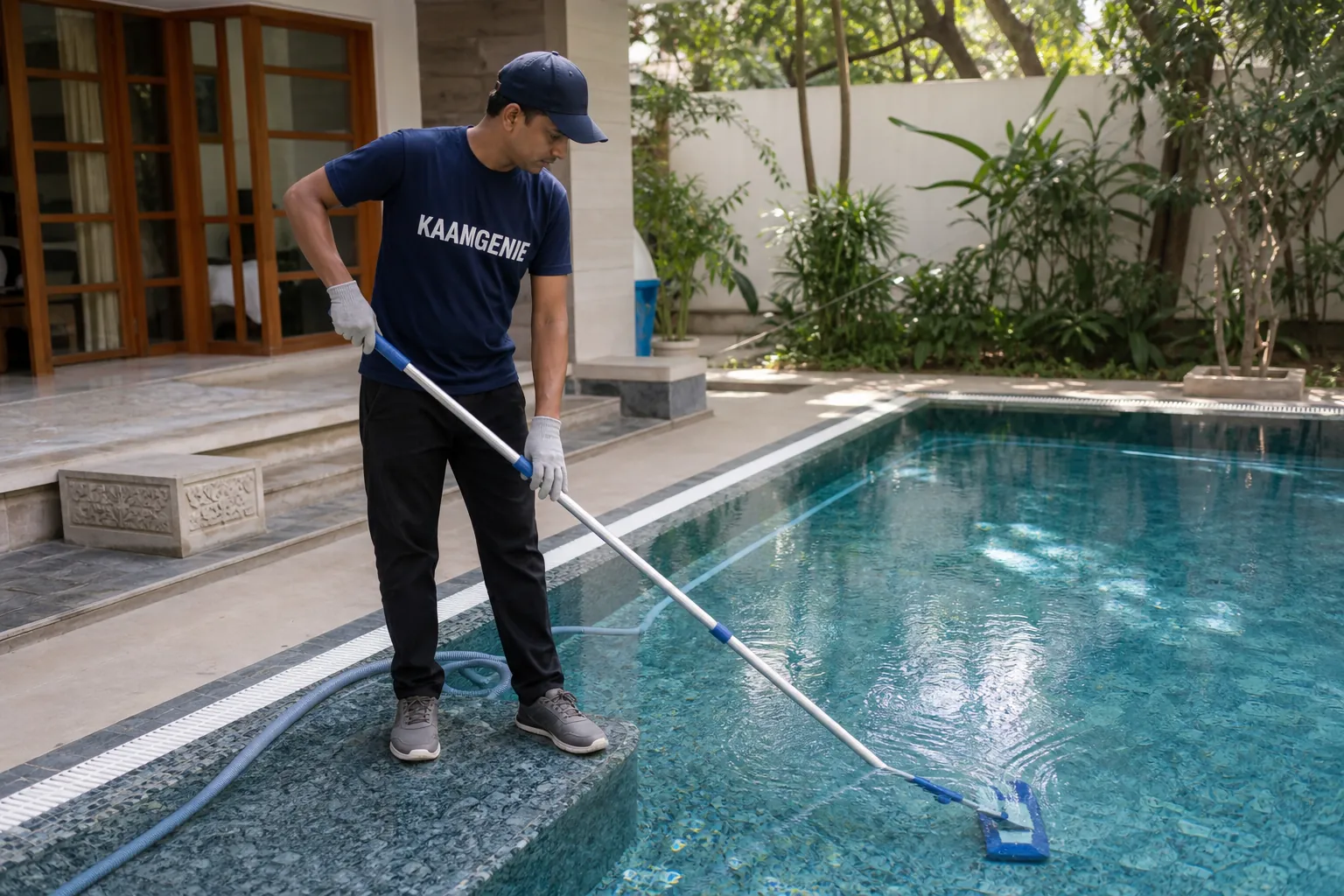
Quick answer
- Skim floating debris off the surface and empty the skimmer and pump baskets.
- Brush the walls, steps and floor to loosen dirt and early algae.
- Vacuum the loosened debris off the floor.
- Clean or backwash the filter so it runs efficiently.
- Test and balance the water: chlorine, pH 7.2–7.6 and alkalinity.
- Call a professional for a green or heavily soiled pool.
Cleaning a pool is a sequence, and the order matters. If you vacuum before you brush, you leave dirt clinging to the walls. If you test the water before you have cleaned it, your readings are meaningless. Follow the steps below from top to bottom and you cover everything a home pool needs in a single session. We clean swimming pools across Delhi NCR, from South Delhi, Dwarka and Gurgaon to Noida and Ghaziabad, so this method is written for the dust, heat and monsoon runoff that pools in this region actually face.
What you need before you start
Gather your kit before you begin so you are not walking back and forth mid-clean. The core tools are a telescopic pole, a skimmer net that clips onto it, a pool brush, and a vacuum head with a hose. You will also want a water test kit or test strips that read chlorine, pH and alkalinity, plus your chemicals: a chlorine product, pH increaser and reducer, and an alkalinity increaser. Keep a bucket handy for pre-dissolving granular chemicals, and wear gloves when you handle them. Check that your pump and filter are running before you touch the water, because circulation is what carries dirt to the filter and spreads the chemicals evenly afterwards. In Delhi, a lot of pool trouble comes down to fine dust and tree litter settling faster than people expect, so having the kit ready to use weekly is half the battle. Regular swimming pool cleaning is far easier to keep up than a rescue job on a neglected pool.
Step 1: Skim the surface and empty the baskets
Always start at the top of the water. Use the skimmer net on your telescopic pole to lift out floating leaves, insects, flower petals and any surface film before they sink and become harder to remove. Work methodically around the whole pool, then sweep the middle where debris tends to gather. Skimming first matters because anything you leave floating will settle onto the floor within hours and turn a quick clean into a heavy vacuum job. Once the surface is clear, empty the skimmer basket set into the pool wall and the basket inside the pump. Both trap debris that would otherwise choke water flow, and a blocked basket starves the filter and strains the pump motor. Give them a quick rinse with a hose, seat them back firmly, and check that water is flowing freely again. In dusty Delhi conditions and through the leaf-fall of autumn, these baskets fill faster than you would think, so a weekly empty is the minimum through the swimming season.
Step 2: Brush the walls, steps and floor
With the surface clear, attach the pool brush to your pole and scrub every internal surface. Work from the shallow end toward the deep end and from the top of the walls downward, so that everything you loosen drifts toward the floor where you can vacuum it up next. Pay close attention to the spots where dirt and algae take hold first: the steps, the corners, the waterline, and any shaded areas that stay damp. Brushing does two jobs at once. It lifts settled grime and biofilm off the surfaces, and it disturbs the earliest stage of algae before it can root and spread, which is exactly what keeps a pool from turning green in Delhi’s heat. Use firm, overlapping strokes and do not rush the tiled or textured areas, because these hold the most buildup. If you feel a slippery film under the brush, that is early algae and it is a signal to brush thoroughly and then check your chlorine level once you reach the testing step. A pool that is brushed every week rarely develops the stubborn stains that a neglected one does.
Book a professional swimming pool clean
Trained crew, proper equipment, before/after photos and a service record every job. One-time and deep cleans, same-day where possible across Delhi NCR.
Step 3: Vacuum the pool floor
Now that everything loose has drifted to the bottom, vacuum it away. Attach the vacuum head to your pole, connect the hose, and prime it by filling the hose with water so no air is left inside, then connect it to the skimmer suction port. Move the vacuum head slowly across the floor in long, overlapping passes, the way you would vacuum a carpet, so you lift the fine silt instead of kicking it back into the water. Go especially slowly in the deep end and around drains where the heaviest debris collects. If you rush and stir up a cloud, stop, let it settle for an hour, and resume. For pools that have collected a lot of sediment, set the filter valve to the waste or drain position while vacuuming so the dirt bypasses the filter and goes straight out, which saves you clogging the filter with heavy muck. A manual vacuum takes patience, but it is the step that gives you a genuinely clean floor rather than a merely clear surface. If you own an automatic or robotic cleaner, this is where it does the same job while you move on to the filter.
Step 4: Clean the filter or backwash it
The filter is the organ that keeps your water clear between manual cleans, so it needs attention too. What you do depends on the type. A sand or diatomaceous earth filter is cleaned by backwashing: you set the multiport valve to backwash and run the pump, which reverses the flow and flushes the trapped dirt out to waste, then you rinse and return the valve to filter. Backwash when the pressure gauge climbs about 8 to 10 psi above its clean reading, which for most home pools is roughly once every week or two. Do not backwash more often than needed, because a lightly dirty sand bed actually filters finer particles than a spotless one. A cartridge filter is different: you switch off the pump, remove the cartridge, and hose it down thoroughly, replacing it once it no longer rinses clean. After any filter clean, top the pool back up to its normal level, because backwashing sends a fair amount of water to waste. A neglected filter is one of the most common reasons a Delhi pool stays slightly cloudy no matter how much you brush and vacuum.
Step 5: Test and balance the water
The final step is chemistry, and it comes last because you want to balance clean, circulating water rather than dirty water. Use your test kit or strips to read three things. Chlorine keeps the water disinfected and should sit in the range your kit marks as safe for swimming. pH should sit between 7.2 and 7.6, the band where water feels comfortable, protects the surfaces and lets chlorine work at full strength. Total alkalinity should sit between 80 and 120 ppm, because it acts as a buffer that stops the pH from swinging around. Adjust in the right order: correct alkalinity first, then pH, then chlorine, dosing in small amounts and retesting rather than tipping everything in at once. Pre-dissolve granular products in a bucket of water where the label advises it, and add chemicals with the pump running so they circulate. Delhi’s heat burns off chlorine quickly and heavy monsoon rain dilutes and unbalances the water overnight, so plan to test at least twice a week through summer and after any storm. Give the pump a few hours to mix everything, then retest before anyone swims.
When to call a professional
Weekly skimming, brushing and balancing is well within a homeowner’s reach, but some situations are genuinely a job for trained hands. If the water has turned green, gone cloudy, or developed a strong smell, the pool needs correct shock dosing and heavy vacuuming that are easy to get wrong, and a badly balanced rescue can waste a lot of chemicals or even irritate swimmers. The same applies to a pool that has sat unused for weeks, where algae and sediment have had time to take hold, or one where algae keeps coming back no matter how you dose it. A green or neglected pool is usually best handed to a proper deep cleaning rather than fought with a home kit. It is also worth booking a professional for the season-opening clean and before large gatherings, when you want the water reliably right. KaamGenie does one-time and deep pool cleans, not ongoing maintenance contracts, and pool pricing depends on the size and condition of the pool, so it is quoted after a visit rather than fixed online. You can see typical ranges in our swimming pool cleaning cost guide, then call for a quote for your pool.
Frequently asked questions
How do I clean a swimming pool step by step?
Start by skimming floating leaves and debris off the surface, then empty the skimmer and pump baskets. Brush the walls, steps and floor to loosen dirt and early algae. Vacuum the settled debris off the floor, then clean or backwash the filter. Finish by testing the water and balancing chlorine, pH and alkalinity. Run the pump for a few hours so everything mixes and circulates. If the pool is green or heavily soiled, call a professional instead of doing it yourself.
How long does it take to clean a swimming pool?
A routine weekly clean of a clear residential pool takes about 45 minutes to an hour and a half, covering skimming, brushing, vacuuming, a filter check and water testing. A pool that has been neglected, or one that has turned green, takes much longer because it needs heavier vacuuming, shock dosing and often a day or two for the water to clear. Larger society pools take proportionally longer and usually need a trained crew.
What chemicals do I need to balance pool water?
The three you check most often are chlorine, pH and total alkalinity. Chlorine keeps the water disinfected, pH should sit between 7.2 and 7.6 so the water is comfortable and the chlorine works, and alkalinity between 80 and 120 ppm keeps the pH stable. You will use a chlorine product such as trichlor or stabilised granules, plus pH increaser or pH reducer and an alkalinity increaser as needed. Test first, then dose in small steps and retest, rather than adding everything at once.
How often should I backwash the pool filter?
For a sand or DE filter, backwash when the pressure gauge reads about 8 to 10 psi above its clean starting pressure, which for most home pools works out to once every week or two. Backwashing too often is wasteful and actually reduces filtering, because a lightly dirty sand bed traps particles better. A cartridge filter is not backwashed at all; you remove the cartridge and rinse it with a hose, and replace it when it stops coming clean.
When should I call a professional pool cleaner instead of doing it myself?
Call a professional when the water is green, cloudy or smells bad, when algae keeps returning despite dosing, or when the pool has sat unused for weeks. These situations need correct shock dosing, heavy vacuuming and sometimes equipment checks that are hard to judge by eye. It is also worth booking a professional for the season-opening clean, before large gatherings, or any time you are unsure about chemical safety. KaamGenie handles one-time and deep cleans across Delhi NCR; call 95603 66362 for a quote.
Sources & references
- Bureau of Indian Standards (BIS): IS 3328 and related standards cover swimming pool water quality and the acceptable limits for physical, chemical and biological parameters.
- WHO Guidelines for Safe Recreational Water Environments: the global reference on pool water quality, disinfection and safe use.
- Food Safety and Standards Authority of India (FSSAI): defines water quality and hygiene standards, including acceptable disinfection chemicals for stored water.
- WHO Fact Sheet on Drinking Water: overview of safe water requirements and contamination risks relevant to stored and recreational water.
- CPHEEO Manual on Water Supply and Treatment: the Government of India engineering manual covering disinfection practices and water treatment.
Last verified: 20 August 2026. If you find any of these links broken, please let us know.