
Quick answer
- First identify the algae type: green, black, or mustard/yellow, because each needs a slightly different approach.
- Brush the affected walls, steps and floor to break up the growth so chlorine can reach it.
- Test and balance the pH to roughly 7.2 to 7.4 before you treat.
- Shock the pool by superchlorinating at the right dose for its volume, adding shock after dusk.
- Add a suitable algaecide and run the filter continuously until the water clears.
- Vacuum out the dead algae and clean the filter once the water turns from green to cloudy blue.
- Black algae and a fully green pool usually need a professional deep clean.
Algae is a living plant, and like every plant it needs light, warmth and nutrients to grow. A swimming pool in Delhi supplies all three in abundance for much of the year, which is why a pool that looked crystal blue on Friday can turn cloudy green by Monday. The trick to beating it is not a single miracle chemical, it is a sequence done in the right order: work out what you are dealing with, break up the growth mechanically, get the water chemistry right, then hit it hard with chlorine and an algaecide while the filter does the heavy lifting. Below we cover how to tell the three main algae types apart, why Delhi conditions favour blooms, and the exact steps for each one.
How to identify green, black and mustard algae
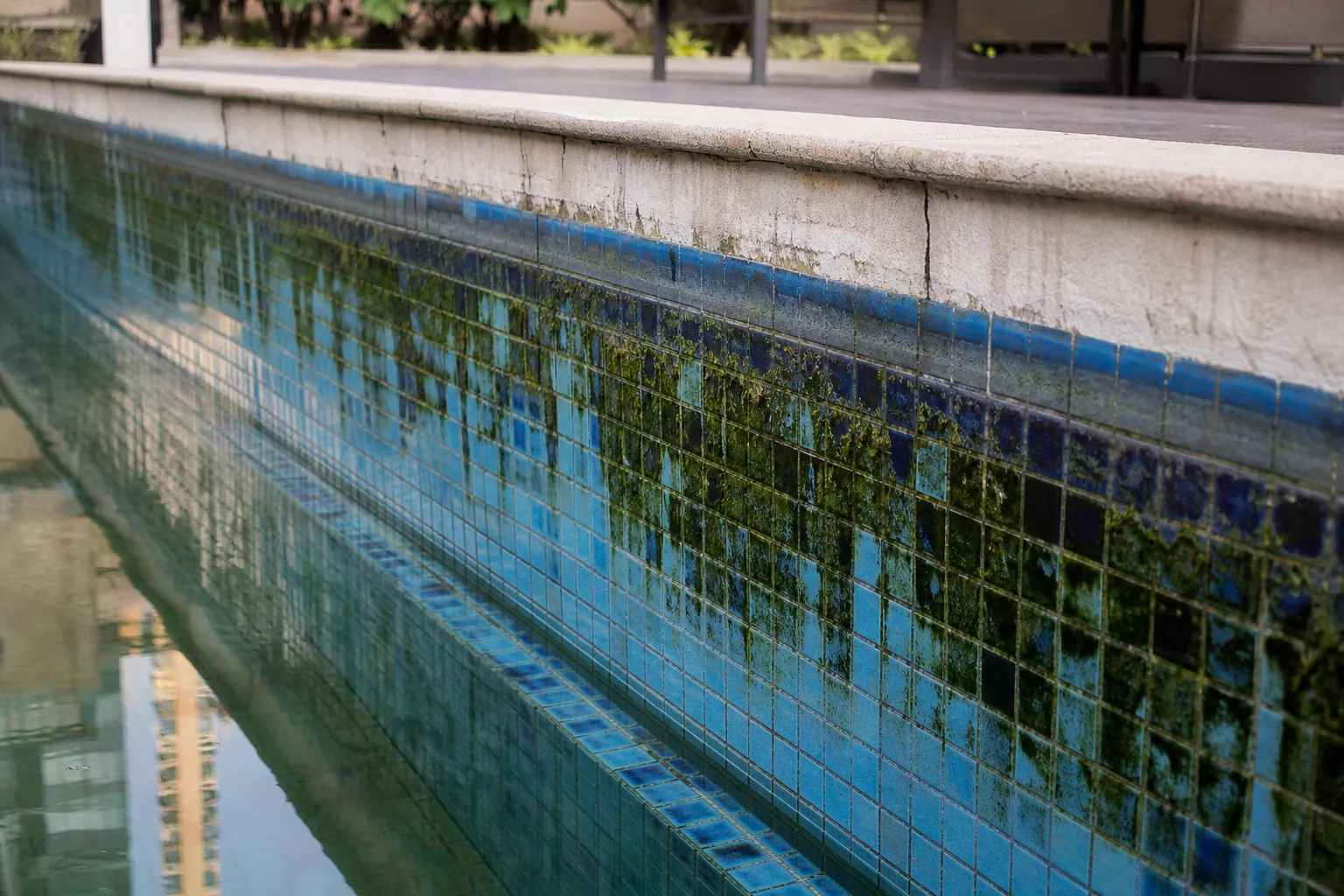
Getting the identification right saves you time and chemicals, because the three common algae behave very differently. Green algae is the one everyone knows: it turns the whole pool a cloudy green, coats the walls and floor in a slimy film, and makes surfaces slippery underfoot. It is the fastest to appear and, thankfully, the easiest to clear if you catch it early. Black algae is the opposite: it shows up as small, dark green or almost black raised spots, usually on rough plaster, tile grout or shaded corners, and each spot has roots that burrow into the surface and a waxy layer that shrugs off ordinary chlorine. Mustard or yellow algae sits somewhere in between, appearing as a fine yellow or brownish powder that looks almost like sand or pollen settled on the floor and shaded walls; it wipes away with a brush but drifts back within a day because it clings stubbornly to nets, ladders and swimwear. If you can name the colour and texture, you already know most of what you need to plan the fix.
Why algae blooms in Delhi pools
Delhi gives algae close to ideal growing conditions for a long stretch of the year. Through the peak summer, water temperatures in an outdoor pool climb well past the point where algae multiplies quickly, and the intense sun both feeds photosynthesis and burns off free chlorine faster than many owners expect, so a level that read fine in the morning can be gone by evening. Then the monsoon arrives and adds its own problems: rain dilutes the chlorine, wind carries in dust, leaves and spores, and runoff brings a fresh load of nutrients that algae feeds on. Add the usual human factors, an under-run filter, a pump switched off to save electricity, patchy testing during a busy week, and the bloom has everything it needs. This is why prevention in Delhi is really about consistency: holding a steady sanitiser level and good circulation matters far more here than in a cooler, cloudier climate. Understanding the cause also explains why a one-off treatment rarely holds unless you fix the routine behind it.
Step-by-step green algae removal
Green algae responds well to a methodical home treatment if the pool is only lightly to moderately affected. Start by testing the water and balancing the chemistry, because chlorine works far better when the pH sits around 7.2 to 7.4; if the pH is high, bring it down first or your shock will be largely wasted. Next, brush every affected surface, the walls, steps, floor and any shaded corners, to break up the algae film so the chlorine can actually reach and kill it. With the water balanced and brushed, shock the pool by superchlorinating: for a light green pool a double dose of shock is usually enough, and you should always add it after dusk so the sun does not burn it off before it can work. Follow the shock with a suitable algaecide to mop up what the chlorine misses, then run the filter continuously for 24 to 48 hours so it can pull the dead algae out of the water. As the pool shifts from green to a cloudy blue-grey, you are winning. Finally, once the water clears, vacuum out the settled dead algae and clean or backwash the filter, which will now be full of what it captured. A pool caught early can look blue again within a day or two, though a badly neglected one may take several cycles.
Book your swimming pool cleaning
Trained crew, proper testing and dosing, before/after photos and a service record every job. Same-day where possible across Delhi NCR, price quoted on a visit.
Treating stubborn black algae
Black algae is the hardest of the three to shift, and it rewards patience over brute force alone. Those dark raised spots are protected by a tough outer layer and anchored by roots that reach into the pool surface, which is exactly why a normal chlorine level barely touches them: the sanitiser cannot get through the coating to the living cells underneath. The fix begins with a hard mechanical scrub of every spot, using a stiff or, for plaster and concrete pools, a stainless steel algae brush to physically break that protective layer open. Once a spot is scoured, spot-treat it directly, many owners rub a chlorine tablet straight onto the spot or apply a thick paste made from pool shock so a concentrated dose sits right on the exposed roots. With the pool as a whole, shock at a raised dose after dusk, keep the filter and pump running around the clock, and brush again the next day. Because black algae regrows from any roots that survive, you should re-shock after a day or two and keep inspecting the treated spots for a week or more. Even done carefully, black algae in a plaster pool with deep-rooted colonies often defeats a home routine, and a swimming pool deep cleaning visit, where the surface can be worked properly and dosed correctly, is usually the more reliable route for a badly infested pool.
Treating mustard or yellow algae
Mustard algae, sometimes called yellow algae, is less dramatic than a full green bloom but frustrating because it comes back so readily. The powdery yellow film brushes off surfaces easily, which fools people into thinking the job is done, but it survives at chlorine levels that would kill green algae and it hides on everything that touches the water. To clear it, first balance the water and check that your chlorine is holding, then brush every surface thoroughly, paying attention to shaded walls and the pool floor where the dust settles. Shock at a raised dose, roughly the same higher level you would use for a heavy bloom, and add a mustard-specific algaecide, since ordinary algaecides are often less effective against this variety. The step people miss, and the reason it keeps returning, is decontaminating everything that entered the pool: nets, poles, brushes, floats, toys, ladders and even swimwear can all harbour spores, so soak or sanitise them alongside the treatment or they will simply reinfect the clean water. Brush daily and keep the filter running for a few days, and re-test before you declare victory.
Preventing algae from coming back
Every treatment above is wasted effort if the pool drifts back into the conditions that grew the algae in the first place, so prevention is where the real saving lies. The single most important habit in Delhi is holding a steady, adequate chlorine level, because the summer sun burns it off quickly and a pool that dips to zero for even a day can start to bloom. Test the water two or three times a week in peak season, and keep the pH balanced so the chlorine you add actually works. Run the filter and pump long enough each day, dead spots with no circulation are exactly where algae takes hold, and clean or backwash the filter regularly so it is not just moving spores around. Brush the walls and floor weekly even when the water looks clear, since brushing disrupts colonies before they are visible. After heavy monsoon rain, test and re-balance promptly, because the dilution and runoff are a classic trigger. Finally, keep your equipment clean, the same nets and toys that spread mustard algae will happily spread the others too. None of this is difficult, but it has to be consistent, which is why many Delhi households simply book a regular pool clean rather than manage it themselves.
When to call a pro or book a deep clean
Some blooms are genuinely a home fix, and some are not, and knowing the difference saves you days of chasing a pool that will not clear. If the water is only lightly green and you can still see the bottom, the step-by-step green routine above will very often bring it back. But if the pool has gone fully opaque green so you cannot see the floor, if you are dealing with established black algae rooted into plaster, or if a mustard or green bloom keeps returning within days no matter what you do, the pool has passed the point where chemicals alone will fix it efficiently. At that stage the water usually needs to be worked mechanically, dosed accurately for its true volume, and in the worst cases partly or fully drained and scrubbed, which is what a professional swimming pool cleaning or a full deep clean is built for. KaamGenie handles one-time and deep cleans rather than ongoing maintenance contracts, so if you want a standing arrangement we will talk you through what a repeat visit schedule looks like, quoted after we see the pool. We remove algae and deep-clean pools across Delhi NCR, from South Delhi, Dwarka and Gurgaon to Noida and Ghaziabad. We do not quote fixed pool prices online because size, condition and access vary so much; you can see how pricing is worked out on our swimming pool cleaning cost page, and the exact figure is confirmed on a visit. Call KaamGenie on 95603 66362 and we will get a green pool blue again.
Frequently asked questions
How do I get rid of green algae in my pool?
Test and balance the water so the pH sits around 7.2 to 7.4, then brush every affected wall, step and floor to break up the algae. Shock the pool with a strong chlorine dose, add a suitable algaecide, and run the filter continuously for 24 to 48 hours. Once the water clears from green to cloudy blue, vacuum out the dead algae and clean or backwash the filter. A lightly green pool clears in a day or two; a fully green pool usually needs a professional deep clean.
What is black algae and how do I remove it?
Black algae shows up as small dark green or black spots with roots that dig into plaster and grout, most often on shaded or rough surfaces. It resists normal chlorine because of a protective layer, so you must break that layer first. Scrub each spot hard with a stiff or stainless brush, spot-treat with a chlorine paste, then shock the whole pool at a raised dose and re-shock after a day or two. Because the roots regrow if any survive, badly affected pools are best handled with a professional deep clean.
What is mustard (yellow) algae and how do I treat it?
Mustard or yellow algae looks like fine yellow or brownish dust or sand on the pool floor and shaded walls, and it brushes away easily but returns fast because it clings to equipment. Balance the water, brush every surface, then shock at a raised dose and add a mustard-specific algaecide. Brush again daily and run the filter continuously. Because it hides on nets, brushes, toys and swimwear, clean or sanitise anything that touched the water or it will reinfect the pool.
How much shock do I need to kill pool algae?
For a light green pool, a double dose of chlorine shock is usually enough; for a heavily green, black or mustard pool you may need a triple dose. Always follow the product label for your pool volume, and add shock after dusk so sunlight does not burn it off before it works. Keep the filter running and re-test the next day, repeating the shock if the water has not turned from green to cloudy blue.
Why does algae keep coming back in my pool?
Algae returns when the underlying conditions are never fixed: low or unstable chlorine, high pH, poor circulation, a dirty filter, or spores left on equipment and pool toys. Delhi heat and sun burn off chlorine quickly, and monsoon runoff adds fresh nutrients, so a pool that is not maintained blooms again within days. Hold a steady chlorine level, keep the pH balanced, run the filter long enough each day, brush weekly and sanitise your equipment to stop it returning.
Sources & references
- Bureau of Indian Standards (BIS): IS 3328 and related standards cover swimming pool water quality and disinfection practice in India.
- WHO Guidelines for Safe Recreational Water Environments, Volume 2: the global reference for swimming pool water safety, covering disinfection, filtration and algae control.
- US CDC Healthy Swimming: practical public-health guidance on pool chlorination, pH and safe operation.
- Food Safety and Standards Authority of India (FSSAI): water quality context for hygiene standards applicable to shared and commercial water facilities.
- CPHEEO, Manual on Water Supply and Treatment: the Government of India engineering manual covering disinfection chemistry and practice.
Last verified: 20 August 2026. If you find any of these links broken, please let us know.