
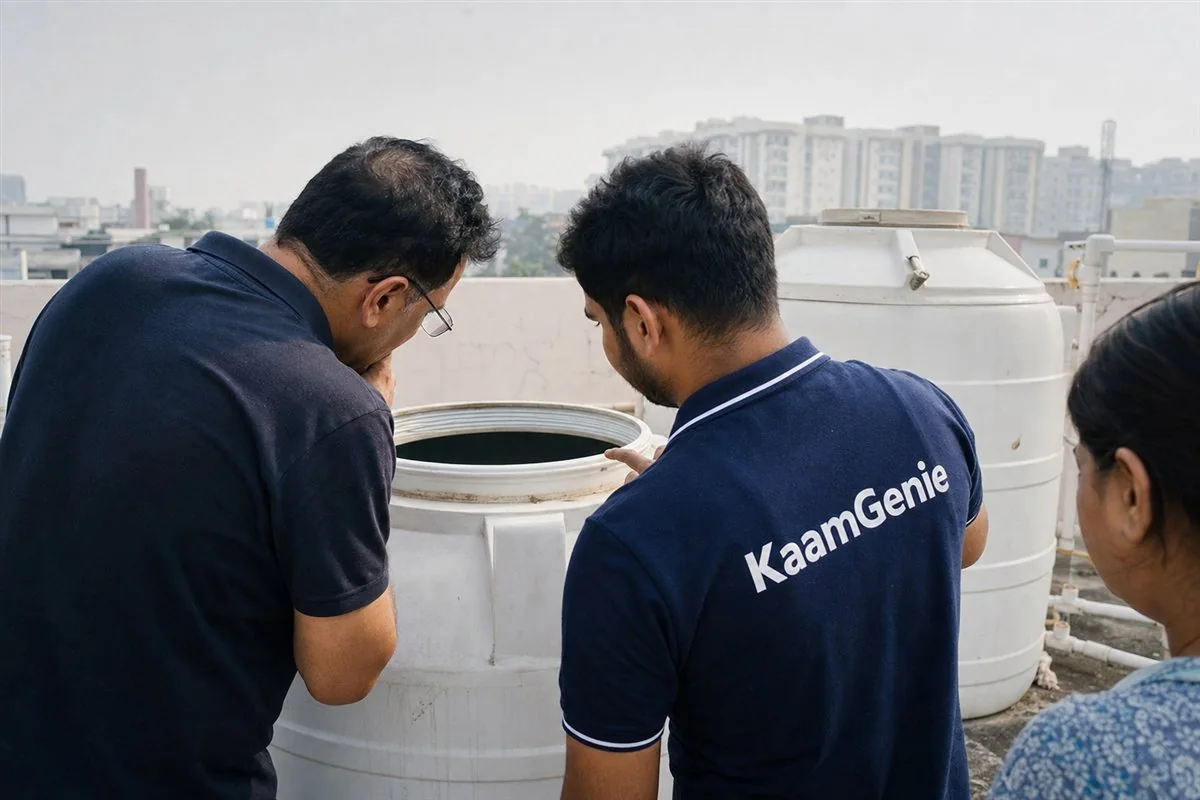
The honest short answer
- Small rooftop tank (about 1,000L or less) you can reach into from the lid? DIY is fine with care — drain, scoop, scrub, rinse, disinfect, refill.
- A tank you would have to climb inside, or any underground sump or reservoir? Never DIY. Confined spaces can hold toxic gas and too little oxygen. This kills people in India every year.
- Heavy hard-water scale, a society or commercial tank, or a deep concrete tank? Call a professional — you need a jet wash, a wet vacuum, and confined-space safety gear.
- Gurgaon-specific catch: hard borewell water and tanker supply build scale fast, so even DIY-friendly tanks need doing every 3–6 months.
This guide is deliberately safety-first. We would rather you booked a pro than took a risk on a tank you should not be inside.
There is a lot of bad advice online about cleaning water tanks — videos of people climbing into deep concrete reservoirs with no gear, “hacks” using acid, and 15-minute “cleanings” that are really just a rinse. This is the opposite of that. We clean tanks across Gurgaon for a living, and we will tell you plainly what you can do yourself, what you genuinely should not, and where the honest dividing line sits.
The single most important thing in this whole article is the safety rule, so let’s get it out of the way first.
The one rule that matters most: never enter a tank you shouldn’t
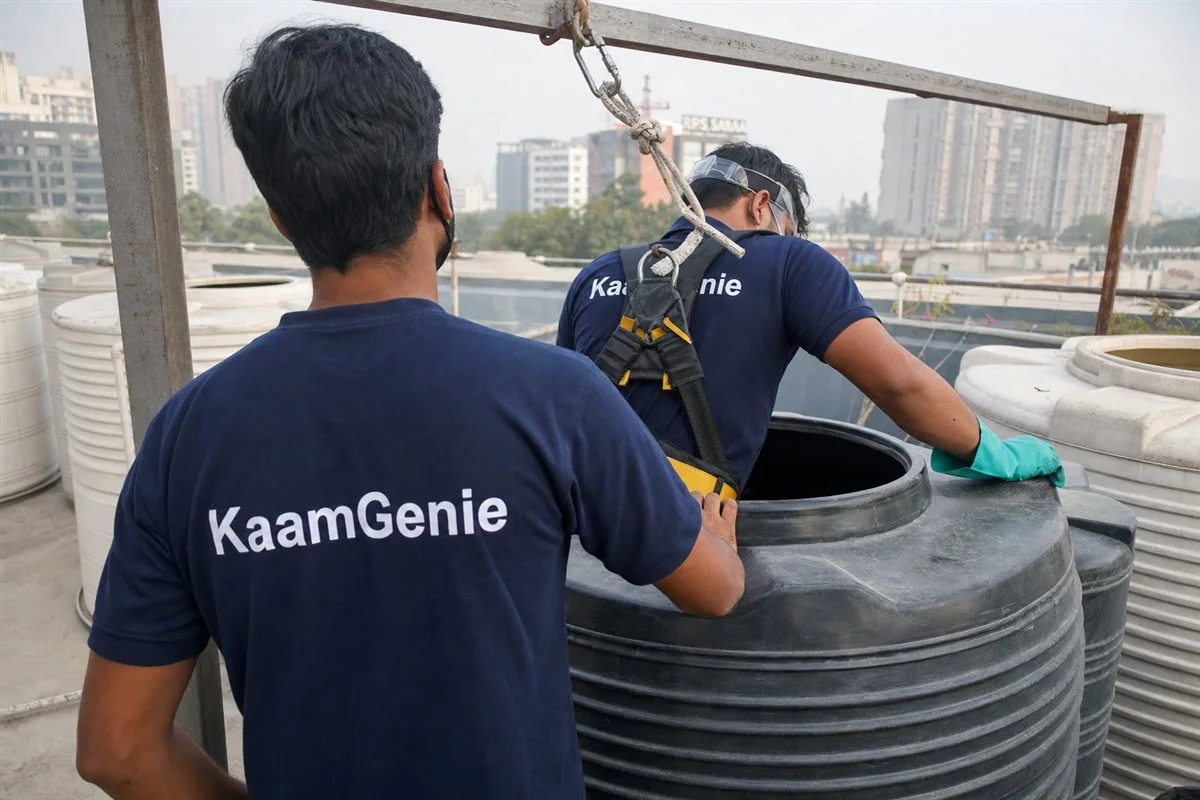
A large overhead tank, an underground reservoir (UGR), or a sump is a confined space. When water and sludge sit still for months, the decomposing organic matter consumes oxygen and can release gases — hydrogen sulphide (the rotten-egg smell), methane, carbon dioxide. The cruel part is that your nose stops registering hydrogen sulphide at exactly the concentrations that become dangerous, so the warning disappears just when you need it. A person climbs in, is overcome within seconds, and collapses. Someone climbs in to help, and the same thing happens to them.
This is not a theoretical risk. Deaths from cleaning tanks, sumps and septic pits happen across India every single year, and very often it is the rescuer who dies alongside the first person. Professional crews enter these spaces only with gas testing, forced ventilation, a safety harness and a trained standby person watching from outside who never enters. If you do not have all of that, the answer is simple: do not go inside. No tank is worth a life.
So the dividing line for DIY is not really about your skill. It is about whether you have to enter the tank at all. If you can do the whole job standing outside, reaching in through the lid — you can consider DIY. If you would have to get your body inside it, stop and book a pro. That is the whole rule.
| Factor | DIY (small rooftop tank) | Professional |
|---|---|---|
| Suitable for | Small accessible plastic rooftop tank, up to ~1,000L | Any tank — large overhead, UGR, sump, society, commercial |
| Confined-space safety | None — so you must never enter the tank | Gas testing, ventilation, harness, standby person |
| Scale & biofilm removal | Hand brush only — struggles with hard-water scale | 100–150 PSI jet wash + wet vacuum reach what brushes can’t |
| Disinfection | Possible with food-grade chlorine + contact time | Measured food-grade dose, correct contact time, done every job |
| Time & effort | 60–90 min of physical work, your weekend | 75–90 min for a home tank, you don’t lift a finger |
| Record / proof | None | Before/after photos + certificate for RWA or FSSAI |
| Cost | Your time + a few hundred rupees of supplies | ₹699 onwards residential; society/UGR quoted on site |
Not a small accessible tank? Let us handle it
Underground reservoirs, society tower tanks and deep concrete tanks need confined-space gear and a jet wash. We bring all of it. ₹699 onwards for residential.
How to clean a small rooftop tank yourself (step by step)
If you have read the safety rule above and your tank passes — a small rooftop plastic tank you can clean entirely from the outside — here is the honest method. You will need rubber gloves, a mask, non-slip shoes, a long-handled food-grade brush (never metal or wire), a bucket and scoop, food-grade detergent, food-grade chlorine (sodium hypochlorite), and a safe, stable way to reach the lid. Tell someone you are working on the roof before you start.
- Shut the inlet and drain the tank. Close the inlet valve so no fresh water flows in mid-job. Drain through the outlet, or pump it out. If the water is clean, save some in a drum for non-drinking use like floor washing or plants.
- Scoop out the sludge. Reach in and scoop the sediment off the floor — in a Gurgaon tank fed by tankers and borewell water, this is usually a gritty layer of sand, mineral scale and silt. Put it in a bucket; do not flush it down the building plumbing, where it just resettles in the pipes.
- Scrub every surface. Using the food-grade brush and detergent, scrub the four walls top-to-bottom, the floor in overlapping passes, the corners and seams, around the inlet and outlet, and the underside of the lid. This is the part that takes real effort — and the part most people rush.
- Rinse out the dirty water. Hose or pour clean water to flush the loosened dirt towards the drain, and get the dirty water out so it does not redistribute when you refill.
- Disinfect with food-grade chlorine. Apply a food-grade chlorine solution (roughly 50–100 PPM available chlorine) over all interior surfaces and leave it for 15–30 minutes of contact time. This is the step that actually kills bacteria — skipping the wait makes it close to pointless.
- Final rinse, refill, check. Rinse once with clean water, drain, restore the inlet and refill. Water is fine for washing straight away; for drinking, give it a couple of hours and run it through your RO/UV as you normally would.
Done honestly, that is about 60–90 minutes of work. If you find yourself finishing in 15 minutes, you have rinsed the tank, not cleaned it — the sludge scoop and the disinfection contact time are where the real value is.
Why DIY is genuinely harder in Gurgaon
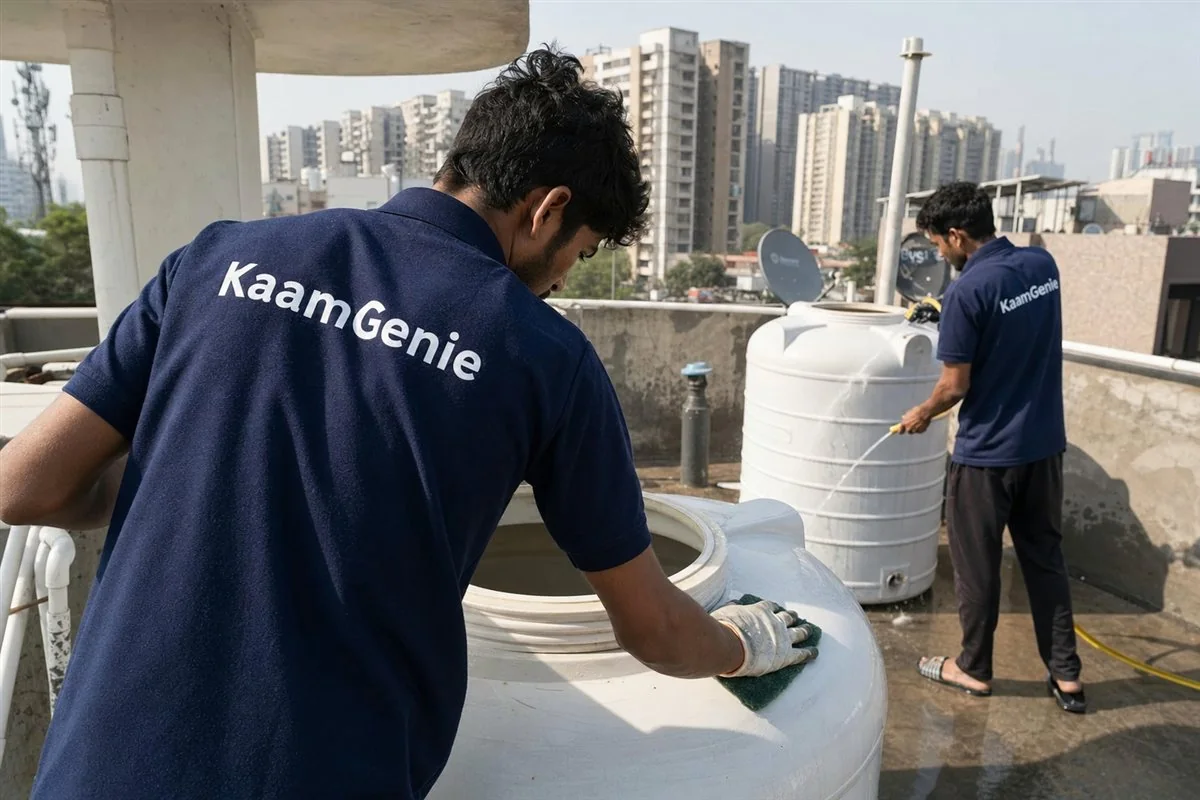
Gurgaon — the Millennium City — has a particular set of conditions that make tank cleaning tougher than the average. Large parts of the city run on hard borewell groundwater and on water tankers, both of which leave thick mineral scale and a lot of fine sediment. That chalky scale clings to tank walls and resists an ordinary hand brush; it is exactly the kind of buildup a high-pressure jet wash is designed for. If you have read our piece on hard-water tank cleaning in Gurgaon, you already know why a brush alone often loses that fight.
Access is the other half of the problem. A huge share of Gurgaon homes are high-rise flats and luxury condominiums along Golf Course Road, Sohna Road, Southern Peripheral Road and the Dwarka Expressway belt — and those are fed by a big underground reservoir at the base feeding rooftop tower tanks high above. Both ends of that system are firmly off-limits for DIY. Even independent builder floors and plotted homes in colonies like Sushant Lok or the older DLF phases often have tanks placed awkwardly on the terrace parapet. The combination of stubborn hard-water scale and difficult, sometimes unsafe access is why so many well-intentioned Gurgaon DIY attempts end with a phone call to us halfway through.
DIY vs professional — how thoroughly each removes contamination
Indicative, for a typical hard-water-scaled Gurgaon rooftop tank
Careful DIY handles sludge and disinfection well; it is hard-water scale, corners and behind fittings where a jet wash and wet vacuum pull clearly ahead. The harder your water, the bigger that gap.
When you must call a professional
Hand the job to a trained crew — do not attempt DIY — in any of these cases:
- The tank is large or you would have to climb inside. Confined-space risk, full stop.
- It is an underground sump or reservoir (UGR). These are the most dangerous tanks of all and need gas testing and ventilation. See our guide to underground sump cleaning in Gurgaon.
- It is a shared society or condominium tank. Multiple flats, tower tanks and a base reservoir — that is a society tank cleaning job with per-tank certificates, not a weekend project.
- There is heavy hard-water scale or sludge you simply cannot shift by hand.
- It is a deep concrete (RCC) tank. The rough, porous surface holds biofilm in its pores and needs pressure a brush can’t supply.
- You smell gas or rotten eggs, or the access feels unsafe. Stop immediately.
When you do book, a professional brings the things DIY can’t: confined-space safety gear, a 100–150 PSI jet wash, a wet vacuum, measured food-grade disinfection, and a documented before/after record. It is worth understanding what you are paying for — our Gurgaon cost guide breaks down honest pricing, and you can compare against the wider water tank cleaning services we run across NCR. We clean across the city, from Sector 56 and Sushant Lok to the high-rise belt along Sohna Road.
Rather not risk it? Book a real cleaning
Trained crew, jet wash and food-grade disinfection, photos and a certificate every job. Residential ₹699 onwards; society and UGR quoted on site.
The bottom line for Gurgaon homeowners
DIY tank cleaning is not a scam or a trap — for a small, accessible rooftop plastic tank, a careful homeowner can do a genuinely good job in an afternoon. The traps are doing it carelessly (skipping the scrub and the disinfection wait) and, far more seriously, attempting a tank you should never enter. Get the safety rule right, match the tank to the method, and you will make a sensible choice either way. When the tank is large, deep, underground, scaled, or shared, the smart and safe move is a professional crew — see options and coverage on our water tank cleaning in Gurgaon hub.
Frequently asked questions
Can I clean my own water tank in Gurgaon?
Yes, for a small rooftop plastic tank up to about 1,000 litres that you can reach into from the lid without climbing inside. With basic safety gear, food-grade detergent and chlorine, and an hour of effort, a fit adult can do a reasonable job. You should NOT attempt a large overhead tank, an underground reservoir or sump, or any tank you would have to physically enter — those carry a real risk of toxic gas and oxygen deficiency and need trained crew.
Why should I never enter a large or underground water tank myself?
A closed or underground tank is a confined space. Stagnant water and sludge can deplete oxygen and release gases like hydrogen sulphide and carbon dioxide that you cannot smell reliably. People die every year in India climbing into tanks and sumps to clean them — often the person who climbs in to rescue the first one dies too. Confined-space entry needs gas testing, forced ventilation, a harness, and a trained standby person outside. This is exactly the work you hand to professionals.
What do I need to clean a small rooftop tank myself?
Rubber gloves, a mask, non-slip footwear, a food-grade scrubbing brush with a long handle (never a metal brush or wire), a bucket and scoop, food-grade detergent, and food-grade chlorine (sodium hypochlorite) for disinfection. You also need a safe, stable way to reach the tank lid and someone aware that you are working on the roof. Do not use hardware-shop bleach, acid, or industrial cleaners in a drinking-water tank.
How do I disinfect a water tank after scrubbing it?
After the tank is scrubbed and rinsed empty, wipe or spray the walls and floor with a food-grade chlorine solution (roughly 50-100 PPM available chlorine) and leave it to act for 15-30 minutes of contact time. Then rinse once with clean water, drain, and refill. Contact time is the part most people skip — without it the disinfection does little. For drinking, give the refilled water a couple of hours and run it through your RO/UV as usual.
Why is DIY harder in Gurgaon than in many other cities?
Gurgaon runs heavily on hard borewell groundwater and tanker supply, which leave thick mineral scale and sediment that ordinary scrubbing struggles to shift. Many homes are high-rise flats and condominiums fed by a large underground reservoir and rooftop tower tanks — those are off-limits for DIY. Even independent builder floors often have tanks placed awkwardly on the terrace. The combination of hard-water scale and difficult access is why a lot of Gurgaon DIY attempts end in a call to a professional.
How long does it take to clean a tank yourself?
A small rooftop plastic tank realistically takes 60-90 minutes done properly — drain, scoop sludge, scrub every surface, jet or hose rinse, disinfect with contact time, rinse and refill. People who finish in 15-20 minutes have only rinsed it. The scrubbing and the disinfection contact time are the two phases that take real effort and the two most often skipped.
Is professional tank cleaning worth the money over DIY?
For a small accessible rooftop tank, careful DIY is genuinely fine. For anything large, deep, underground, hard-water scaled, or shared by a society, a professional is worth it — you get confined-space safety equipment, a high-pressure jet wash and wet vacuum that remove what a brush cannot, food-grade disinfection done correctly, and before/after photos plus a certificate. Residential cleaning starts at ₹699 onwards; society and underground reservoir work is quoted on site.
How often should a Gurgaon tank be cleaned if I do it myself?
Every 3-6 months is sensible in Gurgaon because hard water and tanker supply build sediment quickly. Homes on heavy tanker dependence, or with small children, elderly or anyone immunocompromised, should lean towards the shorter end. If you see yellow or cloudy water, a smell, or particles at the tap, clean sooner regardless of the calendar.
Can I use the same approach for a Sintex plastic tank and a concrete tank?
The steps are similar but concrete (RCC) tanks are harder. Concrete develops a rough, porous surface where hard-water scale and biofilm cling into the pores, so it needs more pressure than a hand brush can give — a professional jet wash is usually required to do it properly. Smooth Sintex-style plastic tanks are far more DIY-friendly. Never use acid on a concrete tank to remove scale unless you know exactly what you are doing; it can damage the structure and is unsafe for drinking water.
What are the signs I should stop DIY and call a professional?
Call a pro if the tank is large or you would have to climb inside, if it is an underground sump or reservoir, if there is heavy scale or sludge you cannot shift by hand, if it is a shared society or commercial tank, if there is any smell of gas or rotten eggs, or if access to the tank is unsafe. If at any point you feel unsafe on the roof or inside the tank, stop immediately. No cleaning is worth a fall or a confined-space accident.
Sources & references
- Bureau of Indian Standards (BIS) — IS 10500:2012 is the canonical Indian Standard for drinking water specification, defining acceptable limits for physical, chemical, and biological parameters.
- WHO Guidelines for Drinking-water Quality, 4th edition — the global reference for water quality standards, including guidance on storage and disinfection.
- Food Safety and Standards Authority of India (FSSAI) — defines water quality requirements for food businesses, including hygiene standards for stored water and acceptable disinfection chemicals.
- WHO Fact Sheet on Drinking Water — overview of safe drinking water requirements and contamination risks.
- CPHEEO — Manual on Water Supply and Treatment — the Government of India’s engineering manual covering tank design, cleaning protocols, and disinfection practices.
Last verified: 29 June 2026. If you find any of these links broken, please let us know.