
The short version
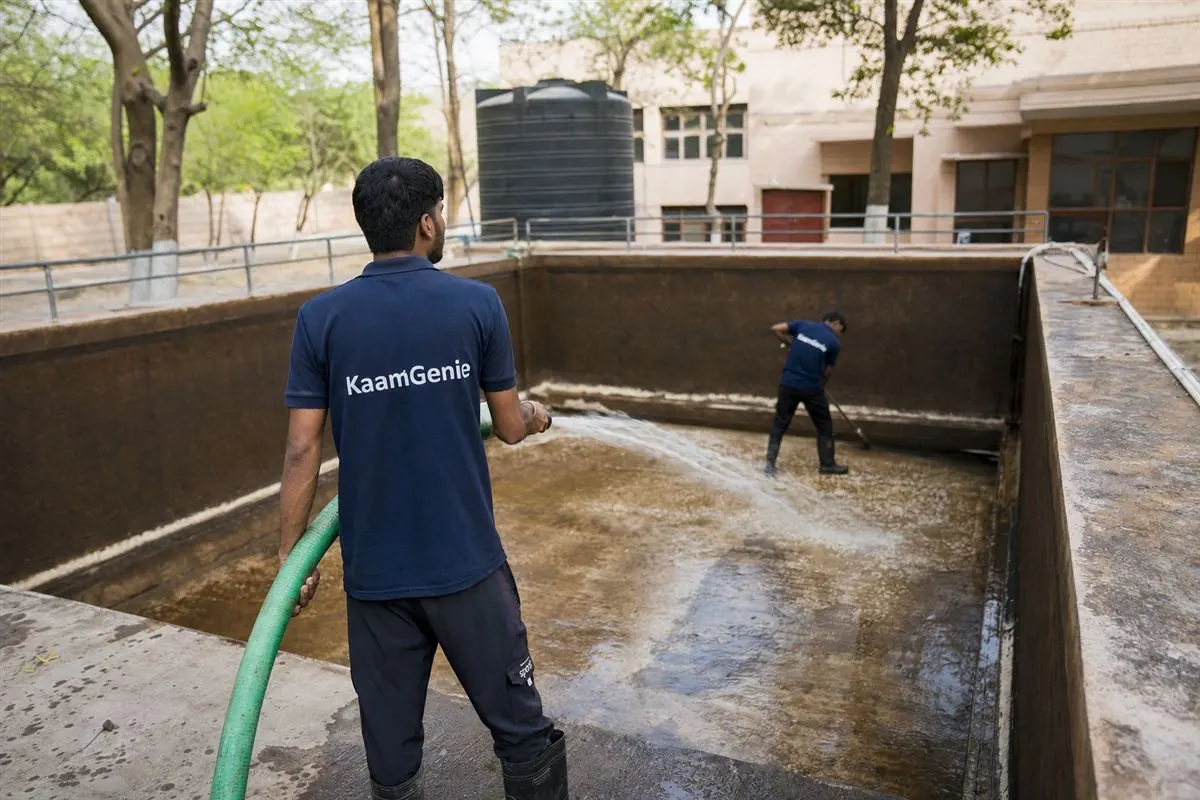
- Scale changes everything. Institutional tanks hold tens of thousands of litres, not 1,000 — one dirty reservoir affects hundreds at once.
- The people are vulnerable. Children, patients, and food guests have far lower tolerance for contaminated water than a healthy adult at home.
- Clean the whole chain. Underground reservoir (UGR) plus every rooftop tower tank — cleaning one and ignoring the other is pointless.
- Schedule after-hours. Term breaks, weekends, low-occupancy mornings — we work around your operations, tank by tank, so water never fully stops.
- Documentation is the deliverable. Dated certificate, before/after photos, and lab testing on request for FSSAI, NABH and management audits.
For institutions, quarterly cleaning on an AMC is the norm — not once-a-year when someone remembers.
| Factor | Typical Gurgaon home | School / hospital / hotel |
|---|---|---|
| People served | 4–6 (one family) | Hundreds to thousands |
| Storage | 1,000L rooftop tank | 20,000L+ UGR + multiple tower tanks |
| Risk if neglected | One household ill | Mass outbreak, audit failure, reputation |
| Recommended frequency | Every 6 months | Every 3 months (quarterly) |
| Scheduling | Anytime, ~90 min | After-hours / holidays, phased over a shift |
| Documentation | Photos + receipt | Certificate + lab report + audit trail |
Get your campus tanks cleaned & certified
Free site survey, after-hours scheduling, per-tank certificates and lab reports. Residential ₹699 onwards; institutional quoted custom.
Why institutional water in Gurgaon is a different problem
Gurgaon — or Gurugram, the Millennium City — grew faster than its piped-water network. Most institutions sit on hard borewell groundwater and lean heavily on water tankers to top up daily. That water doesn’t go straight to taps. It fills a large underground reservoir (UGR), and pumps then lift it to rooftop tower tanks that feed the building. Every one of those stages is a place where sediment settles, scale builds, and bio-film grows.
For a single home that’s a manageable nuisance. For a 1,200-student school, a 300-bed hospital, or a hotel running three restaurants and a banquet hall, the same neglected reservoir becomes a public-health exposure. The hard groundwater across sectors like Sector 65 and Sector 56 leaves heavy calcium scale on reservoir walls, and the constant tanker top-ups mean fresh sediment arrives with every delivery. If you want the bigger picture on why this matters across the whole city, our overview of water tank cleaning in Gurgaon covers the supply situation in detail.
The result is a simple rule we repeat on every institutional survey: the bigger the tank and the more vulnerable the people it serves, the smaller your margin for skipping a cleaning.
Schools: hundreds of children, zero margin for error
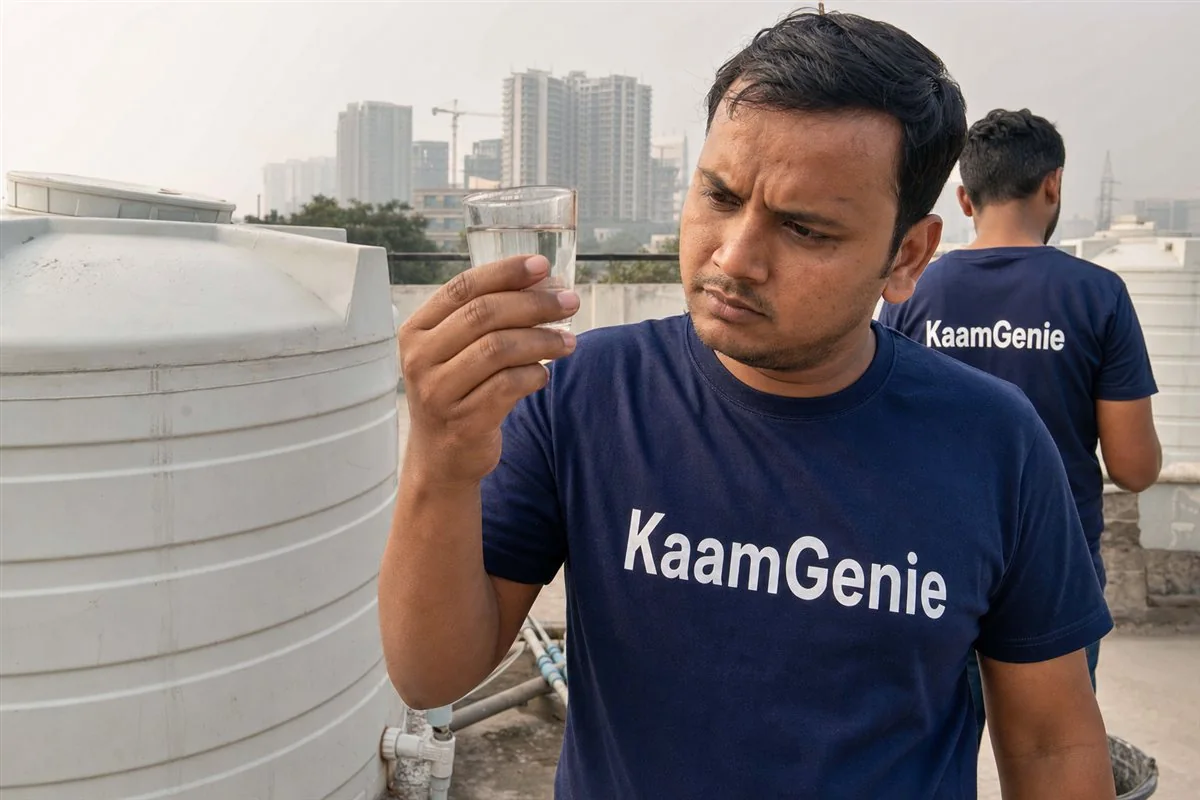
A school is the highest-stakes institutional client we handle, simply because children are more vulnerable to waterborne illness than adults and a single contaminated reservoir feeds every drinking-water point, washroom, and canteen on campus at once. One bad batch can put dozens of students in the sick room in a single morning.
For Gurgaon schools we recommend cleaning every quarter, scheduled into term breaks and weekends so classes are never affected. We clean the canteen’s supply tank, the main drinking-water reservoir, and the rooftop tower tanks together, because children drink from the taps these feed. Every job closes with a dated certificate and before/after photos — the document a principal or parent committee asks for when someone raises a water-quality concern.
Hospitals: the patients are already vulnerable
Hospitals raise the bar again. Patients are frequently immune-compromised, recovering from surgery, or on treatments that lower their resistance — exactly the people for whom a bacterium that a healthy adult shrugs off can become serious. Hospital water also feeds dialysis prep areas, kitchens, laundry, and sterilisation, so the cleanliness of the storage chain has clinical consequences, not just comfort ones.
That’s why hospital tank cleaning has to be both thorough and provable. We clean every reservoir compartment and tower tank, disinfect to potable standard, and hand over documentation that fits into an NABH or internal-audit file. Many hospitals along Golf Course Road and in the newer sectors run on multi-compartment UGRs precisely so one section can be taken offline for cleaning while the rest keeps the building supplied — which is exactly how we phase the work.
Hotels & banquet halls: water that touches food
In a hotel or banquet hall, the stored water doesn’t just reach guest bathrooms — it goes into the kitchen, the ice machines, the coffee, and the cooking. That puts hotels squarely under FSSAI food-safety scrutiny, where stored-water hygiene is part of the licence. A banquet hall serving 800 guests at a wedding is, for that evening, a large food business with a single water source behind it.
For these clients the schedule matters as much as the cleaning. We work around the function calendar — cleaning and certifying tanks before a big event, never during it — and around low-occupancy weekday mornings for hotels. If you run a kitchen or F&B operation specifically, our guide to commercial water tank cleaning in Gurgaon goes deeper on the FSSAI-grade documentation side.
How the cleaning actually runs on a big campus
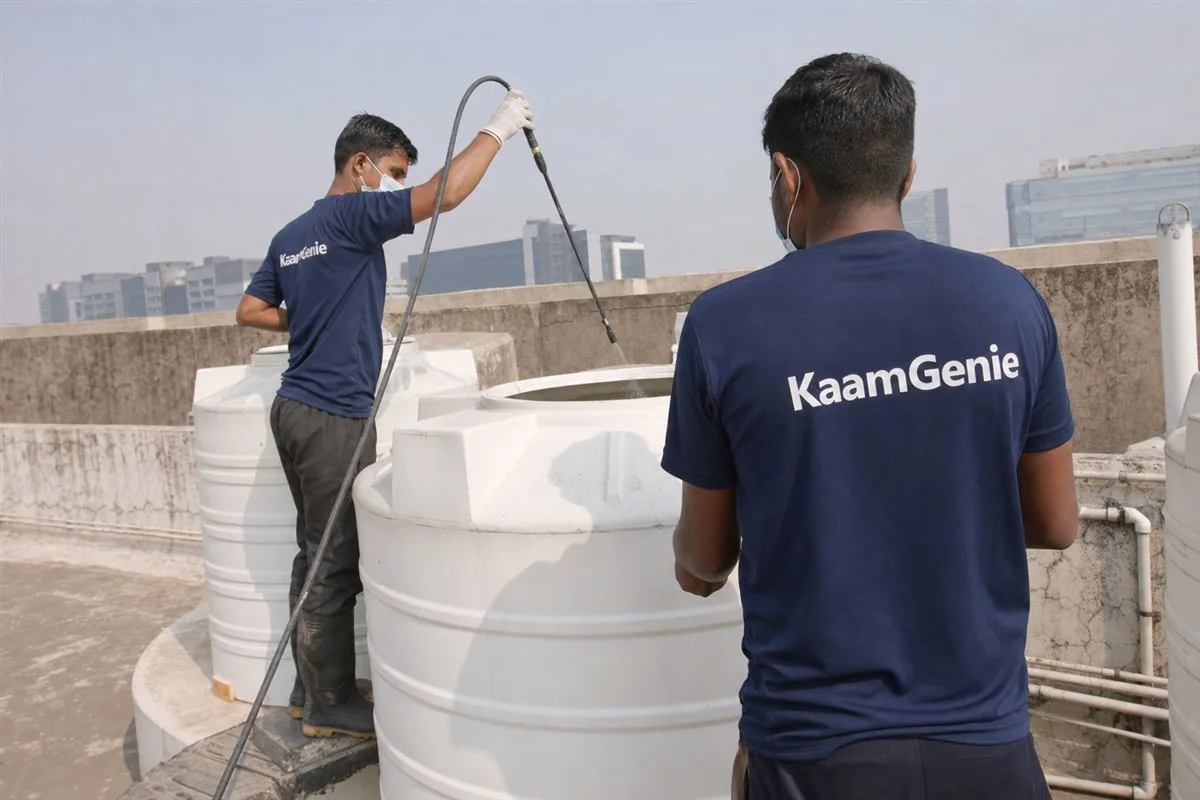
The mechanics of the cleaning itself are the same proven sequence we use everywhere — inspect, drain, remove sludge, scrub, jet-wash, vacuum, disinfect, refill — explained step by step in our water tank cleaning process guide. What changes for institutions is scale and choreography:
- Phased, tank-by-tank. We take one reservoir compartment or one tower tank offline, clean and disinfect it, refill, then move to the next — the campus stays supplied from the rest throughout. No full shut-off.
- Confined-space safety. Large UGRs are deep enough to be confined spaces. Our crews work with ventilation, a buddy system, and protective gear — not something untrained in-house staff should be doing.
- The whole chain. UGR plus every rooftop tower tank. Cleaning a tower tank while leaving a dirty sump below just recontaminates the clean water within days.
- Food-grade disinfection. Sodium hypochlorite at 50–100 PPM, FSSAI-acceptable for potable water, thoroughly rinsed so no residue reaches children, patients, or food.
- Documentation per tank. Each tank gets logged: capacity, chemicals, crew, before/after photos, and a clarity check — with lab testing against IS 10500 on request.
A large reservoir of 20,000 litres or more usually takes 4–6 hours; a full multi-tank campus is planned across a weekend or holiday so no area is ever fully without water.
Recommended cleaning frequency by institution type (Gurgaon)
Higher footfall and more vulnerable users mean shorter intervals between cleanings
Guidance based on footfall and user vulnerability, not a fixed rule — a high-occupancy hospital with hard-water tanker supply may justify even shorter intervals. We set the right cycle during the site survey.
The documentation is the real deliverable
For a home, the proof of a good cleaning is clear water and a couple of photos. For an institution, the certificate is the product. When an FSSAI inspector visits a hotel kitchen, when an NABH assessor reviews a hospital’s utilities, or when a parent body questions a school’s water, the dated cleaning certificate — listing each tank, its capacity, the chemicals used, the crew, and before/after photos — is what closes the conversation.
We keep this audit trail per tank and per visit, and on a quarterly AMC the whole year’s record sits in one file. On request we add a post-cleaning water test against IS 10500 parameters so there’s an independent number, not just our word, behind the certificate. This is also why institutions almost always move to an annual contract rather than calling ad-hoc — the schedule and the paperwork never lapse.
Why institutions use a professional service, not in-house staff
Plenty of campuses have a maintenance team that could, in theory, scrub a tank. The reason they don’t do reservoir cleaning in-house is threefold: the confined-space safety risk of a deep UGR, the need for food-grade chemistry and proper jet-wash and vacuum equipment, and the audit-grade documentation that an internal team rarely produces consistently. A booking made through our water tank cleaning services brings the trained crew, the equipment, and the certificate as one package — which is what an auditor actually wants to see.
Set up a quarterly cleaning AMC for your campus
One survey, one schedule, one file of certificates for the year. After-hours, phased, zero-downtime. ₹699 onwards residential; institutional quoted custom.
Book institutional tank cleaning across Gurgaon
Whether you run a school in the New Gurgaon sectors, a hospital on Golf Course Road, or a hotel and banquet hall on Sohna Road, we’ll survey your campus free, map every tank, and put together a phased, after-hours cleaning plan with certificates and lab testing built in. You can see service areas and pricing on the Gurgaon water tank cleaning hub, or just call and describe your site.
To book a survey, call +91 95603 66362 or use the booking form on this site — we’ll confirm shortly.
Frequently asked questions
How often should a Gurgaon school or hospital clean its water tanks?
For institutions serving hundreds or thousands of people, we recommend cleaning every 3 months — quarterly. Schools, hospitals, and hotels carry far higher contamination risk than a single home because of constant tanker top-ups, hard Gurgaon groundwater, and the vulnerability of the people they serve (children, patients, food guests). Many Gurgaon institutions sign a quarterly AMC so it is never forgotten and there is always a dated certificate on file.
Can you clean our tanks without shutting off water to the building?
Yes, in most cases. Large institutions usually have multiple underground reservoir compartments and several rooftop tower tanks. We clean them one at a time — take one compartment or tower tank offline, clean and disinfect it, refill, then move to the next — so the building stays supplied from the rest throughout. We schedule the work after hours, on weekends, or during holidays to make disruption near-zero.
Do you provide a cleaning certificate and water test report?
Yes. Every institutional job ends with a dated cleaning certificate listing each tank, its capacity, the chemicals used, crew names, and before/after photos. On request we also provide a post-cleaning water clarity check and can arrange lab testing against IS 10500 parameters. This documentation is what your facilities team shows during FSSAI audits, NABH inspections, or parent/management queries.
Why do hospitals and schools need more careful tank cleaning than homes?
Because the stakes are higher and the scale is larger. One contaminated reservoir at a school can affect hundreds of children at once; at a hospital, patients are already immune-compromised; at a hotel or banquet hall, the same water touches food and ice served to hundreds of guests. A single home tank holds 1,000 litres and serves one family — an institutional UGR holds tens of thousands of litres and serves a crowd, so the consequences of skipping a cleaning multiply.
How long does it take to clean a large institutional reservoir in Gurgaon?
A large underground reservoir of 20,000 litres or more typically takes 4-6 hours, sometimes a full shift with two crews. Rooftop tower tanks add 60-120 minutes each. A full campus with multiple sumps and several towers is usually planned as a phased schedule across a weekend or holiday so no single area is ever fully without water.
What chemicals do you use, and are they safe around children and patients?
We disinfect with food-grade sodium hypochlorite at 50-100 PPM — the same compound used in municipal water treatment and acceptable under FSSAI norms for potable water systems. After the contact time we rinse thoroughly so no chemical residue is left. We never use industrial hardware-shop bleach. For institutions serving drinking water and food, food-grade chemistry is mandatory, not optional.
Can you schedule cleaning during school holidays or hotel low-occupancy days?
Yes, and we recommend it. Schools prefer term breaks and weekends; hospitals prefer low-OPD windows; hotels and banquet halls prefer weekday mornings between events. We plan the calendar around your operations so guests, students, and patients are never affected. For banquet halls we work around the function calendar so the tanks are clean and certified before a big event, not during it.
Do you handle multi-tank campuses with both underground sumps and rooftop tanks?
Yes — that is the standard institutional setup in Gurgaon. Tankers and borewell water fill a large underground reservoir (UGR), pumps lift it to rooftop tower tanks, and those feed the taps. We clean the whole chain: the UGR, the transfer pumps area, and every rooftop tank, because cleaning only the rooftop tank while leaving a dirty sump just recontaminates the clean water within days.
What does institutional tank cleaning cost in Gurgaon?
Residential cleaning starts at ₹699 onwards, but institutional work is quoted custom because it depends on the number of tanks, total capacity, access, and after-hours scheduling. We do a free site survey of your campus, map every tank, and give a single written quote — usually as a quarterly AMC for schools, hospitals, and hotels so the price and schedule are locked for the year.
Is your crew trained for confined-space entry into large reservoirs?
Yes. Large underground reservoirs are confined spaces and need proper safety — ventilation, a buddy system, and protective gear. Our crews are equipped and trained for this, which matters on big institutional jobs where a sump can be deep enough that an untrained person should never enter it. This is one more reason large Gurgaon institutions use a professional service rather than in-house staff for reservoir cleaning.
Sources & references
- Bureau of Indian Standards (BIS) — IS 10500:2012 is the canonical Indian Standard for drinking water specification, defining acceptable limits for physical, chemical, and biological parameters.
- WHO Guidelines for Drinking-water Quality, 4th edition — the global reference for water quality standards, including guidance on storage and disinfection.
- Food Safety and Standards Authority of India (FSSAI) — defines water quality requirements for food businesses, including hygiene standards for stored water and acceptable disinfection chemicals.
- WHO Fact Sheet on Drinking Water — overview of safe drinking water requirements and contamination risks.
- CPHEEO — Manual on Water Supply and Treatment — the Government of India’s engineering manual covering tank design, cleaning protocols, and disinfection practices.
Last verified: 29 June 2026. If you find any of these links broken, please let us know.