
Quick answer — mosquito fogging & control in Delhi (2026)
- Fogging kills flying adults, not larvae: a thermal or cold fog knocks down the mosquitoes it touches for a few hours to a day or two. It does nothing to eggs and larvae in standing water.
- Where fogging earns its keep: society common areas, parks, lawns, banquet grounds, basements and large premises — open or semi-open spaces, usually before an event or at peak season.
- The lasting half is larvicidal treatment: anti-larval dosing of tanks, drains and stagnant water kills the next generation before it flies. Real control pairs the two.
- Indoor homes don’t need fogging: a residential survey + anti-larval + residual spray from ₹699 is the right tool for a flat.
- Cost (2026): home mosquito control from ₹699; thermal/cold fogging is quoted by area (society, lawn, basement); monsoon AMC from ₹2,999/year. GST 18% extra.
- Season is Aug–Nov for dengue, chikungunya and malaria — book the pre-monsoon larvicidal round in May–June. We cover all of Delhi; RWA group bookings welcome.
What mosquito fogging actually does in Delhi — and what it doesn’t
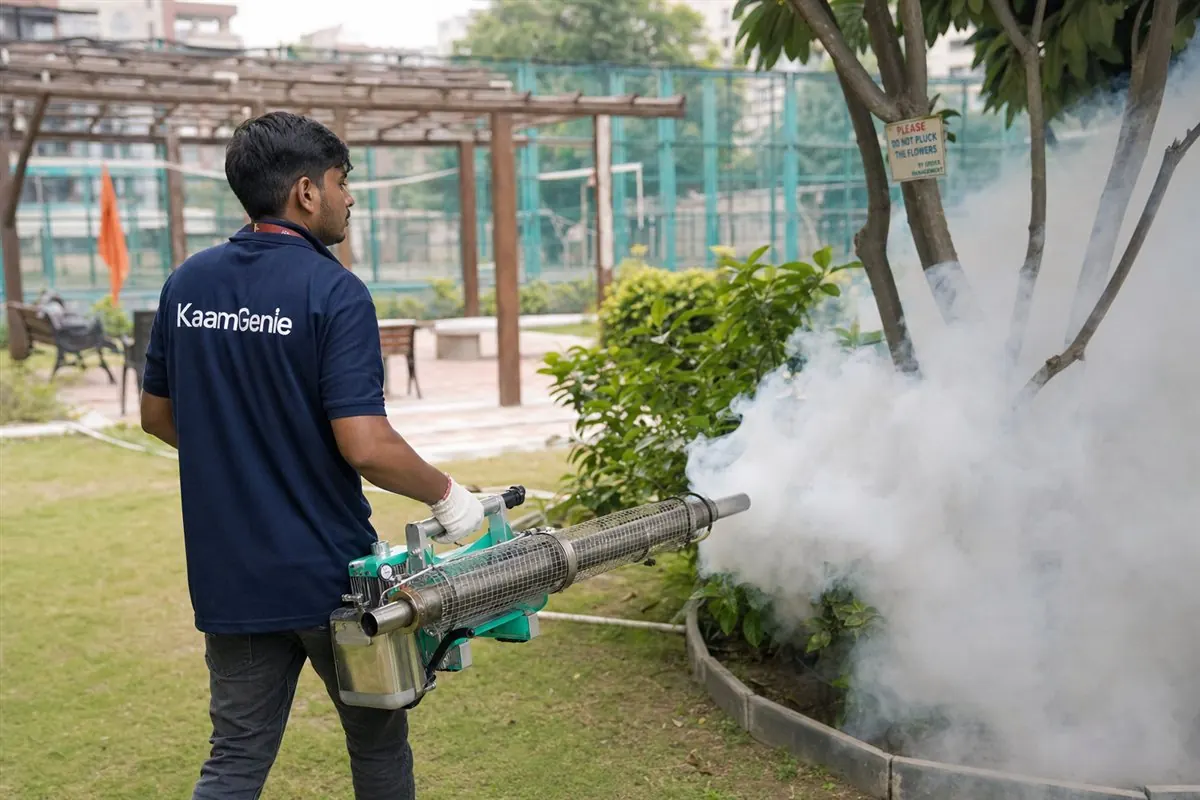
Let me start where most of the confusion lives, because this one misunderstanding costs Delhi families and societies a lot of money every monsoon. Fogging — that white cloud rolling out of a machine, whether it’s the MCD van down your lane or a private crew in the society lawn — kills the flying adult mosquitoes the fog physically touches, right then and there. That’s the whole trick. You get a quiet evening, maybe a calm day or two while the residue lingers, and then the wind clears it and the next batch hatches out of the water nobody dealt with.
So fogging is not a cure, and anyone selling it as one is selling theatre. What it is, used properly, is a fast knock-down for a defined space at a defined moment. A society has a Diwali function in the lawn on Saturday? Fog an hour before and your guests aren’t swatting all evening. Cases are climbing in your block in late September and the kids’ park is unusable at 5pm? A fog buys relief while the real work — killing the larvae — does the long job underneath. The mistake is treating the fog as the long job. It isn’t. If a service turns up, fogs your garden, takes the money and never once asks to see your water tank, your cooler or the basement sump, you have paid for a nice photo and not much else.
The honest rule I give every customer: fog the adults, treat the water. Fogging is the supporting act; larvicidal treatment is the lead. Spend on fogging alone and you’ll be calling again in a week. Pair the two and you actually get ahead of the season.
Thermal fogging vs cold (ULV) fogging — what’s the difference
People ask which fogging is “better,” and the honest answer is they do different jobs. There are two machines a serious Delhi crew carries, and a good technician picks based on the space, not on what’s in the van.
Thermal fogging is the dramatic one — the dense white smoke you picture. It heats an oil-based solution into a thick fog of tiny droplets that drifts and fills a space, settling into the shaded corners and dense foliage where mosquitoes rest. That billowing visibility is genuinely useful outdoors: it gets into hedges, under parked cars, along boundary walls and into the green margins of a society where adults hide through the day. It’s the right tool for open and semi-open spaces — lawns, parks, gardens, driveways, large compounds.
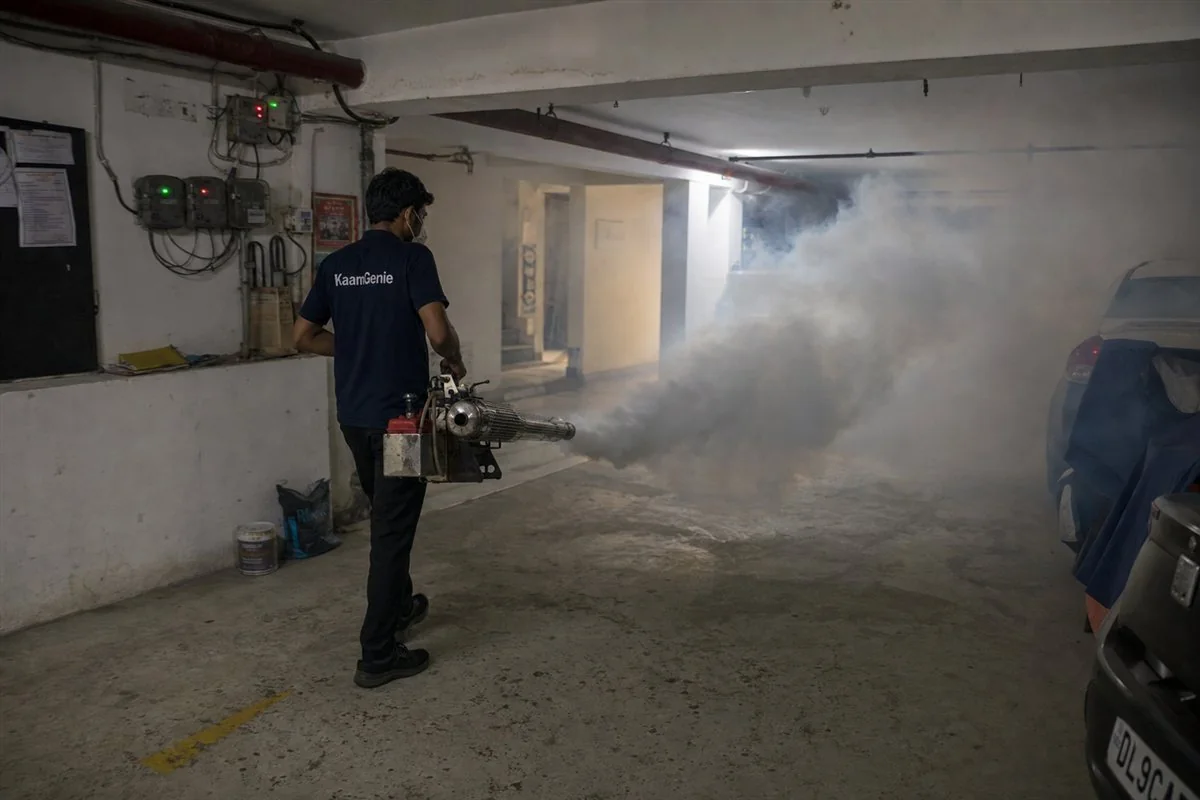
Cold fogging, also called ULV (ultra-low-volume) misting, uses no heat. A blower breaks a water-based solution into an extremely fine, near-invisible mist. There’s no smoke cloud, no oil smell, and no fire risk, which makes it the sensible choice for indoors and enclosed spaces — basement parking, stairwells, clubhouses, warehouses, banquet halls — and anywhere the thick thermal smoke would be a nuisance or a hazard. It drops fewer droplets into the air you breathe and clears faster.
For most Delhi jobs the split is simple: thermal fog for the outdoor green and the boundary, ULV cold fog for basements, indoor common areas and large covered premises. A crew that only owns one machine will try to use it everywhere — that’s the tell of a thin operation.
| Thermal fogging | Cold / ULV fogging | |
|---|---|---|
| Visible fog | Dense white smoke | Near-invisible fine mist |
| Solution base | Oil-based, heated | Water-based, no heat |
| Best for | Lawns, parks, gardens, boundary walls, foliage | Basements, stairwells, clubhouses, halls, warehouses |
| Indoors? | Avoid — smoke & fire risk | Yes — safer in enclosed space |
| Clears in | 15–30 minutes | Faster, less residue in air |
Where fogging earns its keep: societies, parks, lawns, basements & large premises
Fogging shines on scale and on open ground — exactly the spaces an individual flat-owner can’t treat alone. Here’s where I see it genuinely pay off across Delhi.
- Society common areas & parks. The central green, the kids’ play area, the jogging track, the boundary hedges — these are where adult mosquitoes rest by day and swarm at dusk. A scheduled thermal fog through the Aug–Nov peak keeps common spaces usable. This is the classic RWA group booking.
- Lawns & banquet grounds before an event. Weddings, sangeets, society functions, a farmhouse party in Chhatarpur or Mehrauli — fog the lawn 45–60 minutes before guests arrive and the difference is night and day.
- Basement parking & sumps. Delhi basements collect water in the sump pit, in the lift-pit, in slow seepage — dark, still and warm, a perfect nursery. Cold/ULV fogging clears the adults; larvicidal dosing of the sump stops the supply.
- Large premises — warehouses, factories, schools, hospitals, hotels. Big floor plates and loading bays need ULV misting on a schedule, often paired with a commercial pest-control plan and audit-ready records for the facility team.
- Construction sites & vacant plots. Stagnant water in foundation pits and abandoned plots feeds the whole neighbourhood’s mosquitoes. Fog plus larviciding the standing water is the only thing that helps.
Notice the pattern: every one of these is an open or shared space, and every one of them also has standing water nearby. That’s why fogging on its own is never the whole answer — which brings us to the half that actually lasts.
Need a lawn, society or basement fogged before an event?
Our team does thermal and cold (ULV) fogging across Delhi — quoted by area, with anti-larval dosing so it actually lasts. Home mosquito control from ₹699 (GST 18% extra).
Larvicidal treatment — the half of the job that actually lasts
If fogging kills the adults you can see, larvicidal (anti-larval) treatment kills the next generation before it ever flies. This is the part that separates real mosquito control from a smoke show, and it’s the part cheap operators skip because it takes time and knowledge. The mosquito’s egg-to-adult cycle in Delhi’s warmth is only about 7–10 days, so if you only ever fog the adults, a fresh swarm is airborne within a week. Treat the water and you break the cycle.
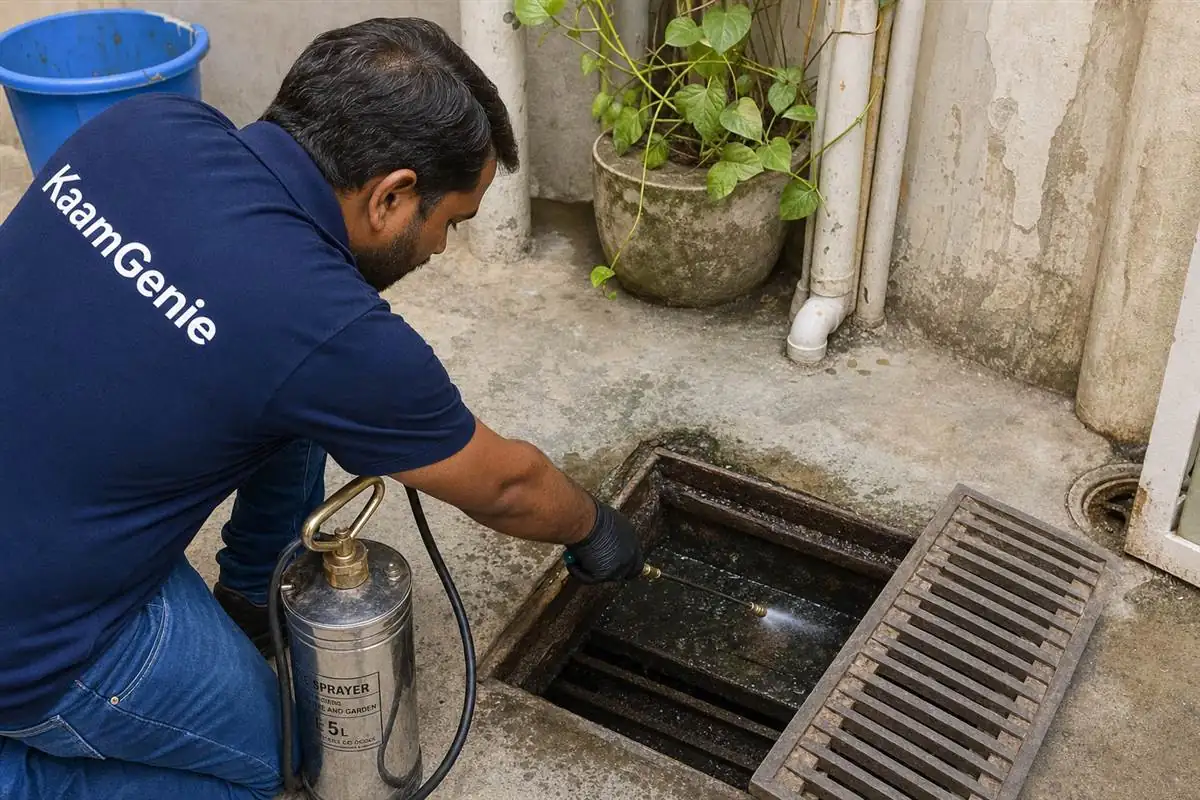
A proper larvicidal round means the technician walks the property — the overhead and underground tanks, the basement sump and lift-pit, blocked drains, the AC drip spots, ornamental fountains, the water collecting in low corners after rain — and doses the spots that can’t simply be emptied with an approved larvicide at the correct concentration. The products used in licensed work are registered with the Central Insecticides Board & Registration Committee (CIB&RC); a serious crew uses the right one at the right dose, not a random bottle tipped in by guess. For the standing water you can remove, removal always beats chemistry — which is why the survey matters more than the spray.
For an individual home, the same logic applies at smaller scale, and you don’t need a fogging machine at all — a flat is an enclosed space. The far bigger win indoors is killing breeding spots: emptying the desert cooler weekly, tipping out plant saucers, sealing the tank lid. We cover that home routine in detail in our guide to getting rid of mosquitoes and preventing dengue at home in Delhi. For the society and the large premises, larviciding the shared water is the single highest-value thing on the whole list.
| Breeding spot | Where in Delhi | Treatment |
|---|---|---|
| Basement sump & lift-pit | Societies, towers, malls | Larvicidal dosing; cover & pump |
| Overhead & underground tanks | Every building | Seal lid / mesh; anti-larval if exposed |
| Blocked drains & storm channels | Lanes, compounds | Clear silt; larvicide standing pools |
| Ornamental fountains & ponds | Society greens, hotels | Larvicide or keep water moving |
| Construction & foundation pits | Plots, sites | Larvicide; drain where possible |
| Desert coolers (homes) | Flats, houses | Empty & scrub weekly — no chemical needed |
Indoor mosquito control for homes — from ₹699
If you’re a flat-owner reading this hoping to book a fog for your living room: you don’t need one, and a reputable team won’t sell you one. Thermal smoke indoors is a hazard, and a dense fog in an enclosed flat clears in minutes without doing much that a targeted treatment doesn’t do better. Residential mosquito control starts at ₹699 and is built from three things: a quick breeding-source survey, an anti-larval treatment of any water that can’t be emptied, and a residual spray on the shaded surfaces — behind furniture, under sinks, dark corners — where adult mosquitoes rest. The residual keeps working for some weeks as mosquitoes land on it, then fades; that’s normal, and it’s why seasonal plans exist.
A word on safety, because it matters at home more than anywhere: tell the technician about children, pregnant women, asthmatics, fish tanks and pets before they start, vacate treated rooms for the time advised, and ventilate afterwards. Licensed work uses CIB&RC-approved products at the labelled dose. A crew that won’t talk you through this calmly is cutting corners somewhere you can’t see. And no honest service promises a permanently mosquito-proof flat — new water collects, mosquitoes drift in from the neighbour’s terrace, and sprays wear off. It’s maintenance, not magic.
Dengue, chikungunya & malaria season in Delhi (Aug–Nov)
Timing is everything, and Delhi’s mosquito calendar is predictable enough to plan around. Numbers stay low through the dry pre-monsoon stretch of May and June, climb as the rains arrive in July, and peak from August through November — September and October are usually the worst weeks across colonies from Rohini to Lajpat Nagar to Dwarka. Three diseases ride that curve: dengue and chikungunya, both spread by the day-biting Aedes mosquito that breeds in clean standing water, and malaria, spread by the night-biting Anopheles. Different mosquitoes, same root cause — stagnant water.
This is exactly why the smart move is to act before the peak, not during it. By the time the RWA WhatsApp group is panicking in late August, the breeding has been quietly running for weeks. A pre-monsoon larvicidal round in May–June, when populations are still low, blunts the whole season before it builds. The MCD does run outdoor space-spraying drives and anti-larval checks, and that has its place — but municipal fogging is broad and occasional, and it was never going to deal with the sump in your basement or the cooler on your floor. The water inside your boundary is your responsibility; the fog van outside is a bonus, not a plan.
Organising it for the whole society?
RWA group bookings get a per-block schedule and bulk pricing. Pre-monsoon larvicidal rounds plus peak-season fogging. Monsoon AMC from ₹2,999/year.
What mosquito fogging & control costs in Delhi (2026)
Fogging is priced by area and access, not a flat per-visit rate — a 200 sq-yd society lawn and a multi-tower basement are not the same job. Home treatment, by contrast, has a clear starting price. Here’s an honest 2026 range so you can spot both the lowball and the overcharge. Anything quoted at ₹100–₹200 for “mosquito spray” is one bottle and no survey — skip it.
| Service | What you get | Price (2026) |
|---|---|---|
| Home mosquito control | Survey + anti-larval + residual spray (flat) | From ₹699 |
| Lawn / garden fogging | Thermal fog of lawn, driveway, boundary | Custom by area |
| Society common-area fogging | Thermal fog of greens, park, walks + larvicidal dosing | Custom by area |
| Basement / indoor ULV fogging | Cold fog of parking, stairwells, clubhouse | Custom by area |
| Event fogging (one-off) | Pre-event thermal/ULV fog, timed to arrival | Custom by venue |
| Monsoon AMC (yearly) | Multiple visits across the Aug–Nov season | From ₹2,999/year |
My honest steer: for a family flat, the ₹699 home treatment plus your own weekly cooler-and-saucer routine is plenty. For a society, don’t pay per panic — a monsoon AMC from ₹2,999/year that brings a crew back on schedule through August to November is far better value than calling in fire-fighting mode every fortnight. And whatever you book, make sure the quote includes larvicidal dosing of the water, not just fogging. The chart below is the honest difference I see on the ground between the two approaches.
Fogging-only vs fogging + larvicidal — spaces still mosquito-light at 4 weeks (2026)
Rough share of Delhi societies reporting low mosquito activity a month later, from what we see on the ground.
RWA & society group bookings — how to organise it
Most of our fogging work in Delhi comes through RWAs, and the societies that get it right share a few habits. First, they book the schedule, not a one-off — a pre-monsoon larvicidal round in May–June, then scheduled fogging of common areas through the Aug–Nov peak, with extra visits timed to any function. Second, they treat the whole complex together. One block fogging its lawn while the next-door basement sump is a swamp is a losing game; mosquitoes don’t respect tower boundaries. Third, they ask for audit-ready records — a simple log of dates, areas covered, products used and a GST invoice — so the managing committee can show residents the money was well spent. We never issue anything called a “certificate”; what you get is honest before/after notes, the visit log and a proper invoice.
Group bookings also bring the per-flat cost right down, because the crew and machine are already on site. If your society also runs an annual pest contract, it’s usually cleanest to fold mosquito fogging into the same plan — we explain how that works in our guide to society and RWA pest-control AMCs in Delhi. If you’re on the managing committee and want a walkthrough quote, that’s exactly the kind of job we do best.
Book mosquito fogging & control — across Delhi
Here’s the whole guide in one breath: fogging knocks down the adults you can see, larvicidal treatment kills the ones you can’t, and the two together — timed before the August–November peak — are what actually keep a Delhi society, lawn, basement or home livable through the monsoon. Fogging alone is a smoke show. If you want a crew that surveys the water first, doses the breeding spots and fogs the right space with the right machine, that’s exactly what we do. We serve homes, societies and commercial premises across Delhi — from Dwarka, Janakpuri and Rohini in the west and north, to Saket, Lajpat Nagar and Greater Kailash in the south, to Mayur Vihar, Preet Vihar and Laxmi Nagar in the east, plus Central and North Delhi. Coming soon: Gurgaon, Noida, Faridabad and Ghaziabad. Home control starts at ₹699; fogging is quoted by area; RWA group bookings welcome. Call 95603 66362 and let’s get ahead of the season.
Frequently asked questions
Does mosquito fogging actually get rid of mosquitoes in Delhi?
Only temporarily. Fogging kills the flying adult mosquitoes the fog touches, giving a few hours to a day or two of relief. It does nothing to the eggs and larvae in standing water, so a fresh batch hatches within about a week. Fogging is genuinely useful before an event or at the seasonal peak, but it must be paired with larvicidal (anti-larval) treatment of the water to last. No honest service sells fogging alone as a permanent fix.
What is the difference between thermal fogging and cold (ULV) fogging?
Thermal fogging heats an oil-based solution into a dense white smoke that drifts into hedges, foliage and shaded corners — ideal for outdoor lawns, parks and gardens. Cold or ULV fogging uses no heat and breaks a water-based solution into a near-invisible fine mist with no smoke or fire risk — the right choice for indoors and enclosed spaces like basements, stairwells, clubhouses and warehouses. A good Delhi crew carries both and picks by the space.
How much does mosquito fogging cost in Delhi in 2026?
Fogging is priced by area and access, not a flat rate — a small society lawn and a multi-tower basement are very different jobs, so lawn, society common-area, basement and event fogging are all quoted custom by area or venue. Home mosquito control (survey + anti-larval + residual spray for a flat) starts at ₹699. A monsoon AMC with multiple visits across the season starts from ₹2,999 a year. GST 18% is extra.
Do I need fogging for my flat or home?
No. Thermal smoke is a hazard indoors and a fog clears in minutes in an enclosed flat without doing much extra. For a home the right tool is a residential treatment from ₹699 — a breeding-source survey, anti-larval treatment of water that can’t be emptied, and a residual spray on resting surfaces — plus your own weekly habit of emptying the cooler and plant saucers.
What is larvicidal or anti-larval treatment, and why does it matter?
Larvicidal treatment doses the standing water where mosquitoes breed — tanks, basement sumps, blocked drains, fountains, low pooling spots — with an approved larvicide that kills the larvae before they become flying adults. Because the egg-to-adult cycle in Delhi is only 7–10 days, treating the water is the part that actually lasts. Fogging kills today’s adults; larviciding stops next week’s. Real control needs both.
Where is fogging most useful?
Open and shared spaces an individual can’t treat alone: society common areas and parks, lawns and banquet grounds before an event, basement parking and sumps, large premises like warehouses, schools, hotels and hospitals, and construction sites or vacant plots with standing water. These are exactly the spaces with both resting adults and nearby breeding water, which is why fogging there is paired with larvicidal dosing.
When is mosquito and dengue season in Delhi?
Numbers stay low through the dry May–June stretch, climb with the July rains, and peak from August through November — September and October are usually worst. Dengue and chikungunya come from the day-biting Aedes mosquito and malaria from the night-biting Anopheles, but all of them trace back to stagnant water. The smart time to act is May–June with a pre-monsoon larvicidal round, before the peak builds.
Can mosquito fogging be done indoors, like in a basement or clubhouse?
Yes, but with cold/ULV fogging, not thermal. ULV misting uses no heat, makes no smoke and carries no fire risk, so it is the correct choice for basement parking, stairwells, clubhouses, halls and warehouses. Thermal fogging’s dense oil-based smoke should stay outdoors. Always ventilate after and follow the technician’s re-entry timing.
Is mosquito fogging and treatment safe for kids and pets?
When done properly, yes. Tell the technician about children, pregnant women, asthmatics, fish tanks and pets beforehand, keep them out of the treated area for the time advised, and ventilate afterwards. Licensed services use CIB&RC-approved products at the correct dose. For societies, fogging common areas is usually scheduled for low-traffic times. A team that won’t walk you through safety is one to avoid.
How do RWA and society group bookings for fogging work?
An RWA books a schedule rather than a one-off: a pre-monsoon larvicidal round in May–June, then scheduled fogging of common areas and parks through the August–November peak, with extra visits timed to functions. Treating the whole complex together is essential — mosquitoes ignore tower boundaries. Group bookings lower the per-flat cost, and you get a visit log, before/after notes and a GST invoice for the committee’s records.
Does the MCD already fog my area, so why pay for it?
The MCD runs outdoor space-spraying drives and anti-larval checks during the season, and that helps — but it is broad, occasional and outdoors. It was never going to deal with the sump in your basement, the tank on your roof or the cooler on your floor. The water inside your boundary is your responsibility; municipal fogging is a bonus on top of your own treatment, not a substitute for it.
How often should fogging be done during the season?
For a society at peak, roughly every 1–2 weeks through August to November keeps common areas usable, because the knock-down effect is short-lived — that is why an AMC schedule beats one-off calls. Crucially, the fogging frequency only buys time; the lasting reduction comes from the larvicidal rounds that dry up the breeding water, so the schedule should always pair the two rather than fog endlessly.
Get your society, lawn or home fogged the right way
We survey the water, larvicide the breeding spots and fog the right space with the right machine — thermal outdoors, ULV indoors. Home control from ₹699; fogging by area; RWA bookings welcome.
Sources & references
- WHO — Dengue and severe dengue — global reference on Aedes transmission and why source reduction and larval control are primary.
- National Center for Vector Borne Diseases Control (NCVBDC) — India’s nodal body for dengue, chikungunya and malaria control, including fogging and anti-larval guidance.
- National Centre for Disease Control (NCDC) — tracks vector-borne disease patterns across Indian cities including Delhi.
- Central Insecticides Board & Registration Committee (CIB&RC) — regulates the larvicides and adulticides used in licensed fogging and mosquito control.
Last verified: 12 June 2026. If you find any of these links broken, please let us know.