
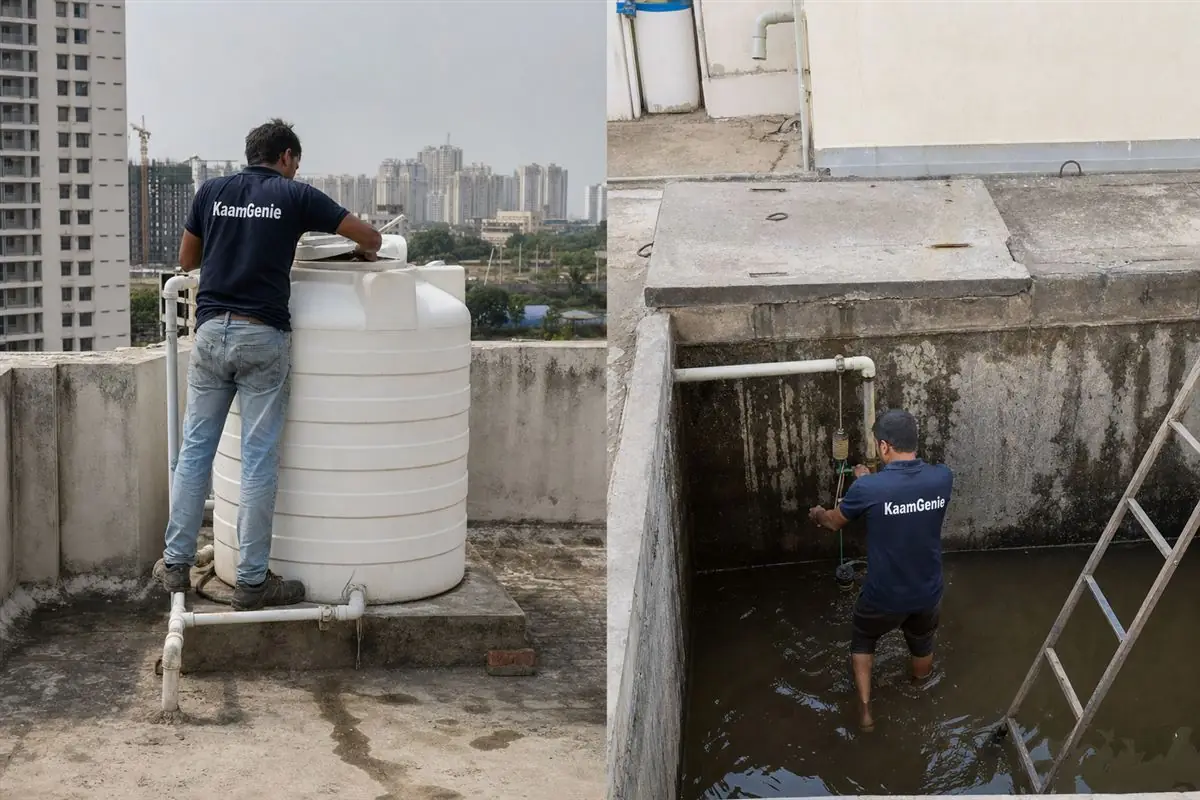
The short version
- The underground reservoir (UGR / sump) is the dirtier tank — it receives water first, so sediment settles and stays there.
- The overhead tank (OHT) on the roof gets water that has already partly settled below, so it collects less but still grows bio-film.
- In tanker-fed Greater Noida West and the Expressway high-rise belt, the UGR loads up fast and needs cleaning more often.
- Always clean underground first, then overhead — otherwise the sump pumps dirt back into your clean rooftop tank.
- The UGR needs confined-space safety; the rooftop tank does not. That difference drives the time, the risk and the price.
If your budget only covers one tank this cycle, clean the underground one. That’s where the contamination actually sits.
Noida and Greater Noida were planned sector by sector, and most buildings here — from plotted Authority houses in Sector 44 and 50 to the tall societies along the Noida Expressway — use a two-stage water system. Bulk water arrives and lands in a large underground reservoir, often called the UGR or sump. A pump then lifts that water to one or more overhead tanks on the roof, which feed the taps by gravity. It is a sensible design. It also means you have two storage tanks to keep clean, and they do not get dirty at the same rate or in the same way.
This is the single most common point of confusion we hear when booking water tank cleaning in Noida: people think of “the tank” as the one they can see on the roof. The one they can’t see, down below, is usually the bigger problem.
| Factor | Overhead tank (OHT, rooftop) | Underground reservoir (UGR / sump) |
|---|---|---|
| Where water lands | Second — pumped up from the UGR | First — piped, tanker and borewell water all arrive here |
| Typical material | Plastic / Sintex, sometimes RCC | RCC concrete, built into the ground or basement |
| Sediment load | Lighter film and scale | Heavy — sand, silt and sludge settle and stay |
| Capacity | 500–2,000L per tank (home); more for society towers | Several thousand to tens of thousands of litres |
| Access & safety | Open lid, work from above | Confined space — ventilation, lighting, standby person |
| Cleaning frequency | Twice a year (more if tanker-fed) | Every 3–4 months if tanker / borewell fed |
| Cleaning order | Second | First — always |
| Price | ₹699 onwards (residential) | Custom — larger volume, heavier desludging |
Have both tanks? Get both done right
We clean the underground reservoir first, then the rooftop tank — the correct order, with photos and a record for each. Residential ₹699 onwards; UGR & society quoted on capacity.
Why the underground reservoir is almost always dirtier
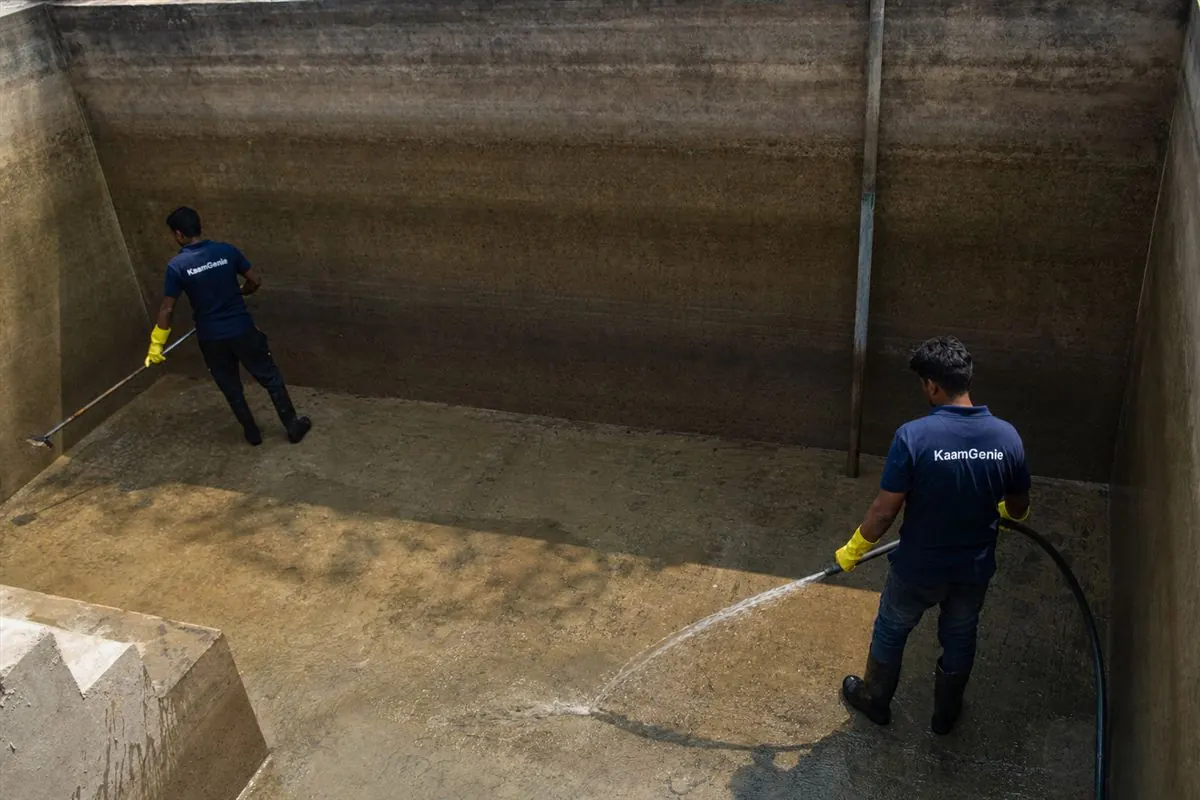
Think about the path water takes into your building. Whether it’s piped Ganga Jal supply, hard borewell groundwater, or a private tanker, it all empties into the underground reservoir first. The UGR is the bottom of the system, and it is the settling chamber for everything the water is carrying. Sand, fine silt, rust flakes from old fittings, and grit drop out of suspension by gravity and collect on the floor. The cleaner water near the top is what gets pumped up to the roof.
So the overhead tank is, in effect, drinking from a tank that has already done your settling for you. That is why a rooftop tank in Noida usually shows a lighter film and some scale, while the UGR below it can hold a genuine sludge layer. The contamination has not disappeared — it has just collected in the tank you don’t see.
This gap is widest in tanker-fed areas. Greater Noida West, also called Noida Extension, and many of the newer Expressway townships run heavily on tanker water during shortfalls. Tanker water is drawn from borewells and is rarely filtered before it’s pumped into your reservoir, so it brings a fresh load of fine sand with every fill. The UGR in a tanker-dependent society can need cleaning two or three times as often as the rooftop tanks it feeds. We cover that supply problem in detail in our guide to underground sump cleaning in Noida.
The hard-water and material difference
There’s a second reason the two tanks behave differently: what they’re made of. Overhead tanks in Noida homes are usually plastic or Sintex, which are smooth and relatively easy to scrub. Underground reservoirs are almost always RCC concrete, cast into the ground or the basement. Concrete develops a textured, slightly porous surface over the years, and bio-film and mineral scale cling into that texture far more stubbornly than they do on plastic.
Add Noida’s hard borewell groundwater to a concrete UGR and you get mineral and iron scale building up on the walls and floor — the same problem we describe for rooftop tanks in our piece on hard water tank cleaning in Noida, but worse, because the UGR is bigger and the surface holds scale better. Clearing it properly needs manual scrubbing plus a high-pressure jet wash, not just a rinse.
The right cleaning sequence: underground first, always
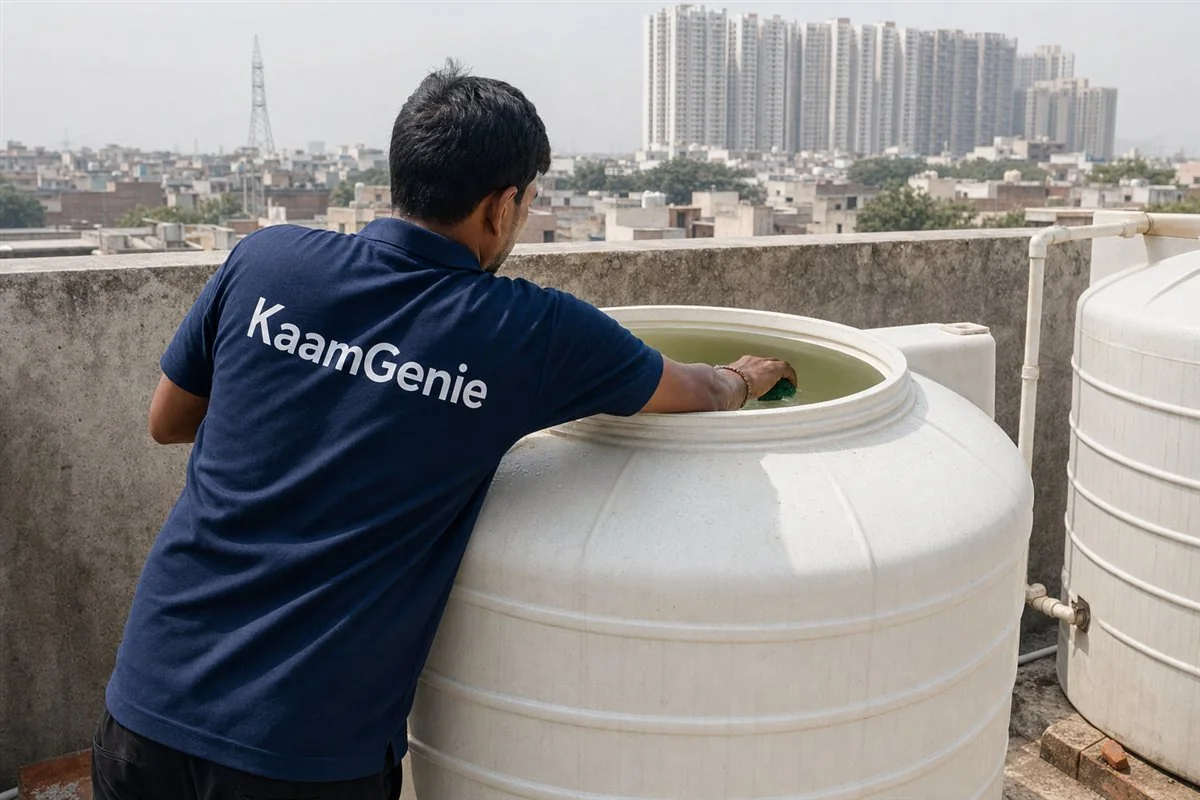
This is the part people most often get wrong, and it’s where a cleaner who doesn’t understand the system can waste your money. The underground reservoir feeds the overhead tank. So the cleaning has to follow the water:
- Clean and disinfect the underground reservoir first. Drain it, desludge the floor, scrub and jet-wash the walls, disinfect with food-grade chemical, and refill with clean water.
- Then clean the overhead tank. Do the full process up top, and let it refill — now it’s pulling from a clean UGR.
Do it in the wrong order — rooftop tank first, then the sump — and the very next pump cycle disturbs the sediment you stirred up in the UGR and pushes that cloudy water straight back into the overhead tank you just cleaned. Within a day or two, the rooftop tank is dirty again and you’ve effectively paid for half a job. We always run UGR-first on any building that has both tanks, which is the same principle behind our step-by-step water tank cleaning services across the NCR.
Confined-space safety: the real practical gap
An overhead tank is an open job. You lift the lid, you can see inside, and the crew works from above or reaches in. An underground reservoir is a confined space, and that changes everything about how the work is done safely.
A UGR that has been sealed for months can hold stale air — low oxygen, or harmful gases that have accumulated. Sending a worker into that without procedure is genuinely dangerous, and it is the reason underground cleaning should never go to an unequipped one-man operator with a bucket. Our crew:
- Ventilates the reservoir and lets it air out before anyone enters
- Never sends a worker in alone — a second person stays stationed at the opening throughout
- Uses proper lighting, and harnesses where the depth requires it
- Carries the desludging out methodically so footing stays safe on a wet concrete floor
This safety overhead is a big part of why UGR cleaning takes longer and costs more than an overhead tank. It is not padding — it is the difference between a job done properly and a real risk to a person.
How often each tank actually needs cleaning in Noida
Recommended cleanings per year — the underground tank almost always wins
Indicative guidance for typical Noida buildings, not a fixed rule — the dirtier the water source, the more often the underground reservoir needs doing. Have your crew assess the actual sediment load on the first visit.
Frequency and cost — how the two differ
Because the underground reservoir collects more and is harder to clean, it generally needs doing more often than the tank on your roof. A sensible baseline for most Noida homes is twice a year for both, but if your building runs on tanker or borewell water — which covers most of Greater Noida West and the new Expressway high-rises — the UGR should be on a tighter 3-to-4-month schedule. If you want the full reasoning on intervals, we’ve laid it out in how often to clean a water tank in Noida.
On cost, the honest picture is simple. A residential overhead tank starts at ₹699 onwards. The underground reservoir is quoted custom, because the price tracks capacity, how heavy the desludging is, and the confined-space procedure involved. A small home sump is a modest step up; a large society UGR feeding several towers is a different scale of job entirely. None of that is an upsell — it is genuinely more water, more sludge, and more risk than an open rooftop tank.
The Expressway high-rise context
The tall societies along the Noida Expressway — Sector 137, Sector 150, Sector 75, and the belt running through Sectors 168, 76, 78 and 100 — are where the two-tank system is at its largest. These towers run on big underground reservoirs at ground or basement level that collect the bulk supply, with pumps lifting water up to overhead tanks on each tower’s roof, often one per wing. The UGR here is a serious confined-space job; the rooftop tanks are smaller but there are many of them.
For a high-rise, the only sane approach is a scheduled society contract that covers both stages — the shared underground reservoirs and every tower tank — on a rolling calendar, so nothing gets forgotten. If you sit on an RWA or manage a society here, our society water tank cleaning in Noida guide walks through how those contracts are structured. And if you’re weighing a high-rise against a plotted house, the trade-offs are covered in high-rise vs plotted water tank cleaning in Noida.
The same overhead-vs-underground logic applies in Delhi too, just with a different water-supply picture — if you’re comparing across the river, see our overhead vs underground tank cleaning in Delhi piece.
Not sure how dirty your underground tank is?
Book a cleaning and you’ll see the before-photos from the floor of the reservoir — they surprise most people. Underground & society jobs quoted on capacity.
Get both tanks done, in the right order
If your building has both an overhead tank and an underground reservoir — and most in Noida do — the sensible move is to clean them together, UGR first, in a single visit. You coordinate access once, the rooftop tank refills from clean water, and you get before/after photos plus a cleaning record for each tank. Whether you’re a homeowner in Sector 75, an RWA member managing towers in Sector 137, or running a society on the Expressway in Sector 150, you can book the whole job through our water tank cleaning in Noida page. Tell us how many tanks and roughly what capacity, and we’ll confirm a price and a slot.
Frequently asked questions
In Noida, which is dirtier — the overhead tank or the underground reservoir?
Almost always the underground reservoir (UGR or sump). It is the first thing every drop of water touches when it enters your building — piped supply, borewell, and tanker water all land in the UGR before being pumped up to the rooftop overhead tank. Sediment, sand and grit settle to the bottom by gravity and stay there. The rooftop tank receives water that has already partly settled in the UGR below, so it collects far less. In Noida and Greater Noida West we routinely find a thick sludge layer in the underground tank and a comparatively thin film up top.
Why does the underground reservoir need cleaning more often in Greater Noida West?
Because Greater Noida West (Noida Extension) towers are heavily tanker-fed. Tanker water is drawn from borewells and is rarely pre-filtered, so it carries fine sand and silt straight into the underground reservoir. Every tanker that fills the UGR drops a fresh load of sediment that settles to the bottom. Hard borewell groundwater also leaves mineral and iron scale on the walls. A tanker-dependent UGR in Noida Extension or the Expressway belt usually needs cleaning every 3-4 months, versus twice a year for a UGR on clean Ganga Jal piped supply.
What is the correct cleaning sequence — overhead or underground first?
Underground first, then overhead. The UGR feeds the rooftop tank, so if you clean the overhead tank first and then clean the dirty UGR afterwards, the next pump cycle pushes disturbed sediment from the sump straight back up into your freshly cleaned overhead tank. The correct order is: clean and disinfect the underground reservoir, refill it with clean water, then clean the overhead tank and let it refill from the now-clean UGR. We always do UGR-first on any building that has both.
Is underground sump cleaning more expensive than overhead tank cleaning in Noida?
Yes, usually. A residential overhead tank starts at ₹699 onwards. Underground reservoirs cost more because they hold far more water, the desludging is heavier, access is awkward, and they need confined-space safety procedure and equipment. UGR and society jobs are quoted custom after we know the capacity and access. The honest reason the UGR costs more is simply that it is more work and carries more risk — not an upsell.
How often should each tank be cleaned in Noida?
As a baseline, clean both at least twice a year. The underground reservoir should be done more often than the overhead tank because it collects more sediment — every 3-4 months if it is tanker-fed or on hard borewell water, which covers most of Greater Noida West and the new Expressway high-rises. A rooftop overhead tank on clean piped Ganga Jal supply can often stretch to twice a year. When in doubt, clean the UGR more frequently than the OHT.
Is it safe for a worker to enter an underground reservoir?
Only with proper confined-space procedure. An underground reservoir is a confined space — it can hold stale air with low oxygen or harmful gases, especially if it has been sealed for months. Our crew ventilates the tank first, never sends a worker in alone, keeps a person stationed at the opening, and uses lighting and harnesses where the depth requires it. This is a major practical difference from an open rooftop tank, and it is one of the reasons UGR cleaning should never be handed to an unequipped one-man operator.
Do high-rise towers on the Noida Expressway have both types?
Yes, almost universally. The high-rise belt along the Noida Expressway — Sectors 137, 150, 168, 75, 76, 78 and 100 — runs on a two-stage system: large underground reservoirs at ground or basement level collect the bulk supply, and pumps lift water to overhead tanks on each tower’s roof, often one per wing. The UGR is the dirtier, higher-volume job; the rooftop tanks are smaller but numerous. A proper society contract covers both stages on a schedule.
Can I clean just the overhead tank and skip the underground one?
It is a false economy. The underground reservoir is the source — it is where the contamination actually sits. Cleaning only the rooftop tank while leaving a sediment-loaded UGR below means the dirty water simply gets pumped back up within days. If your budget only stretches to one this cycle, clean the underground tank, not the overhead one. Ideally do both in the right order in a single visit.
Do you clean both tanks in a single visit?
Yes, and for any building with both tanks that is the sensible approach. We clean the underground reservoir first, disinfect and refill it, then move to the overhead tank so it refills from clean water. Doing both together in the correct sequence avoids re-contamination and means you only coordinate access once. You get before/after photos and a cleaning record for each tank.
Sources & references
- Bureau of Indian Standards (BIS) — IS 10500:2012 is the canonical Indian Standard for drinking water specification, defining acceptable limits for physical, chemical, and biological parameters.
- WHO Guidelines for Drinking-water Quality, 4th edition — the global reference for water quality standards, including guidance on storage and disinfection.
- Food Safety and Standards Authority of India (FSSAI) — defines water quality requirements for food businesses, including hygiene standards for stored water and acceptable disinfection chemicals.
- WHO Fact Sheet on Drinking Water — overview of safe drinking water requirements and contamination risks.
- CPHEEO — Manual on Water Supply and Treatment — the Government of India’s engineering manual covering tank design, cleaning protocols, and disinfection practices.
Last verified: 30 June 2026. If you find any of these links broken, please let us know.