

Quick answer — pest control for Delhi hospitals & clinics (2026)
- Why healthcare is zero-tolerance: pests carry pathogens onto sterile surfaces, threaten immune-compromised patients, and a single sighting can fail an NABH accreditation or infection-control audit.
- High-risk zones first: kitchens and canteens, pharmacy and medicine stores, pathology labs, wards near ICUs, drains and the linen/waste areas — these get the closest attention.
- Safe methods around patients: odourless gel bait, tamper-proof bait stations and crack-and-crevice treatment instead of fogging — low-toxicity, food-safe products, never sprayed over patient or sterile areas.
- Documentation is non-negotiable: you need audit-ready pest logs, a station map, before/after photos, MSDS and a GST invoice for every visit — the records NABH assessors and biomedical-hygiene auditors actually ask for.
- Schedule zone-wise & after hours: treat one wing or department at a time, in low-occupancy windows, so patients and theatres are never disrupted.
- Real cost (2026): clinics commonly run ₹3–₹7 per sq-ft one-time; hospital AMC is quoted per bed or per sq-ft, typically from ~₹25,000/year for a small nursing home to a custom quote for a multi-speciality hospital. GST 18% extra. AMC beats one-time for any healthcare facility.
Why healthcare has zero tolerance for pests
In a home, a cockroach is an annoyance. In a hospital, it’s a clinical risk and a compliance failure rolled into one. I’ve walked enough Delhi healthcare floors to know that facility managers here aren’t worried about being grossed out — they’re worried about an infection-control nurse, an NABH assessor, and a patient whose immune system can’t take what a pest carries in. That is a completely different bar from any other building, and it’s worth being honest about why.
Start with the patients. A hospital is full of people who are already unwell — post-surgical wounds, chemotherapy patients, newborns in the nursery, the elderly in a nursing home. Cockroaches and flies move from drains and waste to sterile surfaces, carrying organisms that a healthy person shrugs off but that can seed a serious infection in someone immune-compromised. Rodents gnaw, foul stored medicines and chew cabling in critical areas. Mosquitoes breeding in a courtyard cooler are a dengue risk to the very people least able to fight it off. None of this is theoretical; it’s exactly why infection-control committees treat pest sightings as reportable events.
Then there’s accreditation. If your facility holds or is chasing NABH accreditation — and most serious Delhi hospitals and many nursing homes are — pest control isn’t optional housekeeping, it’s an assessed requirement with a paper trail. An assessor can and does check the pest log, the bait-station map and the corrective-action records, and a live infestation or a missing log is a finding you don’t want. A diagnostic lab carries its own NABL expectations; an in-house kitchen falls under FSSAI. So when a clinic in South Ex or a hospital near Saket calls us, the brief is never just “kill the cockroaches” — it’s “keep us clean, keep patients safe, and give us records we can put in front of an auditor.” That is the whole job.
The high-risk zones — and the pest risk in each
You don’t treat a hospital as one undifferentiated space. The risk is concentrated in specific departments, and a serious programme maps and prioritises them. The kitchen and canteen are the biggest draw — warmth, food, water and waste in one place. The pharmacy and medicine stores hold packaging and cardboard that rodents and cockroaches love. The pathology lab has samples, drains and reagents that must never be contaminated. Wards adjacent to the ICU need the gentlest, lowest-odour handling because the patients there are the most vulnerable. And the drains, linen rooms and biomedical-waste holding areas are the breeding and harbourage sources that feed everything else.
| Zone | Main pests | Why it matters |
|---|---|---|
| Kitchen & canteen | Cockroaches, flies, rodents | Food contamination; FSSAI-assessed; feeds the rest of the building |
| Pharmacy & medicine stores | Cockroaches, rodents | Cardboard harbourage; fouled or gnawed stock; stock-loss and contamination |
| Pathology / diagnostic lab | Cockroaches, ants, flies | Sample and reagent contamination; NABL records at stake |
| Wards & ICU-adjacent areas | Cockroaches, mosquitoes, ants | Immune-compromised patients; needs odourless, low-toxicity methods only |
| Drains, linen & waste holding | Cockroaches, flies, rodents | Primary breeding and harbourage; the source you must treat, not just symptoms |
| Lobby, OPD & courtyards | Mosquitoes, flies | Standing water in coolers and planters; dengue risk in monsoon |
The pattern of what gets reported follows the zones. In the facilities we handle, kitchens and drains drive the bulk of cockroach and fly complaints, pharmacy stores account for most rodent sightings, and the monsoon brings a spike in mosquito activity around courtyards and water-storage points. The rough breakdown below is what we log on the ground — it’s why a programme that fixes the kitchen, drains and stores first clears most of the problem.
Where Delhi hospitals report pests most — share of complaints by zone (2026)
Rough breakdown of pest complaints we log across Delhi healthcare sites, by department.
Safe methods around patients — odourless, low-toxicity, food-safe
The fear every hospital matron and clinic owner raises first is the same: the memory of a building that got fogged and reeked of chemical for a day, with patients on the ward. In healthcare you genuinely cannot do that, and you don’t need to. Serious medical pest control is built almost entirely on targeted, low-odour methods rather than blanket spraying, precisely because there are vulnerable people present and sterile surfaces nearby.
Cockroaches are handled with odourless gel bait placed into cracks, hinges and voids — no smell, nothing drifting over a patient bed or a sample bench, and it keeps working for weeks. Rodents are managed with tamper-proof bait stations and traps set along walls, drains and the basement, numbered and mapped, never loose poison where a patient or child could reach it. Where a residual treatment is needed it’s applied as a precise crack-and-crevice treatment to skirting and service voids, not open surfaces, using low-toxicity, food-safe products approved for occupied and food-handling premises. Drains and breeding points are treated at source. In kitchens and canteens this matters doubly, because the same products have to clear FSSAI’s food-safety bar.
Be honest with any vendor who promises “100% chemical-free” or “treat the whole ward while patients stay in bed” — the responsible approach is still to keep patients clear of an actively treated spot for the advised time and ventilate, even when the product is low-toxicity. Tell us where your immune-compromised patients are, where the sterile and theatre areas sit, and where the nursery is, and we plan the methods and timing around them. Done right, the treatment leaves no lingering smell and the ward is normal within the hour.
Need a pest programme that passes your NABH audit?
We run zone-wise, after-hours treatment with audit-ready pest logs, a station map, before/after photos and MSDS on file. Survey first, then an honest per-bed or per-sq-ft quote.
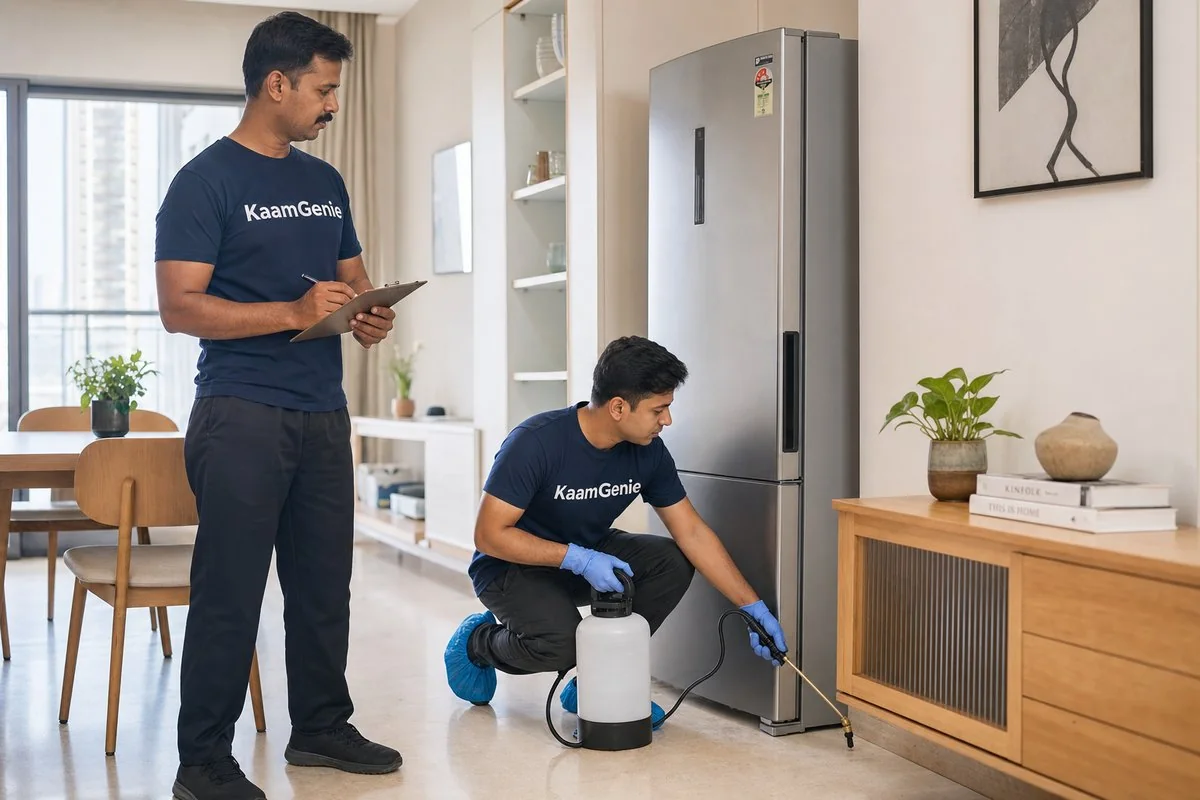
Documentation — the audit-ready pest log NABH actually checks
This is where most cheap services collapse, and it’s the part that matters most in healthcare. Killing the pest is only half the job; in a hospital you have to prove it — what was found, what was done, what product was used, by whom, and what happens next. An NABH assessor, a biomedical-hygiene auditor or an FSSAI inspector for the kitchen can ask to see this, and “the pest man comes sometimes” is not an answer that survives an audit. A proper healthcare programme hands you a documentation pack you can put on the table without scrambling.
| Document | What it shows | Who asks for it |
|---|---|---|
| Pest control log / service report | Date, technician, zones covered, products used, next visit | NABH assessor, infection-control committee |
| Bait & monitoring station map | Numbered rodent boxes and insect monitors, checked each visit | NABH assessor, hospital quality team |
| Pest-sighting & corrective-action record | Each complaint and its follow-up treatment, traceable | Infection-control committee |
| Before/after photos | Treated kitchen, drains, stores and bait points, dated per visit | Quality & hygiene auditor |
| Material safety data sheets (MSDS) | Toxicity and safe-use data for every product on site | Hospital safety officer, FSSAI for kitchen |
| GST invoice + vendor licence | Verifiable, licensed vendor; clean spend in your books | Accounts, audit, NABH vendor checks |
If a service can’t hand you a treatment log, a station map and photos, it isn’t built for a hospital, whatever the rate. The framework underneath all of this is Integrated Pest Management — the inspect, prevent, treat, monitor and document cycle that bodies like the Central Insecticides Board & Registration Committee and FSSAI lean on for sensitive premises. NABH’s facility and infection-control standards expect exactly this documented, repeatable approach, which is why we build the paperwork in from day one rather than bolting it on before an audit.
Scheduling zone-wise — without disrupting patients or theatres
A hospital never closes, so you can’t empty the building the way you might a home or even an office. The answer is zone-wise, scheduled treatment — you treat one wing, department or floor at a time, in its lowest-occupancy window, and leave the live clinical areas untouched until their slot comes round. The kitchen gets done after the last meal service and before the next; the OPD and lab get done after closing; wards are treated room by room as they free up, and the ICU and theatres are handled with the most caution and the lowest-odour methods, planned with the infection-control team rather than sprung on them.
One honest caveat on speed: we’ll come quickly for a flare-up — same-day where slots allow — but a hospital programme works best when it’s a planned, recurring schedule agreed with your facilities and infection-control staff, not a panic call. Tell us your department layout, your theatre and ICU locations, where the nursery and immune-compromised patients are, and your quiet windows, and we build the rota around your operation. That is how a 200-bed hospital near Saket or a busy polyclinic in Lajpat Nagar stays continuously covered without a single patient noticing the work.
AMC vs one-time — and what it costs in Delhi (2026)
For healthcare, I’ll be blunt: a one-time treatment is almost never the right standing arrangement. A hospital generates pest conditions every single day — the kitchen runs, waste accumulates, drains stay wet, patients and visitors flow through — and an accreditation body expects continuous control with a continuous record, not a one-off visit. So virtually every serious Delhi facility runs an Annual Maintenance Contract with scheduled monthly visits (and quicker call-outs between them if needed). A one-time service still has a place — a sudden flare-up before an inspection, or a new clinic doing an initial clean-out — but as the ongoing programme, AMC is what keeps you both pest-free and audit-ready.
| Factor | One-time service | Annual Maintenance Contract (AMC) |
|---|---|---|
| Best for | Sudden flare-up, pre-inspection clean-out, brand-new clinic | Any hospital, nursing home, lab or polyclinic in regular use |
| Visits | Single visit | Scheduled monthly visits + call-outs between |
| Records for audit | One invoice + photos | Continuous pest log, station map, photos, MSDS — NABH-ready |
| Result | Clears the current problem | Continuous control the auditor can see proof of |
| Typical price (2026) | ₹3–₹7 per sq-ft | Per bed or per sq-ft; from ~₹25,000/year |
Pricing in healthcare is quoted two honest ways: per square foot for a one-time job and per bed or per sq-ft on an annual contract, adjusted for how many high-risk zones you carry and how strict your accreditation needs are. As a rough 2026 guide, a one-time clinic treatment runs about ₹3 to ₹7 per sq-ft, the higher end for a facility with a full kitchen, lab and pharmacy. An AMC for a small nursing home commonly starts around ₹25,000 a year; a mid-size hospital is quoted per bed, and a large multi-speciality hospital is always a custom quote after a site survey.
| Facility | One-time (approx) | AMC per year (approx) |
|---|---|---|
| Single clinic / dental / eye / IVF (up to 1,500 sq-ft) | ₹5,000–₹10,000 | ₹18,000–₹30,000 |
| Polyclinic / diagnostic lab (1,500–4,000 sq-ft) | ₹10,000–₹25,000 | ₹30,000–₹60,000 |
| Nursing home (up to ~30 beds) | ₹20,000–₹45,000 | ₹40,000–₹90,000 |
| Multi-speciality hospital | Custom quote | Custom quote (per bed) |
Two warnings on price, the same ones I give every facility manager. Be wary of a suspiciously cheap quote — a hospital is a serious, high-stakes job, and a team offering to cover a nursing home for a token amount is skipping the drains, the stores and the documentation that make it worth anything. And be wary of any quote given over the phone without a survey; an honest healthcare quote comes after a technician has seen your kitchen, your lab, your stores and your drains. The real saving in healthcare isn’t a cheaper rate — it’s an AMC that keeps you out of an infection-control incident and through your next accreditation cleanly.
Want odourless treatment that won’t disturb patients?
Gel bait and tamper-proof stations instead of fogging — low-toxicity, applied wing by wing in low-occupancy windows. AMC plans for a typical Delhi nursing home from around ₹25,000/year.

Booking healthcare pest control across Delhi
Hospitals and clinics aren’t offices and they certainly aren’t homes — they need zero-tolerance control, methods safe around the most vulnerable patients, scheduling that never disrupts a theatre, and documentation that survives an NABH or FSSAI audit. We run scheduled pest control for hospitals, nursing homes, diagnostic labs, polyclinics and dental, IVF and eye clinics across Delhi — the hospital clusters around Saket and Karol Bagh, the clinics in South Ex and Lajpat Nagar, and facilities right across the city. Coming soon: Gurgaon, Noida, Faridabad and Ghaziabad. Tell us your facility size, your high-risk zones and your bed count, and we’ll survey the site and quote an honest per-bed or per-sq-ft AMC. Call 95603 66362 and let’s keep your facility clean, safe and audit-ready.
Frequently asked questions
How much does pest control cost for a hospital or clinic in Delhi in 2026?
A one-time clinic treatment in Delhi runs roughly ₹3–₹7 per sq-ft — about ₹5,000–₹10,000 for a small single clinic, more for a polyclinic or lab with a kitchen and pharmacy. An AMC for a small nursing home commonly starts around ₹25,000 a year; a mid-size hospital is quoted per bed, and a multi-speciality hospital is a custom quote after a survey. GST 18% is extra. An honest quote comes after a site visit, not over the phone.
Why do hospitals have zero tolerance for pests?
Because their patients are already vulnerable. Cockroaches, flies and rodents move from drains and waste onto sterile surfaces and can seed serious infections in post-surgical, chemotherapy, newborn or elderly patients who can’t fight them off. On top of the clinical risk, a single sighting can fail an NABH accreditation or infection-control audit. Pest control in healthcare is an assessed safety requirement, not just housekeeping.
Is hospital pest control safe to do around patients?
Yes, when it’s done with the right methods. Serious medical pest control uses odourless gel bait, tamper-proof bait stations and precise crack-and-crevice treatment with low-toxicity, food-safe products rather than fogging or open spraying. The responsible approach is still to keep patients clear of an actively treated spot for the advised time and ventilate after, even with low-toxicity products, and to plan ICU, theatre and nursery areas with your infection-control team.
Which hospital zones are highest risk for pests?
Kitchens and canteens are the biggest draw, followed by drains, linen and biomedical-waste holding areas, then pharmacy and medicine stores, pathology and diagnostic labs, and wards near the ICU. Lobbies, OPDs and courtyards add a mosquito risk in the monsoon from standing water. A good programme maps and prioritises these zones rather than treating the building as one space.
Does hospital pest control help with NABH accreditation?
Yes — it’s effectively required for it. NABH facility and infection-control standards expect documented, continuous pest control, and an assessor can check your pest log, bait-station map and corrective-action records. A proper programme gives you exactly those audit-ready records, so pest control becomes a box you can confidently tick rather than a finding against you.
What documents should a healthcare pest control service provide?
An audit-ready pack: a pest control log recording date, technician, zones, products and next visit; a numbered bait and monitoring station map; a pest-sighting and corrective-action record; dated before/after photos; material safety data sheets for every product; and a GST invoice plus the vendor’s licence. These are the records NABH assessors, infection-control committees and FSSAI inspectors for the kitchen actually ask to see.
Will pest control leave a chemical smell on the wards?
It shouldn’t, if done properly. Healthcare pest control leans on low-odour, targeted methods — gel bait in cracks and voids, tamper-proof rodent stations, and any residual treatment applied to crevices rather than open surfaces, using odourless products approved for occupied premises. Treated wing by wing in low-occupancy windows with ventilation, a treatment typically leaves a normal-smelling ward within the hour.
How do you treat a hospital without disrupting patients?
Zone by zone, on a schedule. You treat one wing, department or floor at a time in its lowest-occupancy window and leave the live clinical areas untouched until their slot. Kitchens are done between meal services, OPD and labs after closing, wards room by room as they free up, and ICU and theatres with the most caution, planned with the infection-control team. The hospital never has to close.
Should a clinic get an AMC or a one-time pest control service?
For any healthcare facility in regular use, an AMC is the right choice. A hospital or clinic generates pest conditions daily and accreditation expects continuous control with a continuous record, so scheduled monthly visits keep you both pest-free and audit-ready. A one-time service only makes sense for a sudden flare-up before an inspection or an initial clean-out at a brand-new clinic.
Do you cover nursing homes, diagnostic labs and dental or IVF clinics?
Yes. We run programmes for hospitals, nursing homes, diagnostic and pathology labs, polyclinics and specialist clinics including dental, IVF and eye clinics across Delhi — the hospital clusters around Saket and Karol Bagh, and clinics in South Ex and Lajpat Nagar among others. Each facility is surveyed and quoted to its own zones and accreditation needs.
How are pathology labs and pharmacies handled?
With the most careful, contamination-free methods. Pathology labs have samples, reagents and drains that must never be contaminated, so the work is targeted gel bait and monitored stations rather than spraying near benches. Pharmacy and medicine stores hold cardboard packaging that draws cockroaches and rodents, so harbourage is removed and stations are placed and mapped. Both are documented for your NABL and quality records.
How quickly can you start a hospital pest control contract?
We can often survey quickly and do same-day treatment for a flare-up where slots allow, but a healthcare programme works best as a planned, recurring schedule agreed with your facilities and infection-control staff. Flag your theatre, ICU and nursery locations, your high-risk zones and your quiet windows up front so we build the rota around your operation rather than disrupting it.
Keep your Delhi hospital clean, safe and audit-ready
Let us survey your facility and run a zone-wise AMC — low-toxicity methods around patients and NABH-ready pest logs. Hospitals, nursing homes, labs and clinics across Delhi.
Sources & references
- National Accreditation Board for Hospitals & Healthcare Providers (NABH) — sets the facility and infection-control standards that require documented pest control in accredited Indian hospitals.
- Central Insecticides Board & Registration Committee (CIB&RC) — the Indian regulator that approves the low-toxicity pest-control products and concentrations used in sensitive premises.
- Food Safety and Standards Authority of India (FSSAI) — sets the pest-control and Integrated Pest Management expectations for hospital kitchens and canteens.
- National Centre for Disease Control (NCDC) — tracks urban pest and vector patterns, including mosquito-borne disease relevant to healthcare facilities in Delhi.
Last verified: 13 June 2026. If you find any of these links broken, please let us know.