

Quick answer — pest control for Delhi offices & corporate spaces (2026)
- Why offices get pests: pantries and shared kitchens, false ceilings, server-room warmth, parking basements and the daily flow of food deliveries — all of it feeds cockroaches, rodents and flies.
- Schedule after hours: the smart move is a weekend or late-evening slot so treated areas are empty and ventilated before staff return Monday morning.
- AMC beats one-time for most offices: a scheduled contract with monthly or quarterly visits keeps it under control and keeps your records audit-ready; a one-time visit only clears a flare-up.
- Real cost (2026): small offices commonly run ₹3–₹6 per sq-ft for a one-time service; AMC plans for a typical floor start around ₹15,000–₹40,000/year depending on size and frequency. GST 18% extra.
- Audit-ready & low-odour: a serious service gives you before/after photos, a GST invoice and a treatment log for ISO and health-safety audits, and uses odourless, low-toxicity products on occupied floors.
- We cover offices across Delhi — custom quote per site. No honest service promises a pest-free office forever; ongoing scheduled visits are how you keep it that way.
Why offices get pests — and why they’re harder than homes
People assume an office is cleaner than a home, so it should have fewer pests. In practice the opposite is true, and after years of walking corporate floors across Delhi I can tell you exactly why. An office concentrates everything a pest wants into one building: food, warmth, water and a hundred dark voids to hide in — and then leaves it largely unattended for sixteen hours a day and all weekend, which is precisely when pests come out to feed.
Start with the pantry. A shared office kitchen sees tea, biscuits, lunch dabbas, milk, sugar and a dustbin that often isn’t emptied until the morning. The crumbs behind the microwave, the spill under the fridge, the sticky ring where the coffee machine sits — that is a buffet for cockroaches and ants. Then the false ceiling: the grid of panels above your head hides cabling, pipes and a warm, undisturbed cavity that runs the length of the floor. Rodents and cockroaches use it as a highway, moving between the pantry, the washrooms and the server room without ever being seen. The server room itself is a quiet, warm, climate-controlled space that pests love — and the one room facilities are most nervous about treating, which is exactly why infestations settle there.
Add the parking basement, usually damp, poorly lit and connected to the building’s drainage — a classic entry point for rats coming up from the sewer line into the lobby and lift shafts. Add the constant churn of food deliveries arriving at the reception desk, the cardboard cartons stacked in a store room (cockroach egg cases love corrugated cardboard), and the planters in the lobby holding moist soil. Now picture all of that in a Nehru Place IT building where four companies share one floor, or a co-working space in Saket where the pantry never sleeps, and you understand why corporate pest control is its own discipline. It isn’t a bigger version of a home job — it’s a different job, with access, scheduling and documentation problems a home never has.
The pests Delhi offices actually report
Across the corporate sites we handle, the complaints fall into a predictable pattern. Cockroaches are the runaway number one — American and German cockroaches in pantries, washrooms and the cable voids of the false ceiling. Rodents are next, usually entering through the basement and the service ducts, gnawing cables (a genuine fire and downtime risk in a server room) and leaving droppings that turn up in an audit. Then come flies and mosquitoes, breeding in the basement water pooling, AC drip trays and lobby planters, worst through the monsoon. Termites are less frequent but the most expensive when ignored — they go for wooden partitions, document storage and the paper records in older Connaught Place buildings. The rough split below is what we see on the ground, and it explains why a pantry-and-ceiling focused programme handles most of the load.
What Delhi offices report most — share of corporate pest complaints (2026)
Rough breakdown of the complaints we log across Delhi office sites, by pest type.
Scheduling around your staff — after-hours and weekends
This is the part that separates a service that understands offices from one that doesn’t. You cannot spray an occupied floor during working hours and expect people to keep typing. Beyond the obvious disruption, some treatments need the area vacated for a couple of hours and then ventilated, and you do not want forty people breathing that or a client walking into a treated reception. So the scheduling is the whole game.
For most Delhi offices the answer is a weekend or late-evening slot. We come in on a Saturday or after the last shift leaves, treat the pantries, washrooms, false-ceiling voids, server-room perimeter and basement, and the floor sits empty overnight so it’s clear and aired by Monday morning — nobody loses an hour of work. For 24x7 operations like a BPO or a support floor in Gurgaon-adjacent Delhi offices, we plan around shift gaps and treat zone by zone so the live area is never the one being worked on. The other reason after-hours matters: cockroaches and rodents are nocturnal, so an evening treatment actually catches them when they’re active and out of their harbourage, which makes gel baiting and trapping far more effective than a daytime spray of empty corners.
One honest caveat on speed. We’ll do same-day where slots allow, but for a planned office programme it’s better to book the survey first, agree the zones and the slot, and treat on a date that suits your floor — rushing it usually means somebody’s desk gets missed. Tell us about the server room, any food-handling area, asthmatics on staff and your fire-panel locations up front, and we plan around them.
Need your office floor sorted without disrupting staff?
We schedule after-hours and weekend slots so treated areas are empty and ventilated before your team returns. Custom quote per site — GST 18% extra.
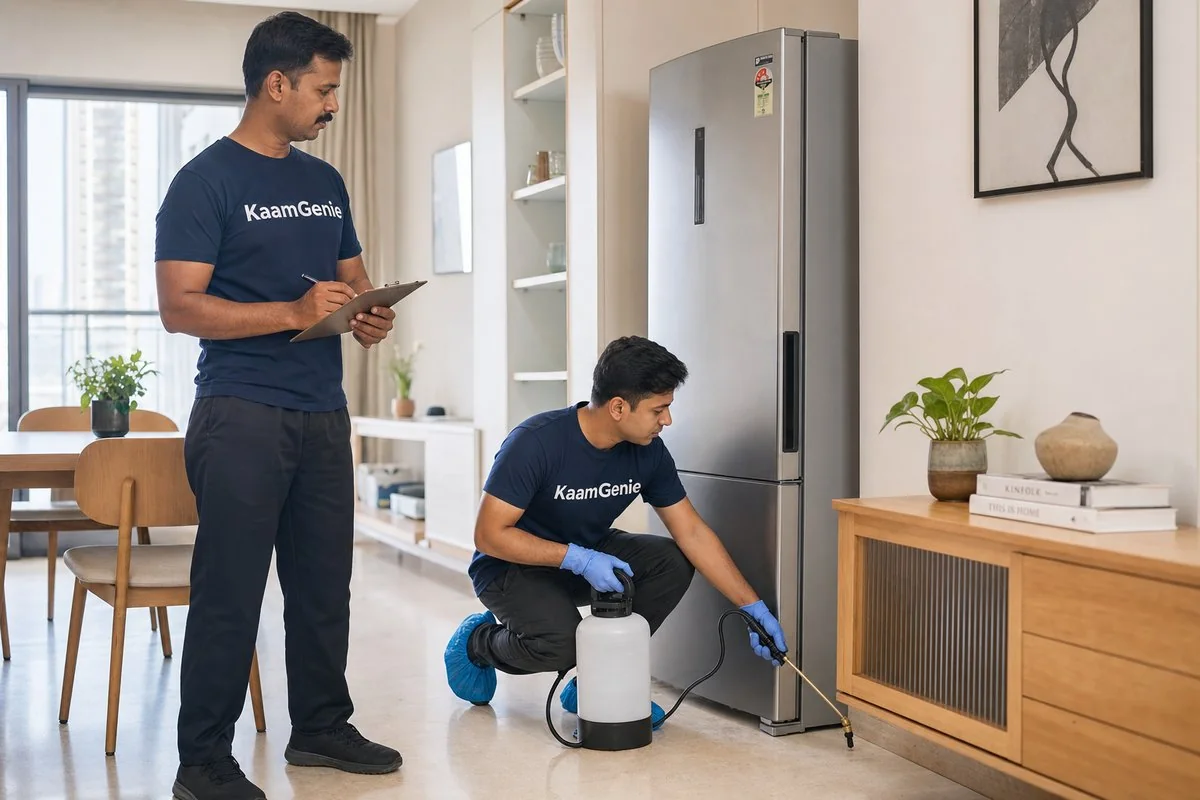
AMC vs one-time — what makes sense for an office
For a home, a one-time treatment with a warranty often does the job. For an office, I’ll be straight with you: a one-time service is usually the wrong call. An office never stops generating the conditions that draw pests — the pantry refills every morning, deliveries keep arriving, the basement stays damp. Treat it once and you’ve cleared today’s problem, but you’ve done nothing about next month’s. That’s why almost every serious corporate site runs an Annual Maintenance Contract (AMC) with scheduled visits.
An AMC buys you three things a one-time visit can’t. First, prevention instead of reaction — a technician walks the floor monthly or quarterly, catches a problem at the “two cockroaches in the pantry” stage instead of the “client saw a rat in reception” stage. Second, a paper trail — every visit is logged, photographed and invoiced, which is exactly what your ISO or health-safety auditor wants to see. Third, cost control — an annual plan is far cheaper per visit than calling out an emergency one-time team every time something crawls. A one-time service still has its place: a sudden flare-up before a big client visit, a move into a new floor that needs a deep clean-out, or a small startup that genuinely can’t commit to a contract yet. But as the standing arrangement, AMC wins for almost every Delhi office.
| Factor | One-time service | Annual Maintenance Contract (AMC) |
|---|---|---|
| Best for | Sudden flare-up, new-floor move-in, small startup | Any established office or shared floor |
| Visits | Single visit | Monthly or quarterly scheduled visits |
| Result | Clears the current problem | Keeps it under control over the year |
| Records for audit | One invoice + photos | Ongoing treatment log, photos, invoices |
| Cost efficiency | Higher per visit | Lower per visit; predictable annual budget |
| Typical price (2026) | ₹3–₹6 per sq-ft | From ~₹15,000–₹40,000/year per floor |
Real office pest control cost in Delhi (2026)
Pricing an office is different from pricing a home, because no two floors are the same. The honest way to quote it is per square foot for a one-time service and an annual figure for an AMC, adjusted for how many pantries and washrooms you have and how bad things are. As a rough 2026 guide, a one-time treatment runs about ₹3 to ₹6 per sq-ft, with the lower end for a clean, single-pantry floor and the higher end for a food-heavy co-working space or a site with a known rodent problem. Some clients prefer to think in per-seat terms for budgeting — on a typical floor that works out to roughly ₹150–₹400 per seat per year on an AMC, which is a useful way to compare quotes across offices of different shapes.
| Office size | One-time (approx) | AMC per year (approx) | Rough per-seat/year |
|---|---|---|---|
| Small (up to 2,000 sq-ft) | ₹6,000–₹12,000 | ₹15,000–₹22,000 | ₹150–₹300 |
| Medium (2,000–5,000 sq-ft) | ₹12,000–₹25,000 | ₹22,000–₹40,000 | ₹200–₹350 |
| Large floor (5,000–10,000 sq-ft) | ₹25,000–₹50,000 | ₹40,000–₹80,000 | ₹250–₹400 |
| Whole building / multi-floor | Custom quote | Custom quote | Custom quote |
Two warnings on price. Be wary of a quote that sounds suspiciously cheap — an office is a serious job, and a team offering to do a 5,000 sq-ft floor for a few thousand rupees is either skipping the false ceiling and basement or using a single watered-down chemical that won’t hold. And be wary of a quote given over the phone without a site visit; an honest office quote comes after a survey, because the technician needs to see your pantries, your ceiling access and your basement before putting a number on it. The cheapest real saving isn’t a lower rate — it’s an AMC that stops a small problem becoming an expensive one.
Want pest control your auditor will accept?
Our AMC plans include before/after photos, a GST invoice and a treatment log for ISO and health-safety audits. Plans for a typical Delhi floor from around ₹15,000/year.

What an audit-ready office service looks like
If your office carries an ISO certification, an FSSAI licence for a cafeteria, or simply a client who runs vendor audits, your pest control has to do more than kill pests — it has to prove it did. This is where cheap, cash-in-hand services fall down, because they leave no record. A proper corporate programme gives you a documentation pack you can put in front of an auditor without scrambling.
- Before/after photos of the treated areas — the pantry, the bait points, the rodent stations — dated and filed for each visit.
- A GST invoice for every visit, so the spend is clean in your books and the vendor is verifiable.
- A treatment log recording the date, the technician, the areas covered, the products used and the next scheduled visit — the audit-ready record auditors actually ask for.
- A pest-sighting and corrective-action record, so a complaint and its follow-up treatment are both traceable.
- Material safety data sheets for the products used, on file for your health-safety team and anyone with a sensitivity.
- A site map of bait and monitoring stations, so the rodent boxes and insect monitors are documented, numbered and checked each visit.
None of this is exotic — it’s the standard a credible commercial provider works to as a matter of course. If a service can’t hand you photos, an invoice and a log, it isn’t built for an office, whatever the price says. Integrated Pest Management — the inspect, prevent, treat, monitor cycle that bodies like the Central Insecticides Board & Registration Committee and FSSAI lean on for food premises — is exactly this documented, repeatable approach, and it’s what an auditor is looking for under the bonnet.
Low-odour, low-toxicity treatment for occupied floors
The last worry I hear from facility managers is the smell — the memory of a school or society that got “fogged” and reeked of chemical for two days. On a working office floor you genuinely cannot have that, and the good news is you don’t have to. Modern corporate pest control leans on targeted, low-odour methods rather than blanket spraying. Cockroaches are handled mostly with gel bait placed precisely in cracks and voids — no smell, no spray drifting over desks, and it keeps working for weeks. Rodents are managed with tamper-proof bait stations and traps along the walls and basement, not poison scattered where staff walk. Where a residual spray is needed, it’s applied to cracks, crevices and service voids, not open surfaces, and the products chosen are odourless or near-odourless and approved for use in occupied premises.
That said, treat any claim of “100% chemical-free” or “completely safe, treat while you work” with caution — the responsible approach is still to keep staff clear of an actively treated zone for the advised time and ventilate after, even when the products are low-toxicity. Tell us about pregnant staff, asthmatics, the cafeteria and the server room, and we’ll plan the methods and the timing around them. Done this way, a Saturday treatment leaves no lingering smell and your team walks into a normal office on Monday — which, for most of the facility managers I deal with, is the whole point.
Booking office pest control across Delhi
Offices aren’t homes, and they shouldn’t be treated like them — they need scheduling that respects your staff, documentation that survives an audit, and methods that don’t empty the building for a day. We run scheduled pest control for offices, IT parks and co-working spaces across Delhi — Connaught Place and the central business district, Nehru Place and Jasola, the Saket corporate towers, and floors right across the city. Coming soon: Gurgaon, Noida, Faridabad and Ghaziabad. Tell us your floor size, your pantries and your shift pattern, and we’ll survey the site and quote an honest AMC or one-time programme. Call 95603 66362 and let’s keep your office off the team WhatsApp group for the wrong reasons.
Frequently asked questions
How much does pest control cost for an office in Delhi in 2026?
A one-time office treatment in Delhi runs roughly ₹3–₹6 per sq-ft — about ₹6,000–₹12,000 for a small floor up to 2,000 sq-ft, and more for larger or food-heavy spaces. An AMC for a typical floor starts around ₹15,000–₹40,000 a year depending on size and visit frequency, which works out to roughly ₹150–₹400 per seat per year. GST 18% is extra. An honest quote comes after a site survey, not over the phone.
Should an office get an AMC or a one-time pest control service?
For most established offices an AMC is the better choice. An office never stops generating pest conditions — the pantry refills daily, deliveries keep arriving, the basement stays damp — so scheduled monthly or quarterly visits keep it under control and keep your records audit-ready. A one-time service makes sense for a sudden flare-up, a move into a new floor, or a small startup not ready to commit to a contract.
Can office pest control be done after hours or on weekends?
Yes, and for most Delhi offices that’s the right way to do it. A weekend or late-evening slot means treated areas — pantries, washrooms, false-ceiling voids, basement — sit empty overnight and are ventilated before staff return, so nobody loses working time. After-hours also works better because cockroaches and rodents are nocturnal and more active when the floor is quiet.
Why do offices get pests if they’re cleaner than homes?
Because an office concentrates food, warmth, water and hiding places and then leaves them unattended overnight and all weekend — exactly when pests feed. Shared pantries, false ceilings full of cabling, warm server rooms, damp parking basements and constant food deliveries all draw cockroaches, rodents and flies. It’s a harder environment to control than a home, not an easier one.
What pests are most common in Delhi offices?
Cockroaches are the biggest complaint — in pantries, washrooms and false-ceiling cable voids. Rodents come next, entering through basements and service ducts and gnawing cables. Flies and mosquitoes breed in basement water, AC drip trays and lobby planters, especially in the monsoon. Termites are less frequent but the most damaging, going for wooden partitions and document storage.
Is office pest control safe to do while staff are working?
The responsible approach is to keep staff clear of an actively treated zone for the advised time and ventilate after, even with low-toxicity products. That’s why most offices schedule after-hours. Modern methods like gel bait and tamper-proof bait stations are low-odour and targeted, so a weekend treatment leaves no lingering smell. Be cautious of anyone claiming you can treat the whole floor while everyone works with zero precautions.
Will office pest control leave a strong chemical smell?
It shouldn’t, if it’s done properly. Corporate pest control leans on low-odour, targeted methods — gel bait in cracks and voids, tamper-proof rodent stations, and any residual spray applied to crevices rather than open surfaces, using odourless products approved for occupied premises. A Saturday treatment with overnight ventilation typically leaves a normal-smelling office by Monday.
What records do I get for an ISO or health-safety audit?
A proper corporate service gives you a documentation pack: before/after photos of treated areas, a GST invoice per visit, a treatment log recording date, technician, areas covered and products used, a pest-sighting and corrective-action record, material safety data sheets for the products, and a numbered site map of bait and monitoring stations. That’s the audit-ready trail an ISO or FSSAI auditor expects.
How is the server room handled during office pest control?
Carefully and with low-odour methods. The server room is warm and climate-controlled, which pests love, but it’s also sensitive equipment, so the technician uses targeted gel bait and bait/monitoring stations around the perimeter and cable entry points rather than spraying over equipment. Flag the server room in the survey so the team plans the right approach and timing for it.
Do you cover co-working spaces and IT parks in Delhi?
Yes. Co-working spaces and IT parks are some of the hardest sites because the pantry never sleeps and multiple companies share a floor, so they benefit most from a scheduled AMC. We run programmes across Delhi business districts including Connaught Place, Nehru Place, Jasola and the Saket corporate towers, with custom quotes per site.
How quickly can you start an office pest control contract?
We can often arrange a survey quickly and do same-day treatment where slots allow, but for a planned office programme it’s better to book the survey first, agree the zones and the after-hours slot, and treat on a date that suits your floor. That avoids desks being missed in a rush. Flag the server room, any cafeteria, asthmatic staff and fire-panel locations up front so we plan around them.
How is office pest control priced — per sq-ft or per seat?
Both framings are used. The technical basis is usually per square foot — roughly ₹3–₹6 per sq-ft for a one-time service — because that reflects the area, pantries and washrooms to be covered. Many facility managers prefer a per-seat figure for budgeting, which on an AMC works out to about ₹150–₹400 per seat per year. We can quote either way once we’ve surveyed your floor.
Keep your Delhi office pest-free, on schedule
Let us survey your floor and run a scheduled AMC — after-hours visits, low-odour treatment and audit-ready records. Offices, IT parks and co-working spaces across Delhi.
Sources & references
- Central Insecticides Board & Registration Committee (CIB&RC) — the Indian regulator that approves the pest-control products and concentrations used in commercial premises.
- Food Safety and Standards Authority of India (FSSAI) — sets the pest-control and Integrated Pest Management expectations for office cafeterias and food-handling areas.
- National Centre for Disease Control (NCDC) — tracks urban pest and vector patterns relevant to commercial buildings in Delhi.
- Indian Council of Medical Research (ICMR) — publishes research on pest biology and integrated pest management protocols.
Last verified: 13 June 2026. If you find any of these links broken, please let us know.