

Quick answer — pest control for Delhi retail stores, malls & showrooms (2026)
- Why retail gets pests: stockrooms full of cardboard cartons, food courts and grocery aisles, customer footfall holding doors open, and shared mall service ducts — all of it feeds rodents, cockroaches and stored-product insects.
- Reputation is the real cost: one pest sighting on the shop floor loses the sale and can lose the customer for good. Discreet, scheduled treatment protects the brand, not just the building.
- Treat during closed hours: the smart move is an early-morning or after-close slot so the floor is empty, the smell clears, and no customer ever sees a technician at work.
- Real cost (2026): a one-time store treatment commonly runs ₹3–₹7 per sq-ft; AMC plans start around ₹12,000–₹45,000/year by floor area and frequency. GST 18% extra.
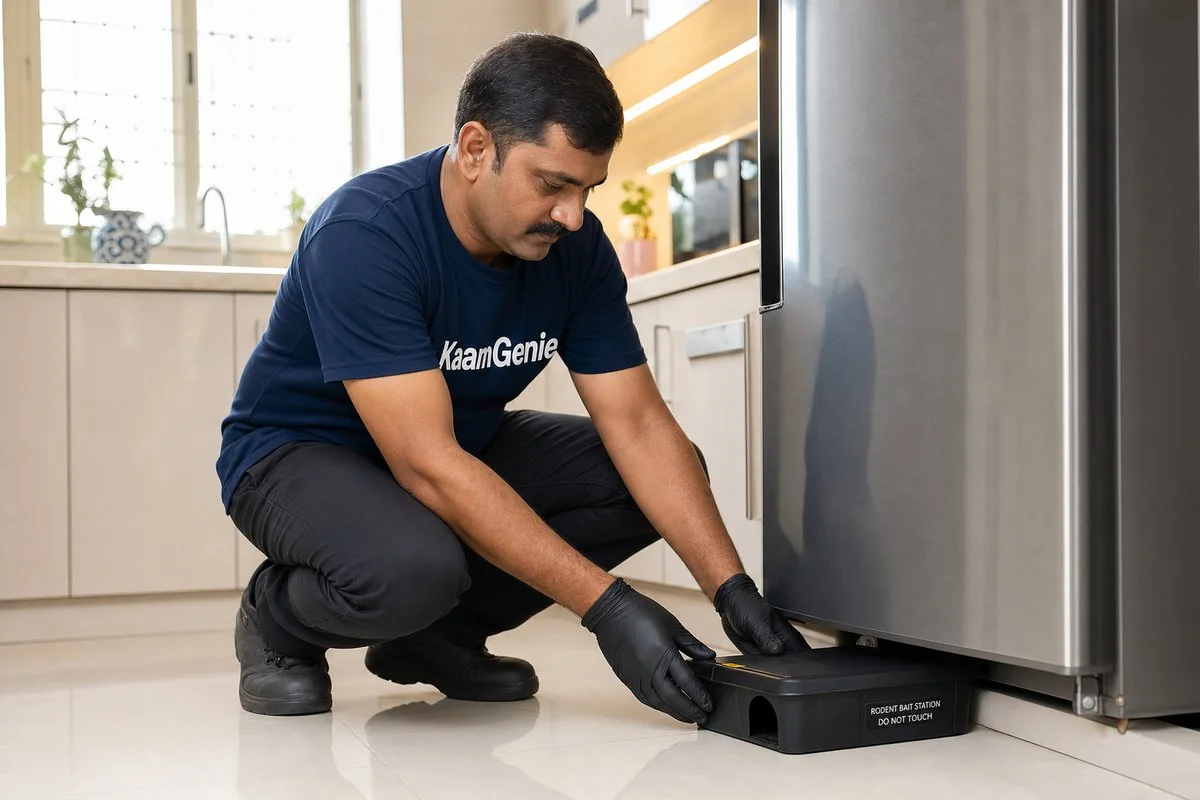
- Bait grids + ILT, not fogging: tamper-proof rodent bait stations along the stockroom walls, gel bait for cockroaches, and insect light traps (ILT) at entries — documented and checked each visit.
- AMC with logs for mall compliance — before/after photos, a GST invoice and a pest log that mall management and FSSAI (for food courts) actually ask for. We cover retail across Delhi; custom quote per site.
Why retail stores and malls are a pest magnet
People assume a smart showroom or a clean supermarket should have fewer pests than a home. In practice retail is one of the hardest environments to keep pest-free, and after years of working Delhi shops I can tell you exactly why. A store concentrates everything a pest wants — food, packaging, warmth and a hundred hiding places — and then opens its doors to the street for twelve hours a day, with customers and delivery staff holding those doors wide open the entire time.
Start with the stockroom. Whether it’s a garment shop in Lajpat Nagar or an electronics store in Nehru Place, the back room is stacked with corrugated cardboard cartons — and corrugated cardboard is where cockroaches lay egg cases and where rodents love to nest. Boxes sit undisturbed for weeks, the lighting is poor, and nobody’s watching the corner behind the last pallet. That’s where a rat colony settles in, gnawing through stock and, far more dangerously, through the wiring that runs along the skirting. A chewed cable in a stockroom is a genuine fire risk and an insurance problem, not just a nuisance.
Then the shop floor itself. Grocery and supermarket aisles in Karol Bagh or Sarojini Nagar carry open packs of flour, rice, pulses, dry fruit and biscuits — a buffet for stored-product insects and rodents. A mall food court in Saket or Vasant Kunj is worse still: multiple kitchens, shared grease traps, a common dustbin yard and an HVAC plenum that links every unit, so a cockroach problem in one stall becomes everyone’s problem. Add the shared mall service ducts and basements, the loading bays where deliveries pile up, and the planters and water features in the atrium, and you understand why retail pest control is its own discipline. It isn’t a bigger home job — it’s a different job, where the customer must never see it happening.
The pests Delhi retail actually reports
Across the stores, showrooms and mall units we handle, the complaints fall into a clear pattern. Rodents are the headline worry — rats and mice in stockrooms gnawing stock and wiring, entering through loading-bay shutters and shared service ducts. Cockroaches are close behind, in food courts, grocery backrooms and the cracks behind billing counters and chillers. Stored-product insects — weevils, flour beetles, moths — are the quiet menace in grocery and dry-goods stores, breeding inside open sacks and contaminating stock before anyone notices. Then come flies and mosquitoes around food courts, dustbin yards and atrium water features, worst through the monsoon. The rough split below is what we log on the ground, and it’s why a stockroom-and-foodcourt focused programme handles most of the load.
Top retail pest issues in Delhi — share of store complaints (2026)
Rough breakdown of the complaints we log across Delhi retail stores, malls and showrooms, by pest type.
Pest risk by retail zone — where the problem actually lives
One thing I tell every shop owner: don’t treat the whole store as one undifferentiated space. The risk is wildly uneven. The shop floor a customer sees is usually the cleanest part; the trouble starts in the back, where boxes sit and bins fill. Mapping the risk by zone is how a serious survey works, and it’s how you spend your money where it counts rather than spraying the showroom for show.
| Zone | Main pests | Why it’s at risk | What we do there |
|---|---|---|---|
| Shop floor / display | Cockroaches, the odd rodent sighting | Customer-facing; a single sighting loses sales | Discreet monitoring, crack-and-crevice gel bait, no visible spray |
| Stockroom / backroom | Rodents, cockroaches, stored-product insects | Cardboard cartons, dark corners, gnawed wiring | Tamper-proof bait stations along walls, snap traps, carton inspection |
| Food court / grocery | Cockroaches, flies, rodents | Open food, grease, shared HVAC and bins | Gel baiting, ILT units, drain and grease-trap treatment |
| Storefront / entry | Flies, mosquitoes, crawling pests | Doors held open, footfall, atrium water | Insect light traps, door-line residual, air-curtain advice |
The pattern is always the same: the stockroom and the food-handling areas carry the real risk, while the shop floor needs the lightest, most invisible touch. Get the zoning right in the survey and you treat the back hard, the front discreetly, and never have a customer watch a technician kneel under a display rack.
Treating discreetly during closed hours
This is the part that separates a service that understands retail from one that doesn’t. You cannot have a technician in overalls baiting the floor while shoppers browse — it reads as “this store has bugs,” and the customer walks. So the scheduling is the whole game. For most Delhi stores the answer is an early-morning slot before opening, or an after-close evening visit. We come in when the shutters are down, treat the stockroom, billing counters, food-handling areas and entry lines, and the floor is empty, aired and back to normal before the first customer of the day.
For mall units there’s an extra layer: most malls in Saket, Vasant Kunj and the like have fixed maintenance windows — usually before mall opening or after close — and require vendors to coordinate with facility management and carry the right gate passes. We work within those windows as a matter of routine. The other reason closed-hours treatment matters: rodents and cockroaches are nocturnal, so an evening or pre-dawn visit catches them when they’re out of their harbourage and feeding, which makes baiting and trapping far more effective than a daytime spray of empty corners.
One honest caveat on speed. We’ll do same-day where slots allow — useful when a rat’s been seen and you need it handled before tomorrow’s footfall — but for a standing programme it’s better to book the survey, agree the zones and the closed-hours slot, and treat on a date that suits your store. Tell us about any food counter, the wiring runs in the stockroom and your delivery timings up front, and we plan around them.
Need your store treated without a single customer noticing?
We schedule early-morning and after-close slots so the floor is empty and aired before you open. Custom quote per site — GST 18% extra.
Bait-station grids and ILT — the right method for shops
If a service turns up at your store with a fogging machine and a tank of strong-smelling spray, send them away. Fogging a retail floor is the wrong tool: it stinks for a day, drives pests deeper rather than killing the colony, and leaves residue near stock and, in a grocery, near food. The professional approach to retail is Integrated Pest Management — targeted, documented, low-visibility methods built around monitoring.
For rodents, that means a grid of tamper-proof bait stations and snap traps, numbered and fixed along the stockroom skirting, loading bay and service-duct entries, checked and logged every visit so you can see whether activity is rising or falling. For cockroaches, gel bait placed precisely into the cracks behind chillers, billing counters and kitchen equipment — no smell, no spray over stock, and it keeps working for weeks. For flying insects around the entrance and food court, insect light traps (ILT) mounted away from customer sightlines catch flies without any chemical at all. For stored-product insects in a grocery, the answer is inspection and stock rotation advice as much as treatment — finding the infested sack and getting it out before it spreads. Where a residual spray is genuinely needed it goes into cracks and crevices, not open surfaces, using products approved for occupied and food premises. This grid-and-monitor approach is exactly what mall management and an FSSAI auditor for a food court want to see documented.
| Element | One-time service | AMC programme |
|---|---|---|
| Site survey & zone mapping | Yes | Yes, reviewed each visit |
| Rodent bait-station grid | Set up once | Numbered, checked & refilled every visit |
| Cockroach gel baiting | Yes | Yes, topped up on schedule |
| Insect light traps (ILT) | On request | Installed & serviced |
| Before/after photos + GST invoice | Yes | Every visit |
| Pest log for mall / FSSAI compliance | Single record | Ongoing audit-ready log |
| Visit frequency | Single visit | Monthly or quarterly |
Real retail pest control cost in Delhi (2026)
Pricing a store is different from pricing a home, because no two retail floors are the same. The honest way to quote it is per square foot for a one-time service and an annual figure for an AMC, adjusted for how much stockroom and food handling you have and how bad things are. As a rough 2026 guide, a one-time treatment runs about ₹3 to ₹7 per sq-ft — the lower end for a clean dry-goods showroom, the higher end for a grocery, a food court unit or a store with a known rodent problem. A standalone shop in Sarojini Nagar will sit at the low end; a supermarket or a mall food-court kitchen at the high end.
| Store size | One-time (approx) | AMC per year (approx) | Typical fit |
|---|---|---|---|
| Small shop (up to 1,000 sq-ft) | ₹3,000–₹7,000 | ₹12,000–₹20,000 | Standalone store, boutique, showroom unit |
| Medium (1,000–3,000 sq-ft) | ₹7,000–₹18,000 | ₹20,000–₹35,000 | Garment/footwear showroom, mid grocery |
| Large (3,000–8,000 sq-ft) | ₹18,000–₹45,000 | ₹35,000–₹75,000 | Supermarket, electronics megastore, big showroom |
| Mall unit / food court | Custom quote | Custom quote | Food court kitchen, anchor store, multi-floor |
Two warnings on price. Be wary of a quote that sounds suspiciously cheap — a store with a stockroom and a food counter is a serious job, and a team offering to do a 3,000 sq-ft supermarket for a couple of thousand rupees is either skipping the stockroom and loading bay or using one watered-down chemical that won’t hold a colony. And be wary of a quote given over the phone without a site visit; an honest retail quote comes after a survey, because the technician needs to see your backroom, your food handling and your duct access before putting a number on it. The cheapest real saving isn’t a lower rate — it’s an AMC that stops one rat sighting from becoming a week of lost footfall.
Want a pest log your mall management will accept?
Our AMC plans include before/after photos, a GST invoice and a pest log for mall compliance and FSSAI food-court audits. Plans for a typical Delhi store from around ₹12,000/year.

AMC vs one-time — and mall compliance
For a sudden flare-up — a rat seen near the billing desk on a Friday evening — a one-time service is the right emergency call, and we’ll handle it. But as the standing arrangement for a store, a one-time visit is usually the wrong choice. Retail never stops generating the conditions that draw pests: deliveries keep arriving, cartons keep stacking, the food court keeps cooking. Treat it once and you’ve cleared today’s problem and done nothing about next month’s. That’s why almost every serious store and every mall tenant runs an Annual Maintenance Contract (AMC) with scheduled visits.
An AMC buys you three things a one-time visit can’t. First, prevention instead of reaction — the bait grid is checked monthly, so you catch rising activity at the “droppings behind the cartons” stage instead of the “customer screamed on the shop floor” stage. Second, a pest log — many Delhi malls make pest control a condition of the tenancy and ask tenants for a current pest-control record, and any food court unit needs it for its FSSAI licence. Every visit logged, photographed and invoiced is exactly what mall facility management and an FSSAI auditor want to see. Third, cost control — an annual plan is far cheaper per visit than an emergency callout every time something crawls. The one-time service still has its place for a flare-up or a brand-new store fit-out; but as the day-to-day, AMC wins for almost every Delhi retailer.
| Factor | One-time service | Annual Maintenance Contract (AMC) |
|---|---|---|
| Best for | Sudden sighting, store fit-out, very small shop | Any established store or mall tenant |
| Visits | Single visit | Monthly or quarterly scheduled visits |
| Result | Clears the current problem | Keeps it under control over the year |
| Records for mall / FSSAI | One invoice + photos | Ongoing pest log, photos, invoices |
| Cost efficiency | Higher per visit | Lower per visit; predictable annual budget |
| Typical price (2026) | ₹3–₹7 per sq-ft | From ~₹12,000–₹45,000/year |
Booking retail pest control across Delhi
A store isn’t a home, and it can’t be treated like one — it needs scheduling that keeps it out of customers’ sight, a bait-and-monitor method instead of a fog, and a pest log that satisfies mall management and, for food courts, FSSAI. We run scheduled pest control for retail stores, supermarkets, showrooms and mall units across Delhi — the Sarojini Nagar and Lajpat Nagar markets, Karol Bagh, Khan Market and Connaught Place, and the mall units in Saket and Vasant Kunj. Coming soon: Gurgaon, Noida, Faridabad and Ghaziabad. Tell us your floor area, your stockroom setup and whether you handle food, and we’ll survey the site and quote an honest AMC or one-time programme. Call 95603 66362 and keep your shop floor selling, not scaring customers off.
Frequently asked questions
How much does pest control cost for a retail store in Delhi in 2026?
A one-time store treatment in Delhi runs roughly ₹3–₹7 per sq-ft — about ₹3,000–₹7,000 for a small shop up to 1,000 sq-ft, and more for a grocery, supermarket or mall food-court unit. An AMC for a typical store starts around ₹12,000–₹45,000 a year depending on floor area and visit frequency. GST 18% is extra. An honest quote comes after a site survey, not over the phone.
Should a shop get an AMC or a one-time pest control service?
For most established stores an AMC is the better choice. Retail never stops generating pest conditions — deliveries keep arriving, cartons keep stacking, the food court keeps cooking — so scheduled monthly or quarterly visits keep it under control and keep your pest log current for mall management and FSSAI. A one-time service makes sense for a sudden sighting, a store fit-out, or a very small shop not ready to commit to a contract.
Can store pest control be done after hours so customers don’t see it?
Yes, and for retail that’s the right way to do it. We schedule an early-morning slot before opening or an after-close evening visit, treat the stockroom, billing counters, food areas and entry lines while the shutters are down, and the floor is empty and aired before the first customer. For mall units we work within the mall’s fixed maintenance windows and coordinate with facility management.
Why do retail stores get pests if they look clean?
Because a store concentrates food, packaging, warmth and hiding places, then holds its doors open to the street all day. Stockrooms full of cardboard cartons draw rodents and cockroaches, grocery aisles feed stored-product insects, and mall food courts share grease, bins and HVAC ducts. The shop floor a customer sees is usually the cleanest part — the real risk is in the backroom and food-handling areas.
What pests are most common in Delhi retail and malls?
Rodents are the biggest worry — rats and mice in stockrooms gnawing stock and wiring, entering through loading bays and service ducts. Cockroaches come next, in food courts, grocery backrooms and behind billing counters and chillers. Stored-product insects like weevils and flour beetles infest open sacks in grocery stores, and flies and mosquitoes cluster around food courts and atrium water, especially in the monsoon.
Do you use fogging in retail stores?
No — fogging is the wrong tool for a shop. It leaves a strong smell, drives pests deeper instead of killing the colony, and leaves residue near stock and food. The professional retail approach is Integrated Pest Management: tamper-proof rodent bait stations, gel bait for cockroaches in cracks and crevices, and insect light traps for flies — all targeted, low-odour and documented, with residual spray used only in cracks where genuinely needed.
What is a bait-station grid and why does my store need one?
A bait-station grid is a set of numbered, tamper-proof rodent bait boxes and snap traps fixed along your stockroom walls, loading bay and service-duct entries. Each one is checked and logged every visit, so you can see whether rodent activity is rising or falling rather than guessing. It’s the standard for retail because it controls rodents discreetly and gives you a documented record for mall and food-safety compliance.
How does pest control work for a mall food court?
A food court is treated like commercial kitchens under one roof: gel baiting for cockroaches in equipment cracks, insect light traps for flies, drain and grease-trap treatment, and a rodent bait grid in the back-of-house and shared service areas. Because food courts fall under FSSAI, the work has to be documented — before/after photos, a GST invoice and a pest log per visit — and scheduled within the mall’s maintenance window.
What records do I get for mall management or an FSSAI audit?
A proper retail service gives you a documentation pack: before/after photos of treated areas, a GST invoice per visit, a pest log recording the date, technician, areas covered and products used, a numbered site map of bait stations and ILT units, and material safety data sheets for the products. That’s the audit-ready record mall facility management and an FSSAI inspector for a food court expect to see.
A rat was seen near the billing desk — how fast can you come?
We can often arrange a survey quickly and do same-day treatment where slots allow, which matters when a rodent’s been seen and you need it handled before the next day’s footfall. For a standing programme it’s better to book a survey, agree the zones and the closed-hours slot, and treat on a suitable date. Flag any food counter, the stockroom wiring runs and your delivery timings up front so we plan around them.
Will pest control leave a smell on the shop floor before opening?
It shouldn’t, if it’s done properly. Retail pest control uses low-odour, targeted methods — gel bait in cracks, tamper-proof bait stations, ILT units and any residual spray applied to crevices rather than open surfaces, using products approved for occupied and food premises. An early-morning treatment with ventilation typically leaves a normal-smelling store before customers arrive.
Do you cover standalone shops as well as malls and showrooms in Delhi?
Yes. We handle standalone stores, grocery and supermarkets, garment and footwear showrooms, electronics stores and mall units across Delhi — the Sarojini Nagar and Lajpat Nagar markets, Karol Bagh, Khan Market, Connaught Place, and the malls in Saket and Vasant Kunj. Each site gets a custom quote after a survey, with an AMC or one-time programme to suit the store.
Keep your Delhi store pest-free, on schedule
Let us survey your shop and run a scheduled AMC — closed-hours visits, bait-and-monitor method and a pest log for mall and FSSAI compliance. Stores, showrooms and mall units across Delhi.
Sources & references
- Central Insecticides Board & Registration Committee (CIB&RC) — the Indian regulator that approves the pest-control products and concentrations used in commercial and food premises.
- Food Safety and Standards Authority of India (FSSAI) — sets the pest-control and Integrated Pest Management expectations for food courts, grocery and food-handling retail.
- National Centre for Disease Control (NCDC) — tracks urban pest and vector patterns relevant to retail buildings and malls in Delhi.
- Indian Council of Medical Research (ICMR) — publishes research on rodent and pest biology and integrated pest management protocols.
Last verified: 13 June 2026. If you find any of these links broken, please let us know.