

Quick answer — pest control for Delhi schools & colleges (2026)
- Children come first: schools need genuinely child-safe, low-odour, low-toxicity methods — targeted gel bait and tamper-proof bait stations, not blanket fogging — with a clear re-entry interval before any child is allowed back into a treated room.
- Schedule when campus is empty: treat during the summer and winter holidays, on Sundays, or after the last bus leaves, so the area is vacated and ventilated long before students return.
- Dengue is a real campus duty: source-reduction — emptying water coolers, overhead tanks, planters, blocked roof drains and basement pooling — is the MCD’s headline ask, and a school ground is a classic breeding site.
- AMC with documented visits: a scheduled contract with a treatment log, before/after photos and a GST invoice is what keeps a campus under control and survives a CBSE, university or health inspection.
- Real cost (2026): a small playschool or coaching floor runs roughly ₹6,000–₹15,000 one-time; a full school or college campus AMC commonly runs ₹40,000–₹1,50,000+/year by size and number of buildings. GST 18% extra.
- We cover campuses across Delhi — custom quote per site after a survey. No honest service promises a pest-free campus forever; scheduled holiday and weekend visits are how you keep children safe.
Why schools and colleges need pest control more than most buildings
A school isn’t just another building with a few classrooms. It feeds hundreds of children every day, it has a kitchen, a library, washrooms used by small kids, hostel blocks in many cases, and a ground that holds standing water through the monsoon. And the people most at risk from both the pests and a careless treatment are the most vulnerable in the city — children, whose smaller bodies, hand-to-mouth habits and developing lungs make them far more sensitive than the adults in an office. That single fact reshapes everything about how a campus is treated.
Walk a Delhi campus and the pressure points are obvious. The mid-day-meal kitchen or canteen handles food in bulk, and a cockroach or a rodent there isn’t a nuisance — it’s a contamination and a headline. The library is a quiet, dusty, undisturbed room full of paper and glue bindings, which is exactly what silverfish eat; many an old Delhi school library has lost rare books to them. Classrooms collect tiffin crumbs, juice spills and forgotten lunch boxes in desks, drawing ants and cockroaches. The washrooms used by primary children stay damp and draw drain flies and cockroaches. Hostel blocks on residential campuses bring bed bugs, store-room rodents and pantry pests into rooms where students sleep. And the grounds, water coolers and overhead tanks are mosquito-breeding sites that put dengue on the school’s doorstep. No office concentrates this much risk around this vulnerable a population, which is why a campus needs a proper, ongoing programme rather than a one-off spray when someone complains.
Where pests hit hardest on a campus
Across the school and college sites we’ve handled, the trouble clusters in the same zones every time. Understanding which zone carries which risk is how you brief a technician properly and how an estate office decides where to spend. The table below maps the campus zone to the pests it draws and why — it’s the same map we walk on a survey.
| Campus zone | Main pests | Why it’s at risk |
|---|---|---|
| Mid-day-meal kitchen / canteen | Cockroaches, rodents, flies | Bulk food, grease, warmth and waste — the highest-priority zone of all |
| Library & record room | Silverfish, booklice, termites | Paper, glue bindings, dust and stillness feed silverfish; wood and files draw termites |
| Classrooms | Ants, cockroaches | Tiffin crumbs, juice spills and forgotten lunch boxes in desks |
| Washrooms (primary) | Cockroaches, drain flies | Constant damp and drains used by small children |
| Hostel blocks | Bed bugs, rodents, pantry pests | Beds, store rooms and shared pantries on residential campuses |
| Grounds, tanks & coolers | Mosquitoes (dengue) | Standing water in coolers, tanks, planters and roof drains — an MCD focus area |
| Basement / parking | Rodents | Damp, dark, linked to drainage; rats enter and climb into buildings |
The mid-day-meal kitchen and the grounds are usually the two highest priorities — one because of food contamination, the other because of dengue. But a serious programme covers all of these on a rotation, because a campus is only as clean as its worst-ignored corner, and pests simply move from a treated zone to an untreated one.
Child safety first — the methods and the re-entry rule
This is the heart of it, and it’s where I push back hardest on the cheap option. You cannot treat a school the way you’d treat a godown. Children touch surfaces and then their mouths, they sit on floors, and their lungs are still developing, so the treatment has to be built around them. That means targeted, low-toxicity, low-odour methods and a firm rule that no child re-enters a treated space until the safe interval has passed.
In practice cockroaches are handled almost entirely with gel bait placed precisely in cracks, hinges and voids — no spray drifting over a child’s desk, no smell, and it keeps working for weeks. Rodents are managed with tamper-proof bait stations fixed along walls and in the basement, never loose poison a child could reach. Ants and silverfish get crack-and-crevice treatment in the skirting and shelving, not the open floor. Where a residual spray is genuinely needed, it’s confined to crevices and applied with the room emptied. Heavy fogging of occupied teaching areas — the thing that leaves a building reeking for two days — has no place on a working campus during term.
Just as important is the re-entry interval: after a sprayed area, the responsible standard is to keep it vacated for the advised time, ventilate it thoroughly, and only then allow children back. This is precisely why holiday and weekend scheduling matters so much — it gives the treated rooms hours or days to clear before a single student returns. Treat any vendor claiming “100% chemical-free” or “safe to use while kids are in class” with real caution; the honest position is low-toxicity products used carefully, with children kept clear of an active zone. Tell us about asthmatic students, the creche or playschool wing, and any food-handling area up front, and we plan the methods and timing around them.
Need your campus treated while children are away?
We schedule during holidays, Sundays and after-hours so every treated room is empty and ventilated before students return. Child-safe, low-odour methods. Custom quote per site — GST 18% extra.
Scheduling around the school calendar — holidays, Sundays and after-hours
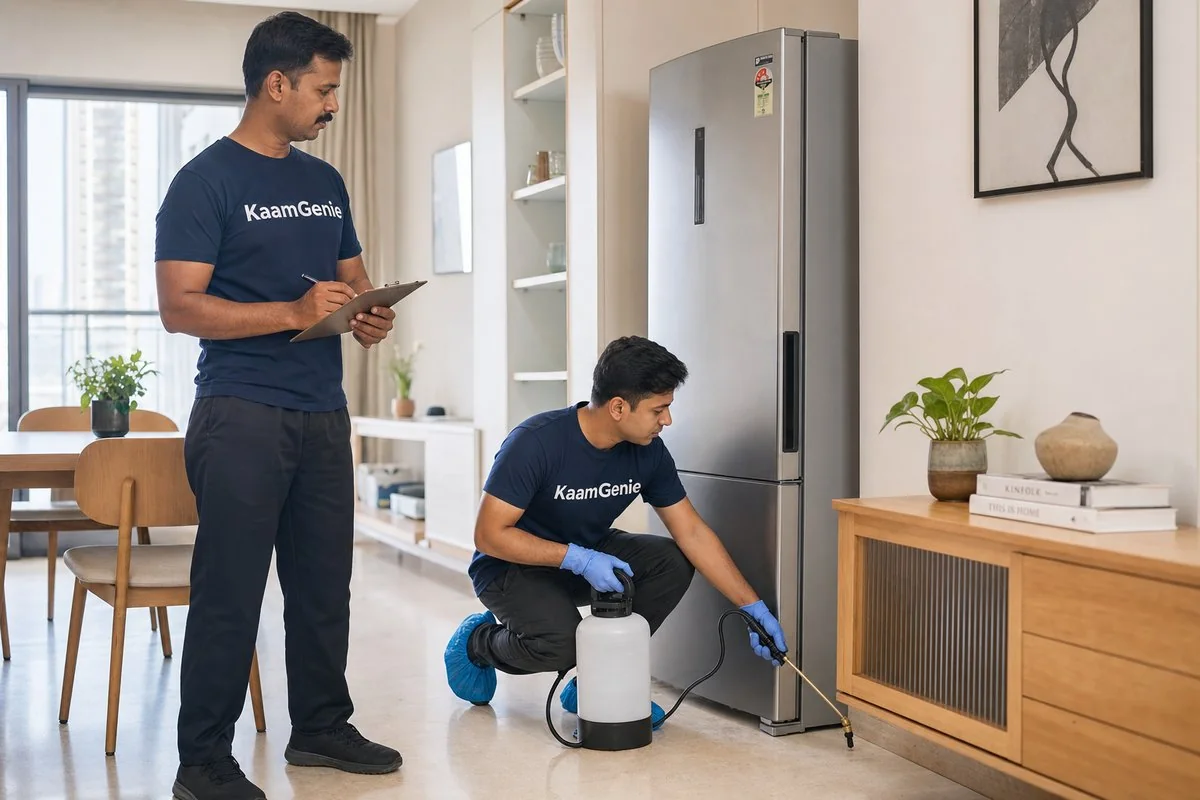
The whole game for a campus is timing. A child should never be present when or shortly after an area is treated, so the schedule is built around the academic calendar rather than the pest’s convenience. The good news is the Delhi school calendar gives you natural windows, and a sensible programme uses all of them.
The summer break (broadly mid-May to end-June in Delhi) and the winter break are the ideal slots for a deep, whole-campus treatment — kitchen, library, classrooms, hostels and grounds all done while the campus is empty for days, so re-entry intervals are a non-issue. Between breaks, Sundays and the gap after the last school bus leaves handle routine AMC visits and any flare-up. For a college or coaching institute running near year-round, we treat zone by zone on rotation so the live area is never the one being worked on, and we use the exam-gap days when blocks empty out. Hostel rooms get done during the vacation when students go home, which is also the right time for a bed-bug treatment that needs the beds stripped.
| Window | What gets done | Why this slot |
|---|---|---|
| Summer break (mid-May–June) | Deep whole-campus treatment: kitchen, library, classrooms, hostels, grounds | Campus empty for weeks — full re-entry intervals, no disruption |
| Winter break (Dec–Jan) | Second deep treatment + pre-monsoon-ahead rodent and termite check | Long empty window; resets the year |
| Sundays / weekly holiday | Routine AMC visits, monitoring-station checks, flare-up response | No students on campus; aired by Monday |
| After the last bus leaves | Targeted kitchen and washroom treatment, mosquito fogging of grounds | Evening = pests active; rooms clear by morning |
| Exam-gap / zone rotation | College and coaching campuses treated block by block | Year-round sites never fully empty — rotate live zones |
One honest note on speed: we’ll do same-day where slots allow for an urgent flare-up, but a campus programme is best planned. Book the survey, agree the zones and the calendar slots, and treat on dates that keep every child clear — rushing it is how a treated nursery room gets reopened too soon.
Dengue and mosquito control on campus — an MCD-grade duty
If there is one pest duty a Delhi school can’t treat casually, it’s mosquitoes. Through and after the monsoon, the city’s dengue and chikungunya season turns every patch of standing water into a breeding site, and the Municipal Corporation of Delhi runs anti-breeding drives and can issue challans to premises — schools included — that let larvae breed. A campus is full of the exact containers Aedes aegypti loves: water coolers, overhead and underground tanks, planters and flower pots, blocked roof drains, AC drip trays, unused tyres in the sports store, and pooling in the basement.
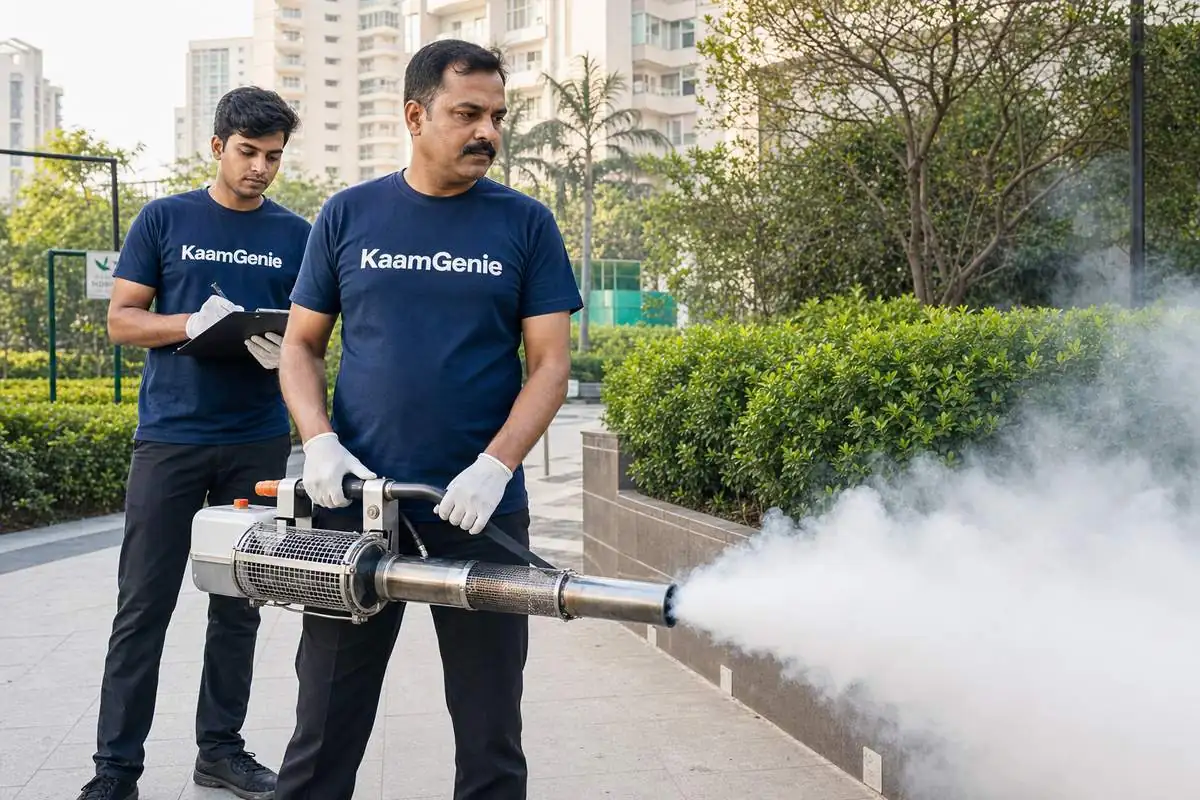
The professional answer is not just fogging — fogging kills adults for a day and does nothing about tomorrow’s larvae. The real work is source-reduction: emptying and scrubbing coolers weekly, covering tanks, clearing roof drains, removing junk that holds water, and applying a larvicide to any water body that can’t be drained. Fogging of the grounds is the finishing touch, done in the evening when mosquitoes are active and children have gone home. This is exactly the integrated approach the National Centre for Disease Control and the NCVBDC promote, and it’s what keeps a school off the MCD’s list and, far more importantly, keeps a dengue outbreak from sweeping a hostel or a primary wing. A good AMC builds this monsoon-season mosquito work into the calendar automatically rather than waiting for the first case.
Want pest records your inspector will accept?
Our AMC plans include before/after photos, a GST invoice and a documented treatment log for CBSE, university and health inspections. Campus plans from around ₹40,000/year.
One-time vs AMC — and what documented visits get you
For a one-off complaint — a wasp nest, a single classroom of ants — a one-time treatment is fine. But for a campus as the standing arrangement, a one-time service is the wrong call, and I’ll be straight about why. A school never stops generating pest conditions: the kitchen runs every day, the grounds flood every monsoon, the library gathers dust, the hostels fill and empty. Treat once and you’ve cleared today’s problem and done nothing for the term ahead. That’s why a serious campus runs an Annual Maintenance Contract with scheduled, documented visits tied to the calendar above.
An AMC buys a school three things a one-time visit can’t. Prevention — a technician walks the campus on schedule and catches a problem at the “two cockroaches in the canteen” stage, not the “parent posted a photo” stage. A documented record — every visit logged, photographed and invoiced, which is exactly what a CBSE affiliation inspection, a university audit, an FSSAI canteen check or a worried parents’ committee wants to see. And cost control — a planned annual contract is far cheaper per visit than emergency call-outs each time something crawls. The documentation is not box-ticking; when a parent complains, being able to show a dated treatment log and before/after photos is what turns an angry WhatsApp thread into a closed matter.
| Factor | One-time service | Annual Maintenance Contract (AMC) |
|---|---|---|
| Best for | A single flare-up, a one classroom complaint, a new wing | Any working school, college, hostel or coaching campus |
| Visits | Single visit | Scheduled visits tied to holidays, Sundays and monsoon season |
| Result | Clears the current problem | Keeps the campus under control all year |
| Records for inspection | One invoice + photos | Ongoing treatment log, before/after photos, GST invoices |
| Dengue/monsoon work | Reactive only | Built into the calendar before the season |
| Typical price (2026) | ₹6,000–₹15,000 (small site) | ₹40,000–₹1,50,000+/year by campus size |
To be clear on the records: a credible provider gives you before/after photos, a GST invoice per visit, and a documented treatment log noting the date, the technician, the zones covered, the products used and the next scheduled visit — plus material safety data sheets for anything used near children. That audit-ready pest log is the standard a CBSE, university or health inspector looks for, and any service that can’t produce it isn’t built for a campus.
What pest control costs for a Delhi school or college (2026)
No two campuses are the same, so pricing is done per site after a survey rather than off a flat rate. The drivers are total built-up area, the number of separate buildings and floors, whether there’s a hostel and a kitchen, and how many monsoon mosquito visits the grounds need. As a rough 2026 guide, a small playschool, creche or single coaching floor runs about ₹6,000–₹15,000 for a one-time treatment, while a full school or college campus AMC commonly runs ₹40,000 to ₹1,50,000 or more a year depending on size and the number of buildings. GST 18% is extra on all of it.
| Campus type | One-time (approx) | AMC per year (approx) |
|---|---|---|
| Playschool / creche / single coaching floor | ₹6,000–₹15,000 | ₹25,000–₹45,000 |
| Mid-size school (one building, with canteen) | ₹15,000–₹30,000 | ₹45,000–₹80,000 |
| Large school / college (multi-building) | ₹30,000–₹60,000 | ₹80,000–₹1,50,000 |
| Campus with hostel blocks | Custom quote | ₹1,50,000+ custom quote |
Two warnings on price, because schools are a frequent target of lowball quotes. Be very wary of a team offering to do a whole campus for a token few thousand rupees — on a child-occupied site that almost always means a single watered-down chemical sprayed around, skipping the kitchen detail, the grounds and the documentation, which is worse than useless when an inspector asks for records. And be wary of a price quoted over the phone without a site visit; an honest campus quote comes after a survey, because the technician needs to see the kitchen, the hostel, the grounds and the library access before putting a number on it. The cheapest real saving is an AMC that stops a small canteen problem from becoming a closed-canteen problem.
Booking school and college pest control across Delhi
A campus isn’t a home or an office, and it shouldn’t be treated like one — it needs child-safe, low-odour methods, scheduling built around the school calendar so no student is ever present, dengue source-reduction the MCD will accept, and documented visits an inspector and a parents’ committee can trust. We run scheduled pest control for schools, colleges, coaching institutes, playschools and hostel-attached campuses across Delhi. Coming soon: Gurgaon, Noida, Faridabad and Ghaziabad. Tell us your built-up area, your buildings, whether you have a kitchen and hostel, and your holiday dates, and we’ll survey the site and quote an honest AMC or one-time programme. Call 95603 66362 and let’s keep your campus safe for the children who use it every day.
Frequently asked questions
How much does pest control cost for a school or college in Delhi in 2026?
It’s priced per site after a survey, because campuses vary so much. As a rough 2026 guide, a small playschool, creche or single coaching floor runs about ₹6,000–₹15,000 for a one-time treatment, while a full school or college campus AMC commonly runs ₹40,000 to ₹1,50,000 or more a year depending on built-up area, number of buildings, and whether there’s a kitchen and hostel. GST 18% is extra. An honest quote comes after a site visit, not over the phone.
Is school pest control safe for children?
It is when it’s done properly. A campus needs targeted, low-toxicity, low-odour methods — gel bait in cracks and crevices, tamper-proof rodent bait stations, crack-and-crevice treatment in skirting — rather than blanket fogging of occupied rooms. The firm rule is that no child re-enters a treated space until the advised re-entry interval has passed and the room is ventilated, which is exactly why campuses are treated during holidays and after hours. Be cautious of anyone claiming a campus can be treated while children are in class with zero precautions.
When should a school schedule pest control?
Around the academic calendar, so no child is present during or shortly after treatment. The summer and winter breaks are ideal for a deep, whole-campus treatment because the site is empty for days. Sundays and the period after the last bus leaves handle routine AMC visits and flare-ups. Colleges and coaching institutes that run near year-round are treated zone by zone on rotation so the live area is never the one being worked on, and hostels are done during the student vacation.
Why do schools and colleges need pest control more than other buildings?
Because a campus concentrates food, water, paper and hiding places around the most vulnerable people in the city. The mid-day-meal kitchen handles bulk food, the library draws silverfish, classrooms collect tiffin crumbs, primary washrooms stay damp, hostel blocks bring bed bugs and rodents, and the grounds and water tanks breed mosquitoes. Children touch surfaces then their mouths and have developing lungs, so both the pests and a careless treatment are higher-risk than in an office.
What pests are most common in Delhi schools?
Cockroaches and rodents in the mid-day-meal kitchen and canteen are the top priority. Silverfish and booklice attack the library and record room, while ants and cockroaches appear in classrooms from tiffin crumbs. Drain flies and cockroaches live in damp primary washrooms, bed bugs and rodents trouble hostel blocks, and mosquitoes breed on the grounds and in water coolers and tanks — the dengue risk that worries every Delhi campus through the monsoon.
How do you control dengue and mosquitoes on a school campus?
Mostly through source-reduction, not just fogging. The real work is emptying and scrubbing water coolers weekly, covering overhead and underground tanks, clearing blocked roof drains, removing junk that holds water like old tyres, and applying larvicide to any water that can’t be drained. Evening fogging of the grounds, done after children leave, is the finishing touch. This is the integrated approach the NCDC and NCVBDC promote and what keeps a campus off the MCD’s challan list during dengue season.
Will pest control leave a chemical smell in the classrooms?
It shouldn’t, if it’s done properly. Campus pest control leans on low-odour, targeted methods — gel bait in cracks and voids, tamper-proof rodent stations, and any residual spray confined to crevices in an emptied room using odourless products. Combined with holiday or after-hours timing and ventilation before re-entry, a treatment done over a break or a Sunday leaves a normal-smelling classroom by the time students return.
What is the re-entry interval after treating a classroom?
After a sprayed area, the responsible standard is to keep the room vacated for the advised interval, ventilate it thoroughly, and only then allow children back. The exact time depends on the product used, which is why holiday and weekend scheduling is so valuable — it gives treated rooms hours or days to clear before any student returns. Gel bait and bait stations don’t require a room to be emptied the way an open spray does, which is part of why they’re preferred on campuses.
Do you treat hostel blocks and bed bugs on residential campuses?
Yes. Hostel blocks bring bed bugs, store-room rodents and shared-pantry pests into rooms where students sleep, so they’re part of a campus programme. Bed-bug treatment needs the beds stripped and the room worked over thoroughly, so it’s best scheduled during the student vacation when rooms are empty. We treat hostel pantries and store rooms on the same rotation as the rest of the campus.
What records do we get for a CBSE, university or health inspection?
A proper campus service gives you a documentation pack: before/after photos of treated areas, a GST invoice per visit, a documented treatment log recording the date, technician, zones covered, products used and next scheduled visit, plus material safety data sheets for anything used near children and a site map of bait and monitoring stations. That audit-ready pest log is exactly what a CBSE affiliation inspection, a university audit, an FSSAI canteen check or a parents’ committee asks to see.
Should a school choose an AMC or a one-time treatment?
For a working campus an AMC is almost always the right choice. A school never stops generating pest conditions — the kitchen runs daily, the grounds flood every monsoon, the hostels fill and empty — so scheduled visits tied to the calendar keep it under control and keep your records inspection-ready. A one-time treatment makes sense for a single flare-up, one classroom of ants, or a brand-new wing, but not as the standing arrangement for a child-occupied site.
Do you cover playschools, creches and coaching institutes?
Yes. Playschools and creches need the most careful, lowest-odour approach because the children are the youngest, so treatment is done when they’re away and with strict re-entry intervals. Coaching institutes that run near year-round are handled zone by zone on rotation. We run programmes for schools, colleges, coaching centres, playschools and hostel-attached campuses across Delhi, with a custom quote per site after a survey.
Keep your Delhi campus safe and pest-free, on schedule
Let us survey your site and run a scheduled AMC — holiday and weekend visits, child-safe low-odour methods, dengue source-reduction and documented records. Schools, colleges, hostels and coaching institutes across Delhi.
Sources & references
- National Center for Vector Borne Diseases Control (NCVBDC) — sets the dengue and mosquito source-reduction guidance behind the campus anti-breeding work in this guide.
- National Centre for Disease Control (NCDC) — tracks urban dengue and vector patterns relevant to schools and institutional premises in Delhi.
- Food Safety and Standards Authority of India (FSSAI) — sets the pest-control and Integrated Pest Management expectations for school canteens and mid-day-meal kitchens.
- Central Insecticides Board & Registration Committee (CIB&RC) — the Indian regulator that approves the low-toxicity pest-control products used around children.
Last verified: 13 June 2026. If you find any of these links broken, please let us know.