
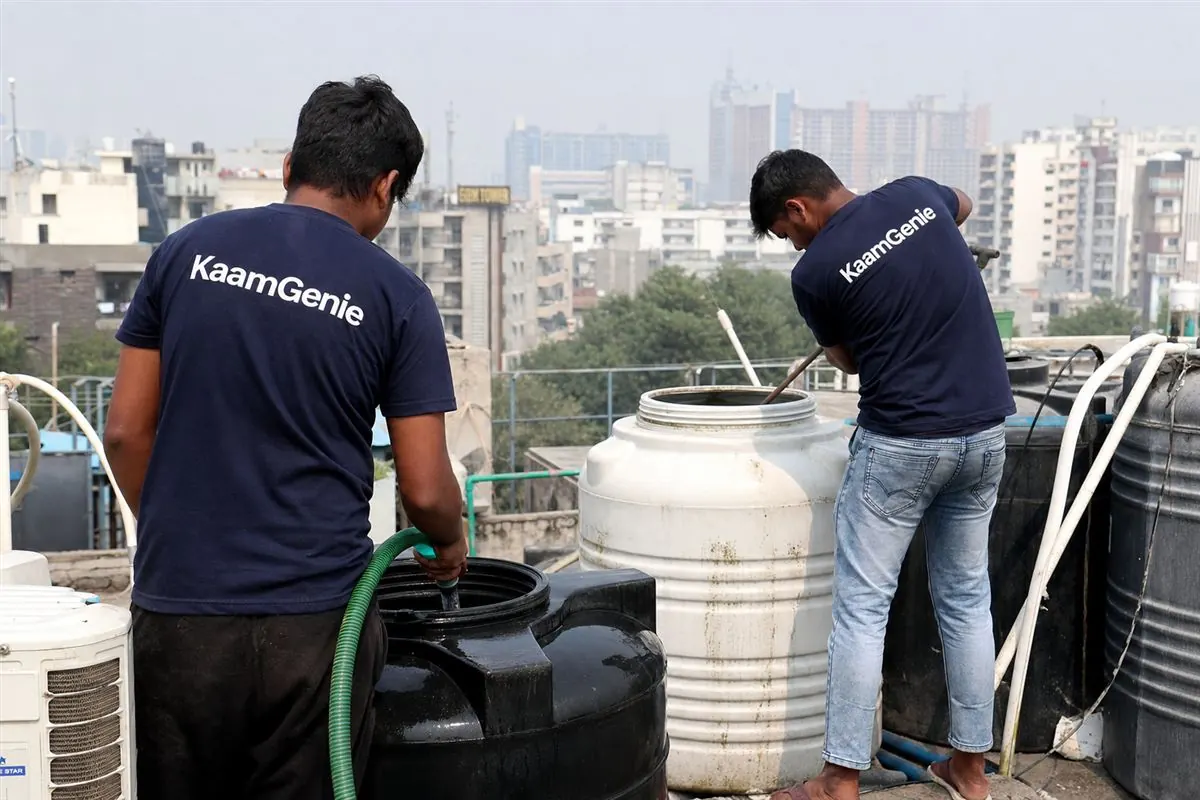
The short version for PG operators & residents
- High occupancy = fast fouling. A PG cycles its tanks several times a day, so biofilm and sediment build up far faster than in a family flat.
- Clean every 4–8 weeks, not quarterly. On Noida’s hard borewell water, a busy PG should lean towards the four-week end.
- The operator carries the duty of care. Whoever runs the PG as a business is responsible for the water residents drink — write it into the owner–operator lease.
- It’s a health issue, not cosmetic. One neglected tank in a 30-bed PG makes the whole building sick at once.
- Cheap per head. Tanks from ₹699 onwards, multi-tank rates for the building — pennies spread across the residents.
If you run rooms for a living, the tank is part of the product you’re selling. Treat it like one.
Why a PG tank fouls in weeks, not months
The single thing that makes PG and co-living water systems different is throughput. A four-person family might turn over a 1,000-litre overhead tank roughly once a day. A PG with 20, 30 or 40 residents — all showering, washing and drawing water across the same morning and evening peaks — cycles its tanks several times over in a single day. Every one of those cycles carries more sediment, more organic matter and more dissolved nutrients through the tank, and a portion of it settles and stays.
That constant movement, combined with the warmth of a rooftop tank baking through a Noida summer, is exactly what biofilm loves. Biofilm is the slick bacterial layer that coats the inside walls of a neglected tank; it feeds on the organic load passing through and it grips harder the longer it’s left. A quiet home tank might take three or four months to build a film worth worrying about. A packed PG tank gets there in four to six weeks. Then layer on Noida’s hard, iron-bearing borewell groundwater — which deposits scale and rusty sediment on top of the biofilm — and you have a tank that needs attention on a completely different schedule from an ordinary flat.
| Factor | Typical family flat | Busy Noida PG / co-living |
|---|---|---|
| Occupancy per tank | 3–5 people | 20–40 residents |
| Tank turnover | ~once a day | Several times a day |
| Organic load through tank | Low | Very high |
| Biofilm build-up | Months | Weeks |
| People affected by one bad tank | A single family | The whole building at once |
| Sensible cleaning interval | Quarterly | Every 4–8 weeks |
Run a PG in Noida? Get the tanks on a schedule
High-occupancy buildings need cleaning every few weeks, not once a year. Per-tank from ₹699 onwards, with a combined rate for the whole building.
Whose job is it — the operator or the building owner?
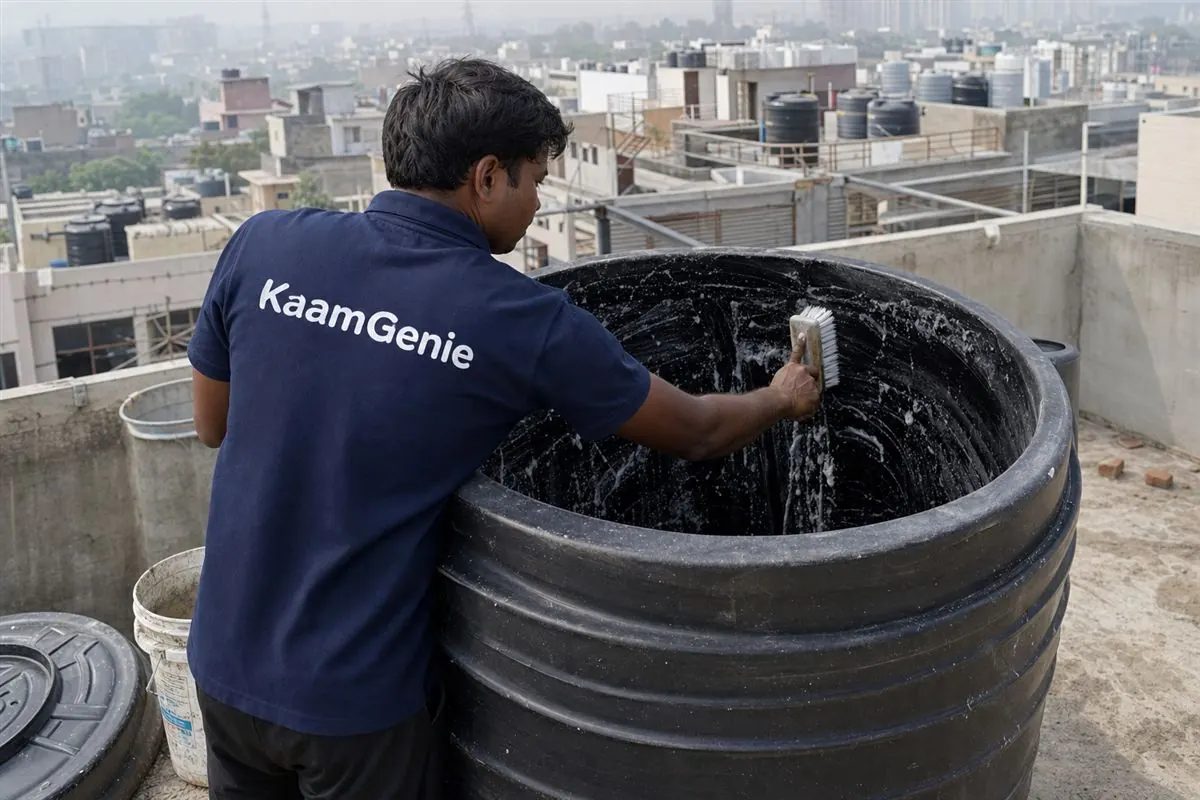
This is where most PGs get into trouble, and the principle is simpler than the arguments around it. Whoever runs the PG as a business — the person collecting rent, allotting rooms and setting the rules — carries the practical duty of care for the water their residents drink, regardless of who holds the title to the building. In a lot of Noida PGs the building is owned by one person and operated by another on a lease; in others the owner runs it themselves. Either way, the operator is the one charging for living conditions, so the operator is the one who has to make sure the tanks are clean.
The cleanest way to remove all doubt is to write it down. If an owner leases their building to a PG operator, the lease should state who arranges and pays for tank cleaning and how often — the same way a sensible rent agreement does for any tenant. We cover the broader landlord-versus-occupant question in our guide to tenant and renter water tank cleaning in Noida; for a PG the logic is the same but the stakes are higher, because it isn’t one household at risk, it’s thirty. And residents, for their part, are entirely within their rights to ask the operator when the tanks were last done — they’re paying to drink and bathe in that water every day.
How often a Noida PG tank actually needs cleaning
The textbook advice of “clean your tank twice a year” is written for a quiet family home, and it’s simply wrong for a PG. A high-occupancy building on Noida’s hard groundwater should be on a four-to-eight-week cycle, with the busiest, most packed buildings — and any running on tanker or raw borewell supply — at the four-week end. The fuller the building and the harder the water, the shorter the interval. Our deeper look at how often to clean a water tank in Noida explains why local groundwater pushes every schedule shorter than the national default.
You don’t have to guess between cleans, either. The warning signs show up in the water itself: a yellow or rusty tint first thing in the morning, a musty or earthy smell, grit settling in a glass left to stand, or a slimy feel on the inside of the tank lid. If residents start mentioning any of those — or worse, a run of stomach upsets across multiple rooms — the tank is overdue. Our rundown of the signs a water tank needs cleaning in Noida is worth pinning up where residents can flag problems early. In a PG, the residents are your best monitoring system; listen to them.
The Noida belt where PGs cluster
PGs and co-living buildings concentrate exactly where students and young professionals do, and in Noida that means a few well-defined pockets. Sector 15 and the surrounding older sectors near the metro and college campuses are dense with paying-guest accommodation, much of it in independent builder floors converted room by room. Sector 18, the commercial and retail heart of the city, draws a constant stream of working tenants who want to live close to the action. And the big one is Sector 62 and its IT-and-corporate belt, where thousands of office workers fill PGs and co-living blocks within walking or short-commute distance of their employers.
What these areas share is a building stock that was never purpose-built for the occupancy it now carries — ordinary builder floors and houses pressed into service as high-density accommodation, with the same single rooftop tank and ground sump they had when one family lived there. That mismatch is precisely why the tanks foul so fast. We service all of these pockets; you can see sector coverage and book through our water tank cleaning in Noida hub, and the same crews and protocols sit behind our wider water tank cleaning services across the NCR.
What a proper PG tank clean involves
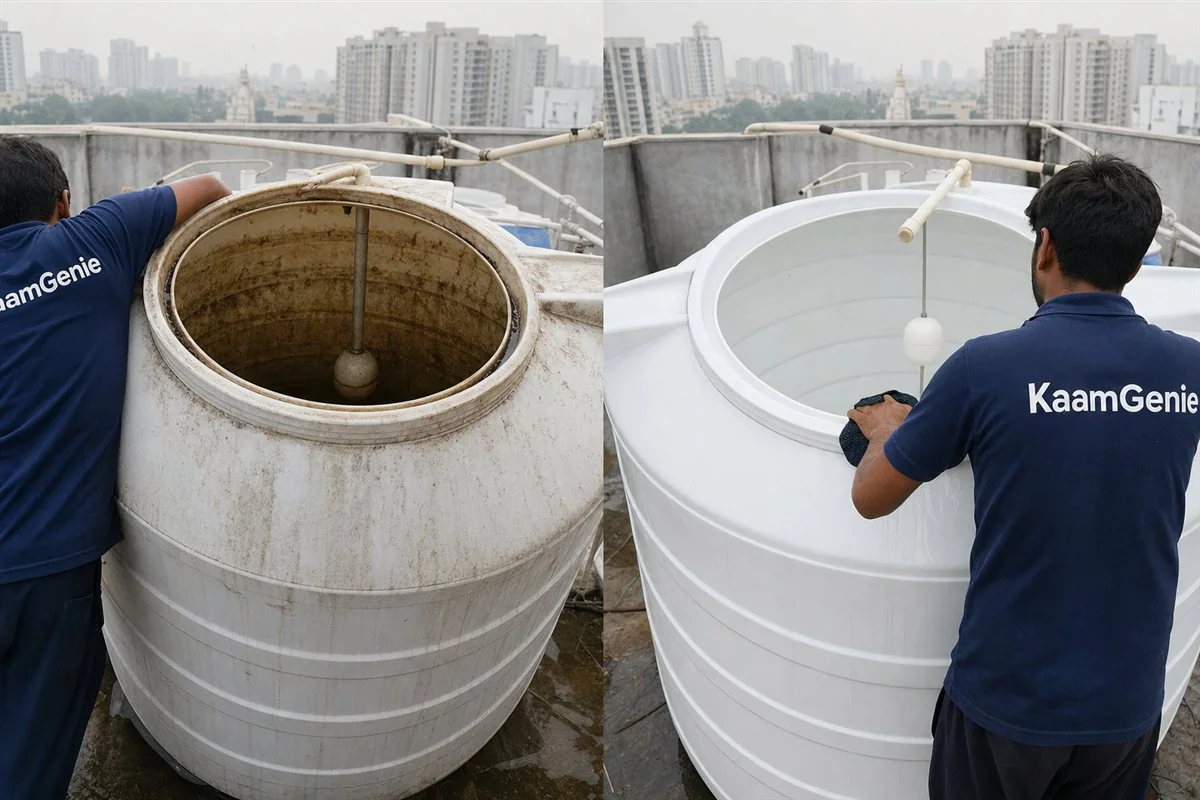
A genuine clean is the same disciplined process whether it’s one flat or a packed PG — the difference is that on a PG it matters more and has to happen more often. We drain the tank, hand-remove the sludge and sediment from the floor, scrub every wall and corner with food-grade brushes, jet-wash the spots a brush can’t reach, vacuum out the dirty residue, and then disinfect every interior surface with food-grade sodium hypochlorite before refilling. That disinfection step is the one that actually kills the bacteria living in the biofilm, and it’s the step the cheap operators skip. A twenty-minute rinse-and-run on a 30-bed PG is worse than useless — it looks done while leaving the real contamination exactly where dozens of people will drink it.
Most PGs aren’t a single tank, either. Expect a couple of rooftop overhead tanks plus a ground sump that the building’s pump fills, and all of them need doing — the sump especially, because that’s where the heaviest sediment settles before water is ever pumped up. We sequence the tanks so the building is never completely without stored water, and the whole job for a typical PG runs to about half a day. Crucially, every clean ends with a dated certificate and before/after photos — the record a good operator keeps to reassure residents and prove the building is properly maintained.
How fast a tank fouls by occupancy — weeks to a film worth cleaning
Illustrative: the more residents on one tank, the shorter the safe interval on Noida’s hard water
Illustrative, not a measured survey — the point is the direction: higher occupancy and harder water both shorten the interval. Use the warning signs in the water to fine-tune, and never stretch a busy PG to the quarterly schedule that suits a quiet home.
What it costs — and why it’s cheap per head
A single standard residential-size tank starts at ₹699 onwards, and since most PGs have more than one tank we quote a combined rate for the building based on the number of tanks, their capacity and access. Booked as a regular schedule, the per-visit rate comes down further. The full breakdown of what drives a Noida quote is in our water tank cleaning cost guide for Noida, and PG operators who want a fully managed, scheduled approach should look at commercial water tank cleaning in Noida, which is built around exactly this kind of recurring, multi-tank work.
Do the arithmetic the way an operator should: a full multi-tank clean spread across 20 to 40 paying residents is a few rupees per head. Set against that is the cost of getting it wrong — a stomach-bug doing the rounds of the building, residents posting about dirty water, rooms emptying, and a reputation that takes far longer to rebuild than a tank takes to clean. For a PG, clean water isn’t an overhead to minimise; it’s part of the product you’re renting out.
Put your PG’s tanks on a clean schedule
One-off or recurring — we clean every tank in the building, sequence so you’re never dry, and leave a certificate every visit. ₹699 onwards per tank.
Book a PG tank clean in Noida
Whether you run a single builder-floor PG in Sector 15, a busy co-living block near the Sector 62 office belt, or a chain of buildings across the city, the answer is the same: get every tank on a 4-to-8-week schedule, keep the certificates, and stop treating the water as an afterthought. Start at our water tank cleaning in Noida hub for sector coverage and booking, and we’ll quote your whole building in one go.
To book, call +91 95603 66362 or use the booking form on this site — we’ll confirm shortly.
Frequently asked questions
How often should a PG or co-living water tank be cleaned in Noida?
Far more often than a family flat. A PG or co-living building runs at very high occupancy — many residents drawing, showering and using the same tanks all day — so biofilm and sediment build up much faster, and Noida’s hard borewell water accelerates scaling on top of that. For a busy PG we recommend cleaning every 4 to 8 weeks rather than the quarterly schedule that suits a normal home. If the building is packed and on tanker or borewell supply, lean towards the 4-week end.
Whose responsibility is it to clean a PG’s water tank — the operator or the building owner?
Whoever runs the PG as a business carries the practical duty of care for the water their residents drink, even if the building is owned by someone else. In most Noida PGs the operator (the person collecting rent and running the rooms) arranges and pays for cleaning, because they are responsible for the living conditions they are charging for. Where the owner runs the PG themselves, it is simply on them. The cleanest arrangement is to write tank-cleaning frequency into the lease between owner and operator so it is never left to assumption. Either way, residents have every right to ask when it was last done.
Why do PG and co-living tanks get dirty so much faster than family flats?
It comes down to throughput and warmth. A four-person family might turn over a 1,000-litre tank once a day; a PG with 20-40 residents cycles its tanks several times a day, so far more sediment, organic matter and nutrients pass through. High, constant water movement plus the warm rooftop temperatures of a Noida summer create ideal conditions for biofilm — the slimy bacterial layer that coats tank walls. Add Noida’s hard, iron-bearing borewell water and you get scale on top of the biofilm. The result is a tank that reaches the same dirty state in weeks that a quiet home tank reaches in months.
Can a PG tenant ask for proof the tank was cleaned?
Yes, and it is a completely fair thing to ask. A professional clean produces a certificate listing the date, tank capacity, chemicals used and before/after photos. If you are paying to live in a PG, asking the operator when the tanks were last cleaned and to see that record is reasonable — you are drinking and bathing in that water daily. A well-run PG keeps the certificates and is happy to show them. A blank look is itself an answer about how the place is maintained.
How much does it cost to clean a PG or co-living building’s tanks in Noida?
A single standard residential-size tank starts at ₹699 onwards, and most PGs have more than one — typically a rooftop overhead tank or two plus a ground sump. We quote per tank based on capacity, number and access, and for a multi-tank building or a regular schedule we give a combined rate that works out lower per visit. Spread across 20-40 paying residents, even a full multi-tank clean every few weeks is a tiny per-head cost — far cheaper than the reputational damage of a stomach-bug outbreak in the building.
We run a PG near the Sector 62 office belt — can you clean without disrupting residents?
Yes. PGs in the Sector 62 IT-and-office belt are full of working professionals who are out during the day, so we schedule the clean for working hours or an agreed window when water demand is lowest. Most of the work happens on the rooftop and at the sump, not inside anyone’s room, and a residential tank is back in service within a couple of hours. For larger PGs we sequence tank by tank so the building is never completely without stored water. We confirm the slot in advance so the operator can give residents a heads-up.
What health problems come from a neglected PG water tank?
Stored water that sits in a biofilm-coated, sediment-heavy tank is a breeding ground for the organisms behind stomach upsets, diarrhoea, typhoid and skin and hair problems — and in a PG the risk is amplified because one bad tank affects everyone in the building at once. High-occupancy buildings are exactly where a single neglected tank turns into a cluster of sick residents. Regular cleaning and food-grade disinfection is the basic, cheap control that keeps stored water within safe limits for the dozens of people relying on it.
How long does it take to clean a PG building’s tanks?
A single residential overhead tank takes about 75-90 minutes for the full process — drain, de-sludge, scrub, jet-wash, vacuum and food-grade disinfection. An underground sump takes longer, around 2-2.5 hours, because it holds more water and access is tighter. For a typical PG with a couple of rooftop tanks and a sump, plan for roughly half a day; we sequence them so the building keeps running. We give a realistic time estimate when we see the setup.
Do you provide a cleaning certificate a PG operator can show tenants or authorities?
Yes. Every clean comes with a dated certificate listing tank type and capacity, the food-grade chemicals used, the crew, and before/after photos. For a PG operator this is doubly useful: it reassures residents who ask about water hygiene, and it is the kind of upkeep record worth keeping if a local authority or a prospective tenant’s parents ever ask how the building is maintained. Keeping the certificates also builds a clean history that makes the next schedule easy to plan.
Sources & references
- Bureau of Indian Standards (BIS) — IS 10500:2012 is the canonical Indian Standard for drinking water specification, defining acceptable limits for physical, chemical, and biological parameters.
- WHO Guidelines for Drinking-water Quality, 4th edition — the global reference for water quality standards, including guidance on storage and disinfection.
- Food Safety and Standards Authority of India (FSSAI) — defines water quality requirements for food businesses, including hygiene standards for stored water and acceptable disinfection chemicals.
- WHO Fact Sheet on Drinking Water — overview of safe drinking water requirements and contamination risks.
- CPHEEO — Manual on Water Supply and Treatment — the Government of India’s engineering manual covering tank design, cleaning protocols, and disinfection practices.
Last verified: 30 June 2026. If you find any of these links broken, please let us know.