
The short version for renters
- It depends on which tank. Society common tanks (shared UGR + tower rooftop tanks) are the AOA/RWA’s job, paid from maintenance you already contribute to.
- A dedicated flat or builder-floor tank is property upkeep — logically the owner’s cost, but in practice often pushed onto the tenant or left unsaid.
- The agreement decides it. Most disputes happen because the rent agreement is silent. Add one written clause: who arranges, who pays, how often.
- Check before you move in. Ask for the last cleaning date or certificate. No record means the tank’s condition is unknown.
- You can act yourself. For a tank serving only your flat, a tenant can book a clean directly — ₹699 onwards, certificate in your name.
If nobody can tell you when the tank was last cleaned, assume it wasn’t — and treat a fresh clean as a condition of moving in.
First, figure out which tank you actually depend on
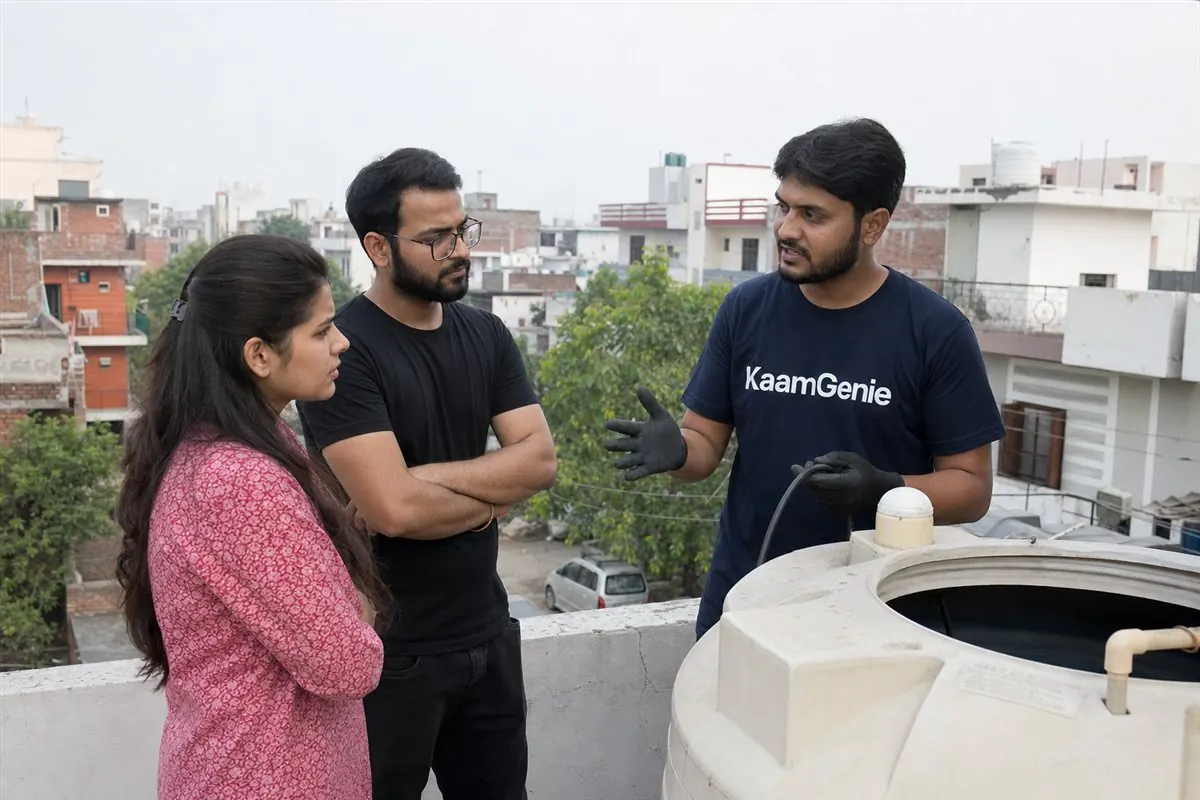
Before you can decide whose job it is, you need to know which tank feeds your tap — because the answer is completely different depending on your building type. In Noida, renters fall into roughly three setups:
- A flat in a high-rise society or apartment complex. Your water lands first in a shared underground reservoir (UGR), gets pumped to your tower’s rooftop overhead tanks, then gravity-feeds down to you. These are common-area tanks.
- An independent builder floor (one floor of a 3–4 storey building, very common across Noida’s sectors and Greater Noida West). Here there’s usually a single terrace overhead tank and sometimes a ground sump serving the whole building — with no RWA maintenance pool behind it.
- A standalone house or kothi with its own dedicated tank, entirely the owner’s asset.
This distinction is the whole game. In a society, the cleaning of the shared tanks is a managed, budgeted activity you contribute to without arranging it. On a builder floor or standalone, somebody has to physically pick up the phone — and the silence about who that “somebody” is causes most of the trouble.
| Your rental type | Which tank | Who usually arranges & pays | What you should do |
|---|---|---|---|
| Society / apartment flat | Shared UGR + tower rooftop tanks (common area) | AOA/RWA, from maintenance charges | Ask facility office for last-clean date & schedule |
| Society flat with its own tank | Dedicated tank serving only your flat | Owner (often), sometimes tenant | Confirm in the agreement who pays |
| Independent builder floor | Building terrace tank / sump | Owner logically; tenant in practice | Settle it in writing before signing |
| Standalone house | Dedicated overhead tank + sump | Owner (property upkeep) | Get last-clean proof; agree who pays |
Renting and want clean water now?
If your flat or builder floor has its own tank, you can book a clean yourself — certificate in your name, before/after photos. Standard residential cleaning ₹699 onwards.
Society flats: the common tanks are already someone’s job
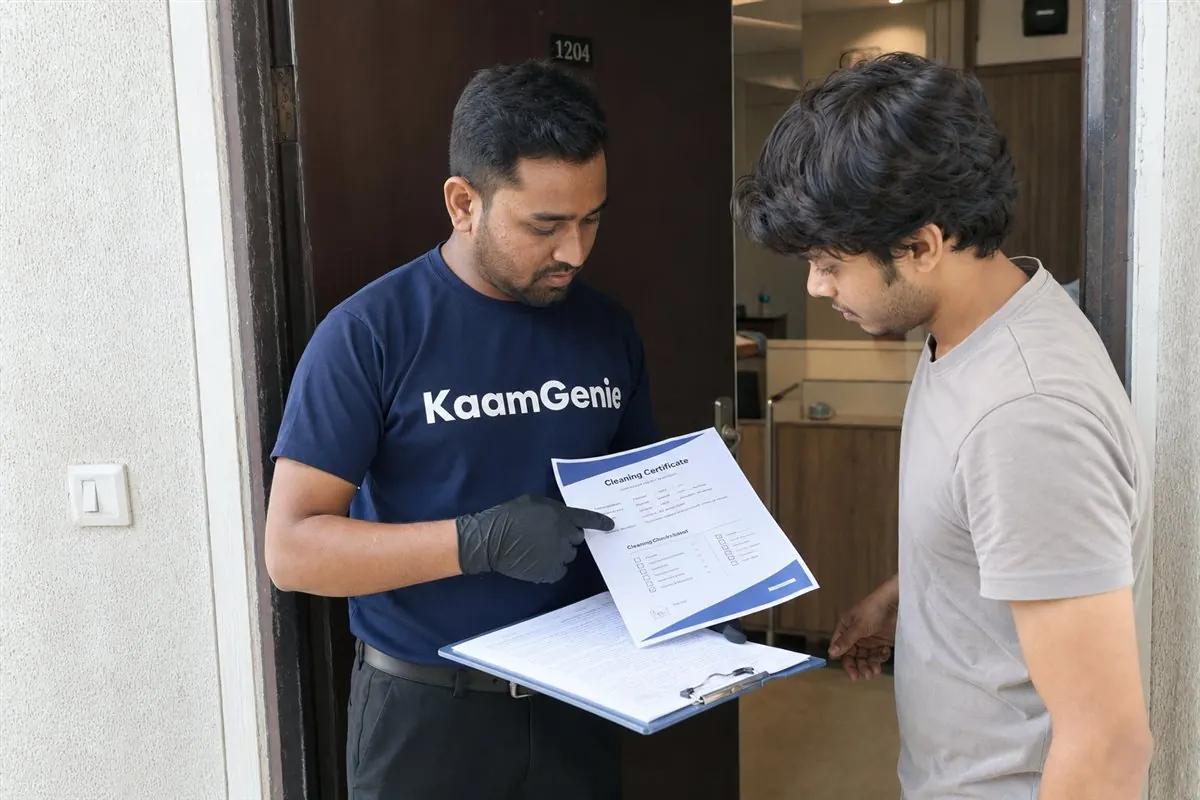
If you rent in a high-rise society anywhere along the Noida–Greater Noida Expressway corridor or in the Noida Extension belt, the good news is that the tanks you mostly depend on are not your problem to organise. The shared underground reservoir and your tower’s rooftop tanks are common-area assets, and their cleaning is run by the Apartment Owners’ Association (AOA) or RWA and paid out of the maintenance budget — the same monthly maintenance you, or your landlord on your behalf, already contribute to. You don’t book it; the committee does. How that whole machine works is laid out in our society and high-rise water tank cleaning guide for Noida.
What you can and should do as a tenant is verify it’s actually happening. You drink that water, which gives you every right to ask. Go to the facility office and ask two things: when were the common tanks last cleaned, and what’s the schedule? A well-run society on Noida’s hard borewell supply cleans quarterly and keeps a per-tank certificate for each one. If the honest answer is “a while ago” or a shrug, that’s your cue to push — politely but in writing — for it to be put back on the calendar. We service exactly these high-rise pockets across Sector 137 and Sector 78, and you can point your committee to our water tank cleaning in Noida service to get a quote.
One exception worth checking: some society flats also have a small dedicated tank serving only that unit. If yours does, that one isn’t covered by the common-area schedule — it falls into the same “dedicated tank” bucket as a builder floor, covered next.
Builder floors and standalone rentals: somebody has to actually call
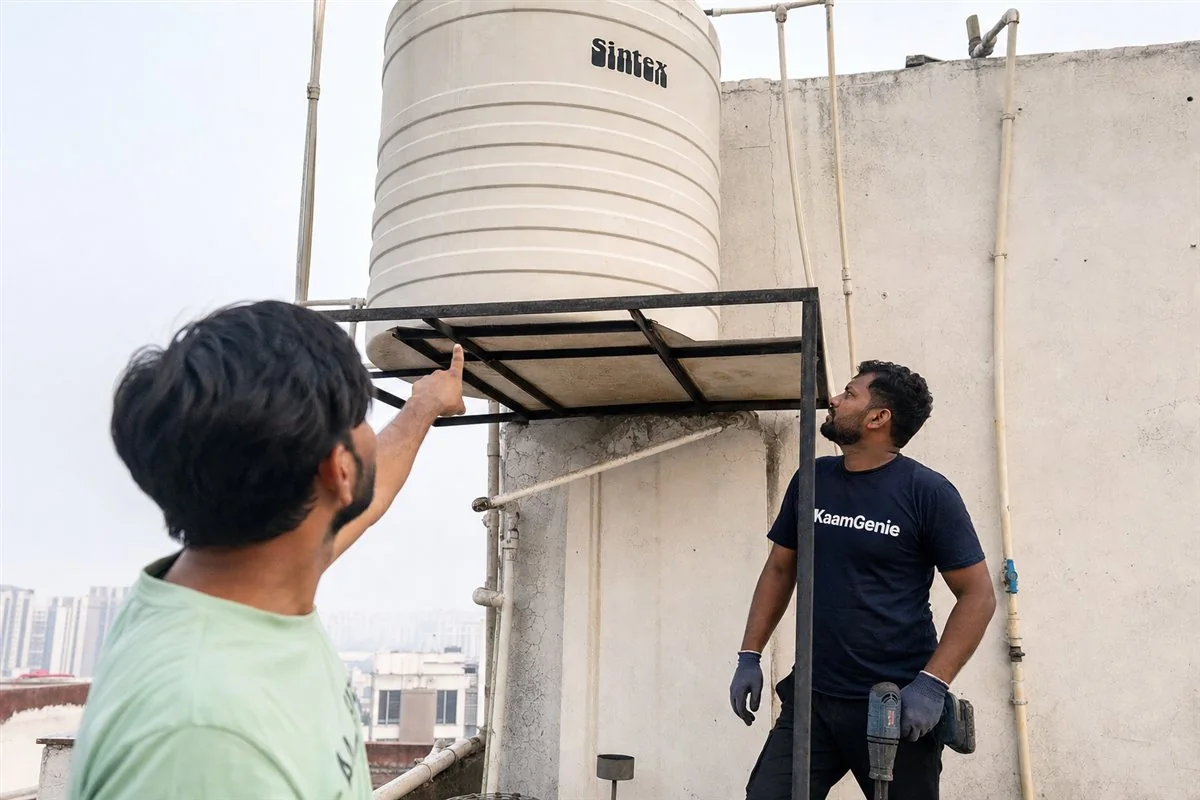
This is where Noida’s huge stock of independent builder floors changes the picture. On a typical builder floor — one floor of a three- or four-storey building in a sector like Sector 62, or anywhere across the FNG corridor — there’s a single terrace overhead tank, often a ground sump too, and crucially no maintenance association standing behind them. Nobody’s collecting a maintenance charge that quietly funds a quarterly clean. So the cleaning only happens if a specific person decides to make it happen.
Whose cost should it be? The tank is the owner’s property, and cleaning it is property upkeep, so the principled answer is the owner. But the reality across Noida is that builder-floor tenants very often end up arranging and paying for routine cleans themselves — because they’re the ones living with the water, the owner may live elsewhere or own multiple floors, and a single clean is cheap enough that it’s easier to just do it than to chase. That’s a fine practical solution as long as it was agreed, not assumed. The trap is the unspoken version, where the tenant assumes the owner will handle it, the owner assumes the tenant will, and the tank goes two years without anyone touching it.
The rent agreement is what actually decides it
Forget what “should” happen in principle — in a dispute, what’s written wins, and what isn’t written is an argument. Most Noida rent agreements are silent on tank cleaning, which is exactly why it becomes a source of friction halfway through a tenancy. The standard framing is that the owner handles structural and major maintenance while the tenant handles day-to-day usage and minor upkeep — and tank cleaning sits awkwardly between the two, so silence resolves nothing.
The fix costs you one sentence at signing. Before you put your name down, get a clause like this into the agreement:
- Who arranges the tank cleaning — owner, tenant, or society.
- Who pays for it, and if split, in what proportion.
- How often — for Noida’s hard groundwater, quarterly to six-monthly is sensible for a dedicated tank.
- The starting condition — that the tank will be cleaned (with certificate) at the start of the tenancy.
This is not being difficult; it’s being clear. Owners who keep their property well will happily agree, because it protects them too. The only people who resist a clear clause are the ones who were hoping the ambiguity would work in their favour.
What to inspect and demand before you move in
The single most useful move a renter can make is to deal with the tank before handing over the deposit, while you still have leverage. Once you’ve moved in, you’re negotiating from a weaker position. So at the inspection visit:
- Ask when the tank was last cleaned. A confident, specific answer (“cleaned in March, here’s the certificate”) is reassuring. A vague one tells you the condition is unknown.
- Ask for the certificate or photos. A professional clean always produces a dated record with before/after photos and the chemicals used. If there’s no certificate, treat it as no clean.
- Look at the water itself. Run the taps. Iron-tinted, cloudy, or musty-smelling water on Noida’s borewell supply is a classic sign of an overdue tank — our guide to the signs your water tank needs cleaning in Noida walks through what to look for.
- Establish whether it’s a common or dedicated tank, so you know who to chase later.
- Make a fresh clean a condition if there’s no recent record. A move-in clean is a small ask and a reasonable one. If you’re the very first tenant after possession, see our dedicated piece on the first water tank clean after possession in a new Noida flat, where construction debris in the tank is a real risk.
Who pays, in practice — how Noida rentals typically settle it
Illustrative pattern of how the cleaning of a dedicated flat/builder-floor tank gets handled
Illustrative, not a survey: society common tanks are almost always handled by the committee; dedicated tanks split between owner and tenant depending on the agreement — and where nothing is written, the tank is the one that gets neglected. A written clause removes the bottom bar entirely.
How to raise it — with the society or the owner
Say the tank is overdue and you want it fixed. How you raise it depends on which tank:
- Society common tank: Put it to the facility office or AOA/RWA in writing — WhatsApp or email, so there’s a record. Ask for the last cleaning date and the schedule; if it’s overdue, request it be added to the quarterly calendar. If other residents in your tower report the same discoloured water, mention that — a shared complaint moves faster than a lone one.
- Dedicated flat or builder-floor tank: Go to the owner directly. State the facts plainly — how long since the last clean, what the water looks like — reference the agreement, and propose who pays. If the agreement is silent and the owner won’t engage, you always have the fallback of arranging it yourself for a small sum and keeping the certificate.
Keep every exchange to text or email. Not because you expect a fight, but because a paper trail quietly settles most disagreements before they become one.
If you just want it done: a tenant can book it directly
Here’s the empowering part. For any tank that serves only your flat or your builder floor, you don’t actually need the owner’s permission to get clean water — you need rooftop or sump access, which you have. A tenant can book a standard residential clean directly, and we’ll do the full professional job: drain, de-sludge, scrub, jet-wash, vacuum, disinfect with food-grade chemical, and hand over a certificate in your name with before/after photos. You can then use that certificate to claim the cost back from the owner, or simply keep it as proof and absorb a small sum for peace of mind.
A single residential tank clean starts at ₹699 onwards, with the exact figure depending on capacity and access — our water tank cleaning cost guide for Noida breaks down what drives the quote. That’s genuinely low enough that no tenant should be drinking iron-tinted or musty water while waiting for a responsibility argument to resolve. The one thing you can’t book yourself is a shared society UGR — that goes through the committee — but a tank that’s yours alone is entirely within your power to fix.
Book a clean for your rented flat in Noida
Whether you’re inspecting a flat before signing, chasing an owner who’s gone quiet, or you simply want clean water in your rented builder floor this week, a single dedicated-tank clean is fast, cheap and gives you a certificate in your own name. We cover renters right across Noida and Greater Noida West — start at our water tank cleaning in Noida hub for sector coverage and booking, or call us and we’ll sort it out.
To book, call +91 95603 66362 or use the booking form on this site — we’ll confirm shortly.
Tank overdue and nobody’s acting?
Don’t drink unknown water while the responsibility argument drags on. If the tank serves only your flat, we’ll clean it and give you a certificate in your name. ₹699 onwards.
Frequently asked questions
In a Noida rental, who pays for water tank cleaning — the landlord, tenant or society?
It depends on which tank and what your agreement says. In a society or apartment complex, the shared underground reservoir and tower rooftop tanks are common-area assets cleaned by the AOA/RWA and paid from the maintenance charges you already contribute to — neither landlord nor tenant arranges that directly. For an individual flat or builder-floor with its own dedicated terrace tank, it is a property-upkeep cost that usually sits with the owner, but in practice many Noida rent agreements push routine cleaning onto the tenant or stay silent. Read the agreement, and if it is silent, agree in writing before you move in.
I’m renting a flat in a Noida society — is the tank cleaning already covered by maintenance?
Usually yes, for the shared tanks. The society’s underground reservoir (UGR) and each tower’s rooftop overhead tanks are common-area assets, and their cleaning is part of the maintenance budget the AOA/RWA runs — funded by the monthly maintenance you (or your landlord on your behalf) pay. What it does not always cover is the dedicated tank serving only your individual flat if your flat has one. Ask the facility office for the last cleaning date and whether your flat draws purely from the common tanks or has a separate one.
I’m renting an independent builder floor in Noida — who cleans the tank?
On an independent builder floor or a standalone house there is no RWA maintenance pool covering it, so somebody has to arrange the clean directly. The terrace overhead tank (and any underground sump) serving your floor is the owner’s property, so the cost is logically the owner’s — but because the tenant is the one living with the water, many builder-floor tenants end up arranging and paying for it themselves, especially for routine mid-tenancy cleans. Settle who pays in the agreement, and if you arrange it yourself, keep the certificate.
What should I check or ask before signing a rental agreement in Noida?
Before signing, ask three things: when was the water tank last cleaned (ask for the date or certificate), who is responsible for cleaning it during the tenancy, and whether the flat draws from common society tanks or a dedicated tank. Get the answers written into the agreement — a one-line clause stating who arranges and pays for tank cleaning and at what frequency prevents almost every later dispute. If the owner cannot say when it was last cleaned, treat a fresh clean at move-in as a reasonable condition of taking the flat.
Can I ask my landlord for proof the tank was cleaned before I moved in?
Yes, and you should. A professional clean comes with a certificate listing the date, tank capacity, chemicals used and before/after photos. Asking for that certificate at move-in is completely reasonable — it is the same proof a society committee keeps. If the owner has no record, the honest position is that the tank’s condition is unknown, which is a fair reason to ask for a clean before you move in or to agree who pays for the first one.
My Noida rent agreement is silent on tank cleaning — what does that usually mean?
Silence is the main cause of disputes. A rent agreement that says nothing about tank cleaning leaves it to interpretation: structural and major upkeep generally sits with the owner, while day-to-day usage and minor maintenance often falls to the tenant — and tank cleaning sits awkwardly between the two. The practical fix is not to argue the principle later but to add a single clause now stating who arranges and pays for tank cleaning and how often. Until that is written down, neither side can assume the other will do it.
How do I raise water tank cleaning with the RWA/AOA or my owner?
For society common tanks, raise it with the facility office or AOA/RWA in writing — ask for the last cleaning date and the schedule, and if it is overdue, request it be put on the quarterly calendar; you are a resident drinking that water, so you have standing to ask. For a dedicated flat or builder-floor tank, raise it with the owner directly: state the issue plainly (discoloured water, time since last clean), reference the agreement, and propose who pays. Keeping it to WhatsApp or email gives you a record either way.
How much does it cost a tenant to get a single flat’s tank cleaned in Noida?
A standard individual residential tank clean — one flat’s overhead tank or a small builder-floor terrace tank — starts at ₹699 onwards, with the exact figure depending on capacity and access. That is a professional 8-step clean with food-grade disinfectant and a certificate, not a rinse. It is low enough that a tenant who wants clean water now can simply arrange it, keep the certificate, and either absorb the cost or settle it with the owner. Shared society UGR and tower work is custom-quoted and handled by the committee, not an individual tenant.
Can a tenant book and pay for cleaning directly, without the landlord?
For a tank that serves only your flat or builder floor, yes — a tenant can book and pay for a clean directly. You only need rooftop or sump access, which you usually have. We provide a certificate in your name with before/after photos, which you can use to claim reimbursement from the owner or simply keep as proof. For shared society tanks you cannot book the common UGR yourself — that goes through the AOA/RWA — but you can certainly push the committee to schedule it.
The water in my rented Noida flat looks or smells bad — what should I do first?
First work out which tank is the likely source. If neighbours in the same tower report the same discolouration or smell, the shared society tank is suspect — report it to the facility office immediately and ask for the cleaning record. If only your flat is affected, the dedicated tank serving your flat is the likely culprit and a single clean fixes it. Noida’s hard borewell water makes iron-tinted, scaly or musty water common when tanks are overdue. Either way, do not ignore it — discoloured stored water is a health issue, not a cosmetic one.
Sources & references
- Bureau of Indian Standards (BIS) — IS 10500:2012 is the canonical Indian Standard for drinking water specification, defining acceptable limits for physical, chemical, and biological parameters.
- WHO Guidelines for Drinking-water Quality, 4th edition — the global reference for water quality standards, including guidance on storage and disinfection.
- Food Safety and Standards Authority of India (FSSAI) — defines water quality requirements for food businesses, including hygiene standards for stored water and acceptable disinfection chemicals.
- WHO Fact Sheet on Drinking Water — overview of safe drinking water requirements and contamination risks.
- CPHEEO — Manual on Water Supply and Treatment — the Government of India’s engineering manual covering tank design, cleaning protocols, and disinfection practices.
Last verified: 27 June 2026. If you find any of these links broken, please let us know.