
The short answer — what it costs in Noida (2026)
- Overhead tank, ~500L (small flat): ₹699
- Overhead tank, ~1000L (typical home): ₹899
- Overhead tank, 2000L+: ₹1,200–1,500
- Underground sump (plotted house): ₹1,800–2,800
- High-rise / society reservoir: priced on size (custom)
- Office / commercial tank: custom, with FSSAI documentation
If someone quotes ₹250–300 for a full paani ki tanki cleaning, be careful — the food-grade chlorine or the scrubbing is being skipped. A proper job is honest work, and this is what honest work costs.
If you’ve searched “tanki saaf karne wala near me” from a Noida address, you’ve probably seen the same thing we have: a handful of phone numbers stuck on a wall, a cycle-cart cleaner who comes by sometimes, and a few apps that never quite confirm a slot. The phrase is Hindi because that’s how we naturally ask — bhaiya, tanki saaf karni hai — but the worry behind it is universal. You want someone who’ll actually do the job, charge a fair price, and not disappear if the water still smells next week. This guide is written for exactly that.
Why Noida tanks need cleaning more than people think
Noida is an Authority-planned city, and that shapes how water reaches your tap. The older plotted sectors — Sector 15, Sector 18, the 14–30 belt — mostly run on a mix of Ganga Jal piped supply and hard borewell groundwater, stored in an underground sump and pumped up to a rooftop tank. The newer high-rise belt along the Noida Expressway (Sectors 137, 150, 168, 75, 76, 78, 100) and the Greater Noida West / Noida Extension townships lean heavily on big underground reservoirs and, in many towers, tanker-fed water. Each setup collects sediment differently, but they all collect it.
Here’s what actually builds up inside a closed tank between cleanings: fine sand and grit that the supply carries, mineral scale from the hard borewell water, dust and the odd insect that gets past the lid, and a thin biofilm on the walls that you cannot see but can sometimes smell. In a tank that hasn’t been opened in two years, that bottom layer can be a finger thick. None of it shows in a glass of water until the day it does — a faint yellow tinge, a smell after the monsoon, or someone in the house with an upset stomach. Getting a tanki saaf done on time is far cheaper than the doctor visit that follows a skipped one.
What a tanki saaf job should cost — honest Noida rates
Prices move a little by tank type, size, and access, but here is the honest range we and most genuine Noida cleaners work within. Use it as a sanity check: a quote far below this usually means a corner is being cut, and a quote far above it usually means someone is charging for your sector’s pin code rather than the work.
| Tank type | Size | Price (Noida) | Time |
|---|---|---|---|
| Overhead plastic tank | 500L | ₹699 | 45–60 min |
| Overhead plastic tank | 1000L | ₹899 | 60–75 min |
| Overhead plastic tank | 2000L+ | ₹1,200–1,500 | 75–90 min |
| Underground sump | 2000–5000L | ₹1,800–2,800 | 90–120 min |
| Society / high-rise reservoir | 10,000L+ | Custom (on size) | 2.5–4 hrs |
| Combo (overhead + sump) | Plotted house | ₹2,500–3,200 | 2.5–3 hrs |
One thing to watch for: the “phone pe kam, ghar aake zyada” trick. A cleaner quotes ₹400 on the call, then at your door adds ₹200 for chlorine, ₹150 for the jet wash, ₹100 for photos. With a fixed-price booking, everything — food-grade chlorine, jet wash, before/after photos, GST bill — is in the base rate. What was quoted is what you pay, on cash, UPI, or card. You can compare these against our detailed water tank cleaning cost in Noida breakdown, which goes sector by sector.
Book a tanki saaf karne wala today
Fixed price, no hidden charges. Food-grade chlorine, before/after photos on WhatsApp, GST bill. Same-day across Noida if you book in the morning. ₹699 onwards.
How to find a reliable tanki saaf karne wala near you
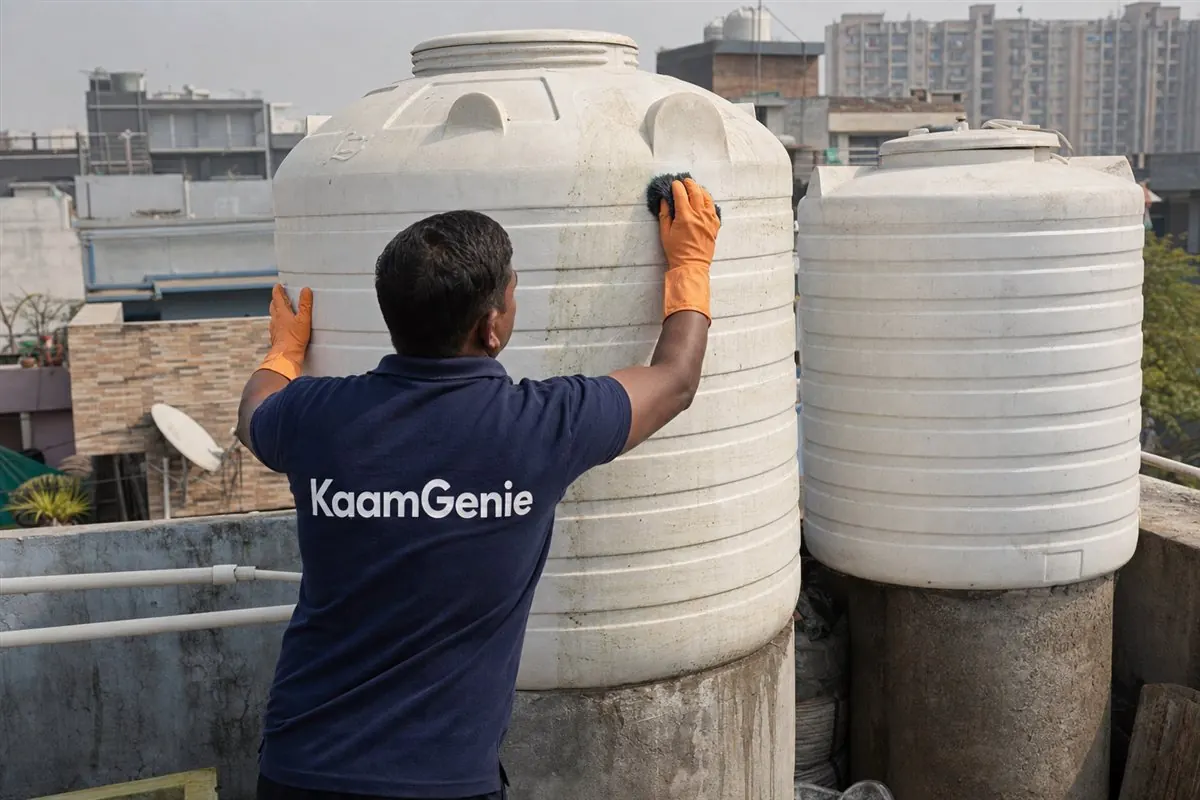
Finding the right person is mostly about asking three short questions before you commit. Any genuine tanki saaf karne wala will answer them happily; a corner-cutter gets cagey.
- “Will someone get inside and scrub the walls?” A real cleaning is hands-on. If the plan is to spray water down from the top and call it done, the sludge and biofilm stay exactly where they are.
- “Do you use food-grade chlorine?” Food-grade sodium hypochlorite is the only disinfectant safe for a drinking-water tank. Bathroom bleach or pool chlorine leaves residue you don’t want in your kitchen water.
- “Will I get before/after photos and a bill?” Photos are your proof the job was done, and a bill means there’s a real business behind the work — someone you can call back.
That last point is the real difference between a registered service and a number off a wall. When you book water tank cleaning services through KaamGenie, the crew is ID-verified, the price is fixed before they arrive, and there’s a company number that answers if anything is off. A cycle-cart cleaner might be perfectly honest — many are — but if the water still smells next week, there’s no one to call.
What a proper paani ki tanki cleaning includes
People sometimes ask why it can’t just be a quick rinse. The honest answer is that a real cleaning is a sequence, and skipping steps is exactly how the cheap jobs go wrong. Here is what the crew actually does, with rough timings so you can check the work yourself:
- Inspect and photograph — open the lid, check the condition, measure how thick the sludge is, take the first photos.
- Drain the old water — shut the inlet, pump out the tank, leave the dirty bottom layer to be removed by hand rather than washed back in.
- Remove the sludge — scoop out the sediment, scale, and grit that collects on the floor. This is the step cheap operators skip, and it’s the most important one.
- Scrub the walls and floor — food-grade brushes on every surface, including corners and around the inlet and outlet pipes.
- High-pressure jet wash — blasts biofilm and scale out of corners and seams a brush can’t reach.
- Vacuum the dirty rinse water — so it doesn’t redistribute when you refill.
- Disinfect with food-grade chlorine — applied to every surface and left for about 20 minutes of contact time. This is the step that actually kills bacteria, and the time cannot be rushed.
- Refill, final check, photos and bill — before/after photos to WhatsApp, GST bill the same day.
For a 1000L home tank, all of this takes 60–90 minutes. If a cleaner is packing up in 15 minutes, steps 3, 4, and 7 didn’t happen. If you want the full step-by-step with photos of each stage, our complete water tank cleaning Noida guide walks through it.
Where a tanki saaf actually goes wrong — the steps cheap jobs skip
Share of corner-cut jobs that skipped each step (from our Noida service notes)
Indicative pattern from our own Noida jobs where customers had a previous “cheap” cleaning — not a formal survey. The takeaway: the dirtiest, most useful steps are the first to be dropped.
Plotted house, builder floor, or high-rise — it changes the job
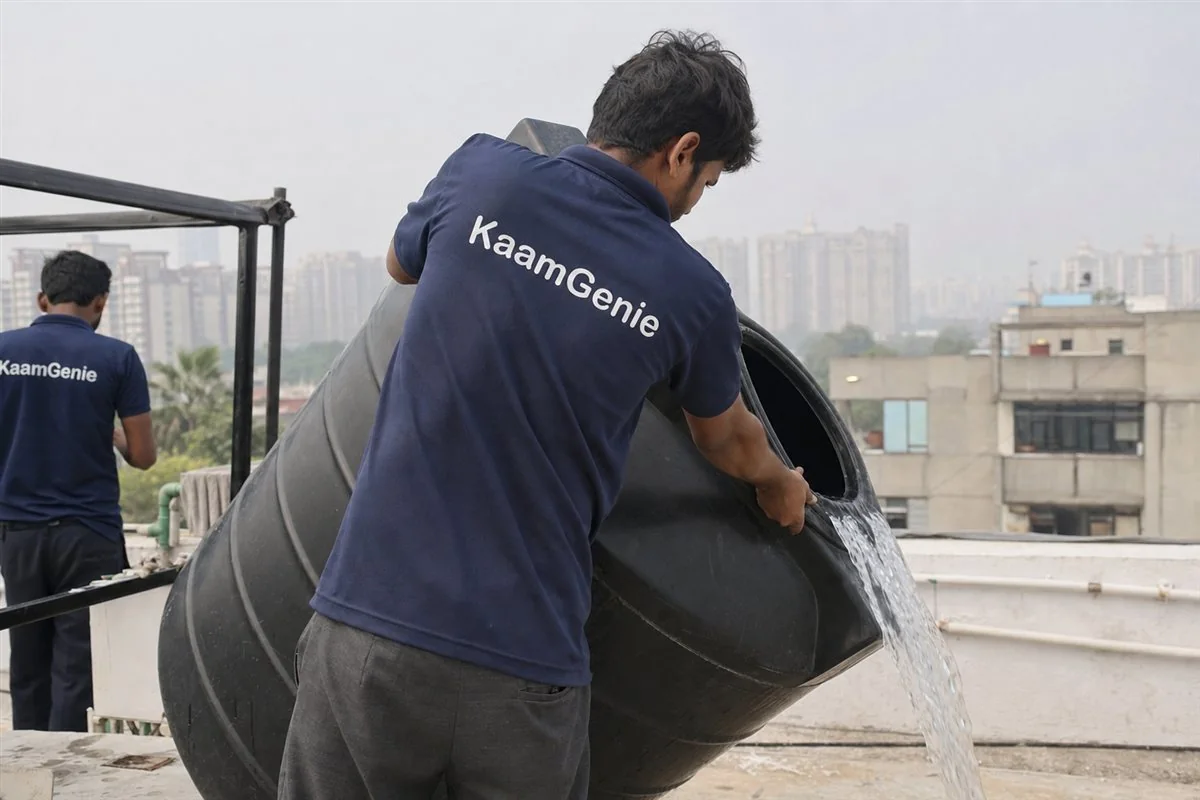
Noida has three common tank setups, and the right tanki saaf karne wala will recognise yours straight away:
Plotted Authority houses in the older sectors usually have one underground sump and a rooftop tank, often on hard borewell water. The sump matters here: it should never be cleaned by going in without a gas meter and a standby person up top. If you have both a sump and an overhead tank, a combo cleaning is the sensible call — and our underground sump cleaning in Noida piece explains the safety side in detail. You can book directly for your area, for example tank cleaning in Sector 15 or Sector 18.
Builder floors share a common sump and motor between flats, so it’s worth coordinating with the other floors — one combined cleaning is cheaper per home and means everyone’s water improves at once. The IT and corporate belt around Sector 62 has plenty of these; you can book water tank cleaning in Sector 62 the same way.
High-rise towers along the Expressway and in Greater Noida West run on a large underground reservoir feeding rooftop tower tanks, usually tanker-topped during shortages. These are handled through the society or facility office rather than flat by flat, and the cleaning is quoted on reservoir size. If you’re on the management committee, our society water tank cleaning in Noida guide covers how to set up a proper schedule and what documentation to keep.
How often, and the hard-water factor
Every 6 months is the BIS-aligned standard, and for most Noida homes the easy rhythm is one cleaning before summer and one after the monsoon. But Noida has a hard-water twist: where the supply is borewell groundwater — common across Greater Noida West and parts of the Expressway belt — mineral scale and sediment build up faster, and every 4 months keeps the water genuinely clean. Tanker-fed towers are similar, because you never quite know what the last tanker carried. If your tank walls feel chalky or the floor is gritty, that’s your sign; our Noida hard-water tank cleaning guide goes deeper on why.
Not sure which cleaning your tank needs?
Tell us your sector and tank type — overhead, sump, or society reservoir — and you’ll get a fixed price before the crew leaves. Photos and bill on every job. ₹699 onwards.
Booking a tanki saaf karne wala in Noida
Booking is the easy part. Call or WhatsApp +91 95603 66362, or use the form on this page. Tell us your sector, your tank type, and a rough size, and you’ll get a fixed price up front — nothing added at the door. Message in the morning and same-day is usually possible anywhere in Noida or Greater Noida, weekends included, at no extra charge.
You don’t even have to be home the whole time — many customers give the crew rooftop access, step out, and check the before/after photos on WhatsApp afterwards. If you want to see every sector we cover and the standard rates, the full water tank cleaning in Noida page lists it all. The phrase that brought you here may be Hindi, but the promise behind it is simple: a real job, a fair price, and clean water you don’t have to think about for six months.
Monsoon update: why August and September bookings jump in Noida
A quick seasonal note, because this guide gets read the most during the rains. Monsoon is when a Noida tanki gets dirty the fastest. Humid air feeds algae on the tank walls, rooftop dust and leaves wash into badly sealed lids with every shower, and in stretches of Greater Noida West and the Expressway sectors, supply interruptions mean tankers top up your tank with water that has spent hours sitting in a road tanker. If your last cleaning happened before the summer, the safest window is right after the heavy spells taper off: late August into September. You clear out everything the season dumped in, and the tank stays clean through the festive months when guests are in the house and nobody has time for a crew on the roof.
Two monsoon-specific things our Noida crews keep finding in these weeks: mosquito larvae in tanks whose lids do not sit flush, and a thin brown silt layer in sump tanks that fill from tanker supply. Both are quick to fix in a standard cleaning, and both are worth fixing before they reach your bathroom taps. If you spot either one when you peek under the lid, that is your sign to stop waiting for a convenient weekend: book the tanki saaf now and let the crew work around your schedule, not the other way round.
Frequently asked questions
How much does a tanki saaf karne wala charge in Noida?
A normal home overhead tank in Noida starts at ₹699 (around 500L) and goes to about ₹899 for 1000L. A 2000L tank is roughly ₹1,200–1,500. Underground sumps and high-rise / society reservoirs are priced on size, usually ₹1,800 onwards. If someone quotes ₹250–300 for a full paani ki tanki cleaning, something is being skipped — usually the food-grade chlorine or the proper scrubbing.
How do I find a reliable tanki saaf karne wala near me in Noida?
Ask three things before you book: do they physically get inside and scrub (not just spray water from the top), do they use food-grade chlorine, and do they send before/after photos plus a bill? A reliable person will say yes to all three without getting defensive. Booking through a registered service like KaamGenie also means a fixed price, an ID-verified crew, and a number you can call back if anything is wrong — which a random handcart cleaner can’t offer.
What does a proper tanki saaf job actually include?
A real cleaning has the same core steps every time: inspect and photograph the inside, drain the old water, scoop out the bottom sludge by hand, scrub the walls and floor with food-grade brushes, high-pressure jet wash the corners, vacuum out the dirty rinse water, disinfect with food-grade chlorine and let it sit, then refill and hand you photos and a bill. For a 1000L home tank this takes about 60–90 minutes. Anything finished in 15–20 minutes is a rinse, not a cleaning.
How often should I get my paani ki tanki cleaned in Noida?
Every 6 months is the standard recommendation from BIS, and most Noida homes do best with a clean before summer (March–April) and another after the monsoon (September–October). If your building runs on borewell groundwater or tanker supply — common in Greater Noida West and the Expressway high-rise belt — every 4 months is safer because hard water leaves mineral scale and sediment faster.
Is Noida borewell water harder on tanks than Ganga Jal supply?
Yes. A lot of Noida and Greater Noida runs partly on hard borewell groundwater, which carries dissolved minerals that settle as a chalky scale on tank walls and a gritty layer on the floor. Ganga Jal piped supply is softer but still picks up dust and sediment in storage. Tanker-fed towers get a mix of whatever the tanker carried. Hard-water tanks simply need cleaning a bit more often than soft-water ones.
Can I clean the tanki myself instead of calling someone?
A small overhead plastic tank with easy rooftop access, you can rinse yourself — but it won’t be a real disinfection. You’d need food-grade sodium hypochlorite (not bathroom bleach), a stiff food-grade brush, and the patience to give the chlorine 20 minutes of contact time. Never go down into an underground sump yourself: sumps can build up hydrogen sulphide and low-oxygen pockets that are genuinely dangerous without a gas meter and a standby person up top.
Do you clean tanks in Noida high-rise societies and builder floors?
Yes — three setups are common in Noida. High-rise towers along the Expressway (Sectors 137, 150, 168, 75, 76, 78) usually have a big underground reservoir feeding rooftop tower tanks, handled through the society or facility office. Builder floors share a common sump and motor between flats. Plotted Authority houses in the older sectors typically have one sump plus a rooftop tank. We clean all three; society and reservoir jobs are quoted on size rather than the flat ₹699 home rate.
Will I get before/after photos and a proper bill?
Yes, on every KaamGenie booking. The crew photographs the inside of the tank before they start and again after, and sends both to you on WhatsApp the same day, along with a GST bill by email or WhatsApp. That record is your proof the job was done — and for society AOA records or an FSSAI inspection at a shop or office, it’s exactly the document that gets asked for.
How do I book a tanki saaf karne wala in Noida for same day?
Call or WhatsApp +91 95603 66362, or use the booking form on this page. If you message in the morning and you’re anywhere in Noida or Greater Noida, same-day is usually possible. Tell us your sector, tank type (overhead, sump, or society), and rough size, and you’ll get a fixed price before the crew leaves — no surprise charges added at your door.
Sources & references
- Bureau of Indian Standards (BIS) — IS 10500:2012 is the canonical Indian Standard for drinking water specification, defining acceptable limits for physical, chemical, and biological parameters.
- WHO Guidelines for Drinking-water Quality, 4th edition — the global reference for water quality standards, including guidance on storage and disinfection.
- Food Safety and Standards Authority of India (FSSAI) — defines water quality requirements for food businesses, including hygiene standards for stored water and acceptable disinfection chemicals.
- WHO Fact Sheet on Drinking Water — overview of safe drinking water requirements and contamination risks.
- CPHEEO — Manual on Water Supply and Treatment — the Government of India’s engineering manual covering tank design, cleaning protocols, and disinfection practices.
Last verified: 30 June 2026. If you find any of these links broken, please let us know.