
Key takeaways
- Cleaning cost tracks tank litres and access, not your BHK count.
- 1BHK cleans start from ₹699; 2–3BHK overhead work runs about ₹799–₹1,400.
- Underground sumps are priced ₹1,500–₹2,500 and billed separately.
- Hard-water zones like Dwarka and Najafgarh scale faster and may need extra time.
- Book overhead and sump together for a combined discount.
- An AMC at 15–25% off usually beats paying per visit for most Delhi homes.
Below we break down what a 1BHK, 2BHK, 3BHK and 4BHK household in Delhi should expect to pay, why overhead and underground sumps are priced separately, and where hidden costs creep in. You’ll also see how DJB supply quality, hard borewell water and monsoon silt push some homes toward more frequent cleaning — and how an annual plan can quietly cut your yearly spend.
Why cost tracks litres, not bedrooms
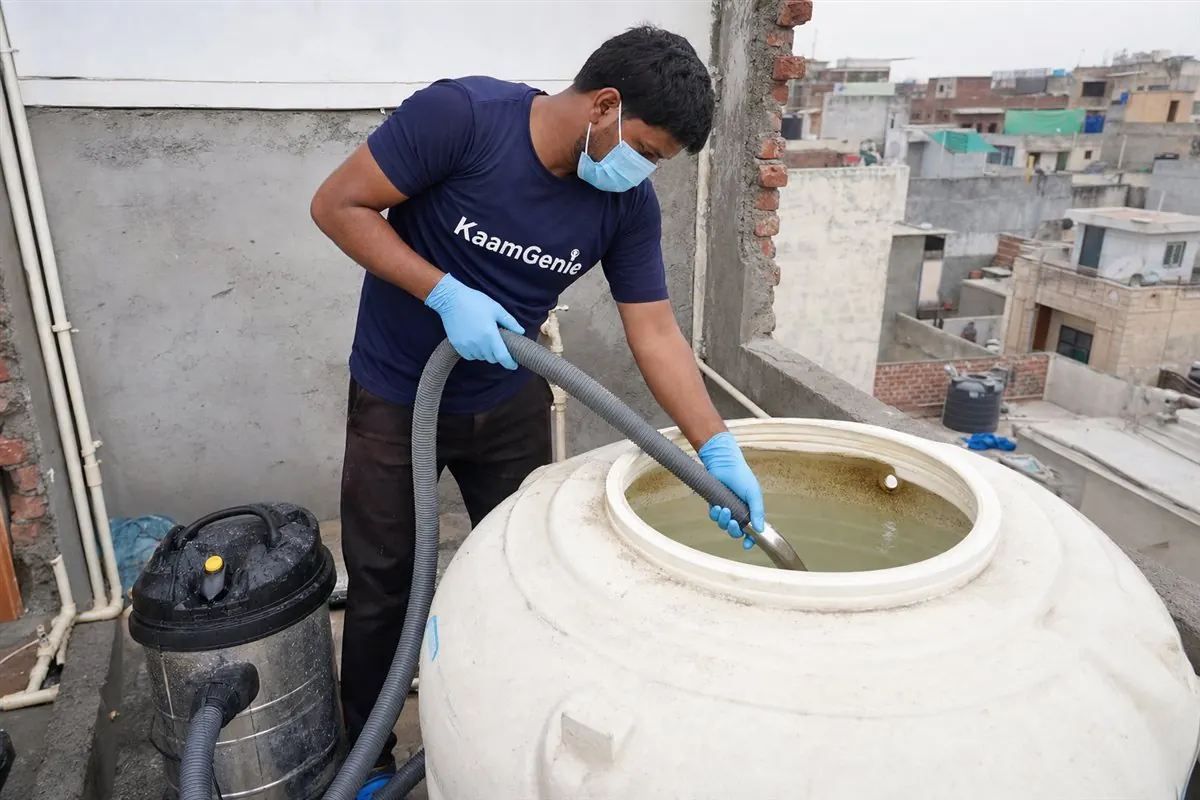
Cleaning is priced on tank capacity and access difficulty, not the number of rooms. A plumber charges for the labour of draining, scrubbing, vacuuming sludge and sanitising — and a 1,000-litre Sintex takes far less time than a 2,000-litre RCC tank on a fourth-floor roof. That’s why two “2BHK” flats can be quoted differently. When you request a quote, share three things: total litres, tank type (plastic, RCC, steel) and location (rooftop, sump, or both). With those, an honest provider like KaamGenie in Delhi can give a firm number instead of a vague range.
1BHK and studio flats: typical band
Most 1BHK homes in Delhi — think DDA Janta flats, Rohini pockets or Lajpat Nagar barsatis — run a single overhead tank of roughly 500–1,000 litres. Cleaning here starts from ₹699 and rarely crosses ₹1,000 unless the roof access is awkward or the tank is heavily scaled. If your building shares a common underground sump, that’s billed separately and split across residents. For a single tenant, budget one visit every four to six months, especially if you’re on tanker-fed supply where silt settles faster.
2BHK and 3BHK: the Delhi mainstream
The bulk of Delhi families sit here. A 2BHK typically has a 1,000-litre overhead tank; many 3BHK builder floors carry 1,500–2,000 litres or twin tanks feeding separate bathrooms. Expect roughly ₹799–₹1,400 for the overhead work depending on litres and scaling. Homes in hard-water belts like Dwarka, Najafgarh and outer Rohini scale faster and may need slightly longer scrubbing. If you also have a ground sump, add the sump price below rather than assuming it’s bundled — always confirm what the quote covers.
Book your water tank cleaning
Trained crew, food-grade process, before/after photos and a service record every job. ₹699 onwards, same-day where possible across Delhi NCR.
4BHK kothis and duplexes: sump matters most
In South Delhi kothis, Punjabi Bagh duplexes and large Greater Kailash homes, the underground sump usually dominates the bill. Sump cleaning runs ₹1,500–₹2,500 because it involves confined-space entry, heavier sludge removal and safety precautions. Add one or two overhead tanks on top and a full-home clean can reach ₹3,000–₹4,500. It sounds steep until you consider these homes store the most water and face the highest contamination risk. Book overhead and sump together and most providers, KaamGenie included, will trim the combined rate.
Hidden costs and how to avoid surprises
A few line items catch Delhi customers off guard. Watch for:
- Extra charge for a second or third tank not mentioned when booking.
- Difficult rooftop access (no ladder, locked terrace) adding labour.
- Heavy monsoon silt after a Yamuna-belt flooding season needing a repeat visit.
Cutting your yearly bill with an AMC
If you clean two or three times a year — sensible for most Delhi homes given DJB supply swings and dust — an Annual Maintenance Contract almost always wins. KaamGenie’s AMC bundles scheduled cleans at 15–25% off per-visit rates, and you never have to remember to book. It suits families in hard-water zones, households with kids or elderly members, and anyone on borewell supply where sediment builds quickly. Compare the math: three ₹999 cleans is ₹2,997, while an AMC covering the same can land meaningfully lower. Call 95603 66362 for a plan tuned to your tank count.
Frequently asked questions
How much is water tank cleaning for a 2BHK flat in Delhi?
A typical 2BHK with a single 1,000-litre overhead tank costs roughly ₹799–₹1,100 to clean. The exact figure depends on litres, tank material and how scaled it is. Homes in hard-water areas like Dwarka may sit at the higher end. Adding a shared sump is charged separately.
Is the underground sump included in the flat cleaning price?
No. Overhead tanks and underground sumps are quoted separately because sumps need confined-space entry and heavier sludge removal. Sump cleaning runs ₹1,500–₹2,500. If you want both done, ask for a combined quote — most providers, including KaamGenie, discount the bundle.
How often should a Delhi household clean its tank?
Every four to six months for most homes. Go on the shorter side if you’re on tanker or borewell supply, live in a hard-water belt, or your building saw monsoon silt intrusion. Public-health guidance recommends at least twice a year, and Delhi’s dust and DJB swings make that a sensible minimum.
Does a bigger BHK always mean a higher cleaning cost?
Not automatically. A large 1BHK builder floor can hold more litres than a compact 2BHK. Price follows total capacity and access difficulty, so share your actual tank size when booking. That said, 4BHK kothis usually cost most because they carry big underground sumps alongside overhead tanks.
Can I lower my annual tank-cleaning spend?
Yes — an Annual Maintenance Contract is the simplest way. KaamGenie AMCs bundle your scheduled cleans at 15–25% off per-visit pricing and remove the hassle of rebooking. If you already clean two or three times a year, the plan typically pays for itself. Call 95603 66362 for a quote.
I share one rooftop tank with the flat below me — how do we split the cleaning cost?
If two flats draw from a single shared tank, the simplest fair split is halving the one cleaning charge. Book it together on one visit rather than paying separately. Many Delhi builder-floor neighbours do this — it’s cheaper than each cleaning their own and keeps the shared supply hygienic for both homes. We’ll give you one quote for the tank.
For a 3BHK, is it cheaper to book tank cleaning with other flats in my building?
Often, yes. If several flats book on the same day, the crew saves travel and setup time, so we can offer a better per-tank rate than isolated single visits. Coordinate with neighbours or your RWA and call 95603 66362 with the number of tanks — we’ll quote a combined rate that beats booking one flat at a time.
Does my BHK size change how often I should clean, or just the price?
Frequency depends on usage and water quality, not bedroom count. A crowded 1BHK on borewell water may need cleaning as often as a lightly-used 3BHK on DJB supply. The rule for every Delhi home is every four to six months. Your BHK mainly affects tank size and therefore price — not the cleaning schedule itself.
I’m moving into a resale flat — should I get the tank cleaned before shifting in?
Definitely. You rarely know when the previous owner last cleaned it, and a tank sitting unused during a sale often grows algae and stale water. A pre-move-in clean, from ₹699, gives you a documented fresh start with before-and-after photos. It’s one of the most common reasons Delhi families book us for a new home.
Is the price per BHK a fixed rate, or just an estimate until you see the tank?
The per-BHK figures are a helpful guide because tank sizes tend to track flat size, but the actual price is set by litres and whether a sump is included. A standard overhead tank starts at ₹699. Tell us your tank size on 95603 66362 and we’ll confirm a fixed price — no surprises on the day.
Sources & references
- Bureau of Indian Standards (BIS) — IS 10500:2012 is the canonical Indian Standard for drinking water specification, defining acceptable limits for physical, chemical and biological parameters.
- WHO Guidelines for Drinking-water Quality, 4th edition — the global reference for water quality standards, including guidance on safe storage and disinfection.
- Food Safety and Standards Authority of India (FSSAI) — defines water quality requirements for food businesses, including hygiene standards for stored water and acceptable disinfection chemicals.
- WHO Fact Sheet on Drinking Water — overview of safe drinking water requirements and contamination risks.
- CPHEEO — Manual on Water Supply and Treatment — the Government of India’s engineering manual covering tank design, cleaning protocols and disinfection practices.
Last verified: 6 July 2026. If you find any of these links broken, please let us know.