
Key takeaways
- Sintex and plastic overhead tank cleaning starts from ₹699, usually ₹699–₹1,200 by size.
- Sunlight plus Delhi hard water drives fast algae and scale in plastic tanks.
- A proper clean drains, scrubs, vacuums, sanitises and reseals the lid.
- A warped or missing lid is the top reason algae returns within weeks.
- Skip risky DIY — wrong chemicals leave residue and rooftop falls are dangerous.
- Shade translucent tanks, seal lids, and use an AMC to cut cost and effort.
This guide covers exactly what Sintex and other plastic overhead tank cleaning costs in Delhi, the size logic behind the price, why these tanks discolour and grow algae faster than you’d expect, and the practical steps of a professional clean. We’ll also cover simple habits that stretch the time between cleans and protect your investment — without the myths that lead people to scrub with the wrong chemicals.
What Sintex cleaning costs in Delhi
A standard plastic overhead tank clean starts from ₹699 and typically lands between ₹699 and ₹1,200 depending on capacity. A 500–1,000 litre single-family tank sits at the lower end; larger 2,000-litre or twin-tank setups on bigger builder floors cost more. Price also nudges up if the tank is severely scaled, has heavy algae, or the rooftop access is awkward. KaamGenie’s Delhi service quotes on litres and condition, so share your tank size when booking to get a firm number rather than a guess.
Why plastic tanks scale and grow algae
Plastic tanks have two Delhi-specific enemies. First, sunlight: a translucent or thin-walled tank lets light through, and light plus warmth plus stored water equals algae. Second, hard water: much of Delhi — Dwarka, Najafgarh, outer zones on borewell — carries high TDS and dissolved minerals that deposit as scale on tank walls and fittings. Add rooftop dust and the odd lizard or insect through a loose lid, and a neglected Sintex becomes a slimy, sediment-lined health risk. None of this is a defect; it’s simply what happens without periodic cleaning.
The professional cleaning process
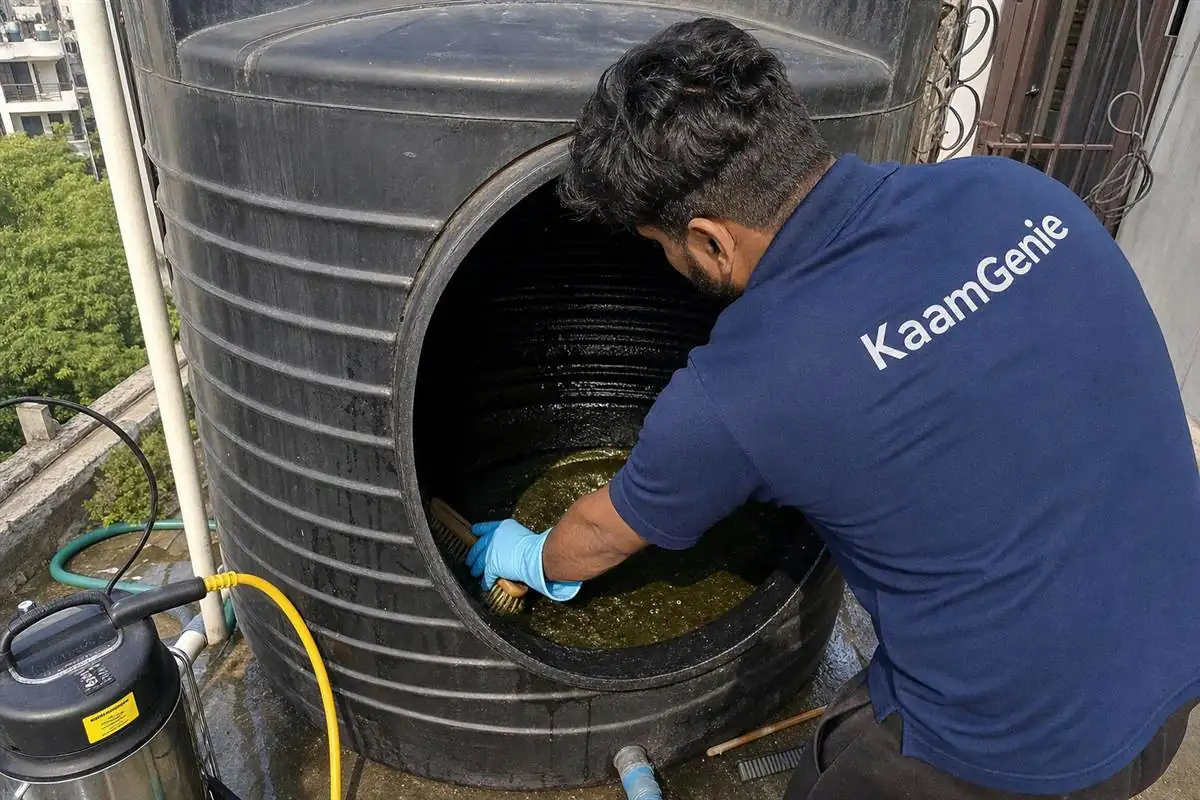
A proper Sintex clean is more than a rinse. The steps:
- Drain the tank fully and remove standing sludge from the base.
- Manually scrub walls, floor and corners to lift algae and biofilm.
- Vacuum out loosened sediment.
- Disinfect with a food-grade sanitiser and rinse.
- Check the lid, inlet and outlet, and reseal against dust and pests.
Book your water tank cleaning
Trained crew, food-grade process, before/after photos and a service record every job. ₹699 onwards, same-day where possible across Delhi NCR.
Why you shouldn’t DIY the scrub
It’s tempting to send someone up with a bucket and detergent, but home DIY often does more harm than good. Household bleach or acid in the wrong dose can leave residue you then drink, and a partial scrub that skips the sludge base or sanitising just spreads biofilm around. There’s also the safety angle — climbing into or over a slippery rooftop tank is a real fall risk. Professional cleaning uses food-grade sanitiser at the correct strength and proper vacuuming, which is why the modest ₹699-plus cost is worth it over a risky DIY.
Habits that stretch time between cleans
You can’t stop scaling entirely in Delhi, but you can slow it. Keep the lid tightly sealed against dust and pests. If your tank is translucent, shading it or using an opaque tank cuts algae dramatically by blocking light. On very hard water, an inlet filter reduces the sediment reaching the tank. And don’t let a tank sit unused and full for long stretches — stagnant water breeds fastest. These habits push a typical clean from every four months toward every six, saving you a visit or two a year.
How often, and saving with a plan
For most Delhi homes a Sintex tank wants cleaning every four to six months — sooner on borewell or tanker supply, sooner if you spot green tinting or a musty smell. Those are your cues, not the calendar alone. If you’re cleaning two or three times a year, a KaamGenie AMC at 15–25% off per-visit rates works out cheaper and removes the reminder burden. For hard-water households in Dwarka or Najafgarh especially, a plan keeps scaling in check. Book or ask for a quote at 95603 66362.
Frequently asked questions
How much does it cost to clean a Sintex tank in Delhi?
Cleaning a plastic overhead tank starts from ₹699 and usually falls between ₹699 and ₹1,200 depending on capacity. Smaller 500–1,000 litre tanks sit at the lower end; larger or twin-tank setups cost more. Heavy scaling, thick algae or awkward rooftop access can nudge the price up. Share your litres for a firm quote.
Why does my Sintex tank grow algae so fast?
Two reasons in Delhi: sunlight passing through thin or translucent plastic feeds algae, and hard, high-TDS water deposits scale on the walls. Add rooftop dust and a loose lid letting in light and pests, and a neglected tank turns slimy within months. Shading the tank and sealing the lid slows it considerably.
Can I clean my plastic tank myself?
It’s risky and often ineffective. Wrong-dose bleach or acid leaves residue you then drink, and a partial scrub that skips the sludge base or sanitising just spreads biofilm. Climbing a slippery rooftop tank is a genuine fall hazard. Professional cleaning uses correct-strength food-grade sanitiser and proper vacuuming, which makes the modest cost worthwhile.
How often should a Sintex tank be cleaned?
Every four to six months for most Delhi homes, and sooner on borewell or tanker supply. Watch for cues rather than only the calendar: green tinting, a musty smell or visible sediment means clean now. Hard-water households in Dwarka or Najafgarh should lean toward the shorter interval to control scaling.
How can I keep my tank cleaner for longer?
Seal the lid tightly against dust and pests, shade or replace a translucent tank with an opaque one to block algae-feeding light, and fit an inlet filter on very hard water. Avoid letting a full tank sit stagnant. These habits can push cleaning from every four months toward every six, saving a visit or two a year.
Does the black Sintex tank grow more algae than a white one in Delhi’s sun?
Colour affects it. Black and dark tanks absorb heat and block light, which slows algae inside but makes the water hot in summer. Translucent or light tanks let sunlight through, and that light is exactly what algae needs to bloom. Either way, a fitted lid and cleaning every four to six months matters more than the colour you chose.
My Sintex tank has a strong plastic smell after summer — will cleaning fix it?
Often yes. That smell usually comes from warm, stale water reacting with algae and biofilm on the walls, not the plastic itself. A proper scrub and food-grade disinfection removes the biofilm and the odour goes with it. If a faint smell lingers, keeping the tank shaded and cleaning on schedule stops it building up again.
Will your cleaning scratch the inside of my Sintex tank and make it dirty faster?
No. We hand-scrub Sintex and other plastic tanks with soft brushes and food-grade cleaners, never wire brushes or acid that scratch the surface. Scratches would indeed trap grime, so gentle cleaning matters. Done right, the walls stay smooth and actually stay cleaner longer. We’ll show before-and-after photos so you can see the finish.
Is a three-layer or four-layer Sintex tank easier to keep clean than a single-layer one?
Multi-layer tanks with a dark middle layer block sunlight, so they resist algae better than thin single-layer tanks that light passes through. They also hold temperature more steadily. That said, no tank is self-cleaning — dust and sediment still settle at the bottom of any Sintex tank, so all of them need a clean every four to six months.
How quickly can you clean a Sintex tank, and is same-day booking possible?
A standard household Sintex tank takes under two hours, and same-day service is often available for a single tank. Call or WhatsApp 95603 66362 in the morning and we’ll usually reach you the same afternoon, subject to crew load in your area. You’ll get before-and-after photos and clean, food-grade water by evening.
Sources & references
- Bureau of Indian Standards (BIS) — IS 10500:2012 is the canonical Indian Standard for drinking water specification, defining acceptable limits for physical, chemical and biological parameters.
- WHO Guidelines for Drinking-water Quality, 4th edition — the global reference for water quality standards, including guidance on safe storage and disinfection.
- Food Safety and Standards Authority of India (FSSAI) — defines water quality requirements for food businesses, including hygiene standards for stored water and acceptable disinfection chemicals.
- WHO Fact Sheet on Drinking Water — overview of safe drinking water requirements and contamination risks.
- CPHEEO — Manual on Water Supply and Treatment — the Government of India’s engineering manual covering tank design, cleaning protocols and disinfection practices.
Last verified: 6 July 2026. If you find any of these links broken, please let us know.