
Key takeaways
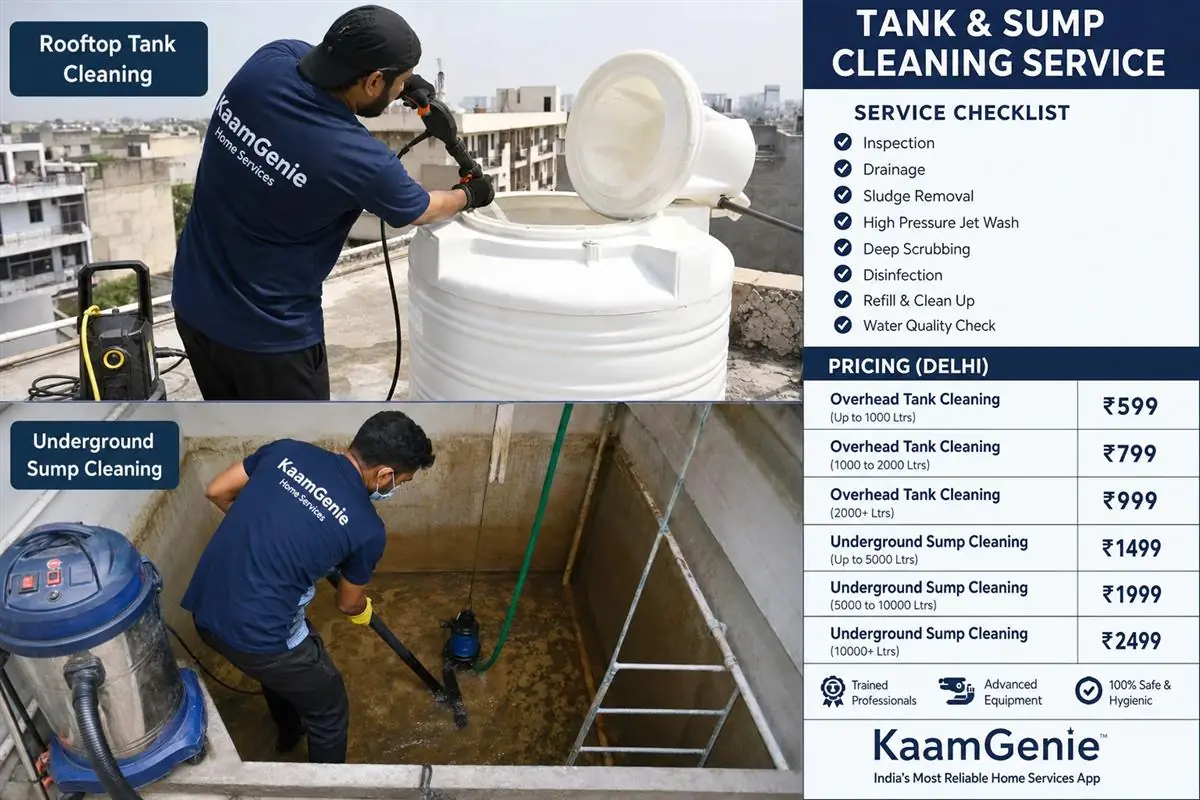
- Domestic overhead tank cleaning starts from ₹699, up to around ₹1,400 for large or twin tanks.
- Underground sump cleaning runs ₹1,500–₹2,500 due to confined-space work.
- Societies and commercial sites are quoted per site after a survey.
- Draining, scrubbing, sanitising and photos should already be included — not add-ons.
- Real add-ons are extra tanks, severe scaling, difficult access and monsoon repeat visits.
- An AMC at 15–25% off cuts the yearly total and removes rebooking hassle.
We’ll walk through domestic overhead pricing, sump cleaning, society and commercial quoting, the genuine add-ons that can change your bill, and how an annual plan cuts the yearly total. Delhi’s hard water, dust and DJB supply swings mean cleaning isn’t optional, so it pays to know the real numbers before you book. Treat this as your reference rate card for the year.
Domestic overhead tanks: from ₹699
The everyday Delhi job — a rooftop Sintex, plastic or small RCC tank on a flat or builder floor. Pricing starts from ₹699 for a single 500–1,000 litre tank and typically runs to around ₹1,400 for larger 2,000-litre or twin-tank setups. This band covers full draining, manual scrubbing, sludge vacuuming, food-grade sanitising and a lid check. It’s the right service for the vast majority of DDA flats, barsatis and independent floors. Book it through KaamGenie’s Delhi page and share your litres for an exact figure.
Underground sumps: ₹1,500–₹2,500
Sumps cost more for good reason. They involve confined-space entry, heavy sludge and silt removal, powerful pumps to drain, high-pressure jetting and strict safety precautions — work no rooftop tank requires. The ₹1,500–₹2,500 band reflects sump size and how much silt has accumulated, which in Delhi depends heavily on whether you’re tanker-fed and how long since the last clean. South Delhi kothis and West Delhi duplexes with large basement sumps sit toward the top. If you have both a sump and overhead tanks, book them together for a combined discount.
Societies and commercial: quoted per site
Apartment societies, hotels, schools, offices and factories are quoted after a survey, not from a fixed rate. The number depends on total storage across all sumps and tanks, number of towers or buildings, access, and whether cleaning must avoid disrupting supply. This is standard across the industry — capacities vary too much for a menu price. What you should demand is a transparent split (master sump, intermediate tanks, per-tower overhead) and a photo completion report. See our society cleaning cost guide for how to convert a bulk quote into fair per-flat math.
Book your water tank cleaning
Trained crew, food-grade process, before/after photos and a service record every job. ₹699 onwards, same-day where possible across Delhi NCR.
What every price includes — and what’s an add-on
Every honest quote should already include draining, scrubbing, sludge removal, food-grade sanitising and before-and-after photos. Genuine add-ons that can change your bill are:
- Extra tanks beyond the one you booked.
- Severe scaling or algae needing longer labour.
- Difficult access — no ladder, locked terrace, or a deep sump.
- A repeat visit after heavy monsoon silt intrusion.
Why Delhi water makes cleaning non-negotiable
Delhi’s conditions accelerate everything a price list assumes. Hard, high-TDS borewell water in Dwarka, Najafgarh and outer zones scales tank walls fast. Tanker and DJB supply carry sediment that settles in sumps. Rooftop dust and summer heat feed algae in plastic tanks. And monsoon silt intrusion can foul storage overnight in low-lying, Yamuna-belt areas. This is why the twice-a-year minimum genuinely applies here — skipping cleans doesn’t save money, it just trades a ₹699 job for a health risk and a much dirtier tank later.
Cutting the yearly total with an AMC
Add up your year: two or three domestic cleans, or a society’s scheduled rounds, and the per-visit total climbs. A KaamGenie AMC bundles those cleans at 15–25% off per-visit rates and removes the need to rebook each time — the team turns up on schedule and knows your setup. It suits hard-water homes, tanker-dependent households, and every RWA. The plan is tailored to your tank count and cleaning frequency, so you only pay for what you need. Get a rate-card quote or an AMC plan on 95603 66362.
Frequently asked questions
What is the basic price for water tank cleaning in Delhi?
Domestic overhead tank cleaning starts from ₹699 for a single 500–1,000 litre tank, rising to around ₹1,400 for larger 2,000-litre or twin-tank setups. That covers full draining, scrubbing, sludge vacuuming, food-grade sanitising and a lid check. Share your tank litres when booking for an exact figure rather than a range.
How much does underground sump cleaning cost?
Between ₹1,500 and ₹2,500, depending on sump size and how much silt has built up. Sumps cost more than rooftop tanks because they need confined-space entry, heavy sludge removal, pumps, jetting and safety precautions. Large South and West Delhi basement sumps sit at the top. Book with overhead tanks for a combined discount.
Why can’t you give a fixed price for societies?
Because society and commercial storage varies too much — total capacity, number of towers, sump depth, access and supply-continuity needs all differ. Reputable providers survey first, then quote. Insist on a transparent split across master sump, intermediate tanks and per-tower overhead tanks, plus a photo completion report, so you can compare like for like.
What counts as a genuine add-on to the price?
Extra tanks beyond the one booked, severe scaling or algae needing longer labour, difficult access such as a locked terrace or deep sump, and a repeat visit after heavy monsoon silt. Sanitising, before-and-after photos and basic safety gear are not add-ons — they should already be included in any honest quote.
How does an AMC reduce my yearly cost?
It bundles your scheduled cleans — two or three domestic visits, or a society’s rounds — at 15–25% off per-visit rates, and removes the need to rebook each time. The team arrives on schedule and knows your setup. Plans are tailored to your tank count and frequency, so you pay only for what you need. Call 95603 66362.
Do you charge extra to clean the tank on a high DDA-flat rooftop?
No, rooftop access on a standard DDA flat or independent house is included in the base price from ₹699. Our crew carries their own ladder and safety gear. We only quote extra when a tank needs special rigging, sits on a very tall commercial terrace, or has no safe walkway — and we tell you before we start, never after.
Is there a minimum charge if I have just one small tank?
The ₹699 domestic rate is already our minimum for a single overhead tank up to roughly 1,000 litres. There is no hidden call-out fee on top. If your tank is smaller than average the price stays the same, because our cost is mostly the crew’s time, food-grade scrubbing and the anti-bacterial treatment, not the water volume.
How do I pay — is UPI or cash fine after the job?
You pay after the work is done and you have seen the before and after photos. We accept UPI, all major payment apps and cash. No advance is needed for a standard domestic booking. For societies and AMCs we can raise a proper invoice for the RWA or facility office on request. Call 95603 66362 to confirm.
Will the quoted price change once the crew sees how dirty my tank is?
For a normal domestic tank, no — the ₹699 rate holds however grimy it looks inside. Price only moves if there is a genuine add-on you agree to first, like a deep de-scale, a sump, or a much larger capacity. A heavily neglected tank simply takes longer to scrub; it does not cost you more.
Do you offer any discount for cleaning two or three tanks together?
Yes. If you have multiple tanks at one address — say an overhead plus an underground sump, or separate tanks per floor — we combine them into one visit and give a better overall rate than booking each alone. Tell us how many and their rough sizes on 95603 66362 and we will share a single clear figure.
Sources & references
- Bureau of Indian Standards (BIS) — IS 10500:2012 is the canonical Indian Standard for drinking water specification, defining acceptable limits for physical, chemical and biological parameters.
- WHO Guidelines for Drinking-water Quality, 4th edition — the global reference for water quality standards, including guidance on safe storage and disinfection.
- Food Safety and Standards Authority of India (FSSAI) — defines water quality requirements for food businesses, including hygiene standards for stored water and acceptable disinfection chemicals.
- WHO Fact Sheet on Drinking Water — overview of safe drinking water requirements and contamination risks.
- CPHEEO — Manual on Water Supply and Treatment — the Government of India’s engineering manual covering tank design, cleaning protocols and disinfection practices.
Last verified: 6 July 2026. If you find any of these links broken, please let us know.