
Key takeaways
- Society cleaning is quoted per-site after a survey, not from a fixed price list.
- The underground master sump is usually the largest cost item.
- Ask for a split quote: master sump, intermediate tanks, per-tower overhead tanks.
- Divided across all flats, professional cleaning costs each household very little.
- Insist on sanitising, safety gear and a photo completion report.
- An AMC at 15–25% off with scheduled cleans beats reactive one-off jobs.
This guide is written for RWAs, MC members and facility managers across Delhi. We’ll unpack what drives society-scale cleaning costs, how to convert a lump-sum quote into a sensible per-flat figure, what a professional scope actually includes, and why an annual contract almost always beats one-off panic cleans after a resident complains about murky water.
Why society cleaning is quoted, not fixed
Unlike a flat, no two societies are alike, so reputable providers survey first and then quote. The number depends on total storage capacity across all sumps and tanks, the number of towers, sump depth and access, and whether cleaning must happen without disrupting supply. A compact group-housing block in Dwarka is worlds apart from a sprawling DDA society in Rohini with multiple basements. That’s why KaamGenie’s Delhi team gives society and commercial pricing on a per-site basis rather than a fixed menu — it protects the RWA from paying for capacity it doesn’t have.
The big cost driver: underground sumps
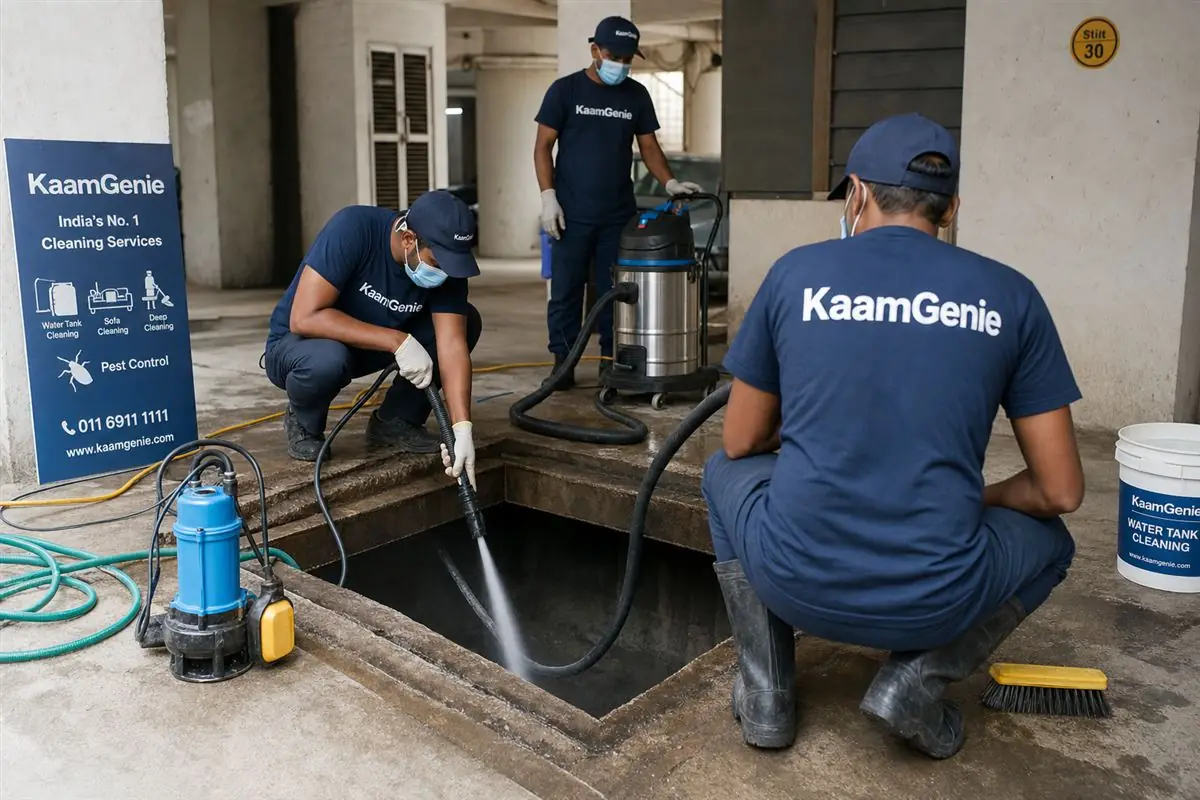
In most Delhi societies the master sump is the single largest line item. These are deep, high-capacity tanks needing confined-space entry, powerful pumps to drain, sludge and silt extraction, high-pressure jetting, and food-grade sanitisation — all under safety protocols. Overhead tanks on each tower add up too, but individually they’re quick. When you read a society quote, ask for a split: master sump, intermediate tanks, and per-tower overhead tanks. That transparency lets the committee sanity-check the bill and compare providers on a like-for-like basis instead of a single opaque figure.
Turning the quote into per-flat math
Residents care about one thing: what it adds to their maintenance. The math is simple once you have the total. Divide the annual cleaning cost by the number of flats and then by twelve for a monthly per-flat figure. Because societies share large sumps across many homes, the per-flat cost of professional cleaning is usually small — often a modest monthly amount folded into common-area maintenance. Presenting it this way in the AGM defuses objections: residents see that clean, safe stored water costs each household very little when the expense is pooled across the society.
Book your water tank cleaning
Trained crew, food-grade process, before/after photos and a service record every job. ₹699 onwards, same-day where possible across Delhi NCR.
What a professional society clean includes
A proper scope, and what your RWA should insist on, covers:
- Complete draining of sumps and overhead tanks.
- Mechanised sludge and silt removal, wall and floor scrubbing.
- High-pressure jetting and vacuuming.
- Food-grade disinfection and safe refill guidance.
- Before-and-after photos and a completion report for records.
Scheduling around resident supply
The practical worry for any RWA is: will taps run dry during cleaning? A competent team plans around it — cleaning tower by tower, or the sump during low-demand hours, so residents barely notice. In Delhi’s summer this coordination is critical because storage is already stretched. Agree the schedule in advance, notify residents through the society WhatsApp group, and keep one tank in reserve during the work. A provider used to Delhi group-housing, like KaamGenie, will build this staging into the plan rather than draining everything at once.
Why an RWA should sign an AMC
One-off cleaning after a complaint is the most expensive way to run a society. An Annual Maintenance Contract fixes a schedule — typically twice or more per year given Delhi’s dust, DJB swings and monsoon silt — at 15–25% off per-visit rates, with predictable budgeting the treasurer will appreciate. It also assigns accountability: the same team knows your layout, keeps records, and turns up on time. For RWAs juggling many vendors, one dependable water-hygiene contract removes a recurring headache. Call KaamGenie at 95603 66362 for a society survey and AMC quote.
Frequently asked questions
How is water tank cleaning priced for a Delhi society?
On a per-site basis after a survey. Cost depends on total storage capacity, number of towers, sump depth and access, and whether cleaning must avoid disrupting supply. Because layouts differ hugely, providers like KaamGenie quote societies individually rather than using a fixed menu, which keeps the RWA from overpaying.
What does society cleaning cost per flat?
Usually very little. Since large sumps are shared across many homes, dividing the annual cost by the number of flats and by twelve gives a small monthly per-flat figure, easily folded into common-area maintenance. Presenting it this way at the AGM helps residents see that safe stored water is inexpensive when pooled.
Will our water supply stop during cleaning?
Not if it’s planned well. A competent team cleans tower by tower or handles the sump during low-demand hours, keeping one tank in reserve so residents barely notice. Agree the schedule in advance and notify residents. KaamGenie builds this staging into every Delhi society plan rather than draining all storage at once.
What should the RWA insist a cleaning scope includes?
Full draining, mechanised sludge and silt removal, wall and floor scrubbing, high-pressure jetting, food-grade disinfection, and a before-and-after photo completion report for records. Confined-space sumps also require proper safety gear. Avoid cheap crews that skip sanitising or safety protocols — that report is your proof for residents.
Is an AMC worth it for a society?
Almost always. Reactive cleaning after complaints is the costliest approach. An AMC fixes a schedule at 15–25% off per-visit rates, gives the treasurer predictable budgeting, and assigns one accountable team that knows your layout and keeps records. For RWAs managing many vendors, it removes a recurring water-hygiene headache. Call 95603 66362.
How much advance notice do residents need before a society tank clean?
We recommend the RWA give residents at least a day’s notice so families can store water for the two-to-three-hour supply pause per tank. Our supervisor helps you plan the timing — often mid-morning when usage dips. A simple notice on the board or society WhatsApp group is enough; we’ll confirm the exact window when we schedule.
Can you clean our society’s tanks in phases so water supply never fully stops?
Yes. In societies with multiple tanks or blocks, we clean one tank or riser at a time so other blocks keep supply while we work. This staggered approach keeps disruption minimal. Tell us your tank layout and we’ll plan a phased schedule — it’s a common request from Delhi RWAs wanting to avoid a full building shutdown.
What proof does our RWA get that all society tanks were actually cleaned?
Each tank gets before-and-after photos and a dated service record, compiled into one report for the RWA. This is useful for your AGM, resident queries and AMC audits. It shows exactly which tanks were done and the sludge removed. Committees value this documentation because it answers the inevitable “was it really cleaned?” questions from residents.
Is your crew police-verified and insured for working inside our society premises?
Our crew is trained and police-verified, which most Delhi RWAs require before allowing vendors in. We can share worker ID details in advance for your security register and gate log. For large or ongoing AMC arrangements, discuss any additional documentation your society needs with our supervisor when you finalise the scope on 95603 66362.
How often should a Delhi society clean its tanks under an AMC?
Most societies do well on a quarterly clean — every three to four months — because shared tanks serve many families and dirty faster than a single home’s. An AMC locks in that schedule so it isn’t forgotten between committee changes, and it spreads the cost predictably across the year rather than one large annual bill.
Sources & references
- Bureau of Indian Standards (BIS) — IS 10500:2012 is the canonical Indian Standard for drinking water specification, defining acceptable limits for physical, chemical and biological parameters.
- WHO Guidelines for Drinking-water Quality, 4th edition — the global reference for water quality standards, including guidance on safe storage and disinfection.
- Food Safety and Standards Authority of India (FSSAI) — defines water quality requirements for food businesses, including hygiene standards for stored water and acceptable disinfection chemicals.
- WHO Fact Sheet on Drinking Water — overview of safe drinking water requirements and contamination risks.
- CPHEEO — Manual on Water Supply and Treatment — the Government of India’s engineering manual covering tank design, cleaning protocols and disinfection practices.
Last verified: 6 July 2026. If you find any of these links broken, please let us know.