
Key takeaways
- DJB runs free scheme-based supply and paid on-demand tankers; rates depend on capacity and category.
- Book via the official DJB app, helpline or zonal office — avoid overpriced private operators.
- Always keep your consumer/K-number and booking reference handy.
- Tanker water still needs a clean tank; deliveries stir up settled sediment.
- Tanker-reliant zones like Sangam Vihar should clean tanks every three to four months in summer.
- Schedule cleans before peak summer and after the monsoon for best hygiene.
This guide lays out how DJB tanker supply is priced in 2026, the difference between the free scheme and paid commercial tankers, and the practical steps to book. Just as important, we explain why tanker-fed water makes a clean storage tank non-negotiable — because whatever the DJB delivers ends up sitting in your sump or overhead tank, picking up whatever sediment is already there.
Free vs paid DJB tankers: the basics
The DJB runs two broad streams. First, emergency and scheme-based free supply to areas without piped water or facing genuine shortage — residents lodge a request and a tanker is dispatched without a delivery charge. Second, paid or booked tankers for households, RWAs, construction sites and events that need water on demand. Rates for paid tankers vary by tanker capacity (commonly 1,000, 3,000 and larger stainless steel tankers) and by whether it’s domestic or commercial use. Always confirm the current schedule directly with your local DJB zonal office, as rates are revised periodically.
What drives the price of a booked tanker
Three factors move the number: capacity, distance and category. A larger stainless steel tanker naturally costs more than a small one; deliveries far from the filling station add haulage; and commercial or construction use is billed differently from domestic. Beware informal “private tanker” operators quoting eye-watering rates during peak summer — the official DJB channel is far cheaper. If a supplier can’t show a receipt, treat the quote with suspicion. Booking through the proper DJB route protects you from monsoon-season profiteering that spikes when demand outstrips supply.
How to book a DJB tanker in Delhi
You have a few official routes:
- The DJB mobile app and website, where you can raise a tanker request tied to your consumer or K-number.
- The DJB helpline and its central control room for emergency supply.
- Your local zonal or divisional DJB office for standing arrangements.
Book your water tank cleaning
Trained crew, food-grade process, before/after photos and a service record every job. ₹699 onwards, same-day where possible across Delhi NCR.
Why tanker water demands a clean tank
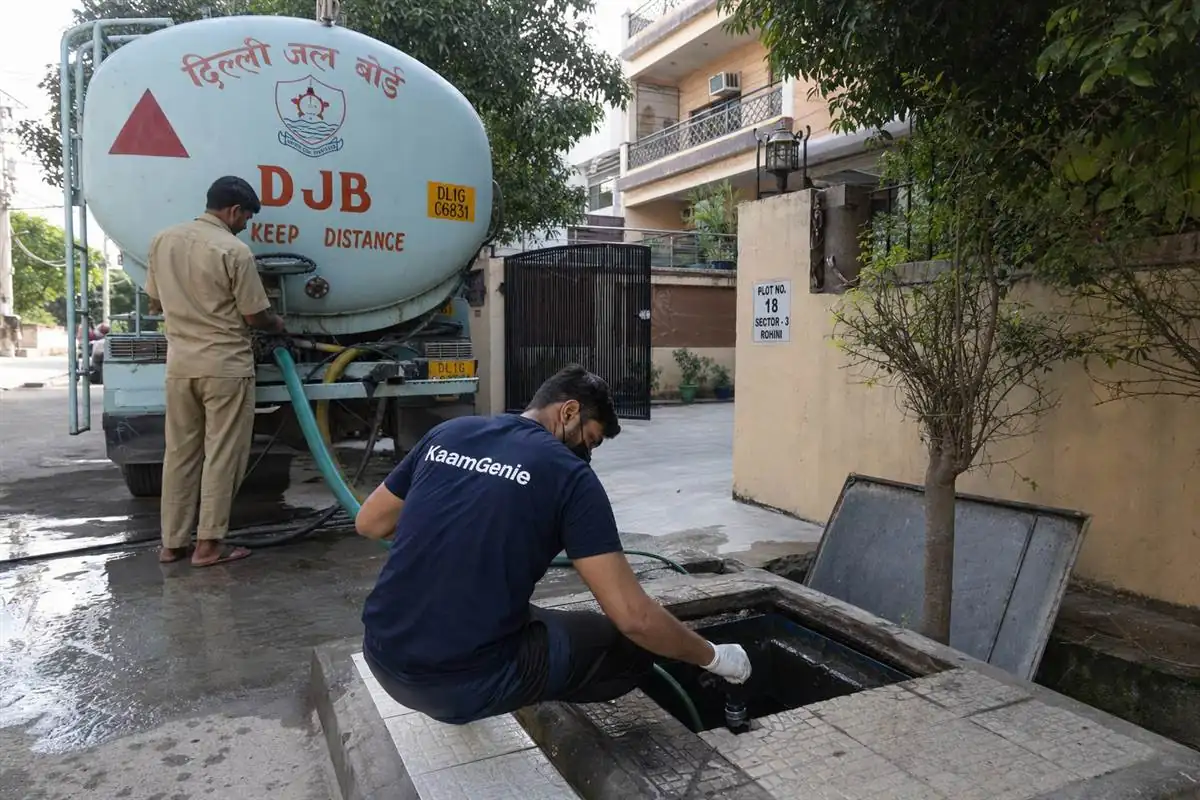
Here’s the part most residents miss. DJB tanker water may leave the station acceptably, but it’s carried in a mobile tanker and pumped into your storage — and your sump or overhead tank is where contamination actually accumulates. Sediment, biofilm and algae in a neglected tank will taint even good incoming water. Tanker-fed homes see faster silt buildup than piped ones because deliveries stir up whatever has settled. That’s exactly why a scheduled Delhi water-tank cleaning matters more, not less, when you depend on tankers.
Areas most reliant on tankers
Tanker dependence is heaviest in Sangam Vihar, parts of outer Delhi, unauthorised colonies awaiting pipelines, and pockets of Chhatarpur and the urban villages. Many South and West Delhi kothis also top up with tankers when borewell yield drops in peak summer. If you’re in one of these zones, storage hygiene is your first line of defence: a clean tank means the water you paid for stays usable. Households topping up frequently should shorten their cleaning cycle to every three to four months during the dry season.
Pairing tanker supply with a cleaning routine
Smart Delhi households treat tanker delivery and tank cleaning as one system. Schedule a clean just before peak summer so your sump is spotless when heavy tanker use begins, then again after the monsoon when silt intrusion is highest. KaamGenie sump cleaning runs ₹1,500–₹2,500 and overhead cleaning starts from ₹699, with an AMC at 15–25% off for households or RWAs that need recurring service. If your colony runs on tankers, ask your RWA to fold tank cleaning into the common maintenance schedule — call 95603 66362 to set it up.
Frequently asked questions
Are DJB water tankers free in Delhi?
Some are. The DJB provides free emergency and scheme-based tanker supply to areas without piped water or facing genuine shortage, arranged on request. Paid tankers are available on demand for households, RWAs and commercial use, priced by capacity and category. Confirm current rates and eligibility with your local DJB zonal office.
How do I book a Delhi Jal Board tanker?
Use the official DJB app or website with your consumer or K-number, call the DJB helpline for emergency supply, or approach your local zonal office for standing arrangements. Keep your booking reference and ask for the delivery window. RWAs should coordinate bulk supply through the zonal office for logged, scheduled deliveries.
Why should I clean my tank if I use DJB tanker water?
Because your sump or overhead tank is where contamination collects. Tanker water is pumped into storage where sediment, biofilm and algae already sit, and deliveries stir settled silt back into the water. A clean tank keeps the water you paid for usable, which is why tanker-fed homes actually need cleaning more often.
How often should tanker-dependent homes clean their tanks?
Every three to four months during the dry season, when tanker top-ups are frequent and silt builds fast. Schedule one clean just before peak summer and another after the monsoon, when intrusion risk peaks. Homes in heavy-dependence zones like Sangam Vihar or Chhatarpur benefit most from this tighter cycle.
Are private tankers more expensive than DJB ones?
Usually yes, especially in peak summer when informal operators inflate rates as demand spikes. The official DJB channel is far cheaper and traceable. If a supplier can’t provide a receipt, be cautious. Book through the DJB app, helpline or zonal office to avoid seasonal profiteering.
How can I tell if a private tanker is supplying clean water or something unsafe?
You can’t judge tanker water fully by eye, but cloudy, smelly or oily-looking water is a red flag — refuse it. Even clear tanker water carries sediment from the tanker’s own hold. That’s why the safest habit is filling into a recently cleaned tank and getting it professionally cleaned every few months if you rely on tankers.
Does tanker water leave more sludge in my tank than regular DJB pipeline supply?
Usually yes. Tanker water, especially from private or borewell sources, carries more suspended silt than treated pipeline supply, and it settles as sludge at your tank’s bottom. Homes on frequent tanker deliveries often need cleaning every three to four months instead of six. Our before photos typically show noticeably more sediment in tanker-fed tanks.
The tanker filled my tank while it was dirty — is that water safe to drink now?
Filling clean tanker water into a dirty tank contaminates it immediately, so treat it with caution — use it for washing, not drinking, until the tank is cleaned. The tank walls and old sludge, not the tanker, are usually the real problem. Get a food-grade clean done, then future tanker fills stay clean much longer.
How much water storage should I have if I depend on DJB tankers?
Enough to cover the gap between deliveries, which in tanker-reliant Delhi pockets can be several days. Many homes add an underground sump plus the rooftop tank. Remember that bigger storage means water sits longer and needs cleaning more regularly — stored water goes stale. Balance capacity with a solid cleaning routine every three to four months.
Can KaamGenie arrange the DJB tanker for me, or only clean the tank?
We’re a tank-cleaning service, so we don’t book DJB or private tankers for you — that goes through the Delhi Jal Board helpline or your local water depot. What we do is make sure the tank receiving that water is food-grade clean, so the supply you pay for actually stays safe once it’s stored.
Sources & references
- Bureau of Indian Standards (BIS) — IS 10500:2012 is the canonical Indian Standard for drinking water specification, defining acceptable limits for physical, chemical and biological parameters.
- WHO Guidelines for Drinking-water Quality, 4th edition — the global reference for water quality standards, including guidance on safe storage and disinfection.
- Food Safety and Standards Authority of India (FSSAI) — defines water quality requirements for food businesses, including hygiene standards for stored water and acceptable disinfection chemicals.
- WHO Fact Sheet on Drinking Water — overview of safe drinking water requirements and contamination risks.
- CPHEEO — Manual on Water Supply and Treatment — the Government of India’s engineering manual covering tank design, cleaning protocols and disinfection practices.
Last verified: 6 July 2026. If you find any of these links broken, please let us know.