
The short version
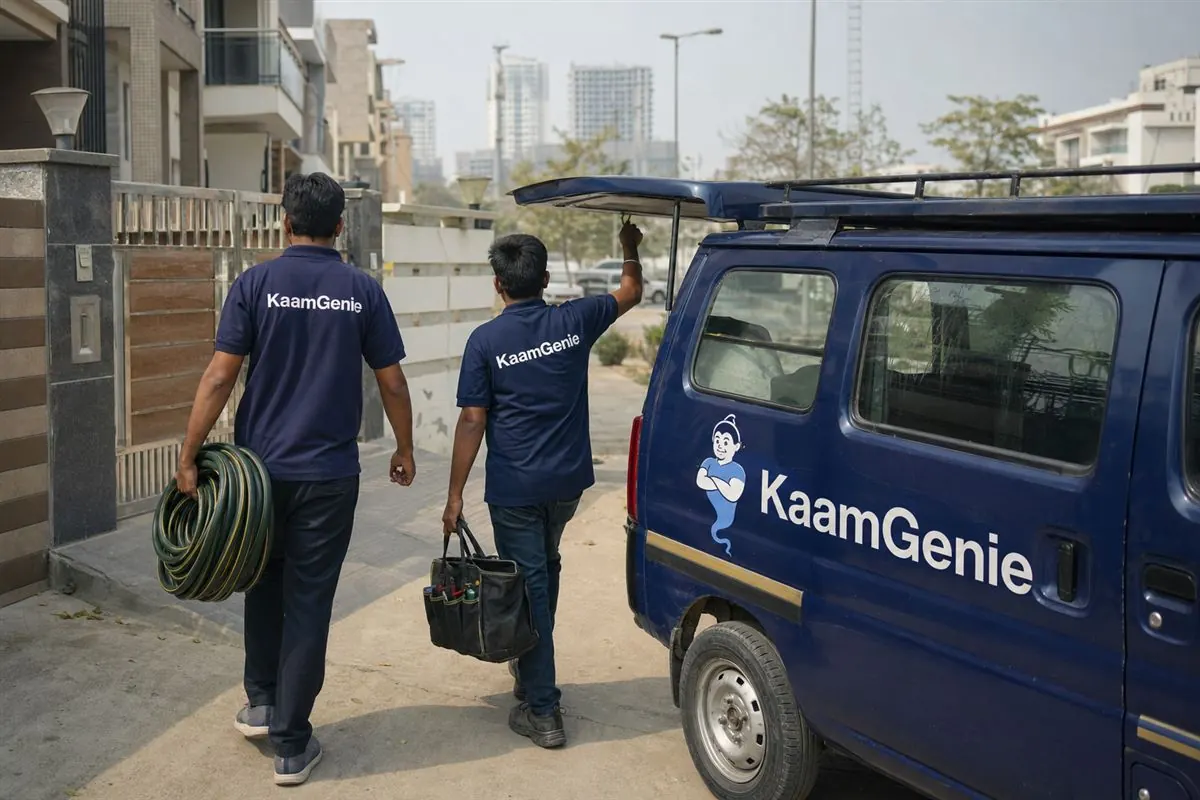
- “Near me” matters less than who actually shows up — a local crew that knows your sector’s supply beats a faceless call-centre lead every time.
- Before booking, verify five things: trained crew, food-grade chemicals, before/after photos, GST invoice, and a dated certificate.
- Red flags: a ₹200–300 quote, a 20-minute job, top-rinse-only with no sludge removal, and no paperwork.
- Same-day is usually possible for one home tank across Noida and Greater Noida if you call before midday.
- Tanker-fed and borewell-fed buildings in the newer belts need cleaning more often, not less.
Booking the cheapest “near me” result is how most Noida families end up paying twice — once for the rinse, then again for the real clean.
Noida is a city built on stored water. The Authority-planned sectors run on a mix of Ganga Jal piped supply and hard borewell groundwater; the IT and corporate belt around Sector 62 and the Expressway towers pull from big underground reservoirs that feed rooftop tower tanks; and the new townships in Greater Noida West lean heavily on tanker deliveries. Whatever the source, it sits in a tank before it reaches your tap — and that tank is the one thing a water purifier can’t fix. That’s why “water tank cleaning near me” is one of the most-searched home-service phrases in the city. This guide is about choosing well once you’ve searched.
What “near me” should actually mean
A search for “near me” rewards whoever spent the most on ads, not whoever does the best work. Many of the numbers you’ll see are lead aggregators who take your call, sell it to whichever cleaner is free, and disappear. The cleaner who turns up may never have worked in your area before.
A genuinely local crew is worth more because Noida’s water behaves differently sector to sector. In the older established belt around Sector 18 and the surrounding low-numbered sectors, tanks are often older RCC and the piped supply runs on fixed hours. In the IT and office corridor around Sector 62, you get large commercial reservoirs and rooftop tower tanks on a different cleaning rhythm. In residential, builder-floor-heavy pockets like Sector 50, shared sumps under independent floors are the norm. A crew that already works these sectors knows what it’s walking into before it arrives. Ask any service one question — which Noida sectors did you clean this week? A real local operator names them instantly.
| What to verify | Why it matters | How to check it |
|---|---|---|
| Trained crew | Someone must physically enter or reach in to scrub the walls and floor | Ask: “Do you go inside the tank or rinse from the top?” |
| Food-grade chemicals | Your tank feeds drinking water — hardware bleach leaves residue | Ask the exact chemical name; the answer should be sodium hypochlorite (food-grade) |
| Before/after photos | Your only proof the inside was actually cleaned | Confirm they send WhatsApp photos with every job |
| GST invoice | A real registered business, not a cash-only one-off | Ask for a GST bill before the crew starts |
| Cleaning certificate | Required for societies and any FSSAI-regulated kitchen | Confirm it lists tank capacity, chemical used, date and crew |
Book a real cleaning, not a rinse
Trained crew, food-grade chemicals, before/after photos, GST invoice and a dated certificate — every job. ₹699 onwards across Noida.
The five things to verify before you book
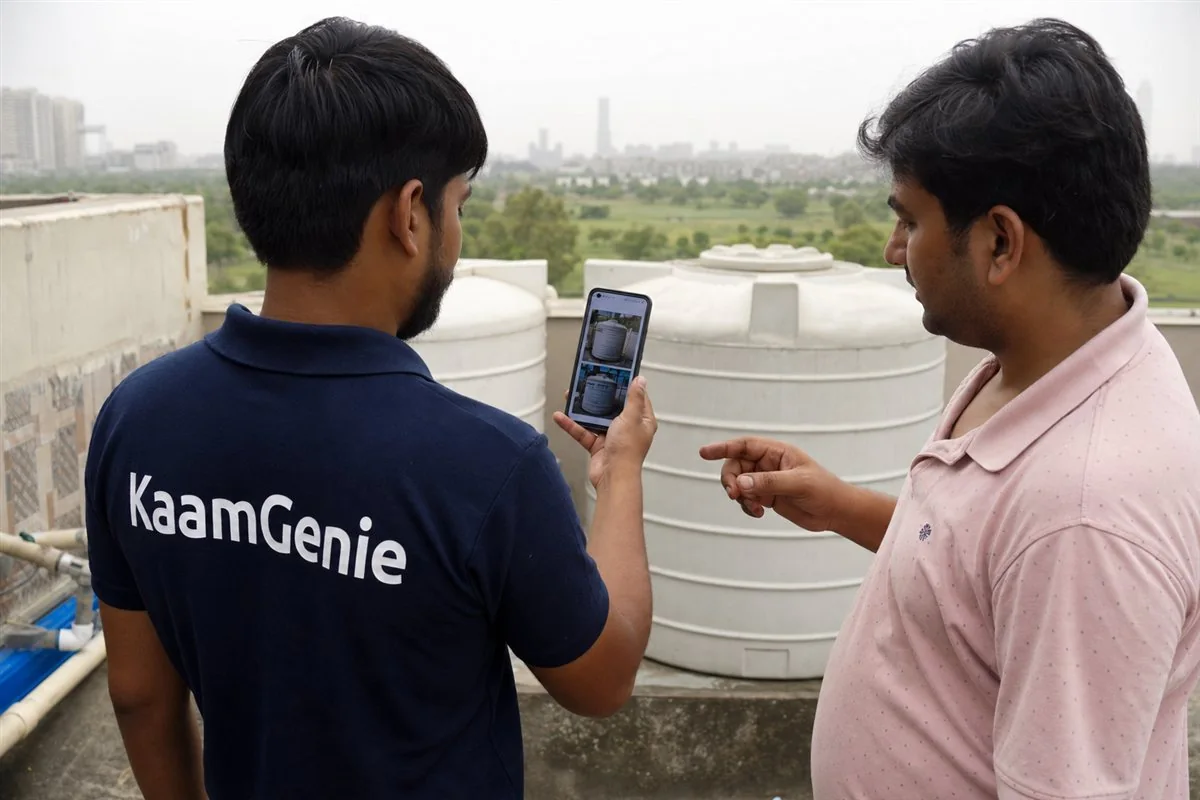
You don’t need to be a water engineer to vet a cleaner. You need five honest answers on the phone before the crew leaves their depot.
1. A trained crew that goes in. A real cleaning means someone physically enters the tank (or reaches fully in, for smaller tanks) and scrubs every wall, the floor, the corners and the area around the inlet and outlet pipes with food-grade brushes. If the answer to “do you go inside?” is “we rinse it from the top with a hose,” that’s not cleaning — that’s a top rinse that leaves the contamination behind.
2. Food-grade chemicals. The disinfection step should use food-grade sodium hypochlorite at the right concentration — the same class of compound used in municipal treatment and accepted under FSSAI guidance for potable systems. Hardware-shop bleach and pool chlorine are cheaper and wrong; they can carry fragrances, stabilizers or contaminants you don’t want in water that feeds your kitchen.
3. Before-and-after photos. Tanks are out of sight on the roof or underground. Photos are your only window into what was actually done. A crew confident in its work sends them without being asked.
4. A GST invoice. A registered business gives you a real bill, a real entity to hold accountable, and a paper trail. Cash-only with no receipt means no recourse if something goes wrong.
5. A dated cleaning certificate. It should list tank capacity, the chemical used, the date and the crew. Keep it. If your RWA asks for proof of maintenance, or an FSSAI inspector visits a food business, this is the document that matters.
Red flags: how corner-cutters operate
The cheap end of the “near me” market survives on the fact that you can’t see your tank. Here’s how the corner-cutting works, so you can spot it:
- The ₹200–300 quote. A proper residential clean takes a crew 75–90 minutes of physical work plus equipment and food-grade chemical. Nobody does that for ₹250. A throwaway price means a throwaway job.
- The 20-minute job. If a cleaner is packed up and gone in twenty minutes, they skipped sludge removal, scrubbing and the disinfection contact time. Real cleaning can’t be rushed because the bottom sediment layer has to be scooped and the chemical needs time to work.
- Top-rinse-only. The most common shortcut in Noida. They spray water in from the top, swish it around, and drain it. The half-inch of sand, rust and biofilm on the floor — the worst of it — stays exactly where it was.
- No jet wash, no vacuum. A pressure jet and a wet vacuum cost money to own. Operators who don’t have them can’t reach corners or remove the dirty rinse water, so the dislodged grime resettles when you refill.
- No photos, no invoice, no certificate. No paperwork means no proof and no accountability. That’s the whole point of skipping it.
If you want the long version of how a thorough job is structured and what each step does, our complete Noida water tank cleaning guide walks through it, and the honest pricing ranges are laid out in our Noida cost breakdown so you can sanity-check any quote.
Same-day cleaning across Noida and Greater Noida
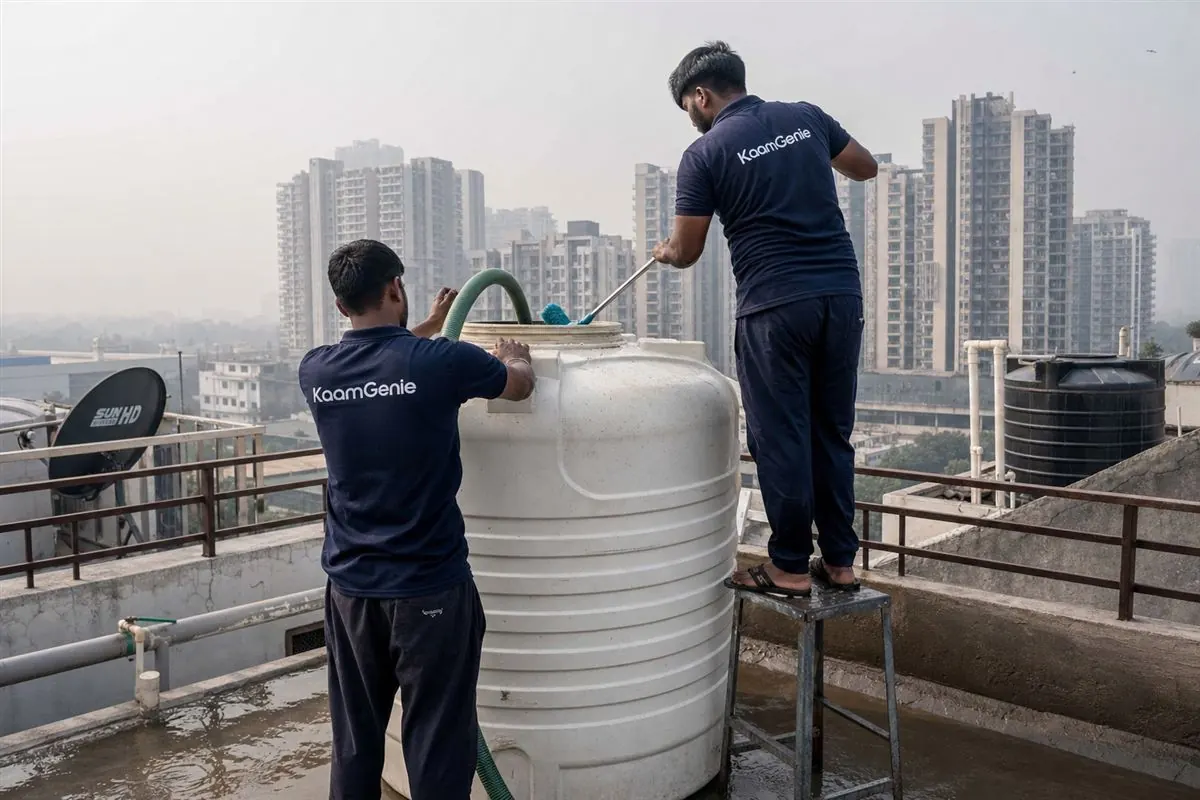
Most “near me” searches happen because of a problem you noticed this morning — yellow water, a smell, grit at the tap — and you want it dealt with today. For a single residential overhead tank, same-day is usually doable across the city if you call before midday: the established sectors, the high-rise belt along the Noida Expressway (Sectors 137, 150, 168, 75, 76, 78, 100), and the new tower townships of Greater Noida West. What you can’t reliably squeeze into the same afternoon is a society reservoir with several towers, or a large underground sump — those need staging and a bigger crew, so they get scheduled honestly rather than promised falsely. If urgency is your main concern, our same-day water tank cleaning in Noida page explains exactly how the slots work.
One Noida-specific point worth flagging: the newer belts are tanker-dependent. Greater Noida West and many Expressway societies fill big underground reservoirs from water tankers, and tanker water carries more suspended sediment than piped supply. Combine that with the region’s hard borewell groundwater, which leaves mineral scale, and these buildings genuinely need cleaning more often — not as an upsell, but because more sediment goes in. A six-monthly clean is sensible there, versus annually for a home on cleaner piped Ganga Jal.
What separates a real Noida cleaning from a “near me” rinse
Share of jobs where each safeguard is present — KaamGenie standard vs the cheap-quote market, illustrative
Illustrative comparison of service standards — not a survey statistic. The point: the safeguards that cost a cleaner time and equipment are exactly the ones corner-cutters drop.
Matching the crew to your kind of building
“Near me” also has to mean “right for my building.” Noida packs in very different housing, and the cleaning differs with it:
- Plotted Authority houses and builder floors — often a shared underground sump feeding individual rooftop tanks. The sump is the bit corner-cutters skip; insist it’s included.
- High-rise societies on the Expressway and in Greater Noida West — large underground reservoirs (UGR) feeding rooftop tower tanks, best handled tower by tower with per-tank certificates. Our society water tank cleaning guide for Noida covers how RWA contracts are staged.
- The IT and corporate belt and institutions — Sector 62 offices, Amity and the colleges, and the hospitals run big commercial tanks on documented schedules and after-hours access.
- PGs, student housing and rented flats — the large tenant and student population means heavily used tanks and the recurring question of who pays. A clear scope and invoice settles it.
Whatever the building, the verification checklist above doesn’t change. The five things you confirm before booking are the same whether it’s a single Sintex tank on a Sector 50 terrace or a four-tower reservoir off the Expressway.
The easiest way to choose well in Noida
You don’t have to gamble on whichever “near me” result ranks first. Pick a service that already covers your sector, ask the five verification questions, and walk away from anyone who can’t answer them or quotes a price that’s too good to be real. KaamGenie’s trained crews work the whole city — start at the water tank cleaning in Noida hub to find your sector, or see the full range of water tank cleaning services across NCR. Same trained crew, fixed prices, photos and a certificate, every job.
Get a straight answer for your sector
Tell us your Noida sector and tank type — we’ll give you an honest same-day slot where possible. ₹699 onwards residential.
Bottom line for Noida residents
The “near me” search is just the start. The cleaner who shows up matters far more than the one who ranks first, and the way to tell them apart is to ask five plain questions before you book: does the crew go in, what chemical do they use, will you get photos, an invoice, and a certificate. Add the warning signs — the throwaway price, the rushed job, the top-rinse-only — and you’ll filter out the corner-cutters in one phone call. When you’re ready, find your sector on the Noida water tank cleaning hub and book a crew that does the real job.
To book now, call +91 95603 66362 or use the booking form on this site — tell us your sector and we’ll confirm shortly.
Frequently asked questions
How do I find a genuinely local water tank cleaning service near me in Noida?
Search your sector by name, not just “near me” — a crew that already works in Sector 18, Sector 62 or Sector 50 can tell you how the supply behaves there (Ganga Jal piped hours, borewell hardness, tanker dependence in the newer belts) before they arrive. Ask which Noida sectors they covered this week. A real local operator names them instantly; a lead-reseller pretending to be local goes vague.
What should I verify before booking a tank cleaner in Noida?
Five things: a trained crew that physically enters or reaches into the tank to scrub; food-grade sodium hypochlorite (not hardware-shop bleach); before-and-after photos sent on WhatsApp; a GST invoice; and a dated cleaning certificate listing tank capacity, chemicals used and crew names. If a service can’t promise all five up front, keep dialing.
Can I get same-day water tank cleaning in Noida?
Usually yes for a single residential tank if you call before midday, across the established sectors and the Expressway and Greater Noida West belts. Same-day depends on crew location and how many tanks you have — a society reservoir with multiple towers needs scheduling. Tell us your sector and tank type and we’ll give you an honest slot, not a fake promise.
What are the red flags of a corner-cutting cleaner?
A quote of ₹200–300, a job that finishes in 20 minutes, only rinsing the tank from the top without removing sludge, no jet wash or vacuum, hardware-shop bleach instead of food-grade chemical, and no photos or invoice. Top-rinse-only cleaning leaves the worst contamination — the sediment layer — exactly where it sits.
How much should water tank cleaning cost near me in Noida?
Residential overhead tanks start at ₹699 onwards. Underground sumps, society reservoirs and commercial tanks are quoted on capacity and access. Be suspicious of both extremes — a ₹200 job is a rinse, and an unexplained four-figure quote for a single home tank is padding. Ask for the price in writing before the crew starts.
Why does it matter that the crew uses food-grade chemicals?
Your tank feeds your kitchen and bathroom taps. Food-grade sodium hypochlorite is certified for potable-water contact and is what BIS, WHO and FSSAI guidance point to for safe disinfection. Industrial or pool bleach from a hardware shop can contain fragrances, stabilizers or heavy-metal traces that have no business in drinking water. Always ask what chemical goes in.
Do I need to be home for the cleaning?
Not necessarily, but someone must give rooftop or sump access. Many Noida customers — especially tenants and working couples in the IT belt — leave a building caretaker or family member to coordinate and then check the before-and-after photos and certificate on WhatsApp. One contactable person on site is enough.
Is tanker-fed water in Greater Noida West a reason to clean more often?
Yes. The newer tower townships in Greater Noida West and along the Expressway lean heavily on tanker supply into large underground reservoirs, and tanker water carries more suspended sediment that settles at the bottom. Heavy borewell groundwater across the region also leaves hard-water scale. A six-monthly clean is sensible for tanker-fed and borewell-fed buildings.
How do I confirm afterwards that the job was actually done properly?
Open the lid and look — the interior should be visibly clean with no slimy film, and the water should be clear with no smell. Check that the photos you were sent match your tank, that the certificate lists your real tank capacity and the chemical used, and that you received a GST invoice. Keep the certificate; societies and FSSAI inspections may ask for it later.
Sources & references
- Bureau of Indian Standards (BIS) — IS 10500:2012 is the canonical Indian Standard for drinking water specification, defining acceptable limits for physical, chemical, and biological parameters.
- WHO Guidelines for Drinking-water Quality, 4th edition — the global reference for water quality standards, including guidance on storage and disinfection.
- Food Safety and Standards Authority of India (FSSAI) — defines water quality requirements for food businesses, including hygiene standards for stored water and acceptable disinfection chemicals.
- WHO Fact Sheet on Drinking Water — overview of safe drinking water requirements and contamination risks.
- CPHEEO — Manual on Water Supply and Treatment — the Government of India’s engineering manual covering tank design, cleaning protocols, and disinfection practices.
Last verified: 30 June 2026. If you find any of these links broken, please let us know.