
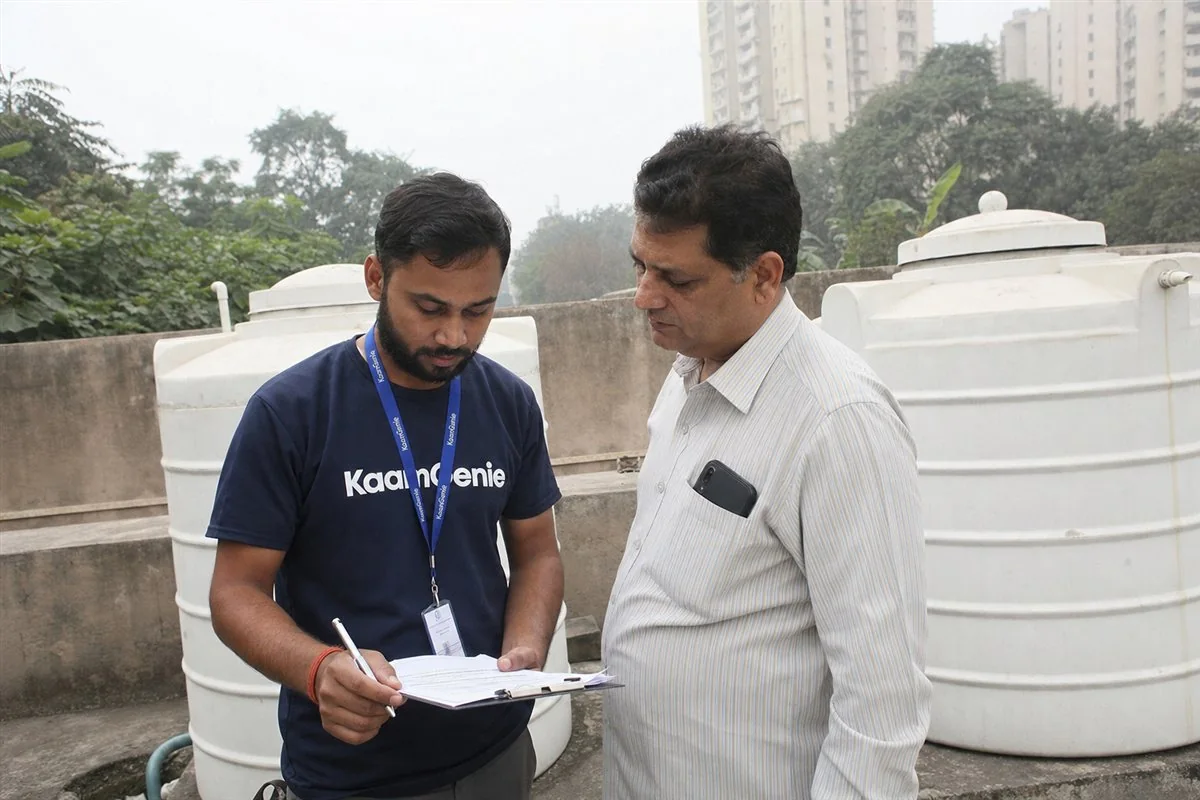
The rules in plain English
- No single statute dictates a society cleaning schedule — a stack of standards and duties does.
- BIS IS 10500:2012 sets the drinking-water quality your supply must meet; a dirty tank breaches it.
- WHO & CPHEEO best practice: clean and disinfect every 3–6 months, minimum twice a year.
- FSSAI applies to any society kitchen, cafe or banquet drawing from the common tank.
- The AOA/RWA owns the duty for common tanks, reservoirs and the distribution system.
- Keep certificates and a register — that’s your proof at an AGM, audit or complaint.
Treat “every 3–6 months, documented” as the working standard. It’s what a court, auditor or insurer would call reasonable care.
Let’s clear up the biggest misconception first. People search for “the water tank cleaning law in Noida” expecting a section number they can quote. There isn’t a UP statute that says “clean your society tank every 90 days or face a fine.” What exists instead is a framework — national drinking-water standards, public-health guidance, food-safety rules, and the general duty your Apartment Owners Association already carries under the apartment deed and bye-laws. Put together, this framework sets a clear and defensible bar, and most well-run Noida societies are already meeting it without realising it has a name.
This matters in Noida specifically because of how the city stores water. Authority-planned sectors and the Noida Expressway high-rise belt — Sectors 137, 150, 168, 75, 76, 78 and 100 — almost all run big underground reservoirs (UGRs) that feed rooftop tower tanks two or three times a day. Greater Noida West and the Noida Extension townships are heavily tanker-fed, so the inbound water quality varies. And the groundwater across the region is hard, which means scale builds inside tanks faster than people expect. The standards don’t change by city, but the cleaning frequency you need to stay inside them does.
| Standard / duty | What it covers | Does it set a cleaning schedule? |
|---|---|---|
| BIS IS 10500:2012 | Drinking-water quality limits (coliforms, turbidity, hardness, residual chlorine, TDS) | No — but a dirty tank breaches the limits |
| WHO Guidelines | Safe storage, disinfection and water-safety planning | Recommends periodic cleaning & disinfection |
| CPHEEO Manual | Govt. of India engineering manual: tank design, cleaning, disinfection | Provides cleaning & disinfection protocol |
| FSSAI | Water quality for any food business (society kitchen, cafe, banquet) | Requires potable water; certificates expected |
| UP Apartment Act + bye-laws | AOA/RWA duty to maintain common areas safely | General duty of safe maintenance |
Need a society tank-cleaning record you can table at the AGM?
Dated certificate, before/after photos, food-grade disinfection to standard. AMC contracts for AOAs and RWAs. Residential from ₹699 onwards; society & UGR custom-quoted.
The standard that really matters: BIS IS 10500
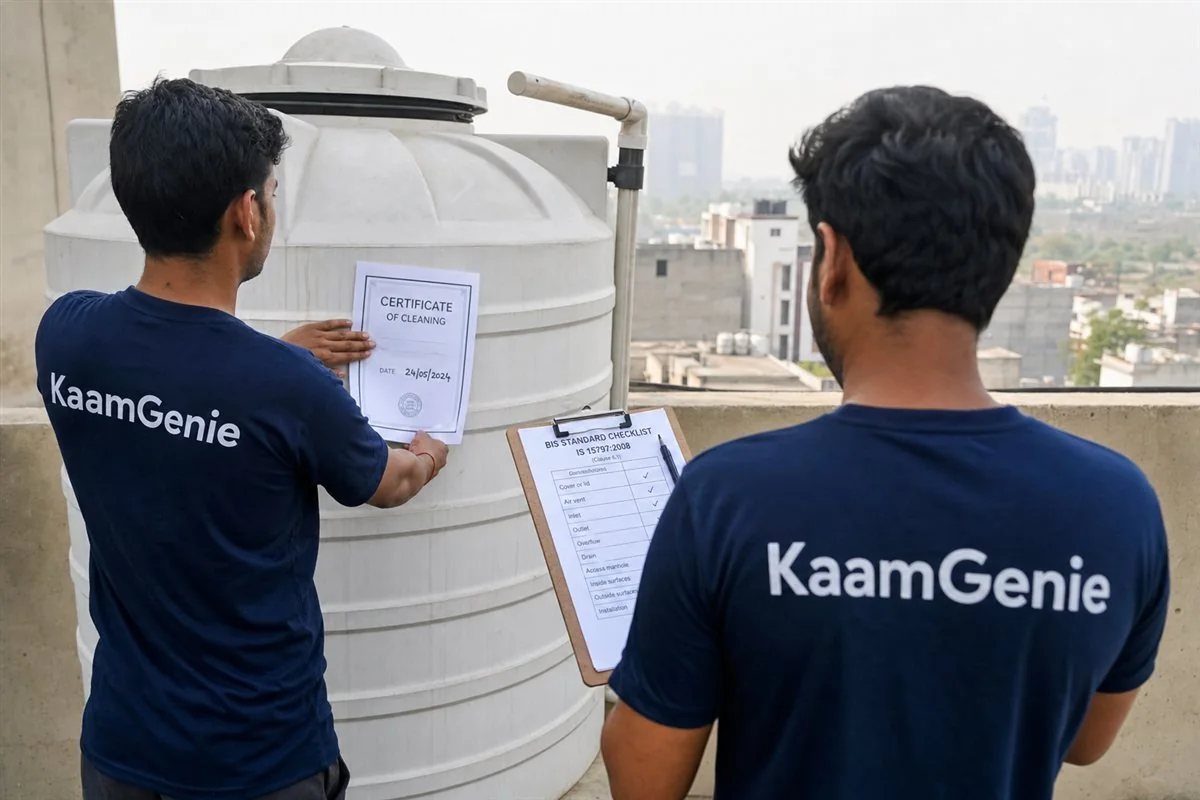
If you only learn one reference, make it IS 10500:2012, the Bureau of Indian Standards specification for drinking water. It defines what “safe to drink” means in measurable terms — acceptable and permissible limits for turbidity, total dissolved solids, total hardness, pH, residual chlorine, and the microbiological lines that matter most: total coliforms and E. coli should be absent in the supply.
IS 10500 does not contain a sentence telling you to clean your tank every quarter. The connection is indirect but unavoidable: a tank that hasn’t been opened in a year grows bio-film on its walls, collects sediment on its floor, and develops coliform counts that push the stored water outside the standard — even if the water entering the building was perfectly fine. You cannot keep society water inside IS 10500 limits without periodically cleaning and disinfecting the tanks. That is the whole logic that links a quality standard to a maintenance schedule.
How often the norms expect you to clean
The number every committee wants is the frequency, and the best-practice answer that WHO water-safety guidance and the CPHEEO manual support is every 3 to 6 months, and at a minimum twice a year. That is the band a reasonable society works within. Where you sit inside it depends on conditions — and Noida conditions tend to push toward the shorter end:
- Hard borewell groundwater across Noida and Greater Noida leaves calcium scale that builds fast — quarterly keeps it in check.
- Tanker-fed towers in Greater Noida West and Noida Extension receive variable-quality water, so the storage needs more frequent resetting.
- Large UGRs feeding rooftop tanks in the Expressway high-rise belt move a lot of water and trap a lot of sediment.
- High-footfall buildings, a clubhouse kitchen, or a recent complaint all justify a strict quarterly cycle.
We dig into the timing question in much more detail in our guide on how often to clean a water tank in Noida — if frequency is your main concern, start there. For the broader picture, the complete Noida water tank cleaning guide walks through tank types and what cleaning involves.
Recommended cleaning frequency by Noida building type
Cleanings per year that keep stored water inside IS 10500 limits
Indicative working frequencies, not a statutory schedule. All sit inside the WHO/CPHEEO best-practice band of every 3–6 months. Harder water and tanker supply push toward the upper end.
Who is actually responsible — AOA, RWA or owner?
This is where most disputes start, usually after something has already gone wrong. The principle is simple: whoever the asset belongs to carries the duty. Under the apartment deed and your society bye-laws, the underground reservoirs, the common rooftop tanks, the pumps and the distribution pipework are common areas. That makes the Apartment Owners Association or RWA responsible for cleaning and disinfecting them on schedule, and for keeping the records.
Individual owners are responsible only for tanks that exclusively serve their own flat or villa — for example a private terrace tank in a Sector 18 plotted house. Builder-floor setups are the grey zone: when four owners share one underground sump, they share the duty, and the practical fix is for whoever manages the building to arrange a single combined cleaning rather than four uncoordinated ones. The cleanest arrangement of all is an AOA-level contract that covers every common tank at once, which is exactly what we set up for societies across the IT and corporate belt around Sector 62 and the new towers in Noida Extension. There’s more on the committee-side mechanics in our piece on society water tank cleaning in Noida.
Records, certificates and the society audit
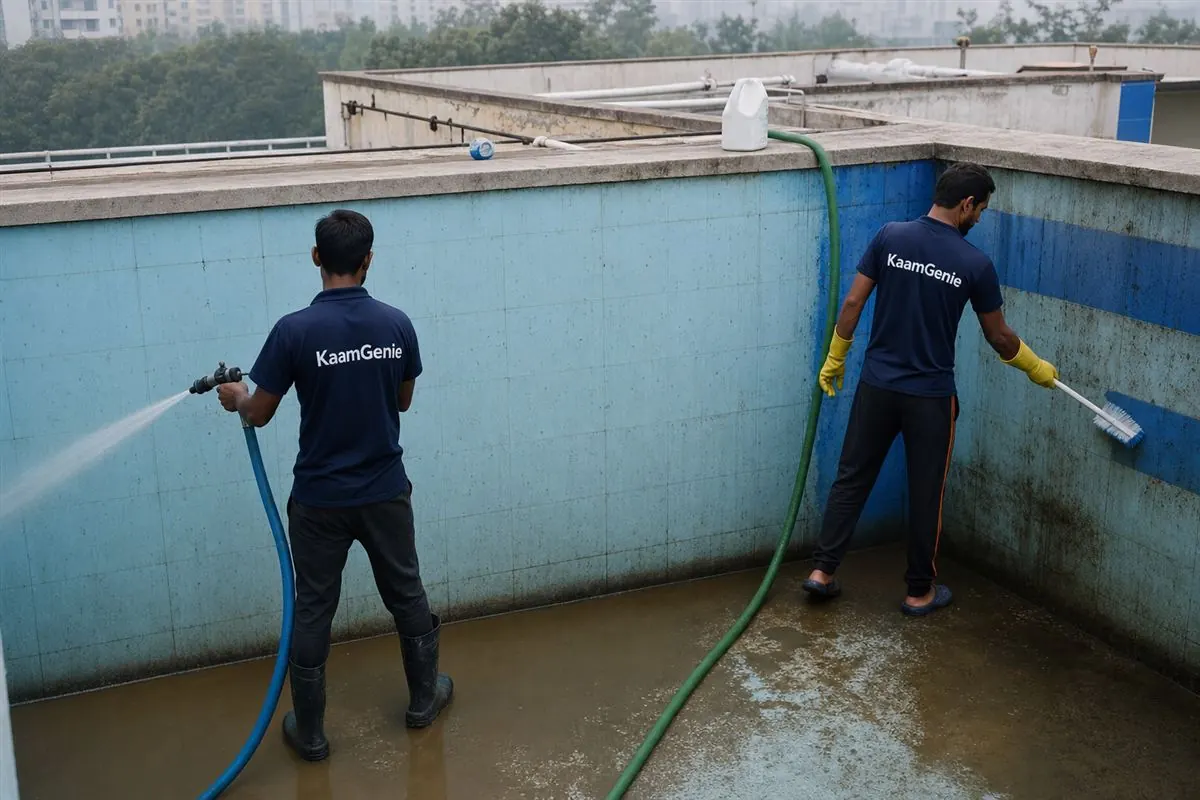
A cleaning you can’t prove may as well not have happened. The norm that matters most in practice — because it’s the one auditors and AGMs actually check — is record-keeping. For every common tank, a well-run Noida society should hold:
- A dated cleaning certificate with tank ID, capacity, date and time, the disinfectant and concentration used, and the technician’s name and signature.
- Before-and-after photos attached to that certificate.
- A running tank-cleaning register for the whole year, so the schedule is visible at a glance.
- Where a kitchen or commercial unit is involved, a post-cleaning water test against IS 10500 parameters.
These documents do real work. They go in front of the AGM when a resident asks what the maintenance fund paid for. They satisfy the facility audit, where the tank-cleaning register is now a standard line item. They complete the FSSAI file for any on-site kitchen. And if a water-quality complaint ever lands, they are the evidence that the association exercised reasonable care. The disinfection itself should use food-grade sodium hypochlorite dosed so surfaces sit in the 50–100 PPM range with proper contact time before rinsing — consistent with WHO and CPHEEO guidance and FSSAI-acceptable. Industrial bleach or pool chlorine has no place in a drinking-water tank. If your society also runs a kitchen or cafe, our note on FSSAI water tank cleaning in Noida covers the food-safety angle in full.
Putting it together: a compliant cycle for a Noida society
Strip away the jargon and a defensible programme looks like this. Set a fixed quarterly cleaning date for all common tanks — UGRs and rooftop tower tanks together — using a single contractor so the records are consistent. Use only food-grade disinfectant at the correct dose and contact time. Collect a dated certificate with photos after every visit and file it in a year-long register. Where a clubhouse kitchen exists, add a post-clean water test. Table the schedule and the register at every AGM, and fold the whole thing into an AMC so it runs on autopilot rather than depending on someone remembering. That is the standard of care the norms expect — nothing exotic, just done on time and written down.
None of this requires a law to force it, and waiting for one would miss the point. The standards already exist, the duty already sits with the AOA, and the residents already expect clean water. You can arrange all of it as part of professional water tank cleaning in Noida, and if you manage tanks across NCR our water tank cleaning services page covers the wider network. Get the schedule, the chemistry and the paperwork right, and the question at the next AGM answers itself.
Set your society on a compliant schedule
Quarterly AMC for all common tanks, food-grade disinfection, certificates and register included. We handle UGRs and tower tanks together across Noida & Greater Noida.
Book a society cleaning that meets the standard in Noida
If your AOA or RWA wants its common tanks brought onto a compliant, documented schedule, that’s exactly what we do across the city. See coverage, tank types and how a society contract works on our water tank cleaning in Noida hub — one trained crew, food-grade disinfection, certificate and register every visit.
To book, call +91 95603 66362 or use the booking form on this site — we’ll confirm shortly.
Frequently asked questions
Is there a legal rule that forces a Noida society to clean its tanks?
There is no single Uttar Pradesh statute that says “clean your tank every X months” for a housing society. What governs you is a stack of standards and duties: BIS IS 10500:2012 sets the drinking-water quality your supply must meet, the UP Apartment Act and your society bye-laws put a general duty of safe maintenance on the AOA, and FSSAI rules bite if any commercial kitchen draws from the tank. In practice societies treat the WHO/CPHEEO best-practice frequency — every 3 to 6 months — as the working standard, because that is what a court, an auditor, or an insurer would consider reasonable care.
How often should a Noida society clean its water tanks?
The widely accepted best-practice frequency is every 3 to 6 months, and at minimum twice a year. Noida and Greater Noida West conditions push most societies toward the 3-month end: hard borewell groundwater leaves heavy scale, large underground reservoirs feeding rooftop tanks trap sediment, and tanker-fed Noida Extension towers receive variable-quality water. High footfall buildings, those with a commercial kitchen, and any tank that recently had a contamination complaint should clean quarterly.
What does BIS IS 10500 actually require?
IS 10500:2012 is the Indian Standard for drinking-water specification. It sets acceptable and permissible limits for parameters such as turbidity, total dissolved solids, hardness, pH, residual chlorine, E. coli and total coliforms. It does not prescribe a cleaning schedule. The link to cleaning is indirect but firm: a dirty tank causes coliform growth, turbidity and sediment that breach IS 10500 limits, so keeping water inside the standard is impossible without periodic tank cleaning and disinfection.
Whose responsibility is tank cleaning — the AOA, the RWA, or individual owners?
For shared infrastructure — underground reservoirs, common rooftop tanks, the pumping and distribution system — the Apartment Owners Association or RWA is responsible, because these are common areas under the apartment deed and bye-laws. Individual owners are responsible only for tanks that exclusively serve their own flat or villa. In builder-floor setups with a shared sump, the owners who share that sump split the duty, usually coordinated by whoever manages the building. The cleanest arrangement is an AOA-level contract covering all common tanks.
What records or certificates should a society keep after cleaning?
Keep a dated cleaning certificate for every tank that records: tank ID and capacity, date and time, the disinfectant and concentration used, before-and-after photos, and the technician’s name and signature. Maintain a running tank-cleaning register across the year, and where required a post-cleaning water test report against IS 10500 parameters. These documents are what you produce at an AGM, during a society audit, for an FSSAI inspection of an on-site kitchen, or if a resident raises a water-quality complaint.
What disinfectant and dose are considered acceptable to standard?
Food-grade sodium hypochlorite is the standard disinfectant for potable water tanks, applied so that surfaces are dosed in the 50–100 PPM range with adequate contact time, then rinsed. This aligns with WHO and CPHEEO disinfection guidance and is FSSAI-acceptable for water that touches food preparation. Industrial bleach, pool chlorine or hardware-shop chemicals are not appropriate for drinking-water tanks because they can carry additives and contaminants that IS 10500 does not allow.
Does a society audit or AGM check tank cleaning?
Increasingly yes. Managing committees in Noida high-rises now table the maintenance and AMC schedule at the AGM, and a tank-cleaning register is a standard line item in the society’s facility audit. Auditors look for evidence that common tanks were cleaned on schedule, that certificates exist, and that a contract or AMC is in place. A society that cannot show these records is exposed if a waterborne-illness complaint ever arises among residents.
Do FSSAI rules apply to a residential society tank?
FSSAI rules apply to the water used by any food business — so if your society has a commercial kitchen, a cafe, a banquet, or a club restaurant drawing from the common tank, that water must meet FSSAI’s potable-water requirement, which references IS 10500. For purely residential supply FSSAI is not the governing body, but the same hygiene logic applies. Many Noida societies with a clubhouse kitchen keep tank-cleaning certificates specifically so the kitchen’s FSSAI file is complete.
What happens if a society ignores these norms?
Beyond the health risk to residents, the AOA carries the exposure. If contaminated common-tank water causes illness, the association can face complaints under consumer and tort principles for failing its duty of safe maintenance, and office-bearers can be personally questioned for negligence. There is also reputational and resale impact — buyers and tenants in Noida increasingly ask about water management. Documented, scheduled cleaning is the cheapest insurance against all of this.
Sources & references
- Bureau of Indian Standards (BIS) — IS 10500:2012 is the canonical Indian Standard for drinking water specification, defining acceptable limits for physical, chemical, and biological parameters.
- WHO Guidelines for Drinking-water Quality, 4th edition — the global reference for water quality standards, including guidance on storage and disinfection.
- Food Safety and Standards Authority of India (FSSAI) — defines water quality requirements for food businesses, including hygiene standards for stored water and acceptable disinfection chemicals.
- WHO Fact Sheet on Drinking Water — overview of safe drinking water requirements and contamination risks.
- CPHEEO — Manual on Water Supply and Treatment — the Government of India’s engineering manual covering tank design, cleaning protocols, and disinfection practices.
Last verified: 30 June 2026. If you find any of these links broken, please let us know.