
Key takeaways
- West Delhi’s tail-end DJB pressure pushes homes to over-store, leaving water stagnant and unsafe.
- Borewells in Uttam Nagar and Najafgarh add iron, grit and hardness that need a descaling wash.
- Shared-riser builder floors should coordinate one visit and clean every tank together.
- Home tanks from ₹699; sumps ₹1,500–2,500; multi-floor buildings quoted on site; AMC saves 15–25%.
- Clean every 3 months on borewell supply and always after the monsoon.
This guide focuses on the realities of West Delhi plumbing: low-pressure tail-end supply, borewell dependence in unauthorised colonies, tightly stacked builder floors sharing risers, and dust ingress through poorly fitted lids. We explain how tanks foul here, what a genuine mechanised clean covers, how much it costs, and how to schedule it for a home or a whole apartment block. Local water tank cleaning pages are linked so you can book straight for your area.
Tail-end DJB pressure and why you over-store
Much of West Delhi sits at the far end of DJB distribution lines, so water arrives late, weak and for a short window. The natural response is to store as much as possible in a big underground sump and pump it up. But over-storing means water sits stagnant for a day or more, warming in the tank and losing any residual chlorine — ideal conditions for bacteria and algae. The fix is not a bigger tank; it is a clean tank on a regular cycle plus a tight-fitting, insect-proof lid. Homes in Janakpuri and Vikaspuri especially benefit from scheduled cleaning rather than reacting to a smell.
Borewells and dust in the unauthorised colonies
In Uttam Nagar, Mohan Garden, Dabri and parts of Najafgarh, borewells still fill the gap when DJB runs dry. That groundwater carries grit, iron and hardness that settle as a gritty, rust-tinged sludge at the bottom of the sump. West Delhi’s constant construction and road dust make it worse, coating tank walls whenever a lid is left ajar. Watch for these warning signs:
- Reddish or brown staining in the tank or on white bathroom fittings.
- Fine grit collecting in the aerator of your taps.
- A metallic taste that appears a day after the tank is filled.
Builder floors and shared risers
West Delhi is full of independent builder floors — three or four flats stacked on one plot in Rajouri Garden, Tilak Nagar or Hari Nagar. Often one shared sump feeds separate overhead tanks per floor, so if only the top-floor owner ever cleans, the others drink from neglected tanks. The smart move is a single coordinated clean where every tank on the plot is done in one visit and the cost split. It is cheaper per tank, and it means no one floor is left with a fouled supply. We are happy to quote the whole building at once.
Book your water tank cleaning
Trained crew, food-grade process, before/after photos and a service record every job. ₹699 onwards, same-day where possible across Delhi NCR.
What a genuine clean includes
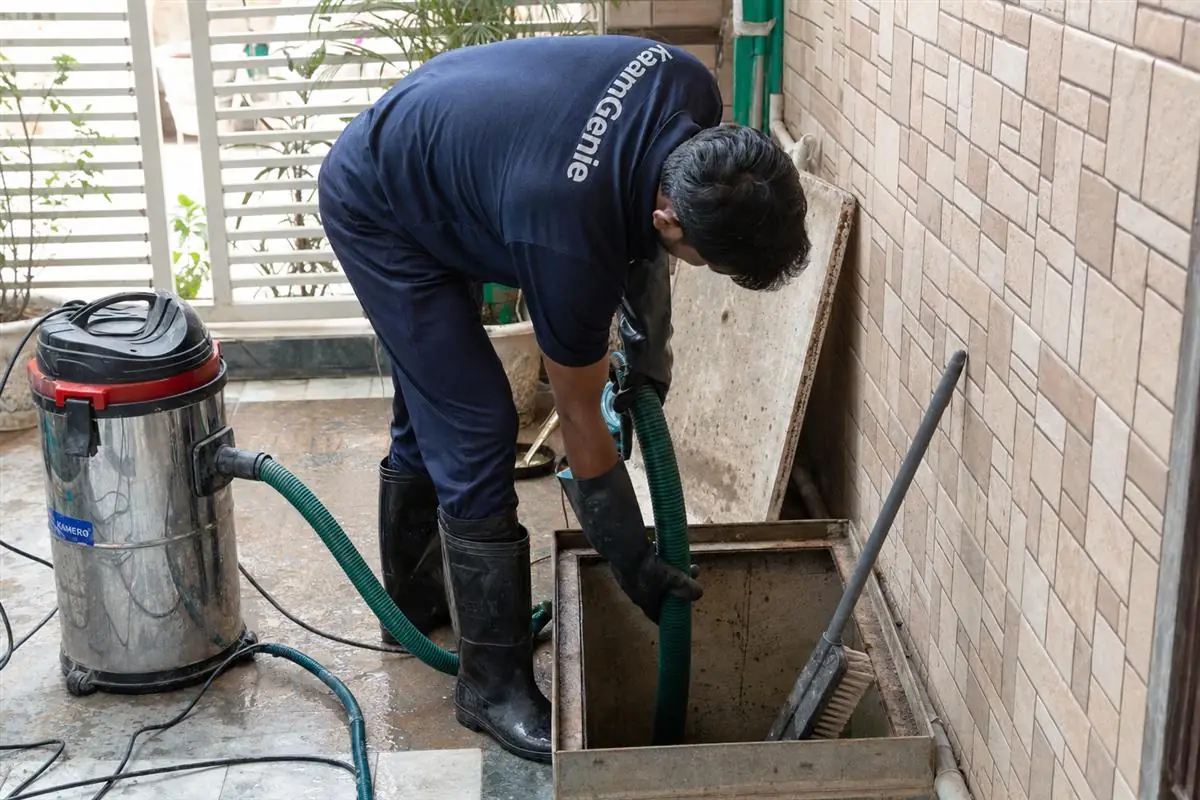
Skip anyone who quotes a price without asking your tank size. A proper West Delhi clean means draining the tank, vacuuming out settled grit and sludge with a dewatering pump, mechanically scrubbing walls and floor, applying a food-grade anti-bacterial and anti-fungal treatment, high-pressure rinsing, then fog or UV sanitising before refill. For borewell-fed homes we add a descaling wash to lift iron and calcium crust. The job runs 45–90 minutes for a home tank. You should receive before-and-after photos every time — that is your proof the sludge actually came out and was not just stirred around.
West Delhi pricing and AMC
Costs track tank size, sludge load and access. A single home overhead tank starts from ₹699; an underground sump is ₹1,500–2,500 by capacity; and multi-floor buildings or societies are quoted after a quick look because of shared risers and several tanks. If your borewell water is heavy with iron and grit, expect the sump to sit at the upper end. An annual maintenance contract knocks 15–25% off each visit and keeps you on a fixed calendar so no clean is forgotten. For a firm quote in your block, call 95603 66362.
Scheduling and booking in your area
For West Delhi we suggest cleaning every three months for borewell-fed homes given the grit load, and twice a year for mostly-DJB supply, with a mandatory post-monsoon clean to clear washed-in silt. Book by picking your area page — for example Uttam Nagar, Paschim Vihar or Punjabi Bagh — or call and we will slot a crew into your supply-off window. For builder floors, coordinate all owners so we do every tank in one efficient visit.
Frequently asked questions
Why does my West Delhi tank empty so slowly and smell?
You are likely on a tail-end DJB line, so water arrives weak and you over-store it. Water then sits for a day or more, warms up and loses chlorine, which lets bacteria and algae grow and cause the smell. A scheduled clean plus a tight insect-proof lid fixes it far better than buying a bigger tank.
My borewell water leaves rust stains — can cleaning help?
Yes. Reddish staining means iron and grit are settling in your sump, common in Uttam Nagar, Mohan Garden and Najafgarh. We drain and vacuum the sludge, then apply a descaling wash to lift the iron and calcium crust off the walls and pump inlet. Pairing this with an inlet filter keeps future grit out.
We have four flats on one builder plot — how should we clean?
Coordinate a single visit. Most West Delhi builder floors share one sump but have separate overhead tanks per flat, so we clean every tank in one trip and split the cost. It is cheaper per tank than each owner booking alone, and it ensures no floor is left drinking from a neglected tank.
What does it cost in West Delhi?
A single home overhead tank starts from ₹699, and an underground sump is ₹1,500–2,500 depending on size and sludge. Multi-floor buildings and societies are quoted after a quick site look. Heavy iron and grit push the sump toward the upper end. An AMC cuts 15–25% per visit. Call 95603 66362 for a firm price.
How often should West Delhi homes clean their tanks?
Every three months for borewell-fed homes because of the grit load, and twice a year for mostly-DJB supply. Always add a clean right after the monsoon to clear washed-in silt and dust. If anyone in the home is very young, elderly or unwell, stick to the shorter cycle for safety.
We are on a builder floor in Uttam Nagar — can each flat book separately?
If your floor has its own tank, yes — you can book just for your flat. If all four floors share one overhead tank and sump, it is cheaper and cleaner to book together so the whole shared store is done at once. Tell us your plumbing setup and we will advise the sensible split.
Does the rust from borewell water stain my tank permanently?
The orange iron deposits usually scrub off with mechanised cleaning, so the tank comes up clean rather than stained for good. Very old tanks may keep a faint tint in the plastic, but the loose rust that discolours your water and clothes is removed. Regular six-monthly cleans stop it building back up.
Can you come same-day in West Delhi if our water suddenly smells bad?
We often manage same-day or next-day slots across West Delhi. A sudden smell usually means biofilm or a dead insect in the tank, and the sooner we clean and disinfect, the sooner it clears. Call 95603 66362, describe the problem, and we will fit you into the earliest available crew run.
Do you also clean the underground sump, or just the overhead tank?
Both, and we recommend it. In West Delhi builder plots the sump fills first from the DJB line and collects the most silt, then pumps that up to the overhead tanks. Cleaning only the roof tank leaves the source dirty, so we clean the sump, the line and the overhead store together.
Is an AMC worth it for a small West Delhi household?
For a single home two paid cleans a year may be simpler than a contract. An AMC makes more sense for builder floors, shops with staff, or anyone who forgets to schedule — it locks in the six-monthly visits and usually a better rate. We are happy to price both so you can choose.
Sources & references
- Bureau of Indian Standards (BIS) — IS 10500:2012 is the canonical Indian Standard for drinking water specification, defining acceptable limits for physical, chemical and biological parameters.
- WHO Guidelines for Drinking-water Quality, 4th edition — the global reference for water quality standards, including guidance on safe storage and disinfection.
- Food Safety and Standards Authority of India (FSSAI) — defines water quality requirements for food businesses, including hygiene standards for stored water and acceptable disinfection chemicals.
- WHO Fact Sheet on Drinking Water — overview of safe drinking water requirements and contamination risks.
- CPHEEO — Manual on Water Supply and Treatment — the Government of India’s engineering manual covering tank design, cleaning protocols and disinfection practices.
Last verified: 6 July 2026. If you find any of these links broken, please let us know.