
Key takeaways
- East Delhi’s humid Yamuna-belt air makes biofilm and algae grow fast in still tank water.
- Society terrace tanks feed whole blocks — they need a fixed RWA cleaning calendar, not complaint-driven cleaning.
- A post-monsoon clean is the most important one of the year for washed-in silt.
- Shared-sump builder floors should clean the common sump and all tanks in one coordinated visit.
- Home tanks from ₹699; sumps ₹1,500–2,500; society tanks quoted on site; AMC saves 15–25%.
This guide is tailored to East Delhi living: common society tanks, humid Yamuna-belt conditions that speed up algae growth, monsoon silt, and packed builder floors sharing one sump. We walk through why tanks foul here, what an honest mechanised clean covers, what it costs, and how RWAs should run an annual schedule. Area water tank cleaning pages are linked so you can book straight for your colony or block.
Yamuna-belt humidity and fast biofilm growth
East Delhi’s low, humid riverine air is a gift to algae and biofilm. Warm, still water in a rooftop tank with even a small light leak through a cracked lid will turn green within weeks. In tightly built colonies like Laxmi Nagar and Krishna Nagar, tanks also sit close to kitchen exhausts and open drains, adding organic load. The tell-tale signs are a slippery inner wall, a faint swampy odour, or mosquito larvae wriggling on the surface. None of that clears with a rinse — it needs draining, mechanical scrubbing and a proper anti-fungal sanitising cycle, plus a snug lid to cut the light and insects that started it.
Society terrace tanks in Mayur Vihar and IP Extension
A huge share of East Delhi lives in group housing where one or two big terrace tanks feed an entire block. That is efficient but risky — if the common tank is neglected, hundreds of flats drink from it. Societies in Mayur Vihar, IP Extension and Patparganj should run a fixed maintenance calendar, not clean only when residents complain. For large capacities we schedule the clean around the society’s supply-off window, use confined-space safety protocols, and give the RWA dated before-and-after photos plus a service record for their files. That paperwork matters at AGM time and for handover audits.
Monsoon silt and post-rain cleaning
When the monsoon hits East Delhi, rooftop dust, leaves and silt wash straight into any tank with a poorly sealed lid or open overflow. Low-lying trans-Yamuna pockets can also see groundwater and drainage issues that stir up sediment. The result is a gritty layer at the tank bottom and cloudy water for days. A post-monsoon clean is the single most valuable one of the year. Quick checklist after heavy rain:
- Check the tank lid gasket and overflow mesh for gaps.
- Look for cloudiness or grit in the first drawn water of the day.
- Book a de-sludge and sanitise if you spot either.
Book your water tank cleaning
Trained crew, food-grade process, before/after photos and a service record every job. ₹699 onwards, same-day where possible across Delhi NCR.
Builder floors and old houses sharing a sump
Like much of the trans-Yamuna area, colonies such as Shakarpur, Geeta Colony and Preet Vihar are full of independent houses and stacked builder floors on one plot, usually sharing a single underground sump. If only one floor ever arranges cleaning, the shared sump still feeds everyone the same sludge. The efficient answer is one coordinated visit that covers the common sump and every floor’s overhead tank together, with the cost split. It is cheaper per tank and guarantees no household is left on a fouled supply. We quote the whole plot in one go on request.
What a proper East Delhi clean covers
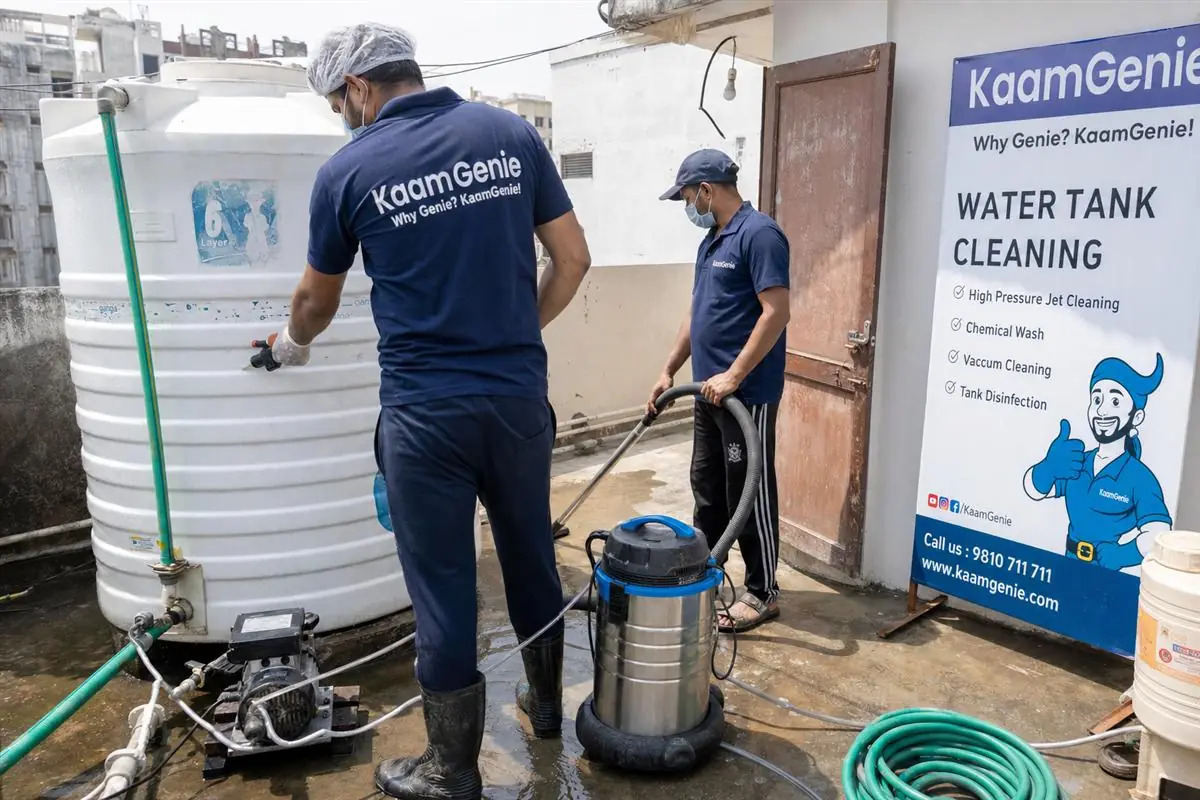
An honest clean is a full mechanised cycle, not a hose-down. We drain the tank, vacuum out settled silt and sludge with a dewatering pump, scrub walls and floor mechanically, apply a food-grade anti-bacterial and anti-fungal solution, high-pressure rinse, then fog or UV sanitise before refilling. Given East Delhi’s humidity, the anti-fungal step is doubly important to slow algae’s return. A home tank takes 45–90 minutes; a large society tank takes longer and is planned around supply timing. Insist on before-and-after photos and a look at the drained sludge as your proof of a real clean.
Costs, schedule and booking
Home overhead tanks start from ₹699, sumps run ₹1,500–2,500 by capacity, and society terrace tanks are quoted on site because of size and access. An annual maintenance contract — ideal for RWAs — saves 15–25% per visit and keeps a fixed calendar. For East Delhi we advise cleaning twice a year for DJB homes, quarterly for anyone on borewell top-up, and always once after the monsoon. Book via your area page such as Anand Vihar or Nirman Vihar, or call 95603 66362.
Frequently asked questions
Why does my East Delhi tank turn green so quickly?
The humid Yamuna-belt climate plus warm, still stored water is ideal for algae. Even a small light leak through a cracked lid lets it bloom within weeks, especially in dense colonies like Laxmi Nagar. Draining, mechanical scrubbing and an anti-fungal sanitising cycle clears it, and a snug lid that blocks light stops it coming back fast.
Who arranges cleaning for a society terrace tank?
The RWA or managing committee should. One or two big terrace tanks feed an entire block, so a single neglected tank affects hundreds of flats. We schedule around the society’s supply-off window, follow confined-space safety, and hand over dated before-and-after photos and a service record for AGM and audit files. A fixed annual calendar works best.
Is a post-monsoon clean really necessary?
Yes — it is the most valuable clean of the year in East Delhi. Rain washes rooftop dust, leaves and silt into tanks through loose lids and open overflows, and low-lying trans-Yamuna pockets stir up extra sediment. If your first drawn water looks cloudy or gritty after heavy rain, book a de-sludge and sanitise straight away.
We share one sump across builder floors — what should we do?
Clean it together in one visit. A shared underground sump feeds every floor, so if only one owner cleans, everyone still drinks the same sludge. We cover the common sump plus each floor’s overhead tank in a single trip and split the cost, which is cheaper per tank and leaves no household on a fouled supply.
What does water tank cleaning cost in East Delhi?
A single home overhead tank starts from ₹699 and an underground sump runs ₹1,500–2,500 depending on capacity. Society terrace tanks are quoted on site because of their size and access. An annual maintenance contract saves 15–25% per visit and suits RWAs best. Call 95603 66362 for a quote for your block.
How do I stop my East Delhi tank turning green again so fast?
Green means algae, which thrives on light and warmth in the humid Yamuna belt. After we clean and disinfect, keep the tank lid sealed and cover any translucent tank so sunlight cannot reach the water. Pair that with a six-monthly clean and the green regrowth slows dramatically instead of returning within weeks.
Can you clean tanks in a Mayur Vihar high-rise with rooftop access rules?
Yes. We regularly work in Mayur Vihar and IP Extension societies where the terrace needs a guard or maintenance escort. Just have your society approve our crew’s entry in advance — we are police-verified and can share IDs — and we bring our own pumps so we do not depend on building equipment.
Who pays when a builder-floor sump is shared across owners?
The usual practice is to split the cleaning cost between the flats that draw from the shared sump, since everyone benefits. One owner can book and coordinate, and we give a single service record everyone can see. Tell us how many floors share the sump and we will quote the combined job clearly.
Is the same-day water safe to drink after an East Delhi clean?
After we disinfect with food-grade chlorine and flush the tank, water is safe for washing and cooking the same day. For drinking straight from the tap we suggest letting the residual settle a few hours or using your usual RO. We can tell your crew to flush longer if you want it drink-ready sooner.
How long does a typical East Delhi flat tank take to clean?
A single overhead flat tank is usually done in about an hour to ninety minutes, including draining, scrubbing, disinfecting and refilling. A shared sump plus overhead tanks takes longer. Either way we finish and reconnect the same visit, so you are rarely without water for more than a short window.
Sources & references
- Bureau of Indian Standards (BIS) — IS 10500:2012 is the canonical Indian Standard for drinking water specification, defining acceptable limits for physical, chemical and biological parameters.
- WHO Guidelines for Drinking-water Quality, 4th edition — the global reference for water quality standards, including guidance on safe storage and disinfection.
- Food Safety and Standards Authority of India (FSSAI) — defines water quality requirements for food businesses, including hygiene standards for stored water and acceptable disinfection chemicals.
- WHO Fact Sheet on Drinking Water — overview of safe drinking water requirements and contamination risks.
- CPHEEO — Manual on Water Supply and Treatment — the Government of India’s engineering manual covering tank design, cleaning protocols and disinfection practices.
Last verified: 6 July 2026. If you find any of these links broken, please let us know.