
The short version
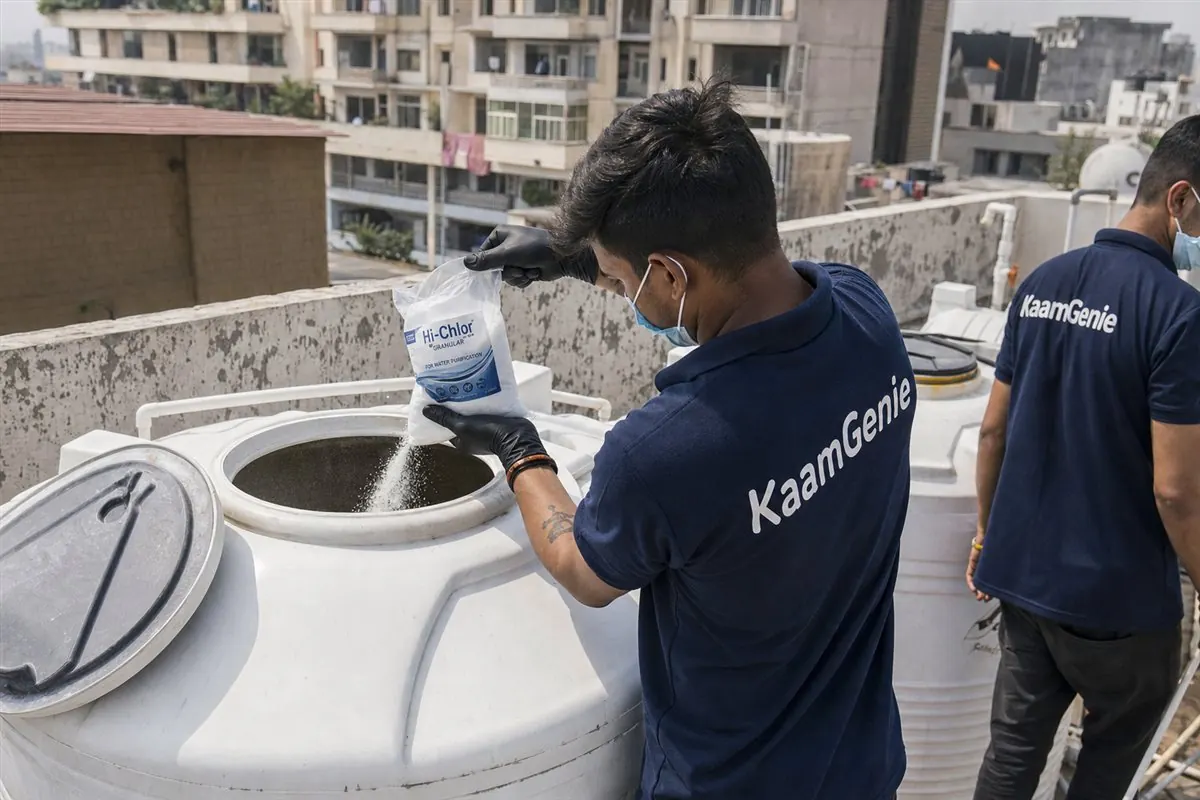
- Cleaning removes dirt; disinfection kills germs. A clean-looking tank can still carry bacteria and biofilm on the walls.
- Food-grade chlorine (sodium hypochlorite) is the standard — the same compound municipal water uses, FSSAI-acceptable, and it leaves a protective residual.
- Dose and contact time are everything. Chlorine has to be measured against tank volume and given time to work, then drained and rinsed.
- Gurgaon’s hard borewell water and tanker top-ups make disinfection more important, not less — scale and sediment shelter bacteria.
- UV and ozone don’t protect a storage tank — they leave no residual. They belong at your RO, not in the tank.
If your cleaner finished the job without a measured disinfection step and a written record, you paid for a wash, not a safe tank.
Most people in Gurgaon think of a tank cleaning as the scrubbing — the crew goes in, the walls get a wash, the sludge comes out, done. That part matters, and we have written the full eight-step water tank cleaning walkthrough for Gurgaon elsewhere. But the step that decides whether your water is actually safe to drink is the last one: disinfection. Skip it, or do it badly, and everything before it was just housekeeping.
This matters more in Gurgaon than almost anywhere in the NCR. The Millennium City runs on a mix of hard borewell groundwater, large underground reservoirs (UGRs) feeding rooftop tower tanks, and a heavy reliance on water tankers across the Sohna Road, Southern Peripheral Road (SPR) and Dwarka Expressway belts. Tanker water is convenient, but every fill is a fresh introduction of whatever was in the source and the tanker. That is exactly the kind of stored water that needs reliable disinfection.
Why disinfection is the step that actually makes water safe
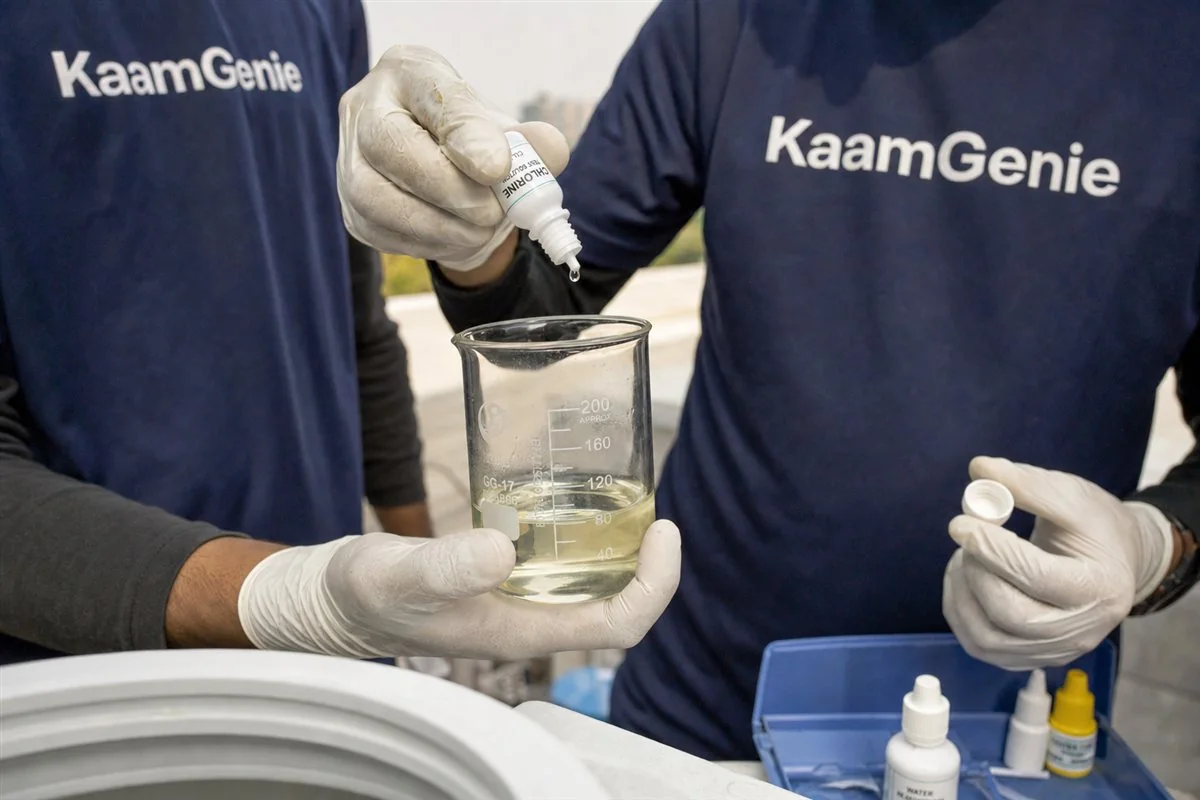
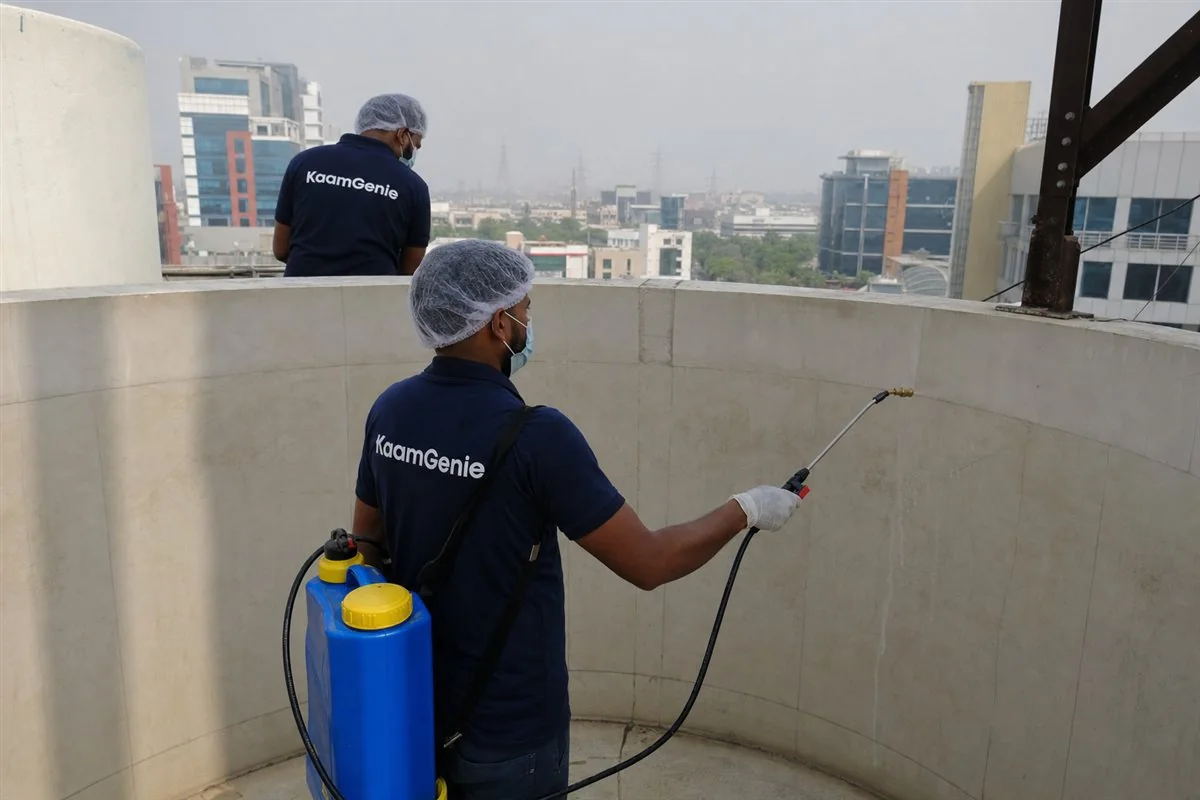
Scrubbing and jet washing are mechanical. They lift sludge, mineral scale and the slimy biofilm that grows on tank walls. But mechanical cleaning cannot guarantee that every last bacterium is gone — biofilm clings into the pores of concrete reservoirs and the micro-scratches in old plastic tanks, and a film you cannot see can still be alive. Disinfection is the chemical kill step that finishes the job: it inactivates E. coli, Salmonella, Legionella and the other organisms behind stomach upsets, typhoid risk and skin trouble.
The order is not optional. You clean first, then disinfect. Pour chlorine onto a layer of sludge and the chlorine gets consumed fighting the dirt — what cleaners call “chlorine demand” — long before it reaches the bacteria. That is why a proper job descales and scrubs first, then disinfects a surface that is already physically clean. A disinfection-only “treatment” on a dirty tank is theatre.
| Method | How it works | Leaves a residual? | Right for a tank? |
|---|---|---|---|
| Food-grade chlorine (sodium hypochlorite) | Oxidises and kills bacteria on surfaces and in water | Yes — protective residual | Yes — the standard |
| Hydrogen peroxide (food-grade) | Strong oxidiser, breaks down to water and oxygen | Minimal / short-lived | Sometimes — premium jobs |
| UV light | Inactivates organisms as water passes the lamp | No | At point of use, not in tank |
| Ozone | Powerful oxidiser injected into a flow | No — dissipates fast | Treatment loop, not storage |
| Industrial / pool bleach | Chlorine plus additives | Yes, but with contaminants | No — not potable-safe |
Book a clean-and-disinfect, done properly
Scrub, descale, measured food-grade chlorination with real contact time, before/after photos and a certificate. ₹699 onwards for homes; societies and UGRs quoted on site.
Why food-grade chlorine, and not the bleach from the hardware shop
The disinfectant we use is food-grade sodium hypochlorite. It is the same chlorine compound that municipal utilities dose into the public supply, and the form the Food Safety and Standards Authority of India (FSSAI) accepts for potable water systems. It is reliable, it is affordable, and crucially it leaves a measurable residual — a small amount of active chlorine that stays in the water and keeps protecting it after we leave.
What we never use is the chlorine bleach sold in hardware shops, or pool chlorine. Those products are formulated for floors and swimming pools, and they often carry fragrances, stabilisers or trace heavy-metal contaminants that are fine in a pool and unacceptable in your drinking water. Food-grade product costs more, and that gap is one of the reasons a serious clean-and-disinfect cannot be done for the ₹200 price a corner-cutter quotes. If you want the honest math on that, our Gurgaon cost guide breaks it down.
Dose, contact time and a safe residual
Two numbers decide whether disinfection works: the dose and the contact time. Neither can be guessed.
The dose is measured against the tank’s volume. For shock disinfection of a freshly cleaned tank, public-health manuals such as the CPHEEO Manual on Water Supply and Treatment and WHO guidance describe applying a high chlorine concentration, holding it for a set period, then draining and refilling so the water you actually drink carries only a low residual. We are deliberately not publishing a fixed recipe here, because the right figure depends on tank volume, material and condition — and a number copied off a blog and poured by eye is how people either under-dose (no kill) or over-dose (undrinkable for days). Our crew calculates it on site.
The contact time is the part most people never see and cheap operators always cut. Chlorine is not instant; it needs time on the surface to inactivate organisms. We apply the disinfectant across every interior surface — walls, floor, lid underside, inlet and outlet zones — and let it dwell before draining and rinsing. Cut that dwell short and you have spent on the right chemical and still failed the job.
The target afterwards is a gentle, safe residual. BIS IS 10500:2012 specifies a minimum free residual chlorine of around 0.2 mg/L at the consumer tap, and WHO gives broadly similar guidance for the point of delivery. So the logic is simple: a strong dose during the contact window to sterilise the tank, then a flush and refill that leaves only that small, protective trace in the water you drink.
Gurgaon’s hard water and tanker supply change the math
Gurgaon’s groundwater is hard. That hardness leaves mineral scale on tank walls, and scale is not just cosmetic — its rough, porous surface is where biofilm anchors and hides from a quick rinse. A tank fed by hard borewell water in a DLF colony or a Sohna Road high-rise builds up far more of this lining than a tank on soft municipal supply, which is why our hard-water tank cleaning approach for Gurgaon puts descaling ahead of disinfection. Chlorine cannot reach bacteria sheltered under scale, so the scale has to go first.
Then there is the tanker factor. Across the SPR, Golf Course Extension and Dwarka Expressway new-tower belts, a large share of supply arrives by tanker into basement UGRs and is pumped up to rooftop tower tanks. Every tanker fill reintroduces sediment and organisms, and a big reservoir that is topped up constantly never gets the chance to sit clean. That combination — hard water that builds scale, plus frequent tanker top-ups that reload the contamination — is exactly why Gurgaon tanks benefit from disciplined, scheduled disinfection rather than a once-in-a-blue-moon wash.
Where the disinfection result is won or lost
Relative weight of each factor in whether a tank ends up genuinely safe
Illustrative weighting, not measured percentages — the point is that no single step carries the job. Skip the cleaning and chlorine gets consumed by dirt; skip the contact time and the right chemical still fails.
UV, ozone and why they don’t replace tank chlorination
People who have a UV or RO system at home often ask why their tank needs chlorine at all. The answer is residual. UV light and ozone are genuinely powerful — they inactivate organisms as water flows past the lamp or through the ozone contactor. But the protection ends the instant the water moves on. They leave nothing behind. Put UV-treated water into a storage tank and let a tanker top it up overnight, and there is no residual disinfectant guarding that stored water until morning.
Chlorine is the standard for tanks precisely because it lingers. It keeps a small protective presence in the stored water between cleanings. So the right way to think about it is not UV versus chlorine, but UV and chlorine: chlorine protects the tank, UV polishes the water at your kitchen tap. If you want the longer comparison, we cover it in tank cleaning versus a water purifier. For most Gurgaon homes the honest answer is that you need both.
When a tank needs re-chlorination, not a full clean
Not every disinfection requires the full strip-down. Re-chlorination — a disinfection top-up on an otherwise recently cleaned tank — is the right call after a specific contamination event: monsoon water getting in through a bad lid, a dead bird or rodent found in the tank, a suspected sewage cross-connection, or a society reservoir that failed a water test but was thoroughly cleaned only weeks earlier. In those cases the surfaces are still physically clean, so a fresh chlorination restores safety without redoing everything.
The catch: re-chlorination only works if the tank is already clean. If there is visible sludge, scale or biofilm, chlorine demand will swallow the dose and you are back to needing a full clean first. When you call us, describe what happened and we will tell you honestly which one you need — a quick re-chlorination or the complete job. We would rather quote the smaller service when that is all the tank requires.
What “safe after disinfection” actually means for your taps
Once we have held the contact dose, drained it, rinsed the tank and refilled with fresh water, the residual drops to that small safe level quickly. Water for washing, cleaning and bathing is usable almost straight away. For drinking, give the new fill a couple of hours and run it through your RO or UV as you normally would. A faint chlorine smell on the first day is normal and expected — that is the residual doing its protective work, and it fades within hours. If you ever get a strong, lingering chlorine taste, that points to over-dosing by whoever did the job, which is exactly the risk of pouring by eye instead of measuring.
For societies and commercial kitchens, the disinfection is also a paperwork step. Gurgaon RWAs and apartment owners’ associations (AOAs) managing shared UGRs and tower tanks use the disinfection record as proof of a maintenance schedule, and food businesses keep it for FSSAI and facility audits. We hand over the same documented record on society and RWA contracts as we do on a single home tank.
Get your Gurgaon tank cleaned and disinfected properly
Disinfection is not an add-on or an upsell — it is the step that turns a clean-looking tank into safe water. Done right it means a physically clean surface, the correct food-grade chemical, a dose measured against your tank’s volume, real contact time, and a rinse that leaves only a safe residual. Done wrong, or skipped, and you are drinking from a tank that merely looks clean.
We do this every day across the city — Golf Course Road condominiums, Cyber City and Udyog Vihar offices, Sector 65 and SPR high-rises, builder floors and independent homes. See the full service and pricing on our water tank cleaning in Gurgaon hub, or read how the wider water tank cleaning services work across the NCR. We clean and disinfect tanks on Golf Course Road, around Sector 65 and through the Cyber City corporate belt — with the disinfection certificate handed over every time.
Not sure if your tank was ever disinfected?
If the last “cleaning” took twenty minutes and came with no chlorination and no certificate, it probably wasn’t. Book a real clean-and-disinfect — ₹699 onwards for homes.
Frequently asked questions
Is disinfection the same as cleaning a water tank?
No. Cleaning is the physical work — draining, scooping sludge, scrubbing, jet washing and vacuuming. Disinfection is the final chemical step that kills the bacteria and biofilm the scrubbing loosened but did not destroy. A tank can look spotless and still carry E. coli or Legionella on the walls. Cleaning without disinfection leaves the job half done; disinfection without cleaning is useless because chlorine cannot penetrate a layer of sludge and biofilm.
What chemical do you use to disinfect a water tank in Gurgaon?
Food-grade sodium hypochlorite — the same chlorine compound municipal utilities use to treat drinking water, and the form FSSAI accepts for potable water systems. It is the most reliable, residual-protecting disinfectant for stored water. We never use industrial bleach, pool chlorine or hardware-shop products because they carry fragrances, stabilisers or heavy-metal contaminants that have no place in your drinking water.
How much chlorine is used, and is it measured?
Yes, it is measured against tank volume rather than poured by eye. For shock disinfection of a freshly cleaned tank, public-health manuals commonly recommend a high chlorine dose held for a fixed contact period, then drained and refilled so the water you actually drink carries only a low, safe residual. BIS IS 10500 sets a minimum free residual chlorine of about 0.2 mg/L at the consumer tap and WHO gives similar guidance, so the aim is a strong dose during contact and a gentle residual afterwards.
How long is the contact time before the tank is safe to use?
Contact time is the whole point of disinfection — chlorine needs time on the surface to kill organisms. For a cleaned tank we leave the disinfectant in contact for a defined dwell period (typically tens of minutes for surface disinfection, longer for shock dosing a filled tank) before draining and rinsing. Rushing this step is the single most common reason a disinfection fails, even when the right chemical was used.
Does Gurgaon’s hard borewell and tanker water affect disinfection?
It makes disinfection more important, not less. Hard Gurgaon groundwater leaves mineral scale that shelters biofilm, and tanker top-ups bring in their own load of organisms and sediment. Heavy scale and organic matter also consume chlorine — the “chlorine demand” — so a scaled tank needs thorough scrubbing first or the disinfectant gets used up fighting dirt instead of bacteria. That is exactly why we descale and clean before we disinfect.
Do you offer UV or ozone disinfection instead of chlorine?
UV and ozone are excellent at the point of use or in a treatment loop, but they leave no residual protection inside a storage tank. The moment treated water sits in a tank and gets topped up by a tanker, there is nothing left to keep it safe. For tank disinfection, chlorine remains the standard precisely because it leaves a measurable residual. UV at your kitchen RO and chlorine in the tank are complementary, not alternatives — you benefit from both.
How soon after disinfection can we drink the water?
After we drain the contact-dose, rinse and refill, the residual settles to safe levels fairly quickly. For washing and bathing the water is fine almost immediately. For drinking, give the fresh fill a couple of hours and run it through your RO or UV purifier as usual. You may notice a faint chlorine smell at first — that is the residual doing its job, and it dissipates within hours.
When does a tank need re-chlorination rather than a full clean?
Re-chlorination — a disinfection top-up without the full strip-down — makes sense after a contamination event on an otherwise recently cleaned tank: a monsoon ingress, a dead bird or rodent, a suspected sewage cross-connection, or a society reservoir that tested positive but was cleaned weeks ago. If the tank has visible sludge, scale or biofilm, re-chlorination alone will not work; it needs the full clean first, then disinfection.
Do you provide a disinfection certificate for societies and FSSAI audits?
Yes. Every job ends with a record listing the date, tank type and capacity, the food-grade disinfectant used, contact time and crew, plus before and after photos. Gurgaon RWAs and AOAs use it as proof the reservoir is on a maintenance schedule, and restaurants and offices keep it on file for FSSAI and facility audits. It is the same document we hand over for both home and commercial work.
Sources & references
- Bureau of Indian Standards (BIS) — IS 10500:2012 is the canonical Indian Standard for drinking water specification, defining acceptable limits including the minimum residual free chlorine at the consumer end.
- WHO Guidelines for Drinking-water Quality, 4th edition — the global reference for water quality standards, including guidance on storage, disinfection and residual chlorine.
- Food Safety and Standards Authority of India (FSSAI) — defines water quality requirements for food businesses, including acceptable disinfection chemicals for stored potable water.
- WHO Fact Sheet on Drinking Water — overview of safe drinking water requirements and contamination risks.
- CPHEEO — Manual on Water Supply and Treatment — the Government of India’s engineering manual covering tank disinfection, chlorination dosing and contact-time practice.
Last verified: 29 June 2026. If you find any of these links broken, please let us know.