
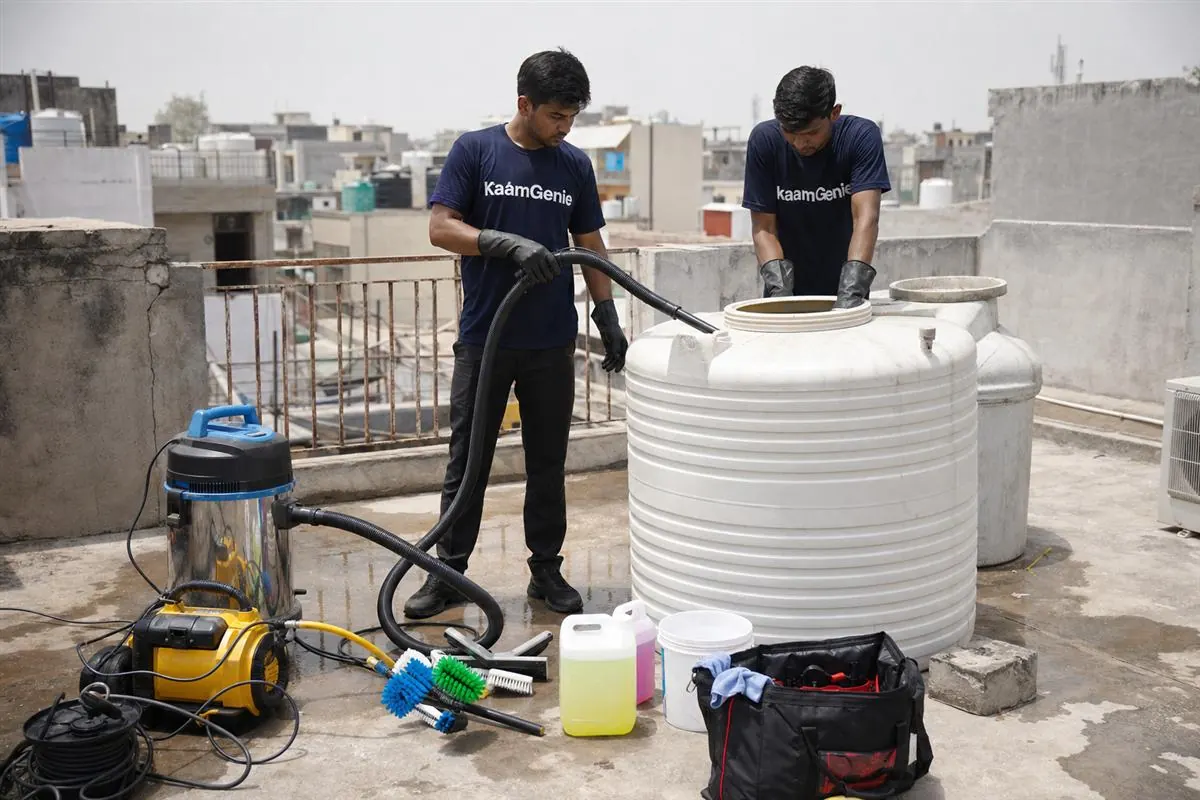
What a real service includes — in one glance
- The cleaning work itself — inspection, drain, sludge removal, scrubbing, jet wash, vacuum, disinfection, refill
- Food-grade chemicals — FSSAI-acceptable disinfectant, not hardware-shop bleach
- Before & after photos on WhatsApp — your proof the inside was actually cleaned
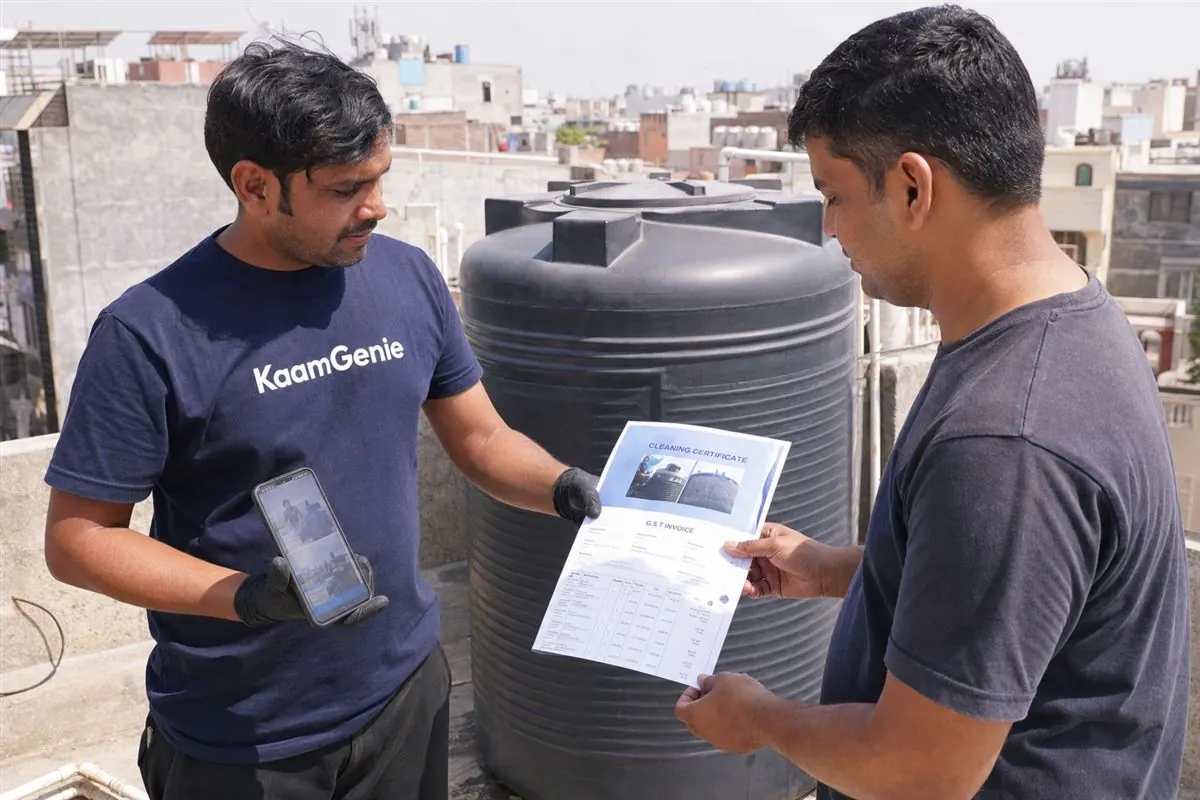
- A cleaning certificate — date, tank type, capacity, chemicals, crew
- A GST invoice — tax-compliant proof of payment
- A re-clean window — we come back if the quality isn’t right
If a quote leaves out the photos, the certificate, or the physical scrubbing — you’re buying a rinse, not a service. This post is about what you pay for and receive; for the step-by-step of how the job is performed, see our water tank cleaning process guide.
| Included as standard | Sometimes an add-on | Red flag if missing |
|---|---|---|
| Inspection + before-photos | Heavy descaling (years of neglect) | No before/after photos at all |
| Drain + sludge & sediment removal | Underground sump / confined-space | No one physically scrubbing inside |
| Manual scrubbing (food-grade brushes) | 2nd, 3rd or multiple tanks | No cleaning certificate issued |
| High-pressure jet wash + wet vacuum | NABL water-quality lab test | No GST invoice (cash-only chit) |
| Food-grade disinfection (50–100 ppm) | Urgent same-day / after-hours | Hardware-shop bleach used |
| Photos + certificate + GST invoice + re-clean window | Tank repair (cracks, lid, valves) | Job finished in 20–30 minutes |
Book a full-scope cleaning
Every inclusion above — work, food-grade chemicals, photos, certificate and GST invoice — in one fixed price. ₹699 onwards.
The standard inclusions — what every proper service should cover
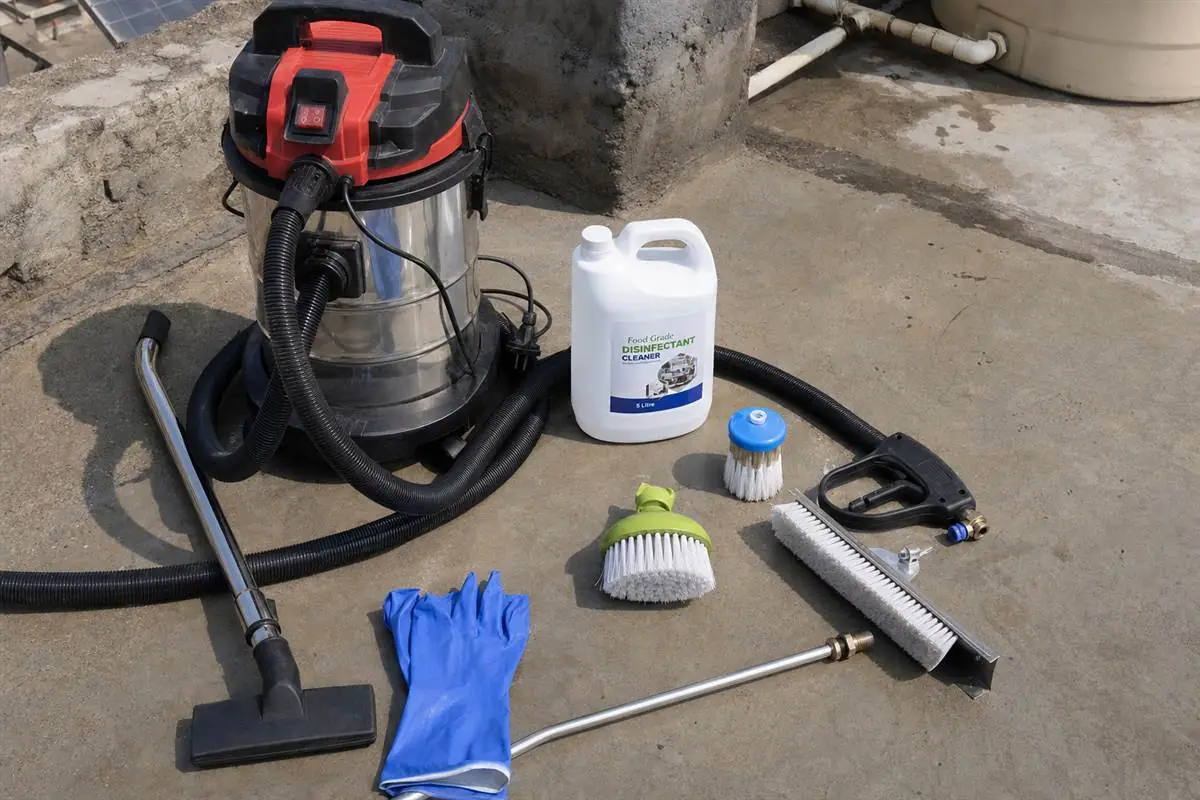
Think of a water tank cleaning service as two things bundled together: the work done to your tank, and the paperwork you walk away with. A real service gives you both. Here’s the standard scope, and what you should expect to find on your invoice without paying a paisa more.
1. The cleaning work itself (the eight steps, as inclusions)
The physical job is a sequence of steps — inspection, draining, sludge and sediment removal, manual scrubbing, high-pressure jet wash, wet-vacuuming, food-grade disinfection with proper contact time, then refill. We don’t re-explain each one here because we’ve covered it in detail in the water tank cleaning process guide. What matters for this page is that all of it is bundled into the single quoted price — not sold to you step by step. If a cleaner offers to “just rinse it” for less, they’re selling you a fraction of the standard scope.
2. Food-grade chemicals
A proper service includes food-grade sodium hypochlorite at 50–100 PPM for disinfection — the same family of compound used in municipal water treatment and FSSAI-acceptable for potable systems. The cost of the chemical is built into the standard price. This is the single biggest dividing line between a real service and a cheap one: hardware-shop industrial bleach is far cheaper, leaves residue, and has no place in a tank that feeds your kitchen tap.
3. Before & after photos
On every job, the crew takes 4–6 photos when they open the tank and the same angles again after refill, then sends them to you on WhatsApp. These photos are your only real proof that someone went inside and cleaned, rather than spraying water down from the top. Photos are a standard inclusion — never an extra, never optional.
4. A cleaning certificate
You should receive a cleaning certificate listing the date, tank type and capacity, the chemicals used, and the crew names. This is the document an RWA keeps on file for a shared rooftop tank, and the one an FSSAI inspector asks a restaurant to produce. It costs us nothing extra to issue and it should cost you nothing extra to receive.
5. A GST invoice
A registered service gives you a proper GST invoice — tax-compliant proof of payment, not a handwritten chit. For homeowners this is reassurance you dealt with a real business; for societies and food businesses, it’s a procurement and audit requirement.
6. A basic warranty / re-clean window
If you spot a genuine problem with the cleaning quality within a short window after the visit, a proper service comes back and re-does it at no charge. That re-clean window is part of the standard service. It’s only voided when the tank was re-contaminated by something outside the cleaning — a broken lid letting birds or dust in, for example.
What’s usually an extra / add-on
Some things genuinely sit outside the standard scope because they need extra time, equipment, consumables, or a third party. That’s fair — what isn’t fair is springing them on you mid-job. Here’s what counts as a legitimate add-on:
- Heavy descaling — a tank neglected for several years can have thick calcium scale and hardened sludge that takes far longer than a routine clean. Delhi’s hard DJB and borewell water makes this common. It needs stronger initial treatment and sometimes a second visit.
- Underground sump / confined-space cleaning — sumps hold more water, are slower to pump out, and require confined-space safety gear. They’re priced above an overhead tank for good reason. See how cost varies by tank type for the numbers.
- Multiple tanks — a second or third tank at the same property is extra work, though usually at a discounted per-tank rate when done in one visit.
- NABL water-quality lab test — sending a post-cleaning sample to an accredited lab for E. coli, TDS and chlorine residual goes to a third-party laboratory, so it’s billed separately. Mostly relevant for restaurants, clinics and societies that need documented proof.
- Urgent same-day / after-hours — squeezing you into a same-day slot, or working after a restaurant closes, may carry a premium.
- Tank repair — if we find a cracked tank, a broken lid, or a failing valve, fixing it is a repair job, not a cleaning. We’ll flag it and quote it separately rather than quietly ignore it.
The honest test of a service is simple: standard inclusions are in the headline price, and any add-on is quoted before work starts. For a full pricing breakdown, see our water tank cleaning cost guide and the area-specific service charges in Delhi.
Where your money goes — a typical ₹699 residential service
Roughly how a fixed-price clean breaks down across work, chemicals and documentation
Illustrative split for a standard 1,000L overhead tank. The documentation costs little to produce — which is exactly why a service that drops it to look cheaper is cutting the wrong corner.
What should make you walk away
A missing inclusion isn’t a haggling point — it’s a signal. If you spot any of these, cancel or refuse to pay:
- No before/after photos. Without them you have no proof the inside was touched. A service that “doesn’t do photos” is hiding the part you most need to see.
- No cleaning certificate or GST invoice. A cash-only operator with no paperwork leaves you with no record and no recourse — and useless to an RWA or FSSAI inspector.
- No physical scrubbing inside. If nobody goes in (or fully reaches in) to scrub the walls and floor, and they just hose water from the top, the sludge and bio-film stay put.
- Hardware-shop bleach. If the “disinfectant” is a bottle of industrial bleach from the local shop rather than a food-grade product, the chemistry is wrong for drinking water.
- A job done in 20–30 minutes. A real residential clean runs 75–90 minutes. A 20-minute job has skipped sludge removal, scrubbing or disinfection — the inclusions that actually matter.
A suspiciously cheap ₹200–300 quote is cheap precisely because most of the standard inclusions have been quietly dropped. If you want help comparing quotes properly, read how to pick the best water tank cleaning service in Delhi.
Not sure what your last clean included?
Book a transparent, full-scope service — you’ll get the photos, certificate and invoice in writing. Standard residential ₹699 onwards.
Know exactly what you’re paying for
A water tank cleaning service is only worth booking if the standard inclusions are all there: the full cleaning work, food-grade chemicals, before/after photos, a certificate, a GST invoice, and a re-clean window — with any genuine add-on quoted upfront. That’s the scope we put on every job. See full pricing and what’s covered on our water tank cleaning service page.
To book, call +91 95603 66362 or use the booking form on this site — we'll confirm shortly.
Frequently asked questions
What is included in a standard water tank cleaning service?
A proper standard service includes inspection with before-photos, draining the old water, hand-removal of sludge and sediment, manual scrubbing with food-grade brushes, a high-pressure jet wash, wet-vacuuming, food-grade disinfection with contact time, refill, after-photos, a cleaning certificate and a GST invoice. At KaamGenie this full scope is the residential ₹699-onwards job — nothing on that list is an extra.
Are before-and-after photos really part of the service?
Yes. On every job we take 4-6 photos when we open the tank and the same angles again after refill, then send them to you on WhatsApp. Photos are the only proof that someone physically cleaned the inside rather than rinsing from the top. If a service doesn’t include photos as standard, treat that as a red flag.
Do I get a cleaning certificate and a GST invoice?
Both, as standard. The cleaning certificate lists the date, tank type and capacity, chemicals used and crew names — it’s the document an RWA or an FSSAI inspector asks for. The GST invoice is your tax-compliant proof of payment. A service that can only give you a handwritten chit and no GST invoice is operating informally.
What is usually an extra or add-on cost?
Heavy descaling on tanks neglected for years, underground sump and confined-space cleaning, a second or third tank at the same property, a NABL water-quality lab test, urgent same-day or after-hours slots, and any physical tank repair (cracks, lids, valves). These sit outside the standard scope because they need extra time, equipment, consumables or a third-party lab — a good service quotes them upfront, never as a surprise.
Is the cleaning certificate valid for FSSAI or RWA records?
Yes. The certificate plus the dated before/after photos is exactly what a food business shows during an FSSAI inspection and what an RWA keeps on file for shared-tank maintenance. Keep the WhatsApp thread and the invoice together — that bundle is your record.
Does the standard service include a water-quality lab test?
No — a NABL-accredited lab test (for E. coli, TDS, chlorine residual and so on) is a paid add-on because it goes to a third-party laboratory. The cleaning itself, disinfection and certificate are standard. We arrange the lab test on request, mainly for restaurants, clinics and societies that need documented water-quality proof.
What chemicals are included in the disinfection?
Food-grade sodium hypochlorite at 50-100 PPM — the same family of compound used in municipal water treatment and FSSAI-acceptable for potable systems. The cost of the chemical is built into the standard price. We never use hardware-shop industrial bleach, which leaves residue you don’t want in drinking water.
Is there any warranty or re-clean window included?
Yes. If you notice a genuine issue with the cleaning quality within a short window after service, we come back and re-do it — that re-clean window is part of the standard service, not a paid add-on. It’s only voided if the tank was re-contaminated by something outside the cleaning, like a broken lid letting debris in.
Should I walk away if a quote seems too cheap?
A ₹200-300 quote almost always means a rinse, not a cleaning — no physical scrubbing inside, no sludge removal, no food-grade disinfectant, no photos and no certificate. The cheap price is cheap because most of the standard inclusions are quietly dropped. If a quote is far below everyone else, ask exactly which of the standard inclusions it covers.
What should make me refuse a water tank cleaning service?
Walk away if there are no before/after photos, no cleaning certificate or GST invoice, no one physically scrubbing the inside, or hardware-shop bleach instead of food-grade disinfectant. Any one of these means you’re paying for a tank that isn’t actually being cleaned to a safe standard.
Sources & references
- Bureau of Indian Standards (BIS) — IS 10500:2012 is the canonical Indian Standard for drinking water specification, defining acceptable limits for physical, chemical, and biological parameters.
- WHO Guidelines for Drinking-water Quality, 4th edition — the global reference for water quality standards, including guidance on storage and disinfection.
- Food Safety and Standards Authority of India (FSSAI) — defines water quality requirements for food businesses, including hygiene standards for stored water and acceptable disinfection chemicals.
- WHO Fact Sheet on Drinking Water — overview of safe drinking water requirements and contamination risks.
- CPHEEO — Manual on Water Supply and Treatment — the Government of India’s engineering manual covering tank design, cleaning protocols, and disinfection practices.
Last verified: 24 June 2026. If you find any of these links broken, please let us know.