
Quick answer
- DIY can rinse, but it rarely disinfects — the gap is chemistry and pressure, not effort.
- Cost gap is tiny (₹400-700 in supplies vs ₹699 for a professional booking).
- Safety gap is huge for underground sumps — never DIY a sump.
- Documentation gap matters if you live in a society or run a food business.
- Verdict: overhead tanks — DIY is possible but rarely worth it; sumps and commercial tanks — always hire pros.
The honest story behind DIY tank cleaning
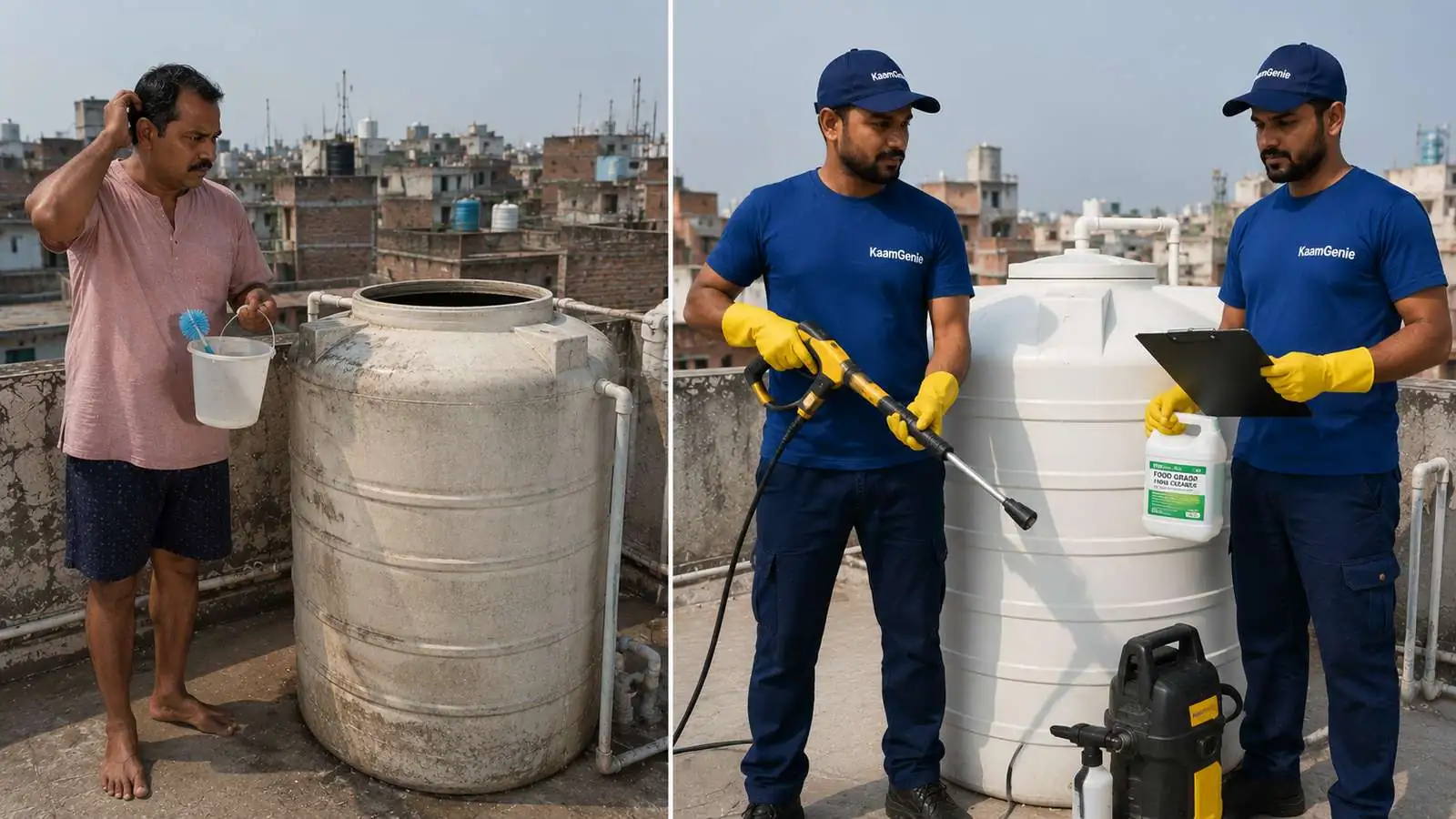
Most Delhi families ask the DIY question for one of three reasons. They want to save money. They’ve been quoted by someone they don’t trust. Or they’ve just watched a YouTube video that made it look easy. All three are fair starting points — but they assume the bottleneck is labour. It isn’t.
The bottleneck is the equipment and chemicals that turn a rinse into a cleaning. A bucket and a brush will get the walls visibly clean. They will not break down bio-film, dissolve mineral scale, or kill the bacterial colonies that have built up in the inlet pipe over the last six months. That requires a 5-6% food-grade hypochlorite solution, applied for at least 20 minutes of contact time, after the sediment has been physically removed. Most homeowners can’t source the chemical, don’t own the pressure washer, and don’t wait the full contact time even when they have the right materials.
This article isn’t a sales pitch. It’s a clear comparison of what changes when a professional crew does the job, so you can decide which side of the line your tank belongs on.
The 8 things a professional brings that you don’t have at home
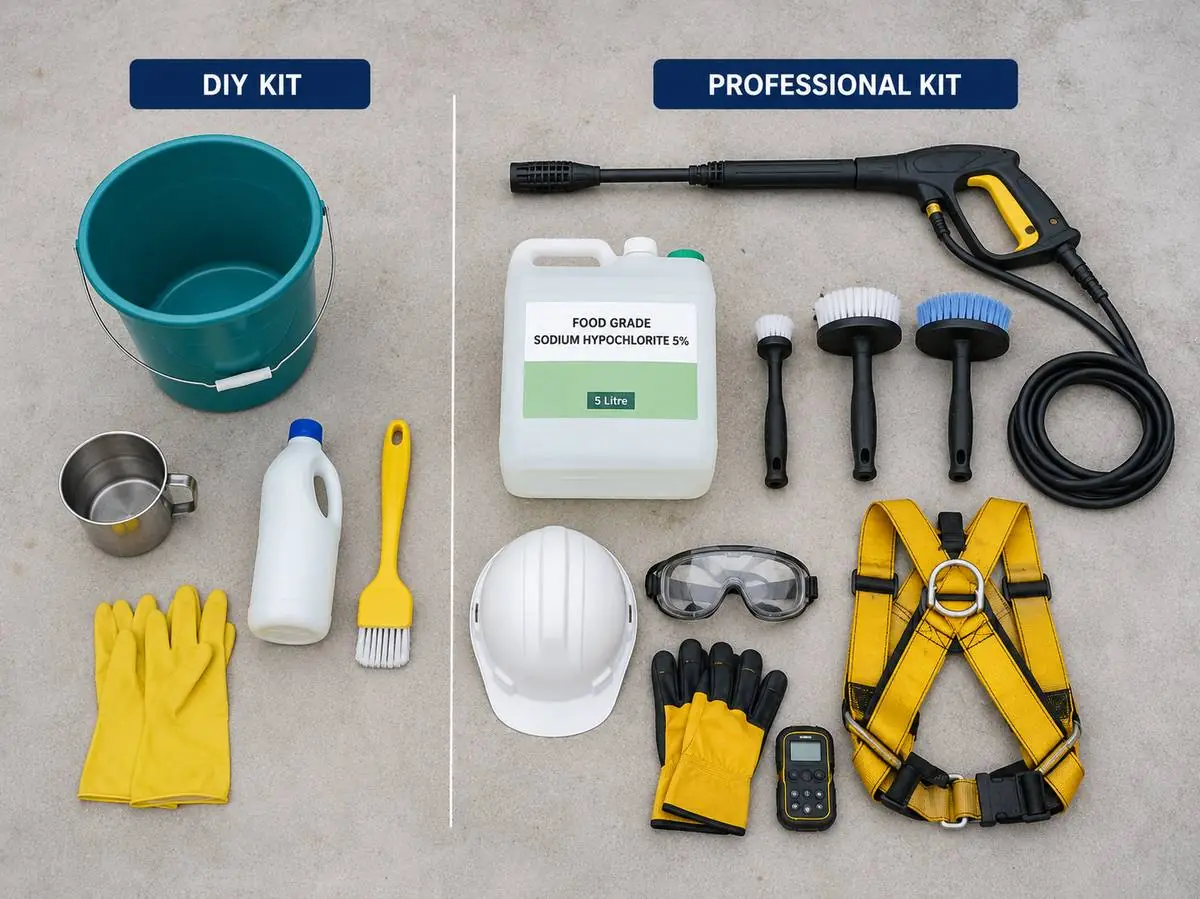
Here’s the actual gap between a DIY effort and a professional cleaning, item by item:
| Element | Typical DIY setup | Professional setup |
|---|---|---|
| Disinfectant | Household bleach or unverified chlorine tablets | Food-grade sodium hypochlorite, 5-6% concentration |
| Cleaning pressure | Garden hose (2-4 bar) | Industrial jet wash (80-120 bar) |
| Sludge removal | Mug, bucket, mop | Wet/dry vacuum + manual scoop |
| Scrubbing tool | Random brush from the kitchen | Food-grade nylon brushes, multiple sizes |
| Safety gear | Slippers, T-shirt | Harness, hard hat, gloves, eye protection, gas meter for sumps |
| Contact-time discipline | "Wait a few minutes" | Timed 20-minute disinfection cycle |
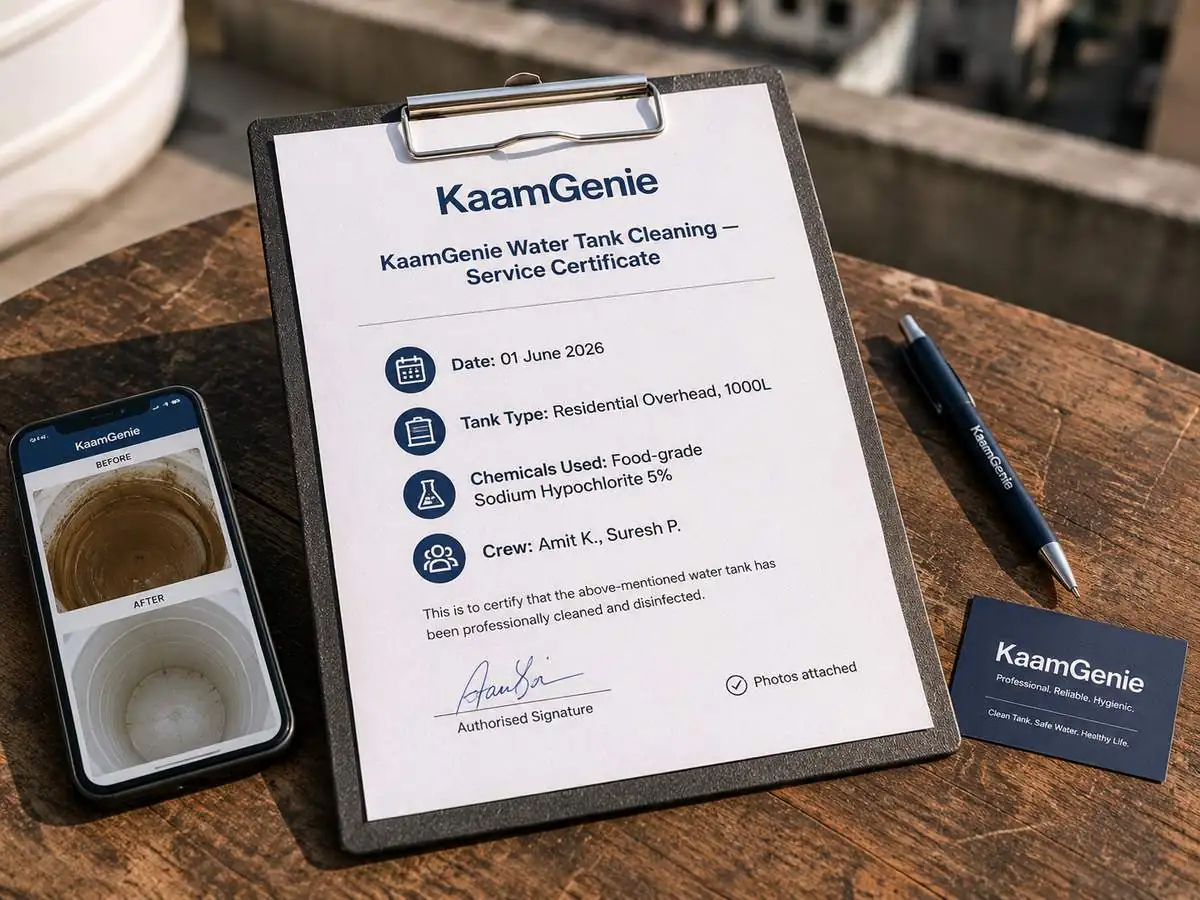
| Documentation | None | Before/after photos + documented proof of cleaning |
| Insurance | None (your problem if you fall) | Crew is covered, you’re not liable |
The single biggest difference, if we had to pick one, is the food-grade disinfectant at the right concentration. Everything else — pressure, scrubbing, vacuuming — matters because it lets the disinfectant actually reach the tank surface. If bio-film is still coating the walls when you add chlorine, the chlorine binds to the bio-film and never touches the bacteria underneath.
Skip the trial and error
One 90-minute visit, food-grade chemicals, before/after photos, signed certificate. Starts at ₹699.
The cost comparison nobody runs honestly
"DIY saves money" is the assumption that doesn’t survive a careful look. If you actually buy the equivalent supplies — food-grade disinfectant, pressure hose attachment, food-grade brushes, gloves and mask, plus the cost of an afternoon — you’re in the same financial ballpark as the professional booking, with materially worse output.
DIY supplies vs Professional booking — cost breakdown for one residential cleaning
Real prices for a single overhead tank cleaning in Delhi (June 2026 estimates)
DIY total excludes 3-4 hours of your time. Professional booking includes equipment, food-grade chemicals, two-person crew, and photos.
The ₹99 difference between a DIY effort and a professional booking is what most people stop at. They miss the second-order costs: you don’t own the equipment after your first job (so the next time you DIY, you’re still buying chemicals), you don’t get the documentation, and if anything goes wrong with the cleaning, you have no recourse. The pro booking comes with a service guarantee and an insured crew.
What actually happens during a professional cleaning (vs a DIY attempt)
Below is the side-by-side sequence. The professional steps are what you’d see if you stood at the tank for the 90 minutes our crew is there.
| Step | DIY attempt | Professional crew |
|---|---|---|
| 1. Inspection | "Looks fine, let’s open it." | Pre-clean inspection, photos of sediment + walls, note any cracks |
| 2. Drain | Open outlet, wait for water to drop | Drain to bottom valve, transfer remaining 5-10 cm with wet vacuum |
| 3. Sludge removal | Scoop with a mug | Manual scoop, then vacuum, then visual confirm |
| 4. Scrubbing | Brush + soap, walls only | Food-grade brushes on walls, floor, inlet pipe and outlet pipe interior |
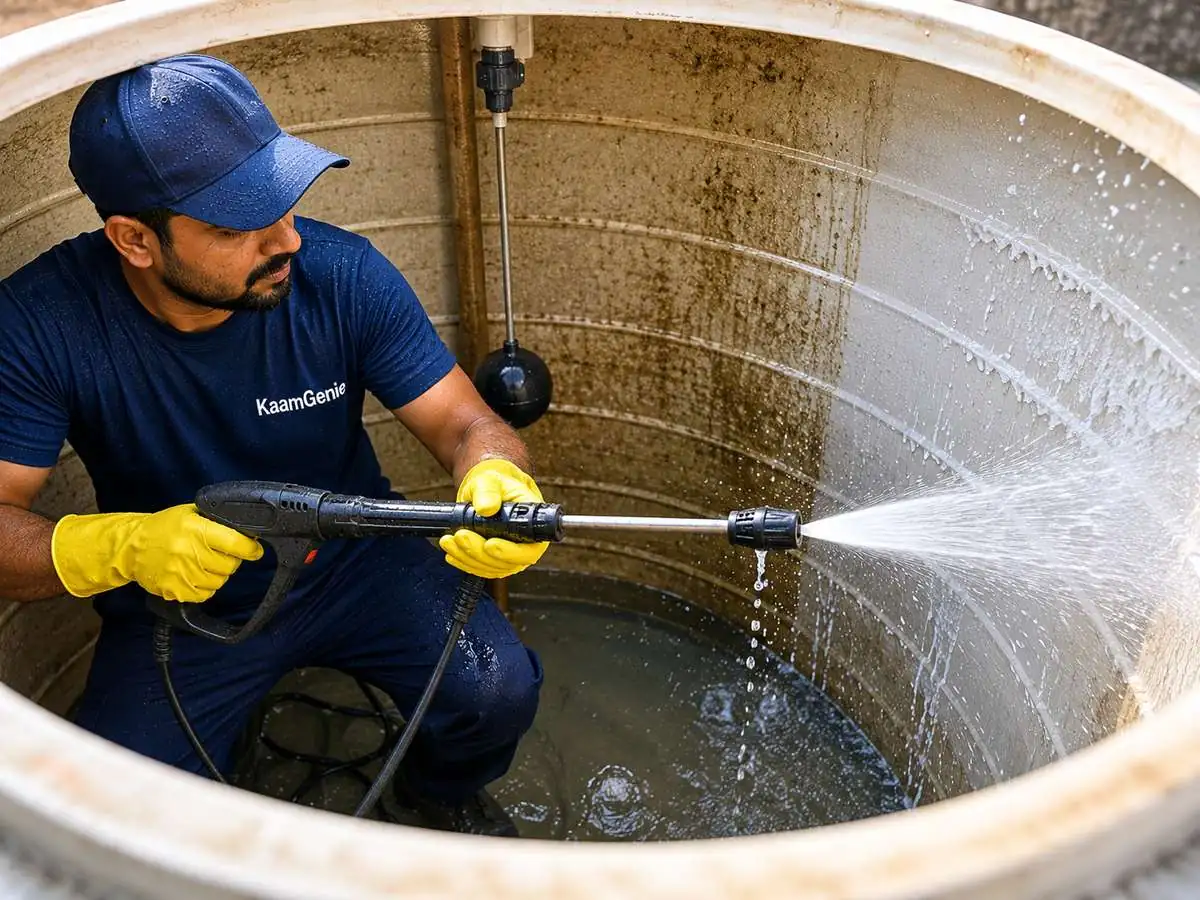
| 5. Pressure rinse | Garden hose | 80-120 bar jet wash, all surfaces, plus the lid underside |
| 6. Disinfection | Bleach swirl, "leave for a bit" | Food-grade hypochlorite applied at correct dose, 20 minutes timed contact |
| 7. Final rinse | Fill and use | Full rinse to remove disinfectant residue, then refill |
| 8. Documentation | None | After photos, dated cleaning documentation with chemicals used, crew names |
The two steps DIY almost always cuts are #5 (real pressure rinse) and #6 (timed disinfection). A garden hose at 2-4 bar can’t dislodge mineral scale; it just makes things visually wet. And nobody waits 20 minutes for bleach to work when they’re tired and want to refill the tank.
The safety gap (this is where DIY gets dangerous)
For an overhead tank on a flat accessible roof, the safety risk is limited — mostly slip-and-fall and chemical splash hazards. Both are manageable with basic care. The serious problem is underground sumps.
Sumps in Delhi kothis are typically 3,000-5,000 litre concrete tanks below ground. They have three failure modes that have killed people:
- Hydrogen sulphide buildup — even small amounts of decomposing organic material at the bottom release gas that can cause unconsciousness in 30-60 seconds at high concentration
- Oxygen depletion — closed sumps with low air exchange can drop below 19% oxygen, which is enough to cause disorientation; collapse follows quickly
- Methane pockets — less common, but flammable and explosive when ignited
Professional sump cleaning protocols include gas-meter checks before entry, a tethered harness, an outside-standby person whose only job is to monitor and pull you out, and at least 15 minutes of forced ventilation before anyone goes inside. None of this is theatrics — the National Institute of Occupational Health publishes annual reports on confined-space fatalities in India, and underground water tank cleaning is consistently on that list.
If you remember nothing else from this article: never enter a sump alone, never enter without ventilation, and never enter without someone outside who can pull you out.
Sump or society tank? Don’t DIY it
Confined-space gear, gas meters, standby crew, harness. Quote on visit for sumps and society reservoirs.
When DIY actually makes sense
There’s a small but real set of cases where DIY cleaning is reasonable. We’d rather tell you the honest truth than pretend the professional route is the only answer:
- Small overhead tank (under 500L), brand new — if it’s less than 12 months old and you’re between professional cleanings, a careful interim rinse is fine
- Visible debris from a recent event — if a leaf or insect fell in and you can fish it out without entering the tank, that’s a rinse, not a cleaning
- Vacant property short-term — if no one’s using the water and it’ll be drained anyway, an inexpensive DIY rinse before refilling is sensible
What doesn’t belong on that list: any sump, any tank serving more than one household, any food business tank, any tank you’ve smelled or seen discoloured water from, and any tank that hasn’t been deep-cleaned in over a year. Those need the equipment, the chemicals, and the paperwork — for any of those, it’s safer and cheaper in the long run to have our trained crew do it properly.
The documentation gap (for societies and food businesses)
If you live in an apartment, your RWA almost certainly maintains records of when the building’s shared tanks were cleaned and by whom. a dated cleaning record is what goes into those records. DIY cleanings produce nothing that satisfies an RWA audit — and a few months later, when residents complain about water quality, your DIY attempt won’t hold up.
For food businesses, the gap is bigger. FSSAI compliance for any kitchen serving food requires documented water hygiene practices, including third-party tank cleaning at defined intervals with verifiable certificates. A DIY job, even a thorough one, fails inspection on the documentation alone.
The honest verdict (by tank type)
| Tank type | Verdict | Why |
|---|---|---|
| Small home overhead (under 500L) | DIY possible, pro better | Safety manageable, but cost gap is tiny and quality gap is large |
| Standard home overhead (500-1,500L) | Hire pros | Equipment + chemicals + time make DIY barely cheaper, materially worse |
| Underground sump | Never DIY | Confined-space risk — sump cleaning fatalities happen yearly in Delhi |
| Society shared tank | Hire pros | RWA needs documentation; tank size beyond DIY capability |
| Restaurant / food business | Hire pros | FSSAI inspection requires third-party documented proof of cleaning |
| Industrial reservoir | Hire pros | Capacity, access, and quarterly compliance requirements |
If you fall in the top row — a small new home tank between cleanings — DIY can be a reasonable interim step. For everyone else, the honest answer is that professional cleaning is the better economics, not the more expensive one.
What we’d tell our own families
If a relative called and said they were thinking of DIY-ing their tank, here’s the conversation we’d have:
- Is it a sump? — no, please don’t.
- Is it a society or commercial tank? — no, you need the paperwork.
- Is it a small home overhead tank, accessible, between professional cleanings? — okay, but use food-grade disinfectant, give it 20 minutes, and don’t skip the post-disinfection rinse.
- Anything else? — spend the ₹699 and let pros do it. Your tank water is what your family drinks.
That’s the same answer regardless of which side of the business we’re on. You can book us at +91 95603 66362, but if you’re in the top category above and want to do it yourself, we’ll cheerfully tell you how.
Frequently asked questions
Can I clean my own water tank without hiring professionals?
Yes, you can rinse and scrub a small overhead tank yourself if it’s accessible, but a real cleaning needs food-grade disinfectant, a high-pressure jet wash, and contact-time discipline — none of which a bucket and brush deliver. For underground sumps the answer is no: confined-space entry without proper gear is genuinely dangerous.
What’s the real difference between a DIY rinse and a professional cleaning?
A DIY effort typically opens the tank, splashes water around, wipes the walls, and refills — bio-film, scale, and bacterial colonies are still there. A professional cleaning drains fully, removes sludge by hand, scrubs with food-grade brushes, jet-washes at 80-120 bar, applies food-grade disinfectant with a 20-minute contact time, rinses, refills, and certifies.
How much does it cost to DIY a tank cleaning vs hire a professional?
True DIY costs about ₹400-700 once you account for food-grade disinfectant, brushes, gloves, mask, and a hose attachment — assuming you already own a ladder. A professional residential cleaning starts at ₹699 and includes the equipment, chemicals, and photos. The price gap is almost zero, but the quality gap is large.
Is cleaning a water tank dangerous?
Overhead tanks on a flat roof are low-risk if you’re careful. Underground sumps are different — they accumulate methane, hydrogen sulphide, and low oxygen at the bottom. Several deaths happen every year across India from amateur sump cleaning. Professional crews use gas meters, harnesses, and a standby person at the top.
What chemicals do professionals use that I can’t buy easily?
Food-grade sodium hypochlorite at 5-6% concentration is the standard. It’s sold in 20-25 litre cans to commercial cleaners — retail hardware stores usually only stock household bleach which is too dilute or contains additives unsafe for drinking water. Most homeowners can’t reliably source the right product.
How long does a professional cleaning take vs DIY?
Professional cleaning of a 1,000L overhead tank takes about 90 minutes from arrival to refill. The same job done DIY-style usually takes 3-4 hours because you don’t have a 5-stage jet wash, you’re carrying water in buckets, and you don’t know how long to let disinfectant sit. Most DIY jobs cut the contact time short, which is what makes them ineffective.
Do I need documented proof of cleaning if I clean it myself?
For your own home, no — but if you’re in a society, you’ll need it for the RWA records. If you run a restaurant or food business, FSSAI inspections specifically ask for third-party documented proof of cleaning. DIY cleanings can’t produce this paperwork.
Can I just use household bleach for tank disinfection?
We strongly recommend against it. Household bleach contains fragrances, stabilizers, and surfactants that aren’t approved for drinking water contact. Even unscented bleach is harder to dose correctly because you don’t know its actual chlorine percentage. The risk of either under-dosing (no kill) or over-dosing (chemical residue) is high.
How often would I need to DIY clean to match a professional schedule?
Because DIY cleanings are usually 40-60% as effective, you’d need to do them roughly twice as often — every 3 months instead of every 6 — to maintain the same bacterial baseline. That’s 4 weekend mornings a year, vs one 90-minute professional booking every 6 months.
What if I just have my building’s caretaker clean the tank?
Caretakers can do basic surface cleaning but rarely have food-grade disinfectant, a pressure washer, or the safety training for sumps. Most caretaker “cleanings” we’ve inspected before re-cleaning had bio-film still present on the walls and no disinfection step at all. Use them for monthly visual inspection; hire pros for the real cleaning twice a year.
Are there any tanks I should never attempt to clean myself?
Yes — underground sumps of any size, society shared reservoirs over 1,500L, food business tanks subject to FSSAI inspection, and any tank that hasn’t been cleaned in 2+ years. The first two are safety risks. The third needs documentation you can’t produce. The fourth needs equipment and chemicals you almost certainly don’t have.
If I already cleaned my tank DIY, should I get it professionally cleaned again right away?
If it’s been less than a month and you’re not noticing any water issues, you can wait until your next scheduled cleaning. If you cleaned it DIY because you suspected contamination (smell, colour, illness), do get a professional inspection — DIY rarely fully resolves a contamination event.
Sources & references
- Food Safety and Standards Authority of India (FSSAI) — documented water hygiene requirements that explain why food businesses need third-party documented proof of cleaning, not DIY cleanings.
- Bureau of Indian Standards (BIS) — IS 10500:2012 drinking water quality parameters that informed cleaning protocols are designed to meet.
- Directorate General of Mines Safety (DGMS) — confined-space entry guidelines that apply to sump cleaning safety protocols across India.
- WHO Fact Sheet on Drinking Water — global framework on the role of disinfection in safe drinking water provision.
- Delhi Jal Board (DJB) — municipal water quality reports that inform why tank-side hygiene matters in Delhi specifically.
Last verified: 1 June 2026. If you find any of these links broken, please let us know.